The noose was already around Tom Horn’s neck when the first woman in the front row covered her children’s eyes. It was not because of what was about to happen, but because of what was already happening. Horn sat on the edge of the gallows platform in Cheyenne, Wyoming, on a cold November morning in 1903. The wooden trapdoor had not yet been released.
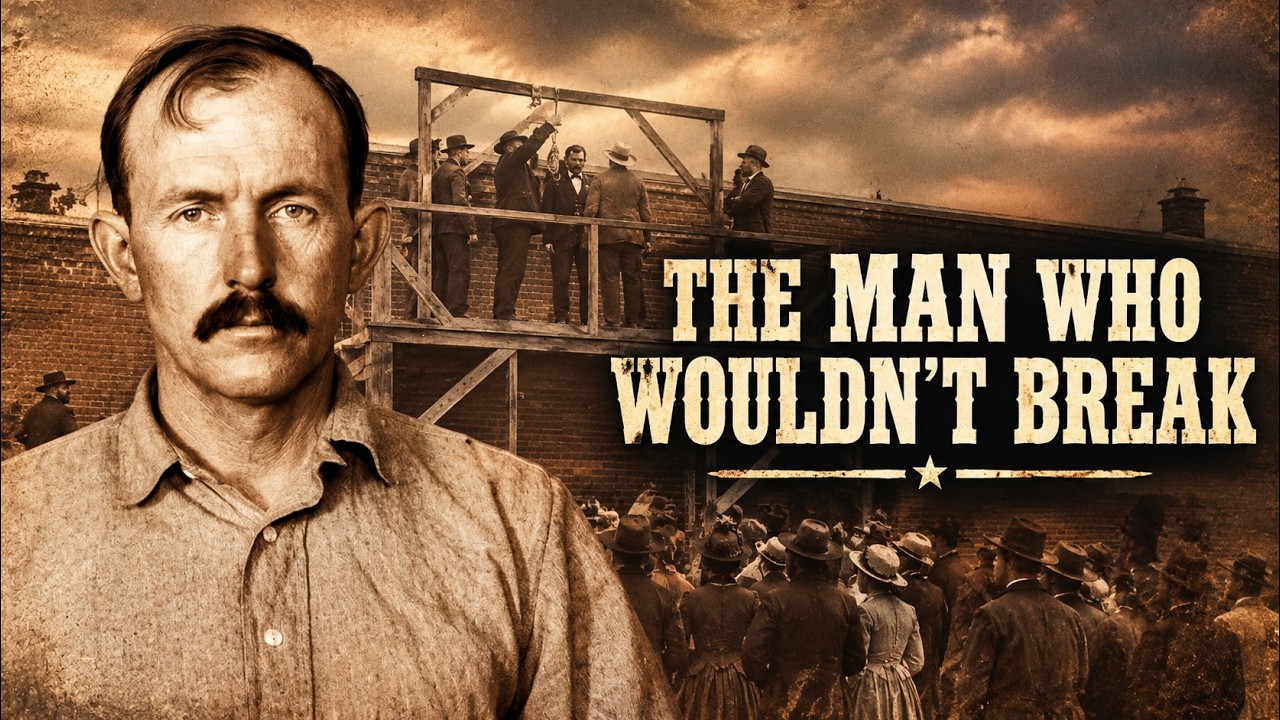
The black hood had not yet been lowered over his face. He was still talking, calmly and with an almost polite courtesy. He asked the sheriff whether the knot had been tied correctly. He asked if anyone had a spare cigarette.
The crowd, roughly 3,000 people packed into the prison yard and spilling into the street, had come to witness an execution. Instead, they got a man who refused to play the role expected of him. Most public executions in the Old West followed a familiar script. The condemned man either broke down, cursed God, or delivered a dramatic final speech about dying bravely.
The audience needed this. It let them feel that justice had been complete and clean. It allowed them to return home and tell the story without the bitterness that accompanies killing when it seems too ordinary. Tom Horn gave them none of that.
He had been a scout, a packer, a livestock detective and, according to the court that sentenced him, a hired killer. In the years after the Johnson County War, large cattle ranchers still hired men who could make problems disappear. Horn was one of those men. He rode alone, carried a Winchester 30-30, and left notes pinned to the bodies of men he believed were stealing cattle.
The notes were short and poorly spelled, but the message was clear. In July 1901, a 14-year-old boy named Willie Nickell was shot from ambush while wearing his father’s hat and riding his father’s horse. The bullet came from a distance. The boy died in the dirt of a lonely road on Iron Mountain.
The case against Horn rested on a confession he made while drunk, which he later claimed was distorted by a deputy sheriff who had bought him whiskey. The jury believed the confession. The judge set the execution date. By the time Horn climbed the thirteen steps in Cheyenne, the West that had once employed men like him was already embarrassed by them.
The open range had been fenced. The big outfits had become formal corporations. Public opinion had shifted. The livestock detective who once received secret pay from cattle associations had become a liability.
The execution was supposed to close that chapter. It did not close cleanly. The gallows had been built inside the prison yard so officials could control the crowd. Still, the people came.
Ranch hands, town merchants, women in winter coats, and a few reporters with notebooks. A photographer set up a camera and was ordered to remove it. The sheriff wanted no pictures of the actual execution. He got what he wanted.
But he could not prevent what the crowd saw with their own eyes. Horn looked at the faces and spoke in a steady voice. He said he never killed the boy. He said the confession had been the rambling of a drunk man.
He said the men who had used his skills for years now contented themselves with watching him hanged for a crime he did not commit. Then he fell silent. No prayer, no curse, no final claim of innocence shouted toward the sky. Just a man waiting for the floor to open beneath him.
When the platform dropped, the rope did its work, but not in the way the crowd expected. Horn’s body fell and the knot tightened. There were no dramatic kicks, no prolonged struggle that would let spectators feel the weight of justice. The sheriff’s men had measured the rope to suit Horn’s height and weight.
The end was decisive enough. What unsettled people was the silence that followed. A public execution was supposed to be a performance. The condemned man was the final actor.
When he refused the role, when he did not beg and did not defy, the audience was left with an empty stage. Many women turned away before the body was cut down. A few men who had come to see a killer get what he deserved found themselves staring at the ground instead of the platform. One reporter later wrote that the crowd dispersed in a quiet he had never witnessed at any execution.
The usual post-hanging talk, the jokes, the debate over the man’s last words, the side bets, never fully began. The body was lowered, placed in a pine coffin, and shipped to Boulder, Colorado, where Horn’s sister buried him. No cattlemen’s association sent flowers. None of his former employers stood at the grave.
The men who once paid him for silent work had already moved on to lawyers and land contracts. What turned the crowd away that morning was not simply the death of one man. It was the realization that the old way of settling accounts, hiring a lone rider with a rifle and a free hand, had become something the new West preferred to forget. Tom Horn was the last man publicly hanged in Wyoming.
After him, executions moved behind walls. Spectators were limited to official witnesses. The theater was closed. The rope, the platform, and the quiet man who refused to perform had all done their parts.
The frontier finally decided it no longer wanted to watch itself kill in broad daylight.