In the summer of 1976, a woman who had feared water since childhood found herself at 90 feet beneath the surface off the British Virgin Islands, surrounded by a cloud of silver bubbles with no idea where her breathing regulator had gone. The cameras kept rolling because nobody watching through the lens could tell whether Jacqueline Bisset was acting or genuinely drowning. She surfaced alive, and the producer was so impressed he wrote a near-death experience into the script. Within a year, that ordeal became the least sensational part of the production, overshadowed by a single photograph she never approved.
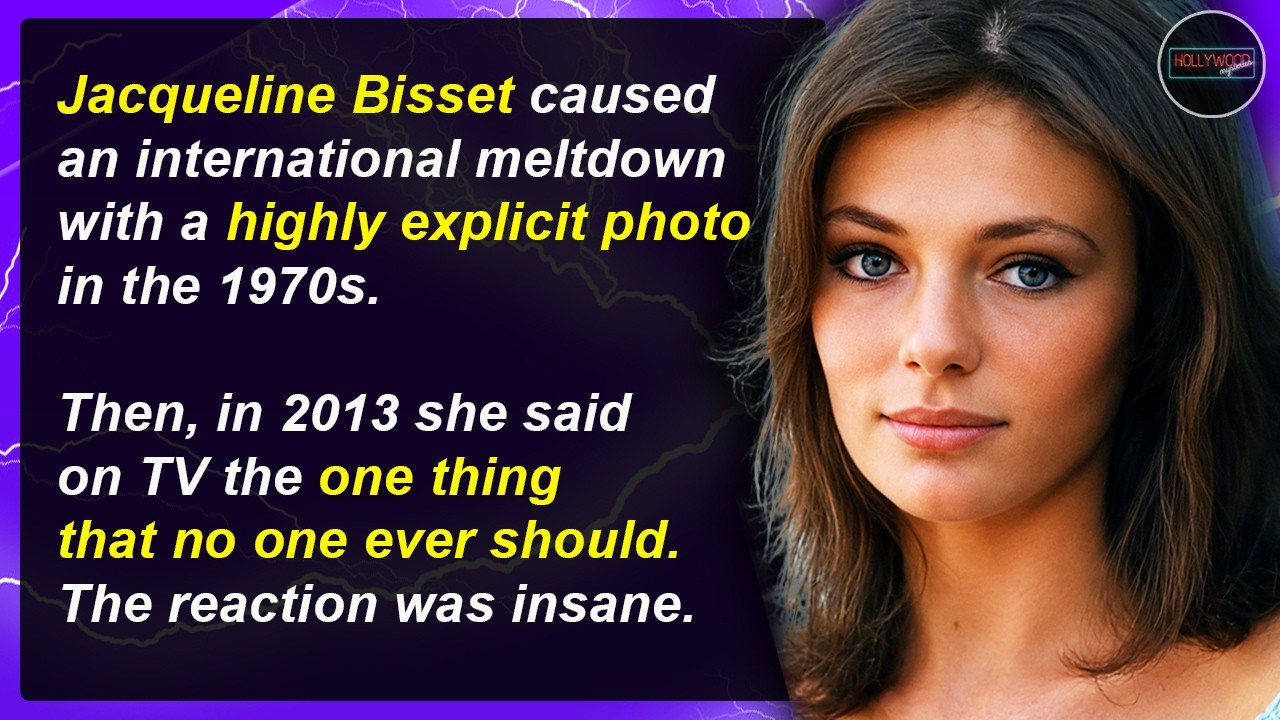
That image would make a man wealthy, inspire a decade of cheap nightclub contests in her honor, and follow her for half a century. Born Winifred Jacqueline Fraser-Bisset on September 13, 1944, in Weybridge, Surrey, her arrival in the world was far less graceful than her name suggests. Her mother and older brother had been evacuated there after a German bomb fell on their village. Her father, a Scottish general practitioner named George Maxwell Fraser-Bisset, was working in a hospital in Iceland.
Her mother, Arlette Alexander, had trained as a lawyer in Paris and escaped France in 1940 by bicycle, riding frantically toward the coast ahead of advancing German forces before sweet-talking her way aboard a British troopship. The family settled in a 17th-century cottage outside Reading, damp and freezing in winter. She and her brother Max fought fiercely; she once broke a bench over his head, a childhood memory she always recalled with some satisfaction. Saturdays were for horses because train tickets to London were expensive.
She read constantly and was hopeless in school plays, usually cast in ridiculous parts like the March Hare. What she really wanted was dancing. Margot Fonteyn was her idol, and ballet became her religion until a harsh verdict about bone structure ended that dream—she was too tall, and her feet were deemed unsuitable. Then, at fifteen, her world shattered.
Her mother was diagnosed with multiple sclerosis, and the family reorganized around the illness. Her father, the doctor, endured it for several years, then left home. Bisset was twenty-two when he departed, and she never entirely got over the pain of it. The doctor who abandoned his patient, who was also his wife, and left her, in Bisset’s words, in her daughter’s care.
Her parents divorced in 1968 after 28 years of marriage. He remarried, had another son at seventy, and died in 1982. Her mother’s care continued intermittently for nearly 40 years, through periods of paralysis, blindness, and dementia that set in while she was still in her early fifties. Bisset later said, “It was my responsibility, and it was quite a grind.
” There were years of transatlantic shuttling, of straining her back trying to lift a grown woman out of a bathtub, of unlocking the bathroom because her mother had locked herself in and found it amusing. At sixteen, she enrolled in a French school in London to polish her language skills before university. University never happened; cinema did instead, in French and Italian films. To pay for acting lessons, she took jobs available to a tall, green-eyed girl in early-1960s London—modeling and waitressing.
Photographers Terence Donovan and Terry O’Neill shot her. Her name puzzled everyone from the start; it is Scottish, pronounced to rhyme with “biscuit,” and she has spent 60 years correcting people who assume it is French. Even her early screen credits spelled it inconsistently. Her actual film debut was in Richard Lester’s 1965 “The Knack…
and How to Get It,” standing outside the Royal Albert Hall in a gray skirt and white blouse among twenty other identically dressed young women, including Charlotte Rampling and Jane Birkin. She only appeared because extras got fed. When she finally saw the film, she was astonished at how good it was. Roman Polanski then cast her in a small role in the 1966 oddity “Cul-de-sac,” and something shifted inside her—a realization that this film world might deserve to be taken seriously.
By 1967 she was in Stanley Donen’s “Two for the Road” as a girl Albert Finney falls for while Audrey Hepburn watches, and 20th Century Fox signed her to a ten-picture contract. She hated the idea of being owned by a studio and told them so, but signed anyway because there was a disabled mother in England who needed care. That same year she played Miss Goodthighs in the chaotic “Casino Royale,” mostly a silly leg joke. What eventually made her a star was someone else’s divorce.
Frank Sinatra had chosen his young wife Mia Farrow to co-star in “The Detective. ” Farrow was still filming “Rosemary’s Baby” three weeks behind schedule while Sinatra’s film ran twelve days ahead, and she refused to leave Polanski’s set. Sinatra’s response was to have his lawyer serve her divorce papers in front of the crew and replace her. On November 30, 1967, the New York Times reported the role had gone to an English actress named Jacqueline Bisset.
It was an unpleasant way to get a job, but she always spoke warmly of the man at the center of the upheaval. Despite his cold treatment of his wife, Sinatra was courteous to his 23-year-old co-star, calling her “kid. ” When a writer was rude to her on set, Sinatra intervened: “Leave the kid alone. She’s got good instincts.
” She expected a monster and found a gentleman. 1968 was the year everything exploded. In “The Sweet Ride,” she played a woman adrift among Malibu beach drifters and received a Golden Globe nomination as most promising newcomer. More importantly, she met an emotional French-Canadian actor named Michael Sarrazin, beginning a seven-year relationship.
They moved in together immediately. Then came “Bullitt. ” Director Peter Yates told her to go to San Francisco and live there for a while to understand the city, instructions she found puzzling, but she did as asked. Her role was the girlfriend, a job description she was trying to escape in films and real life alike.
But she was also the woman in the passenger seat of the most famous car movie ever made, and sometimes in the driver’s seat. Steve McQueen hated being driven by anyone, let alone his co-star. She recalled, “He had his eyes closed most of the time. ” He paid her a compliment as he understood it: “You’re a pretty good driver for a girl.
” She found him “attractive and slightly savage,” speaking slang she couldn’t decode, appearing, saying four words, and vanishing on his motorcycle. By the summer of 1969 she was 24, working under contract, living in a city that had forgotten how dark and violent it could be. Among the people she knew was Sharon Tate. Bisset had visited the house on Cielo Drive a few days earlier, and Tate invited her to return the following Friday.
She canceled at the last moment. That day was Friday, August 8, 1969, and by the early hours of Saturday, Tate, eight and a half months pregnant, and four others were dead at that house. The sixties in Los Angeles ended in a way only violence can achieve. She describes an atmosphere of a city turned overnight to fear and paranoia.
She didn’t leave, but she remains a woman who keeps a mental list of what she would take if the canyon caught fire, a habit that certainly didn’t start with wildfires. Work continued to flow, though often beneath her level. In 1970 she was cast in “Airport” as a pregnant stewardess carrying Dean Martin’s child. That same year she made “The Grasshopper,” a grim film about a girl crushed by Las Vegas that didn’t find an audience.
Then came “Believe in Me” in 1971, in which she played a drug addict opposite Sarrazin, and “Secrets,” a British film containing the only nude scenes of her career, which stayed buried in archives to surprise her later. In John Huston’s 1972 “The Life and Times of Judge Roy Bean” she worked opposite Paul Newman, remembering him affectionately and humorously. At home, she kept house in a way that had nothing to do with Hollywood or the 1970s, cooking and hosting, doing everything women were supposed to rebel against, and she loved it and pursued it to perfection. The artistic rescue, when it came, arrived in French.
Her agent had somehow failed to show her a script from François Truffaut. It took a year and a phone call from the great man himself before she realized what she had nearly missed. “Day for Night,” released in 1973, is a film about filmmaking, and Bisset plays Julie Baker, a fragile English star returning to work after a nervous breakdown, married to a much older doctor. It is her finest artistic moment, and she knew it during filming.
She said of Truffaut, “It’s nice to work with somebody who likes working with women,” a compliment that indirectly criticized others. The film won the Oscar for Best Foreign Language Film. She stayed in France for “Le Magnifique” with Jean-Paul Belmondo, a mad spy spoof that was a smash in France. In 1974 she played Countess Andrenyi in Sidney Lumet’s “Murder on the Orient Express,” part of a cast so large it barely fit on the poster.
When production asked the cast to waive union rules and shorten their lunch hour, Bisset voted no because lunch was when everyone sat and listened to Lauren Bacall. Vanessa Redgrave urged resistance: “We must not accept. We must not give in. ” Bisset raised her hand to discover she was the only one voting on principle.
Her relationship with Sarrazin ended in 1974. She has always said she doesn’t give up on things, which is why many of her relationships lasted longer than they should. On a flight from Los Angeles to Paris, she struck up a conversation with Victor Dray, a Moroccan-born entrepreneur running a clothing line. He sold his business and moved continents to be with her.
They bought and renovated mansions in Beverly Hills, which is how a man from Casablanca who had worked in clothes ended up producing “Weekend at Bernie’s,” and Jacqueline Bisset became a property developer. In 1975 she went to Germany for Maximilian Schell’s “End of the Game. ” John Voight was in the cast, and his young pregnant wife, Marcheline Bertrand, became one of Bisset’s closest friends. Bisset said years later, “She asked me to be the godmother of her little girl when she carried Angie inside her.
” That is how a British actress became the godmother of Angelina Jolie before anyone had heard of her. Then came “The Spiral Staircase” and “The Sunday Woman” with Marcello Mastroianni, and after that she headed to Bermuda. “The Deep,” adapted from a Peter Benchley novel by the makers of “Jaws,” was shot throughout 1976 in Bermuda and on the wreck of the RMS Rhone in the British Virgin Islands. Bisset had feared water since childhood, when some kids held her head underwater.
She dived anyway, day after day, in a production that built the largest underwater set in the world. The costume designer handed her a white shirt and told her it was what divers wore. The shirt was dry when she put it on. She had no reason to doubt him and assumed nobody would see anything underwater anyway.
For weeks there were no dailies because footage had to be sent to New York for processing and returned by boat. Then two things happened in the wrong order. The first was that she nearly lost her life. During a scene where her character escapes toward a boat, she and Nick Nolte ran out of air.
Nolte’s regulator broke at 50 feet; he swam blindly toward the camera gesturing hysterically while the cameraman kept filming out of professional tradition. Bisset, kicking upward in a chaos of bubbles, couldn’t find her regulator. The cinematographer realized she was in trouble and shared his tank. When Peter Guber saw the footage, he decided the air incident was too dramatic to waste and wrote the near-fatal moment into the film.
The second thing happened when the dailies arrived. A wet white shirt is, of course, somewhat transparent. The studio increased the underwater shots Bisset had to do herself and reduced the role of her double. Amid all this, David Doubilet, a National Geographic photographer who was the only one allowed to shoot underwater stills, took the famous photograph.
Bisset had contractual rights to approve her own images. She did not approve that one, yet it was published as a three-page poster in Playboy and Penthouse. The promotional campaign’s internal marketing report targeted “lustful men. ” The goal was for 200 million people to see or hear about the film before its June 17, 1977 release, and the tool to attract attention was Jacqueline Bisset’s chest.
She tried to stop it. “I tried to get an injunction against them,” she said. Columbia banned the image from its ads at her request, but by then the banned photograph had become the studio’s most valuable asset. Newsweek, a promotional partner, published a piece titled “A Beauty Named Bisset” and coined the crude phrase “beyond nude.
” Casablanca Records held wet t-shirt contests across the country to imitate it. The film grossed a hundred million dollars. Guber was at least refreshingly honest: “That shirt made me a wealthy man. ” To add insult, a distributor dusted off “Secrets,” that cheap 1971 film with her nude scenes, and re-released it in America to exploit the wave.
Bisset has been asked about that shirt for five decades. Her objection wasn’t just about exploitation. The film had achieved genuinely difficult things with real risk, and all anyone wanted to discuss was a wet shirt. “People were staring at my chest,” she said, “not my eyes.
” She did not put her head underwater from 1977 onward. In later years she surrendered and began signing copies of the photograph. The truth is it worked. Newsweek declared her the most beautiful actress ever, and at thirty-three she suddenly became a bankable, adored star.
In 1978 she played a barely disguised Jacqueline Kennedy opposite Anthony Quinn as Onassis in “The Greek Tycoon,” wearing Halston clothes and sunglasses without realizing who her character was until Quinn showed up looking exactly like Onassis. That same year she gave a wonderful comic performance in “Who Is Killing the Great Chefs of Europe,” earning a second Golden Globe nomination. In 1980 came the disaster film “When Time Ran Out,” which failed utterly. Her fee reached a million dollars per picture, but her filmography became a museum of missed opportunities, which brings us to the strangest project of her career.
In 1981 she starred in “Inchon,” a Korean War epic financed with $30 million from Reverend Sun Myung Moon and his Unification Church. Directed by the man who made “Dr. No,” starring Laurence Olivier as General MacArthur with a prosthetic nose, its final cost was $46 million while it grossed only five million. It won Razzie awards.
Bisset lost her voice and had to be entirely dubbed. She later described the role modestly as “a sweet little part. ”
She had already realized that one way to get a decent role was to buy it herself. “Rich and Famous,” released in 1981, was produced by her own company.
She deliberately kept her name off it as producer so as not to seem presumptuous, and the move succeeded so well that most industry people never realized she produced it. A remake of Bette Davis’s “Old Acquaintance,” it starred her and Candice Bergen as writers locked in a 20-year friendship that is really a permanent struggle. Robert Mulligan began directing and left after four days when a strike halted production. His replacement was George Cukor, aged 82, the greatest director of actresses in film history, making his fiftieth and final film.
The result was uneven but strikingly honest about midlife female ambition, with a teenage Meg Ryan appearing and a closing scene by Cukor celebrating his retirement. Around the same period, at a New York party in 1981, she met Alexander Godunov. He was a principal dancer of the Bolshoi, over six feet tall, so blond it seemed excessive, a man Joseph Brodsky wrote about and the New York Times once described as a pre-Raphaelite angel disguised as a punk rock star. He had defected in August 1979 during a tour, triggering an international crisis.
The KGB forced his wife, Bolshoi dancer Lyudmila Vlasova, onto a plane at Kennedy Airport. The aircraft sat on the tarmac for three days while the Carter and Brezhnev governments argued over whether she was leaving voluntarily. Bisset’s reaction was immediate and total. She had loved ballet since girlhood, and here was the reality of it, defected, available, and drinking heavily.
She said she felt she already knew him. They were together for seven years. Her career took on a double character. In 1983 she did “Class,” a prep school comedy in which she seduces her son’s naive roommate in a glass elevator at Water Tower Place, delivering one of the most quotable lines of 1980s cinema.
The roommate was played by an unknown named Andrew McCarthy, recently kicked out of college for non-attendance, who was driven to her canyon house to be, in his words, “coffee-poured for her and analyzed. ” He has spent decades telling after-dinner speeches that his first film involved a relationship with Jacqueline Bisset in a glass elevator. When “Class” came out, she complained publicly that the editing had stripped her character of dramatic dimension—an actress’s way of saying a serious performance had been cut into a joke. Redemption came the following year in Mexico.
John Huston, aged 78, finally adapted Malcolm Lowry’s “Under the Volcano,” with Albert Finney as a British consul drinking himself to death on the Day of the Dead. Huston called Finney’s performance the best he had ever witnessed, let alone directed. Bisset played Yvonne, the wife who returns to save a man who doesn’t want to be saved, and earned a Golden Globe nomination. The 1980s pushed her toward European television.
She played a German countess, Anna Karenina opposite Christopher Reeve in 1985, and Josephine de Beauharnais in a 1987 miniseries. In 1988 she shot “La Maison de Jade” in France with a young Swiss actor named Vincent Perez, 21 years her junior. By the end of filming, they were together. The relationship lasted several years of transatlantic travel before distance ended it.
Her relationship with Godunov ended the same year she met Perez. She called it complicated, and they remained close afterward. Godunov had by then defected from ballet as dramatically as from the Soviet Union, kicked out of American Ballet Theatre in 1982 by his childhood friend and rival Mikhail Baryshnikov, before reinventing himself as an Amish farmer in “Witness” and a terrorist in “Die Hard. ” In 1989 she replaced Faye Dunaway in Paul Bartel’s knowingly vulgar “Scenes from the Class Struggle in Beverly Hills,” prompting the New York Daily News to run a headline calling her “Bisset the Bad Girl.
” She followed it with “Wild Orchid” as the manager who pushes Carrie Otis into Mickey Rourke’s arms. Throughout the 1990s she worked in Italy, France, Holland, and Australia, wherever small films could be found, operating on the principle that she preferred intimate work nobody saw to big work she despised. In 1995 she starred in Claude Chabrol’s “La Cérémonie” as an educated bourgeois wife whose politeness turns lethal. It brought her a César nomination and is arguably the second-best film she ever made.
On May 18, 1995, friends grew worried about Alexander Godunov because he had stopped answering the phone. A nurse who hadn’t heard from him since May 8 went to his apartment at the Shoreham Marmont hotel on Sunset Boulevard and found him dead at forty-five from complications of hepatitis caused by chronic alcoholism. He had been gone for several days. His ashes were scattered in the Pacific.
His memorial stone in Los Angeles carries an unbearably Russian epitaph: “His future was in his past. ” His mother, brother, niece, and nephew, still in Latvia, did not attend the funeral. Bisset’s account is among the least sentimental and most devastating things she has ever said: “The two longest relationships of my life ended for reasons I can say were linked to alcohol. ” She admitted she never realized what she was seeing, having never watched anyone drink that way.
Later, at a Moscow film festival, she requested a meeting with Vlasova, the wife held on that plane at Kennedy in 1979. The two women embraced and cried, and Bisset told her that Sasha had spoken of her constantly. Michael Sarrazin was still alive then, though people were already speculating about his fate. He died of cancer in Montreal in 2011 at seventy.
From the mid-decade on, she was linked with Emin Boztepe, a Turkish martial arts trainer much younger than her. She endured British tabloid obsession with such relationships. She read an article describing him as a “toy boy” and decided the phrase came from jealousy. In 1999 her mother died at eighty-five, having spent her final decades in a private, dark world where the bad marriage was forgotten and the pains faded.
Bisset said her mother, by losing her memory, lost the wounds she had stored inside and reached a kind of bliss. Forty years of duty ended, and the daughter who performed it was fifty-five, unmarried, and childless—not by coincidence, and she discussed it without self-pity. She had said since her early thirties that she couldn’t in good conscience do this work and raise a child, and pointed out her life already contained one very large child. Her late career is a study in persistence.
In the year her mother died, she played Isabelle d’Arc in “Joan of Arc,” earning an Emmy nomination, and the Virgin Mary in “Jesus. ” In 2001 she made “Sleepy Time Gal,” a quiet portrait of a woman with terminal cancer arranging her affairs, which premiered at Sundance and was never distributed; she has repeatedly called it the best work she ever did. In 2005 she played Kiera Knightley’s mother in Tony Scott’s “Domino. ” In 2010 the French government awarded her the Legion of Honor, with President Nicolas Sarkozy calling her a cinematic icon.
That same year she began advertising skincare products, having never had a facelift and saying so loudly for decades: “Surgery doesn’t make anybody look younger, just different, and women who have had plastic surgery get a face like a solid curtain. ” Her own phrasing is best: “Character contributes to beauty. It enhances a woman’s strength as her youth fades. ”
In 2013 Stephen Poliakoff cast her as Lady Lavinia Cremone in “Dancing on the Edge,” a BBC drama about a black jazz band in 1930s London.
It was her first British TV appearance in nearly 40 years. On January 12, 2014, at the 71st Golden Globes, she was nominated for Best Supporting Actress in a miniseries or TV film—46 years after her first Globes nomination. She had missed dinner. A waiter brought her a cheese and tomato sandwich.
By her account, she was thinking about food when her name was called. Her table was far from the stage. She made her way, stopped to talk to John Voight, reached the microphone, and couldn’t speak. The orchestra began playing her off before she’d actually started, but she ignored them.
Then, thanking those who had given her joy—and there were many—she added those who had given her trouble, and NBC’s censors were slow to cut the audio, so the obscenity went out live. She recalled what her mother used to say to such people: “Go to hell and don’t come back. ” Having vented, she finished with a table-turn: “If you want to look good, you have to forgive everybody. It’s the best beauty treatment: forgiving yourself and others.
” The internet decided she was drunk. Twitter called her senile and crazy. By morning the news had circled the world. Backstage she couldn’t remember what she’d said.
“I was completely unconscious,” she said. “I was thinking about my dinner. ” She later acknowledged dryly, “I suppose I should have been more polite. ” The truth, obvious to anyone who heard her speak at length, is that she was neither drunk nor deranged.
She speaks in long paragraphs, searching for the precise word. On live television, with a band playing her off late in a long night, that looks like chaos. In a restaurant, it looks like interesting conversation. She kept working and kept choosing strange roles.
In 2014 she played the humiliated political wife opposite Gérard Depardieu in Abel Ferrara’s “Welcome to New York,” a fictionalized account of the Dominique Strauss-Kahn scandal, the only woman who wasn’t asked to have sex with him. She found Depardieu charming and a man of great appetites. She noted with satisfaction that she had reached an age where nobody asked her to do sex scenes. She was Toni Collette’s vain mother in 2015’s “Miss You Already,” and in 2018 she made four films, one of which reunited her with Nick Nolte four decades after “The Deep.
” In February 2025, at eighty, she gave a “Big Six” interview that caused misplaced uproar. Asked about the Me Too movement, she said she found herself, in her words, “not sympathetic at all to these stories, and this Me Too business. ” She allowed that “men should behave properly, but so should women. How you dress and what your messages are is very important and shouldn’t be manipulated.
Women had to learn the word no. ” She has long insisted that she never experienced abuse because she simply decided it wouldn’t happen, that she never traded anything for work. “I would become very cold with them and cut them out completely,” she said. “That’s the way my generation dealt with it.
” Her remarks were received exactly as one would expect in the current era. The woman whose most famous photograph was published without her consent, who spent the 1970s having grown men with press credentials ask her to sign her own breasts, offers a coherent view inside her position: self-possession is a shield, and she survived by wearing it. There is also the fact that this shield is a luxury for those raised in good circumstances and for the staggeringly beautiful, and that she never quite grasped the difference between refusing an offer and being unable to refuse it. In January 2025 she stood on a stage in Palm Springs and presented an award to her goddaughter for her portrayal of Maria Callas, saying Marcheline had been one of her dearest friends and she was immensely proud.
In November 2025 the Turin Film Festival gave her a lifetime achievement award, which she accepted with a caveat worth engraving somewhere: “I haven’t finished my career yet. ” In 2026 she walked the red carpet in Los Angeles at eighty-one in cream silk after recently finishing a western. Who is she, finally? The most underrated of the great film beauties, a ranking she would likely reject from both directions.
Her filmography is strange and uneven: contains two masterpieces, a handful of good films, one of the biggest hits of the 1970s, and a vast quantity of work she accepted because she was paying for her mother’s care and a mortgage in the canyon. She never had the career her talent deserved, partly because the industry couldn’t get past her looks and partly because she was too polite and too busy to fight for it. She produced her own film to get one decent role and kept her name off the credit so as not to seem pushy. But she endured and outlasted everyone.
She never married, never had children, never had work on her face, never left the business, never stopped working, and cared for a dying woman for 40 years while the world cast her as a symbol of desire. A double life the gossip magazines never came close to. The image the world saw was a wet shirt and water she was terrified of. The woman beneath that image voted alone against a studio to protect Lauren Bacall’s health, swore on NBC before telling a room full of the richest Americans that the only real beauty treatment is forgiveness.
Jacqueline Bisset has been asking us to look into her eyes since 1977. It seems reasonable at this point to finally do it.