She never wore a wedding ring. She never held an official title, and no one ever voted for her. Yet for nearly 20 years, Marguerite “Missy” LeHand controlled who saw President Franklin D. Roosevelt, signed his personal checks, and handled some of the most sensitive intelligence entering the White House.
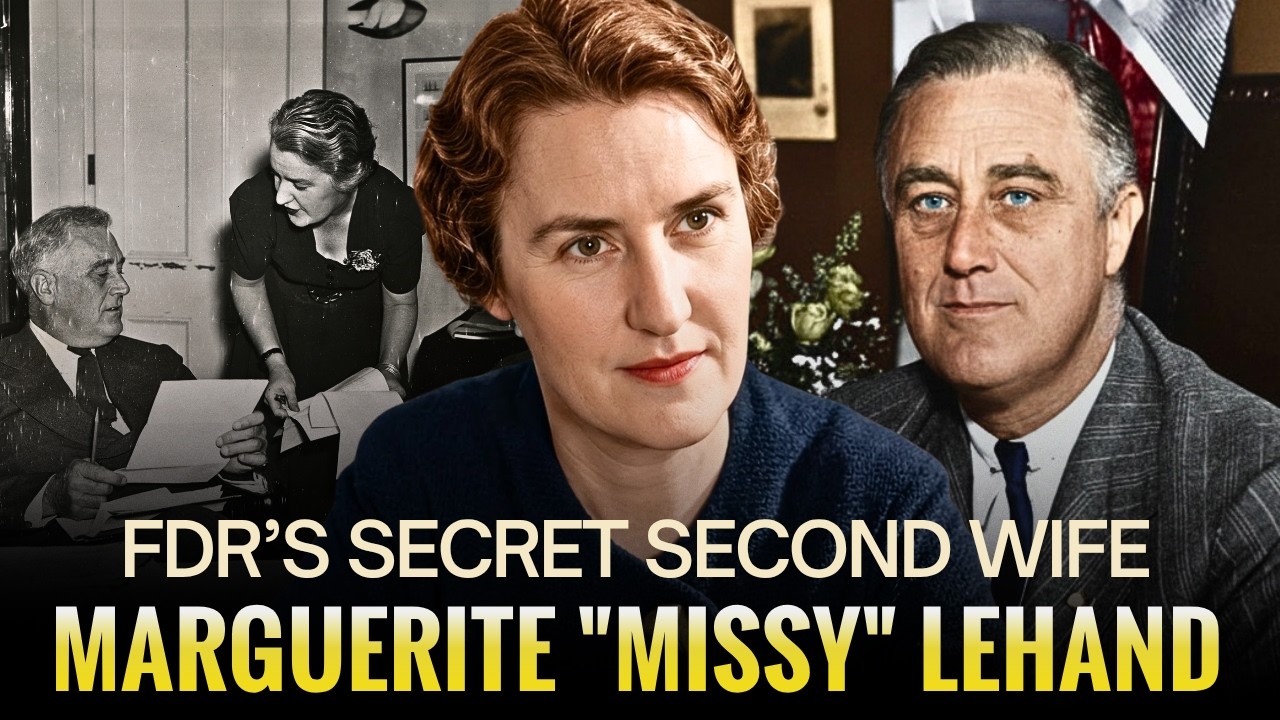
History has often written her off as a secretary, but behind closed doors she functioned as an unofficial chief of staff — and, in the eyes of many historians, a surrogate spouse. Born September 13, 1896, in Potsdam, New York, LeHand was the youngest child of a working-class Irish-Catholic family. Seeking better economic prospects, the family moved to Somerville, Massachusetts, a blue-collar suburb of Boston shaped by factory whistles and physical labor. At the age of 15, a severe case of rheumatic fever permanently damaged her heart valves, leaving her physically unable to sustain heavy labor.
Doctors warned that pregnancy and childbirth would likely be fatal. Faced with a future closed off from both factory work and traditional marriage, she calculated that her only path forward lay in clerical skills. She trained in shorthand and typing at Somerville High School, preparing for a career in administration. When the U.
S. entered World War I in 1917, LeHand moved to Washington and took a clerk position at the Department of the Navy, where Roosevelt was serving as Assistant Secretary of the Navy. Their hierarchical worlds kept them apart at that time. Their paths finally crossed in August 1920, when she was hired as a campaign secretary for Roosevelt’s vice presidential run.
The ticket lost decisively, but Roosevelt recognized her efficiency and discreet calm under pressure, and he kept her on his personal payroll in New York to manage his correspondence and political networking. The defining shift came in the summer of 1921, when FDR contracted polio. Permanently paralyzed from the waist down, he was widely written off as a political figure. Most of his allies abandoned him.
LeHand stayed. She moved into the Roosevelt household, managed his daily life during rehabilitation in Florida and Warm Springs, Georgia, protected his public image, and kept his political networks alive while he recovered. The bond forged in that period was total, unconditional trust. She proved her loyalty was to him personally, not to power or position — and in return, he gave her authority he granted to no one else.
When Roosevelt won the presidency in 1932, LeHand moved with him into the White House, working from an office connected to the Oval Office by a discrete back door. She controlled that door with iron discipline. Cabinet members courted her, sent expensive gifts, and angled for her approval before presenting sensitive proposals to the president. She influenced major appointments, successfully pushing for Homer S.
Cummings as Attorney General and pressing for Felix Frankfurter’s nomination to the Supreme Court. As Europe moved toward war, her reach extended past federal agencies. Ambassadors Joseph P. Kennedy in London and William C.
Bullitt in Paris sent their most sensitive intelligence directly to her desk because they knew that was the surest way to get it before Roosevelt’s eyes immediately. Her influence could override federal protocol. In one documented instance, industrialist Vincent Astor bypassed official immigration procedures to expedite a visa matter for Carl Norden, inventor of the highly classified Norden bombsight. Facing a bureaucratic bottleneck, Astor went directly to LeHand, who cut through the red tape.
Her personal life disappeared into her role. She never married and never had children. She lived in a residential suite on the third floor of the White House, not a home of her own. She was first to see the president each morning, reading newspapers with him while he had breakfast.
She orchestrated his evening “children’s hour” cocktail ritual, carefully selecting guests and banning heavy political talk. She pushed him into decisions when he procrastinated, late into the night, refusing to let difficult calls wait. Roosevelt gave her his power of attorney. She managed his personal bank accounts, signed his checks, paid for his Hyde Park estate, and handled finances for his children.
Historian Joseph E. Persico described her not primarily as chief of staff, but as FDR’s surrogate spouse. First Lady Eleanor Roosevelt did not view LeHand as a rival. She saw the arrangement as a relief.
Eleanor disliked the social duties of being First Lady and willingly left the personal, domestic management of her husband to LeHand. She treated LeHand warmly, even buying her dresses appropriate for a Washington hostess. When Eleanor once offered to help with the president’s private correspondence, Roosevelt immediately rejected the offer, explaining that taking away part of LeHand’s duties would insult her. The workload took a mounting physical toll.
LeHand had a medically vulnerable heart and worked 12 to 14-hour days without weekends, vacations, or reprieve. By the spring of 1941, colleagues saw exhaustion and irritability. On the evening of June 4, 1941, she collapsed in her White House suite after suffering a massive stroke. She was 44.
The stroke left her partially paralyzed and severely aphasic — her mind intact, but her capacity to speak, write, or command effectively destroyed. Some dramatic portrayals, like the series Atlantic Crossing, have depicted the collapse as a romantic breakdown over Roosevelt’s friendship with Crown Princess Martha of Norway. That depiction is contrary to the historical record. The collapse was medical, not emotional.
What followed was a ruthless calculation of utility. The White House, gearing for war, had no function for a broken gatekeeper. Princess Martha, who had taken refuge from Nazi-occupied Norway, became a frequent presidential companion. She took the passenger seat in FDR’s convertible, a seat once reserved solely for LeHand, and took part in the cocktail hours LeHand had designed.
Roosevelt was psychologically unequipped to face severe illness in others, precisely because he had spent two decades denying his own paralysis. He could not look at the woman who had managed his disability, and he could not handle how her condition mirrored his vulnerability. His coping mechanism was avoidance. LeHand was relocated to her sister’s home in Somerville, Massachusetts, for round-the-clock care.
Roosevelt did not visit her. He avoided mentioning her name, and when staff raised it, he changed the subject. He did, however, fund her care extensively out of his own accounts, hiring elite specialists, transforming her sister’s residence into a private medical facility, and covering every expense. He sent gifts, including a silver cup engraved for her years of service, and he wrote letters — but the letters were deliberately trivial, filled with talk of the weather, his dogs, and household gossip, while omitting the world of power and war that had defined their relationship.
Telephone calls were even crueler. She could hear him but could not form words to respond, reduced to silence while the president carried on a one-sided conversation. A year before the stroke, LeHand had quietly attempted to carve out a private life. In the late 1930s, she had a romance with William C.
Bullitt, then the American ambassador to France. The relationship could not survive the geographic distance or the all-consuming demands of her position, and it ended by 1940. The deeper betrayal, though, came from her own successor. Before her breakdown, LeHand had drafted a will giving her assistant Grace Tully the authority to manage her private White House papers.
Tully, who stepped into the secretarial role next to the Oval Office, did not preserve her predecessor’s legacy. When Eleanor Roosevelt formally asked for access to LeHand’s files, Tully lied and claimed the archive did not exist. She hoarded the documents privately, and the true scale of LeHand’s influence was buried for decades. Between 1941 and 1944, her condition steadily declined.
She suffered secondary medical crises and depended entirely on private nurses. Her mind, however, remained sharp, still locked into the machinery of power. On July 16, 1944, weeks before her death, she dictated a final message — addressed to Grace Tully. It contained no mention of family, faith, or her legacy.
It asked only: “Who is going to be nominated for vice president? I’m going crazy trying to figure it out. ” The 1944 Democratic convention’s vice presidential fight mattered enormously because FDR, secretly failing in health, was unlikely to complete a fourth term. LeHand, dying, still wanted to know.
Her heart finally failed on July 31, 1944. She was 47. Roosevelt did not attend her funeral; he was traveling to a Pacific military conference. Eleanor Roosevelt traveled to Massachusetts to oversee the services.
The president provided the epitaph on her headstone: “She was utterly selfless in her devotion to duty. ” The Roosevelt family still maintains her grave. In April 1945, Roosevelt died of a cerebral hemorrhage in Warm Springs. He was not with Eleanor.
He was with Lucy Mercer Rutherford — the woman with whom he had an affair in 1918, whose return he had secretly rekindled after LeHand was exiled. After both figures were gone, the telling of LeHand’s story fell to others. Books by Roosevelt family members and films like Hyde Park on Hudson reduced her to a lovesick secretary, stripping away her operational authority and influence. The documentation needed to correct the record was withheld — hidden in Tully’s private archive.
In 2010, a Congressional mandate forced the transfer of that archive to the national records. Once historians examined it, the full scale of LeHand’s functional power became undeniable. Her story remains a cautionary tale about the economics of power. She traded her youth, her health, and her personal life for proximity to the presidency.
She assumed absolute loyalty would secure her a place in history. Instead, when her body broke, she was exiled, replaced, and rendered obscure for decades. The machinery she helped build did not safeguard her legacy — it erased it until the evidence could no longer be suppressed.