On October 14, 1944, a fifteen-year-old boy named Manfred Rommel watched from an upstairs window as two generals stepped out of a car and walked toward the front door of his family home. They had not come for tea. Downstairs, his father, Field Marshal Erwin Rommel, the most celebrated soldier in Germany, already understood why they were there. The regime had linked Rommel to the July 20 plot, the failed assassination attempt against Hitler three months earlier.
The evidence was thin, drawn largely from confessions extracted under torture. But in the Third Reich, suspicion was enough. The generals presented Rommel with two options. The first was a trial before the People’s Court, presided over by the fanatical Roland Freisler, a public spectacle that would end in execution and bring arrest, imprisonment, or worse upon his wife, Lucy, and their son.
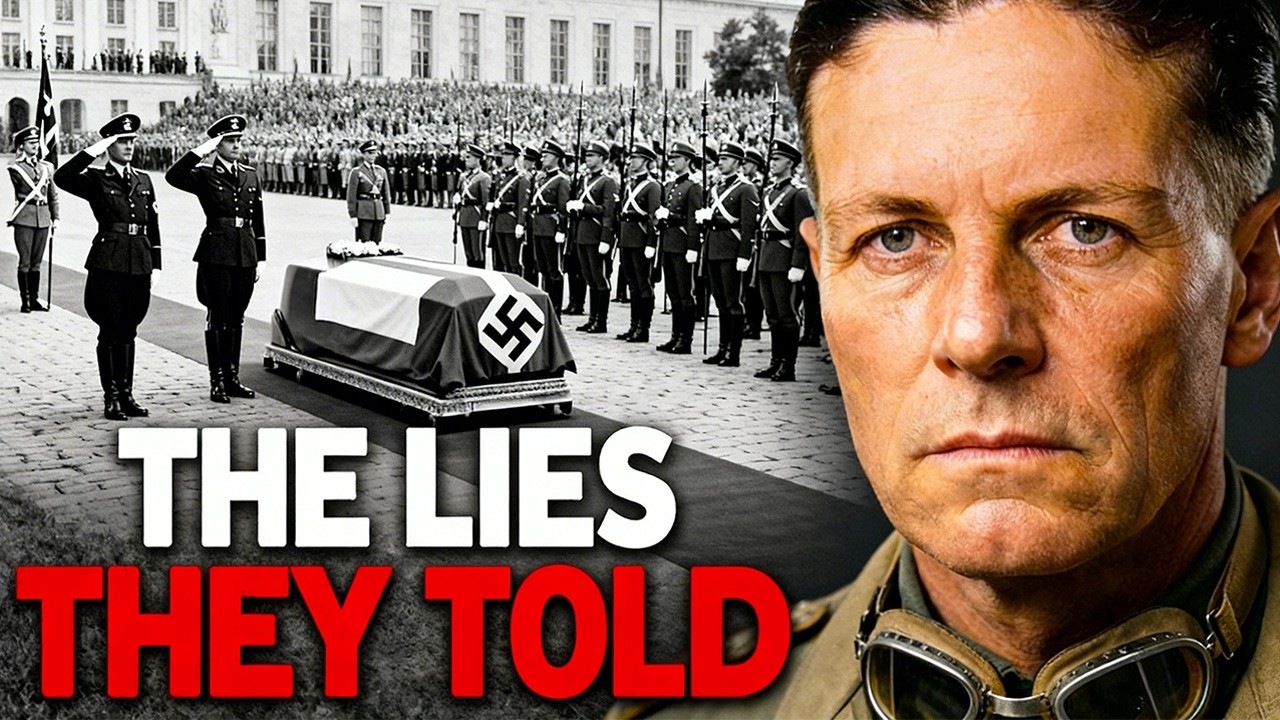
The regime would strip the family of everything: their name, their pension, their safety. The second option was a cyanide capsule. Take it now, and the official story would be that Rommel had died of wounds sustained in an Allied air attack months earlier. He would receive a state funeral with full military honors.
Lucy would keep her pension. Manfred would be left alone. Rommel chose the capsule. He said goodbye to his wife.
He told Manfred what was happening, that in fifteen minutes he would be dead. Then he walked to the waiting car with the two generals, was driven down the road, and swallowed the poison. Within the hour, the Wehrmacht announced that Field Marshal Rommel had succumbed to his injuries. The Führer expressed his deepest condolences.
It was a lie from start to finish. But that lie became the Rommel family’s life insurance. The Nazis got their hero’s funeral and their propaganda moment; Lucy and Manfred got to survive the final months of the war without being branded traitors’ kin, without being hunted, arrested, or sent to a camp. The same deception that killed Erwin Rommel is what saved his family.
And the boy who watched his father leave the house that morning would spend the rest of his life reckoning with what that meant. Manfred had not been a bystander during the war. At fourteen, he had served as a Luftwaffe auxiliary assigned to an anti-aircraft battery while still in school. By early 1945, as the Reich crumbled, he was conscripted into the Reich Labor Service, another teenage body thrown at the collapsing front.
But as April brought Allied armies deeper into southern Germany, Manfred made a choice his father never could. He deserted. Near Riedlingen, in the chaos of a disintegrating army, he slipped away from his unit and was quickly picked up by advancing French forces. He was a prisoner of war at sixteen.
During his interrogation, Manfred was brought before General Jean de Lattre de Tassigny himself, one of France’s most senior commanders. Instead of staying silent or repeating the regime’s cover story, Manfred told the truth. He described the two generals arriving at the family home, the ultimatum, the cyanide capsule, the staged funeral. For the first time, the real story of Erwin Rommel’s death left the family.
A teenage deserter, a prisoner, the son of the most celebrated German general of the war, had handed the Allies the truth the Nazi regime had worked so hard to bury. When the war ended, Lucy Rommel was left alone with her grief and a pension that existed only because her husband had agreed to die quietly. She lived out the postwar decades in southwest Germany, avoiding public life almost entirely. American and British intelligence officers questioned her in the months after the surrender, but she was never charged with anything.
There was nothing to charge her with. She had been a soldier’s wife in a regime that destroyed her husband, and the state funeral that disguised his murder had ironically shielded her from the retribution that engulfed other families connected to the Nazi elite. Lucy died in 1971 in Stuttgart, largely forgotten by the public. Manfred took a completely different path.
After his release from French captivity, he completed his Abitur in 1947, enrolled to study law at the University of Tübingen, and by 1956 had entered the civil service. Step by step, the Field Marshal’s son was embedding himself inside the very democratic institutions that had replaced everything his father had fought for. He married Lieselotte in 1954 and settled into a steady, unglamorous career. He was not running from his name.
He was quietly redefining it. In 1974, Manfred Rommel was elected Oberbürgermeister of Stuttgart, running as a member of the conservative CDU party. On paper, it was a natural fit. But the way Manfred actually governed was anything but conservative.
He became a champion of modern infrastructure, pushing through the Stuttgart S-Bahn commuter rail system in 1978 and investing in international cultural venues. He governed a city with one of the highest proportions of foreign residents in West Germany, and rather than treat immigration as a problem to manage, he embraced it openly. He became known as one of the most pro-immigration, liberal-minded politicians in the country. The son of Hitler’s star Field Marshal, the man whose name was synonymous with the Afrika Korps and Panzer warfare, was running one of Germany’s most diverse cities and thriving at it.
He served for twenty-two years, becoming one of the most popular municipal politicians in the country’s history. His trademark was dry Swabian humor and a legendary frugality. He reportedly made half a butterless pretzel the standard refreshment at official city receptions, a detail that delighted Stuttgart residents and horrified visiting dignitaries in equal measure. During his time as mayor, Manfred developed close personal friendships with two men whose surnames should have made any relationship impossible.
The first was George Patton IV, the son of General George S. Patton, the American commander who had chased Erwin Rommel across North Africa and Sicily. The second was David Montgomery, the son of Field Marshal Bernard Montgomery, the British officer who finally defeated Rommel at El Alamein in 1942. The men whose fathers had tried to kill each other across the deserts of Libya and Tunisia were now friends.
They visited one another, attended events together, and built genuine bonds that went beyond diplomatic courtesy. For Manfred, these friendships were symbolic. They represented the kind of reconciliation that postwar Europe was supposed to embody. But Manfred’s most defining moment had nothing to do with old wars.
By 1977, West Germany was in crisis. The Red Army Faction, the Baader-Meinhof Group, had been waging a campaign of bombings, assassinations, and kidnappings. That autumn, the crisis reached its peak. On October 18, three imprisoned RAF leaders, Andreas Baader, Gudrun Ensslin, and Jan-Carl Raspe, were found dead in their cells at Stammheim Prison in Stuttgart.
The official verdict was suicide. Germany was divided over what to do with the bodies. No city wanted them. The idea of burying terrorists on German soil provoked outrage from conservatives, law enforcement officials, and much of the public.
The bodies sat unclaimed as municipalities refused to act. Then Manfred Rommel stepped forward. As mayor of Stuttgart, he ordered the three buried together at the city’s Dornhaldenfriedhof cemetery. The outcry was ferocious.
Conservatives were appalled. Political allies distanced themselves. Critics accused him of legitimizing terrorism. It was the single most controversial decision of his career.
Manfred’s response was a single principle: after death, every enmity must end. Consider what that statement meant coming from him. This was a man whose father had been forced to swallow poison by his own government and then given a fraudulent funeral designed to serve the regime’s propaganda needs. Erwin Rommel had been denied a truthful burial.
His death had been dressed up as something it was not, his memory manipulated for political convenience. His son had watched this happen at fifteen years old. Now, three decades later, that same son insisted on dignified burial for people most of Germany considered monsters. Not because he sympathized with their cause, but because he believed that what you do with the dead reveals what kind of society you are.
A society that refuses burial to its enemies is a society still governed by the logic that killed his father. The Rommel story had one more chapter that nobody knew about until the year 2000. For decades, a woman named Gertrude appeared in the Rommel household, introduced to visitors as cousin Gertrude. She was treated as extended family, present at gatherings, welcome in the home, trusted with private moments.
She sat at Erwin Rommel’s hospital bedside when he was recovering from his injuries in 1944. But Gertrude was not a cousin. She was Erwin Rommel’s daughter, born on December 8, 1913, the child of Walburga, a young woman Rommel had been involved with while stationed before the First World War. Around the year 2000, a cache of letters surfaced.
Over 150 of them, written by Rommel to Walburga during those early years. In them, he called her his little mouse and wrote about his dreams of building a little nest for her and the baby. The letters painted a portrait of genuine affection. But the relationship did not survive.
Rommel married Lucy Mollin in 1916. When Lucy became pregnant with Manfred in 1928, Walburga’s position became untenable. She died that same year. The official cause was pneumonia, but it was widely believed then and now that she had taken her own life.
Gertrude was absorbed into the Rommel household under the fiction of a cousin. The letters were eventually inherited by Gertrude’s son, Josef Pan, who brought them to light and documented a relationship the Rommel family had concealed for nearly a century. The Rommel family didn’t just survive the postwar period. They actively participated in shaping how the world remembered Erwin Rommel, and in doing so helped construct one of the most powerful narratives in modern German history.
The idea of Rommel as the good German general, honorable, chivalrous, apolitical, a man who fought cleanly and resisted Hitler from within, became a cornerstone of what historians call the Clean Wehrmacht myth. This was the narrative that allowed West Germany to reintegrate former military officers into democratic society without forcing a full reckoning with what the Wehrmacht had actually done. Lucy and Manfred both contributed to this narrative, foregrounding Erwin’s supposed chivalry in North Africa, his distance from Nazi ideology, and his connection to the July 20 plot. But historians still debate how much of this was true and how much was strategic self-presentation.
Rommel had served the regime faithfully for years. He had accepted gifts, promotions, and honors from Hitler personally. His connection to the July 20 conspirators was real but ambiguous. The family shaped the archive as much as they drew from it, choosing which letters to publish, which stories to tell, and which inconvenient facts to leave buried.
None of this erases what the Nazis did to Rommel in the end. The forced suicide was real. The cover-up was real. The grief was real.
Stuttgart Airport was renamed Manfred Rommel Flughafen in 2014, the year after Manfred’s death at age eighty-four. Not for the Field Marshal, for the mayor. The Rommel name traveled from the deserts of North Africa to a civilian terminal in democratic Germany. It got there through a teenager’s desertion, a liberal’s moral courage, and a family secret hidden for nearly a century.
The Field Marshal’s legacy is still debated, and it should be. The Clean Wehrmacht myth did real damage, and the Rommel family’s role in constructing it deserves honest scrutiny. But his son’s legacy is remarkably clear. Manfred Rommel spent a lifetime proving something that most families connected to the Third Reich never attempted: that you can inherit a name without inheriting its sins, if you are willing to spend every day demonstrating what that name means now instead of defending what it meant then.
He buried terrorists with dignity because his father was denied it. He befriended the sons of enemies because he understood that war does not have to be inherited. He governed a diverse modern city because he believed democracy was not just a system of government but a daily choice to be better than the world you came from. Manfred Rommel died on November 7, 2013.
The airport was renamed the following year, and the name that once echoed across the battlefields of North Africa now greets travelers arriving in one of Europe’s most welcoming cities. A quiet final transformation that the Field Marshal could never have imagined, but that his son spent a lifetime earning.