On a black-hulled schooner cruising the Mediterranean, the richest man in Britain went down on one knee. He had given the woman before him a villa on the Riviera, ropes of natural pearls she could wind around her throat three times, loose emeralds by the handful, a Renoir for her wall. He owned half of Mayfair, a Cheshire castle with fifty-four bedrooms, and half a million acres of French hunting ground. He could give a woman anything.
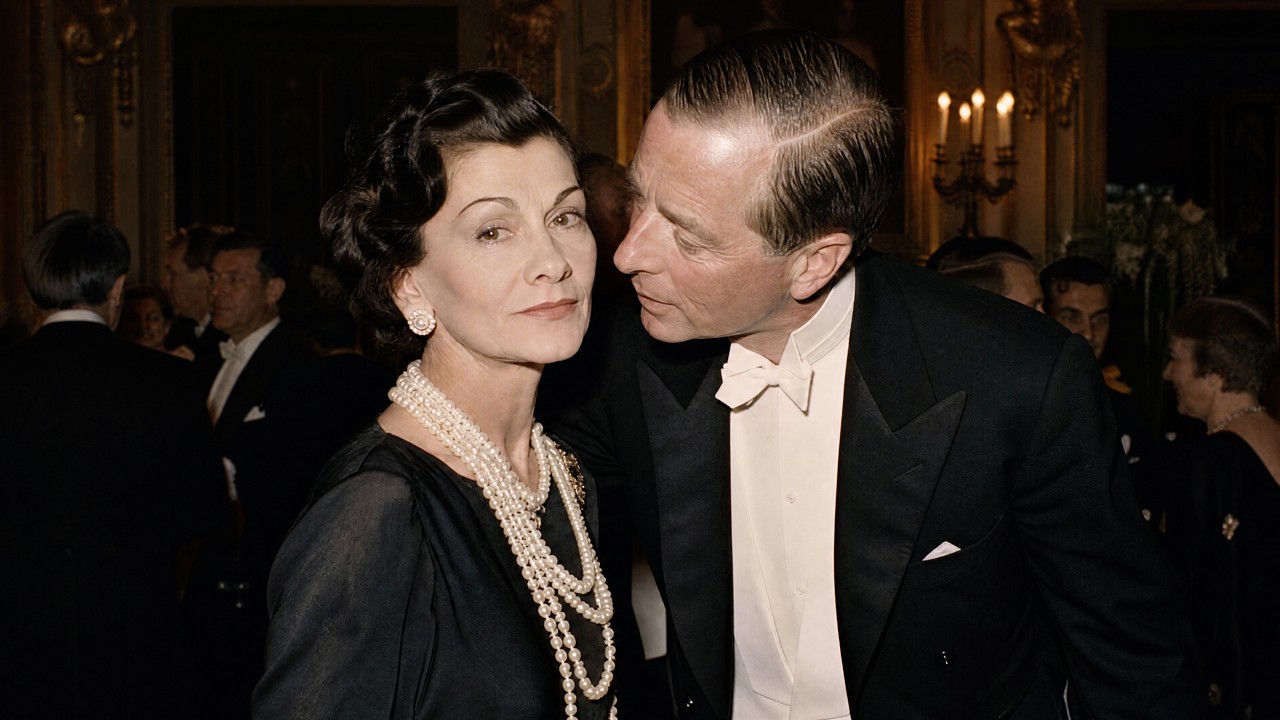
And the dressmaker born in a poorhouse looked at the coronet of a duchess and said no. She would keep saying no for six years. He was Hugh Richard Arthur Grosvenor, the second Duke of Westminster, known all his life as Bendor after a racehorse his grandfather owned that won the Derby at Epsom in 1880. He was twenty years old when, in December 1899, the title and estate leaped over his dead father and landed on him.
Overnight he became one of the richest men alive. The Grosvenor fortune rested on the simplest possible foundation: the freehold of much of Mayfair, Belgravia, and Pimlico, the most valuable residential ground in London. Every townhouse, shop, and embassy that stood on that land paid the family rent, year after year, with no effort and no risk. Beyond the London holdings lay 130,000 acres across Britain: Eaton Hall in Cheshire, hung with Goyas and Rembrandts and Rubens, set in 11,000 acres of park; the Reay Forest in Scotland; a château in France; a hunting estate at Mimizan of some half a million acres; and two ocean-going yachts, including the Flying Cloud, a black-hulled schooner of about eighty-six meters, among the largest private sailing yachts in the world.
Generosity came easy to him. When London needed working-class housing, he granted long leases on his Pimlico ground at rents of a pound a year or even a shilling, so that tenement flats could rise for families who otherwise had nowhere. He gave hugely and barely felt it, because the rest of the rent kept flowing regardless. What he could not do was accept being told no.
By his forties he had married twice, buried a small son, and still had no heir. The dukedom was entailed, passing only through a strict male line; a daughter could not inherit the title or the estate. His first marriage, to the celebrated beauty Constance Cornwallis-West, known as Sheila, produced a son, Edward, styled Earl Grosvenor. In early 1909 the four-year-old fell ill with appendicitis, sudden and savage in the years before such things were reliably treated, and died.
That marriage collapsed under the grief and ended in divorce in 1919. A second marriage in 1920, to Violet Nelson, gave no children and dissolved by 1926. The heir to the greatest private fortune in Britain had no one to pass it to. In the early 1920s, this restless, quietly desperate man went south to Monte Carlo.
He met Gabrielle Chanel, a small, sharp-eyed Frenchwoman whose origins could hardly have been further from his. Born in 1883 in a charity hospital in Saumur to a laundry woman and a market trader, she had been raised in a convent orphanage after her mother died, taught to sew a clean, plain, perfect seam by nuns. Everything her fashion would become, the severe simplicity, the love of black and white, carried the memory of those stone corridors. She left with nothing, sang in provincial cabarets for coins, earned the nickname Coco, and used the attention of wealthy men to escape needing them.
She opened a hat shop and then a dress shop, cut away the corsets and the fuss of the old century, made elegance from humble jersey fabric, and in 1921 launched a perfume she numbered rather than named, the one she called simply Number Five. It became one of the most successful luxury products in history. By the time she met the Duke of Westminster, in the winter of 1923 into 1924, she was not a kept woman waiting to be rescued. She was a self-made magnate with her own couture house, her own perfume fortune, and her own name above her own door.
She was forty. He was forty-four. There was nothing cautious about the affair. He swept her aboard the Flying Cloud; he brought her to Eaton Hall and to his Scottish deer forest, where she fished in the rain and carried tweeds and estate clothing back to her Paris collections; he brought her to Mimizan to chase wild boar.
Winston Churchill, his friend since the South African War, stayed at the houses and on the yachts, met Chanel, and sent home approving reports of her from a boar hunt in 1927. And Bendor poured gifts over her. Long ropes of natural pearls, uncut emeralds and unset sapphires by the handful, a Renoir, Tudor furniture, old silver, Russian icons, the use of houses and cruises that ran for weeks. Across the years, biographers have estimated the total outlay ran into the modern equivalent of tens of millions of pounds.
She took the gifts and was not bought by them. She wore the pearls and added her own glass beads beside them, and made the whole world copy the mixture. She enjoyed the yacht and the cruises, and went on running her business through all of it. In 1927 he gave her a parcel of land above Roquebrune-Cap-Martin on the Riviera.
Between 1928 and 1929 she built La Pausa, a low, pale villa designed around a central courtyard and a great staircase she modeled on the orphanage of her childhood. He gave her a hilltop on the most fashionable coast in Europe, and she rebuilt, in beauty this time, the cold institution that had made her. He asked her to marry him, to become Duchess of Westminster, mistress of Eaton Hall, wife to the richest man in Britain. He asked more than once, most insistently in the later 1920s, when the relationship was deepest.
He needed an heir. Vera Bate Lombardi, the friend who had introduced them, is said to have pressed on him that Chanel was approaching the end of her childbearing years, that he could not wait. So the proposals carried a double weight: the longing of a man for a particular woman, and the dynastic anxiety of a duke who could feel his line dying with him. He was not only asking her to love him.
He was asking her to save the house of Grosvenor. And she refused. Not in anger, not in a single dramatic scene, but steadily and finally, because to marry him she would have had to become his. A duchess is defined by her husband, ranked by his rank, housed in his houses, named by his name.
She had spent her whole life making sure she would never be defined by anyone. She preferred to be the most famous mistress in Europe, free, than the next in a line of duchesses, owned. The refusal has come down through the years in a single perfect sentence, that there have been several Duchesses of Westminster but only one Chanel. Chanel herself, in old age, reportedly denied ever saying it, and the biographer Justine Picardie suggested it more likely grew out of a compliment made by a diplomat across a lunch table at the British Embassy in Paris.
The exact origin is uncertain. It does not matter. The line is true, whoever first said it. He married four women in his life, and not one of them was Chanel.
The romance wound down around 1930, ending in the slow recognition that she would never give him the answer he needed. On February 20, 1930, shortly after the affair ended, the Duke married for the third time. His bride was Loelia Ponsonby, a well-connected young English aristocrat, exactly the sort of suitable duchess Chanel had refused to become. Winston Churchill stood as best man.
Loelia would later describe the marriage, in memoirs published in 1961, with painful honesty; the diarist James Lees-Milne called it a definition of unadulterated hell. It produced no son and ended in divorce in 1947. He married a fourth time that year, to Anne Sullivan, who also gave him no male heir. After Chanel, something in him curdled.
He drank, grew suspicious and difficult, prone to dark moods and grudges. In the 1930s he drifted into open sympathy with Nazi Germany, moving in circles that argued for friendship with Hitler’s regime and against another war, and his private views carried a documented streak of anti-Semitism. He spent his later years on the wrong side of the great moral question of the century. He died on July 19, 1953, at Lochmore, his shooting lodge in the Scottish deer forest, of heart failure, at the age of seventy-four, with his fourth wife at his side and no son anywhere to inherit.
The death duties on his estate came to a record sum of around eighteen million pounds, so large that the family took eleven years to pay it off in installments. The dukedom could not pass to a child of his body; it went sideways to a cousin, William Grosvenor, who became the third duke. The line he had married four times trying to continue ended with him. The dead four-year-old in the nursery at the beginning of the story turned out to be the last direct heir he ever had.
Chanel outlived him by eighteen years. The House of Chanel stood intact, her perfume still selling around the world, her name still her own above her own door. She died in 1971 in her suite at the Ritz Hotel in Paris. He died the richest of men, his line dead with him, his title carried off to a cousin.
She died with her name on a global empire that outlived the century. He spent six years and a fortune trying to make her part of his story. In the end, he became a chapter in hers. La Pausa still stands above the sea.
The estates remain among the great landholdings of Britain. And the question of who really won, the man who owned everything or the woman who refused it, answers itself. There have been several Duchesses of Westminster.
There is only one Chanel.