Lee Harvey Oswald was born on October 18, 1939, in New Orleans, Louisiana. His father, an insurance agent, died of a heart attack two months before he was born, leaving his mother, Margarite, to raise three young sons in increasingly difficult financial circumstances. Margarite had already endured one failed marriage, and after her second husband’s death, she struggled to keep the family afloat. She sold the family home, opened a small shop that failed, and eventually placed her two older sons in an orphanage.
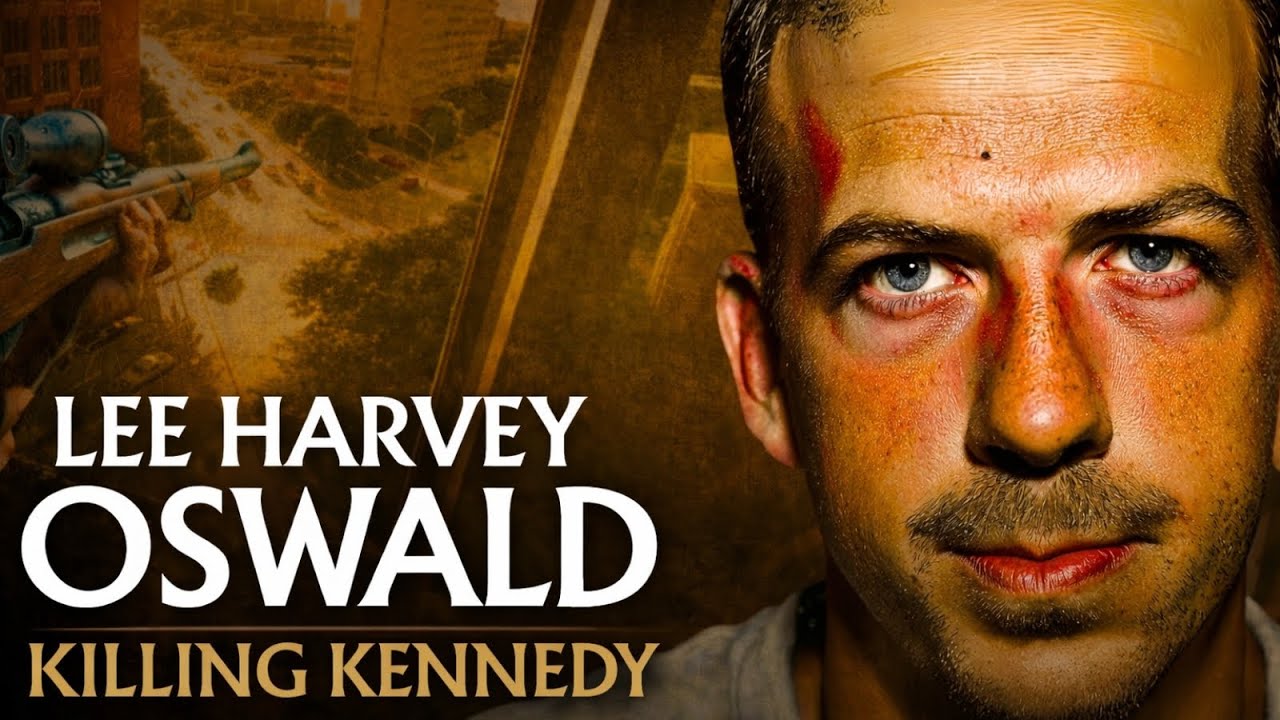
Lee, still a toddler, was moved between apartments and babysitters while his mother worked as a telephone operator. Lee’s early years were marked by instability and inconsistent care. His behavior swung dramatically depending on who looked after him. Some babysitters described him as angry, sullen, and violent, while his aunt Lillian, who adored children, remembered him as sunny and sweet.
Margarite, according to family members, never seemed to enjoy motherhood. Her sons recalled feeling like burdens to her, and Lee’s older brother John, who was eleven when Lee was three, was often left responsible for his younger siblings while their mother worked. In 1944, Margarite moved the family to Dallas, Texas. There she reconnected with Edwin Ekdahl, an electrical engineer she had known in New Orleans.
They married in the summer of 1945 despite Margarite’s doubts about his age and health. For a little over a year, the family seemed happy. Ekdahl was kind and indulgent with the boys, and Lee, who had never known his father, grew attached to him. But the marriage soon deteriorated over control of finances.
After several separations, Margarite discovered Ekdahl was having an affair and filed for divorce. Lee, then eight, refused to testify in court, saying he could not tell right from wrong or truth from falsehood. The jury sided with Ekdahl, and Margarite received only $1,500 and her furniture. The family returned to the bottom of their fortunes.
Over the next several years, Lee’s life remained unstable. He moved constantly, changed schools nearly as often, and made few friends. He grew increasingly isolated, and those around him noticed his anger worsening. A former neighbor reported seeing Lee chase his brother Robert with a butcher knife.
Another said Lee threw rocks at passing children. Margarite dismissed such concerns with a shrug: “Boys will be boys. ”
By the time Lee reached adolescence, his brothers had left home, one joining the Navy and the other the Marines. In the spring of 1952, twelve-year-old Lee traveled to New York to stay with John, who was newly married.
The visit turned tense when Margarite arrived unannounced with several suitcases, intending to move in. Within two months, the living arrangement collapsed. Lee’s erratic and angry behavior frightened John and his wife. When Lee lost his temper during an argument, slapped his mother, and threatened his sister-in-law with a pocketknife, John confronted them.
Margarite defended Lee, insisting the knife was small and he would never hurt anyone. John asked them both to leave. It would be nearly a decade before the brothers reconciled. Margarite and Lee remained in New York for several months.
Lee enrolled in middle school but skipped as much as seventy-five percent of his classes. He preferred roaming the city, visiting museums, the Bronx Zoo, and comic book shops. Eventually, a truant officer picked him up, and the state’s juvenile authorities became involved. Social workers and psychologists who interviewed Lee found him deeply troubled but intelligent.
His IQ tested at 118, and his vocabulary was impressive for his age. Yet he showed almost no ability to control his emotions or follow through on plans. One psychologist described him as “deeply disturbed emotionally with schizoid tendencies,” suffering from emotional isolation, lack of affection, and rejection by a self-involved and conflicted mother. The intervention might have changed his path, but Margarite was outraged by what she saw as bureaucratic meddling.
She promised a judge that Lee’s attendance would improve, then promptly moved back to New Orleans, removing him from the authorities’ reach. Back in Louisiana, Lee’s attendance remained spotty, and he frequently fought with other boys. He managed to make one friend, but the friendship ended after a series of ugly fights. Lee, who had moved from New York, unknowingly sat in the segregated section of a New Orleans bus and was beaten by a group of boys for it.
Days later, he ambushed two of them on the street, punching them in the face. One boy hit back so hard Lee needed dental work. Lee dropped out of school in the tenth grade but continued reading widely. At the public library, he discovered socialist literature, particularly Karl Marx’s Das Kapital and the Communist Manifesto.
Marx’s philosophy resonated deeply with him. He became convinced that the oppression of workers and the racism he saw across America were rooted in capitalism and imperialism. Political ideology gave him a focus for his anger, and his behavior shifted from silent isolation to loud, confrontational argumentation. At sixteen, Lee was desperate to leave home.
He forged his mother’s signature to withdraw from high school and dropped out without telling his family. He tried to enlist in the military but was too young. He worked several part-time jobs while waiting for his seventeenth birthday, then joined the Marines. Initially, Lee distinguished himself in training.
He placed seventh in a class of thirty in an aircraft communications engineering course and qualified as a sharpshooter. In 1957, he was posted to a naval base in Atsugi, Japan. But his military career soured quickly. He was court-martialed twice, once for possessing an unauthorized firearm and again for disputing a superior about the first court-martial.
He openly espoused Marxism and studied Russian, earning the nickname “Oswaldich” from his fellow Marines. By 1959, Lee had decided to defect to the Soviet Union. He applied for a hardship discharge, claiming his mother needed his financial support, then left New Orleans less than two months after returning home. He traveled through France and Finland, arriving in Moscow on October 16, 1959.
The next day, he visited the American embassy to inquire about renouncing his citizenship. Embassy staff urged him to take more time to consider. Angry and frustrated, Lee stormed out, leaving his passport behind. The Soviet authorities were baffled by the young American who seemed not to understand where he had landed.
They denied his citizenship application within a week. Lee was devastated. In his diary, he recorded his despair, writing that his fondest dreams were shattered. That evening, he attempted suicide.
His Soviet liaison found him and he was hospitalized, then confined to a psychiatric ward for a week. In January 1960, the Soviets allowed Lee to stay, granting him a residence permit usually extended to stateless foreigners. He was sent to Minsk, where he received a furnished apartment, a job at an electronics factory, and a substantial income by Soviet standards. Initially content, he soon grew disillusioned.
He complained about compulsory political meetings, mass gymnastics, and being sent to pick potatoes on a collective farm. His diary records his growing boredom with Soviet life, where there were no nightclubs or bowling alleys, only trade union dances. Within months, he was dating a coworker named Ella. He proposed in January 1961 and was heartbroken when she refused, noting that she had no love for him and worried that being American might one day get him arrested.
Reeling from rejection, Lee wrote to the American embassy in February to ask about returning to the United States. On March 17, at a trade union dance, he met Marina Prusakova, a nineteen-year-old pharmacology graduate. They married after just six weeks. By then Lee had already told her of his plan to return to America, and though she had not known before their marriage, she agreed to go with him if they could secure an exit visa.
The process took nearly a year. In the spring of 1962, Lee, Marina, and their newborn daughter June received permission to leave the Soviet Union. They arrived in New Jersey, where Lee’s brother Robert had paid for their travel. Lee was furious at the arrangement but eventually accepted the warmth of the reunion.
The peace did not last. When Margarite arrived, the visit turned hostile. She told Lee she had contacted officials in Washington, asking whether he was secretly an American agent in Russia, and that she had planned to write a book about his defection. Lee exploded.
He was also bitter that no one in the media seemed interested in his story. His marriage deteriorated quickly, and his abuse of Marina escalated from slaps to punches. She often appeared with bruises. Their friends drifted away, and the couple experienced several separations.
In January 1963, Lee created a fake ID under the name Alec James Hidell and bought a handgun and a Carcano rifle by mail. He asked Marina to photograph him holding the rifle in the backyard, a picture that would later become famous. That same month, he instructed her to write to the Soviet embassy requesting permission for her and June to return to Russia, a request she did not wish to make. In early 1963, Lee began studying the neighborhood of retired General Edwin Walker, a fervent segregationist and member of the John Birch Society.
On the evening of April 10, Oswald concealed himself near Walker’s office window and fired a shot. Walker survived because he moved his head at the last second; the bullet passed through the window frame, and he suffered only minor injuries. In late April, Lee went to New Orleans for work while Marina and June stayed with friends in Irving, Texas. He became involved with the Fair Play for Cuba Committee, a pro-Castro group, and handed out leaflets in downtown New Orleans.
A dispute with anti-Castro Cuban exiles turned violent. In September, he traveled to Mexico and applied for visas at both the Cuban and Soviet embassies in Mexico City. Neither granted him one. He returned to Dallas, defeated.
A neighbor helped Lee get a job at the Texas School Book Depository, filling textbook orders. The birth of his second daughter, Rachel, three days after his twenty-fourth birthday, seemed to lift his spirits briefly. But his descent continued. On the evening of November 21, 1963, Lee visited Marina in a last attempt at reconciliation.
When he left the next morning, she found his wedding ring left behind. On the morning of November 22, a coworker gave him a ride to work. Lee carried a long, slim package wrapped in brown paper, which he said contained curtain rods. At lunchtime, while his coworkers gathered on the fifth floor to watch the presidential motorcade, Lee went to the sixth floor.
He positioned himself at the southeast corner window behind a stack of boxes. As President John F. Kennedy’s open-topped car turned into Dealey Plaza, Oswald fired three shots. The first bullet passed through the president’s neck and struck Texas Governor John Connally, who was sitting in front of him.
The second missed. The third struck Kennedy in the back of the head. The president slumped forward as the crowd screamed and Secret Service agents converged on the car. Oswald hid the rifle and went downstairs.
A police captain was already questioning staff in the lunchroom. Lee slipped out of the building. His supervisor soon noticed he was the only employee unaccounted for, and a citywide dispatch was issued with his name and description. Lee went home, changed clothes, and collected his pistol.
On his way back downtown, he was stopped by patrol officer J. D. Tippit, who thought he matched the description of the suspect. When Tippit asked for identification, Lee shot him dead.
The killing was witnessed by nine people. Less than twenty minutes later, a shop owner watched Lee enter a movie theater. Police found him there within half an hour. He tried to shoot the arresting officer, failed, and struck the officer in the face before being subdued.
Oswald spent two days in police custody. He confessed to killing Tippit but refused to confess to assassinating Kennedy. On the night of November 23, he met with his mother and wife for the last time. The next day, as he was being moved from the Dallas City Jail to the county jail, a local club owner named Jack Ruby stepped out of the crowd of reporters and shot him in the abdomen.
Ruby later said he had been outraged by Oswald’s crime and wanted to spare Mrs. Kennedy from seeing her husband’s killer sent to prison. Oswald was taken to Parkland Hospital, the same hospital where Kennedy had died two days earlier. That night, Lee Harvey Oswald died at the age of twenty-four.
His funeral was attended only by Marina, her two daughters, Margarite, and his brother Robert. Several clergymen refused to perform the service, and six news reporters served as pallbearers. Three years after his death, his headstone was stolen. Margarite replaced it with one reading only “Oswald.
” She spent the rest of her life selling her son’s possessions and charging for interviews. She died in 1981 and was buried next to him. In the years after the assassination, the Warren Commission concluded that Oswald had acted alone. But the shock of Kennedy’s death, followed by the assassinations of Malcolm X, Medgar Evers, Martin Luther King Jr.
, and Robert Kennedy, along with the Vietnam War and Watergate, eroded public trust in government. Conspiracy theories flourished. Thousands of classified documents have been released in stages, though several thousand remain sealed.
Most reputable scholars who have studied the extensive record continue to support the original finding: Lee Harvey Oswald acted alone.