Behind the water tower at Pilgrim State Hospital, past the edge of what was once the most ambitious psychiatric institution ever built, lies a cemetery that looks like no other. The headstones carry no family names, no dates of birth, no epitaphs. They carry only numbers, assigned at death, recorded in a ledger, and driven into the ground above whoever happened to be buried there. These were the patients who died at Pilgrim and had no one left to claim them.
The institution logged them, numbered them, and returned them to the earth the same way it had processed them in life, efficiently, anonymously, without ceremony. The question those numbered stones demand is how a place built with so much conviction became what it became. To answer it, you have to understand what New York was becoming in the early twentieth century. Immigration was accelerating, poverty and overcrowding were spreading, and the psychological fractures of a city moving faster than its people could adapt were accumulating faster than the state could address them.
The asylums built in the previous century were failing. Wards designed for forty patients held eighty. Corridors became sleeping quarters. Staff hired to provide care found themselves managing crowds in facilities long past the point of offering anything resembling treatment.
The asylum had become a warehouse, and the warehouse was full. The state’s first response was the farm colony model. Rather than confining the mentally ill in crowded urban institutions, New York would relocate them to the countryside, where fresh air, open land, and productive labor were believed to have therapeutic value. Kings Park State Hospital and Central Islip State Hospital, both opened in the late nineteenth century, were the first expressions of this idea.
They farmed their own food, housed their own staff, and operated as self-sufficient communities. But the city kept growing, and the farm colonies filled at the same rate as the institutions they were designed to replace. In 1927, Governor Alfred Smith brought the matter before the state legislature with unusual directness. The situation was a crisis.
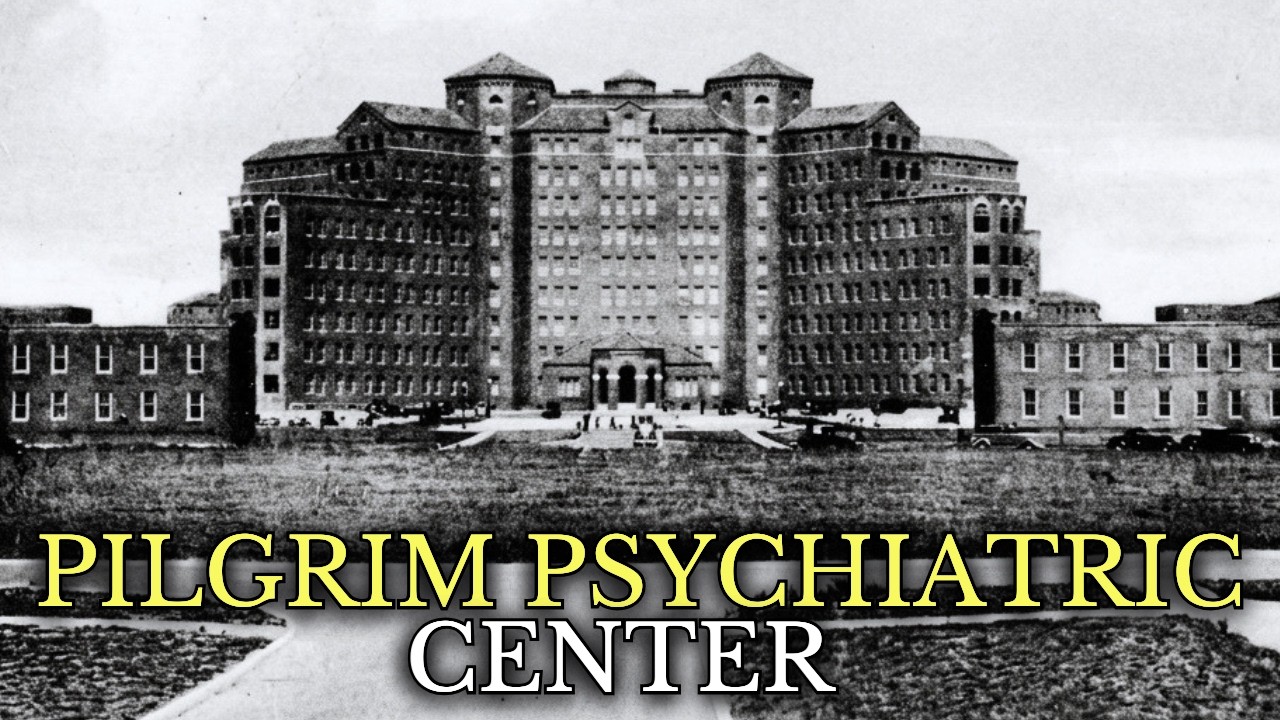
The state needed a minimum of ten thousand new beds in a facility capable of sustaining itself. The answer was Brentwood: one thousand acres of flat, cheap, remote farmland in the middle of Long Island. Construction began in 1929. What was being built was not simply a hospital but a self-contained world that could generate its own electricity, purify its own water, process its own waste, grow its own food, and house the staff who would operate it.
It was named for Dr. Charles W. Pilgrim, a commissioner of mental hygiene who had spent his career advocating for better conditions for the mentally ill. The institution that bore his name would, in time, become a monument to the limits of that aspiration.
On October 1, 1931, one hundred patients were transferred from Central Islip to the newly completed Pilgrim grounds. Nine months later, 2,018 patients were hospitalized there. There was no gradual settling-in period. The need was already fully formed, waiting.
Pilgrim opened its doors and the doors were immediately crowded. The scale of the place was staggering. There was a power plant, a water works, a sewage system, a heating plant, laundry, greenhouses, a working farm, and a dedicated Long Island Rail Road station built to receive patients arriving from the city. Beneath it all ran a network of tunnels connecting the buildings and routing utilities through the ground.
The buildings were organized into quads, groups of four residential structures arranged around a central kitchen, each its own small ecosystem designed for efficiency and supervision. As the population grew, new quads were added, and the campus spread outward until it reached into four separate townships of Suffolk County: Babylon, Huntington, Islip, and Smithtown. Two state roads ran directly through the hospital grounds. This was not a building sitting in a town.
It was a campus large enough to contain parts of several towns, with public infrastructure threading through it as though the institution and the surrounding communities had grown into each other. The society that formed around Pilgrim employed thousands of people: doctors, nurses, attendants, farmers, electricians, cooks, laundry workers, police, and firefighters. Many lived on the grounds in staff housing, raised families, attended the campus church, and collected mail from the campus post office. It was, by any measure, a functioning community.
And that is precisely what made it strange, because the majority of the people living there had not chosen to be there. In the early decades, patients themselves frequently provided the labor that kept the institution functioning. The farm still needed tending. The laundry still needed running.
The kitchen still needed staffing. Whether the work helped anyone is a question the institution never fully answered. The Second World War brought a different presence to the campus. The War Department requisitioned three Pilgrim buildings and renamed them Mason General Hospital, a military psychiatric facility.
Its patients were not the chronic, long-term commitments that filled Pilgrim’s wards. They were soldiers returning from combat theaters in Europe and the Pacific, men carrying what the military called combat fatigue, shell shock, or battle neurosis. At Mason General, treatment was active, intentional, and oriented toward recovery. Across the fence, Pilgrim’s civilian patients continued moving through days structured around management rather than treatment.
The contrast revealed, quietly and without official acknowledgment, a hierarchy of whose suffering the state considered worth addressing with urgency and whose it had learned to simply administer. The filmmaker John Huston documented Mason General during the war in a film called Let There Be Light, completed in 1946. The Army withheld it from public release for thirty-five years, in part because it showed soldiers weeping, men unable to speak, paralyzed by experiences the military preferred to frame as failures of individual fortitude rather than as injuries sustained in service. The war ended, the buildings were returned to Pilgrim, and into that vacancy came a surge of new patients that pushed the institution past every boundary it had been designed to hold.
By 1954, Pilgrim held 13,875 patients, with approximately 4,000 staff members alongside them. The total population on the campus was approaching 18,000 people. In that same year, the entire population of Brentwood, the town in which Pilgrim sat, was smaller than the number of patients alone inside the hospital’s gates. Pilgrim was the largest psychiatric hospital on the face of the earth.
The founding vision of agrarian therapy did not survive contact with these numbers. It had been designed for hundreds, perhaps a few thousand. At 14,000, it had no coherent application. What replaced the philosophy was management.
Attendants responsible for dozens of patients simultaneously could not provide the sustained individual attention any meaningful treatment required. Pilgrim became a holding place for people the broader society had determined it could not accommodate. Among the patients during these peak years was Naomi Ginsberg, born in Russia in 1894, who suffered from schizophrenia throughout most of her adult life and spent extended periods at Pilgrim before dying there in 1956. Her son was the poet Allen Ginsberg, and two years before her death he had written and published Howl, which named Pilgrim State Hospital explicitly.
Naomi’s story is documented only because of who her son became. The others beside her are not documented at all. They are the ward assignments and admission numbers and ledger entries. Not all of them were severely ill by any clinical standard.
Women were committed by husbands for behavior that was inconvenient rather than dangerous. Men were institutionalized for tendencies that ran against the social grain. The institution did not ask many questions about the circumstances of commitment. For most people, the average length of stay was measured not in weeks but in years, in decades.
There is a building that no longer exists at Pilgrim. It was called Building 23, and on its uppermost floor there was an operating room overlooking the whole campus. It was here, according to available historical accounts, that an estimated 1,500 or more patients underwent prefrontal lobotomies during the 1940s and 1950s. The figure is an estimate; Pilgrim did not publicize a running count, and the institutional records that might have produced a precise number have not been made comprehensively available.
The procedure had arrived from Europe with the endorsement of the international medical establishment. The Portuguese neurologist Egas Moniz developed it in the 1930s and was awarded the Nobel Prize in Physiology or Medicine in 1949. This was not fringe medicine. It was recognized science arriving at a moment when American psychiatry had very little else to offer its most unreachable patients.
What the operation actually produced in many cases was a different kind of loss. Patients emerged no longer violent, no longer unreachable, but also no longer fully present. The procedure did not restore anyone to themselves. In the cases where it appeared to succeed, it succeeded by removing the parts of the self that had been causing the problem.
Electroconvulsive therapy ran parallel to the lobotomy program, used more broadly and with less permanence in its effects. The clearest available record of what these treatments cost at Pilgrim is the case of Bula Jones, a patient from 1952 to 1972. During those twenty years, she received both a lobotomy and electroconvulsive therapy. She emerged seriously impaired, not calmed, not stabilized.
The woman who had entered Pilgrim in 1952 was not the woman who was eventually discharged twenty years later. The program wound down not because of an internal reckoning, but because better alternatives eventually arrived to replace it. Building 23 has since been raised, the operating room gone, the ground left empty. Institutions, it turns out, are permitted to forget a great deal.
The thing that ended Pilgrim’s era was not a scandal or a court order or a public uprising. It was a pill. In the mid-1950s, chlorpromazine, the first antipsychotic drug, moved through American psychiatric hospitals. Patients who had been unreachable became reachable.
Symptoms that had seemed permanent became manageable. People who had been committed on the understanding that they would never leave found themselves for the first time in a condition that made leaving thinkable. The transformation was genuine. It did not cure anyone, but it restored to a significant portion of the population a degree of stability that made life outside an institution conceivable.
The man who presided over this transformation at Pilgrim was Henry Brill, who became director in 1958 and held the position until 1974. What the data showed across his sixteen years was an institution in accelerating contraction, measured in discharge. Patients leaving, wards emptying, the population falling year by year. The community infrastructure that was supposed to receive the discharged patients did not exist at the scale required.
Outpatient clinics, supported housing programs, social services, the networks of care that would allow people with serious conditions to live outside an institution without simply being abandoned: these had been discussed and legislated in parts, but the legislation moved faster than the construction of the systems. When the wards emptied, many of the people who left walked into a world that had no adequate place for them. Some found their way. Others cycled through emergency rooms and shelters and brief readmissions and periods of homelessness, trapped in a pattern that would come to define urban life in America for decades.
In December 1971, Edgewood State Hospital closed its doors permanently, the first of the Long Island farm colonies to fall. In 1995, Pilgrim State Hospital was renamed Pilgrim Psychiatric Center, an administrative adjustment that changed nothing structural. In the fall of 1996, Kings Park Psychiatric Center and Central Islip Psychiatric Center were formally closed, their remaining patients transferred to Pilgrim or discharged into community care. Kings Park’s buildings were left largely standing, a sprawling monument to institutional decay.
Central Islip moved toward redevelopment more quickly, portions of its campus eventually becoming a college and a residential development. Pilgrim absorbed the remnants of the Long Island psychiatric system and became its sole survivor. In 2002, a developer purchased 462 acres of the former Pilgrim property for $21 million and announced plans for a $4 billion mixed-use development. In preparation, demolitions began in 2003.
The administration building came down in 2012. The development did not come. The cleared ground sat empty. In building 45, on the still-functioning portion of the campus, there was a museum.
The Long Island Psychiatric Museum had assembled photographs, relics, and institutional artifacts drawn from all three Long Island farm colonies. On November 5, 2020, building 45 flooded. The water destroyed most of the collection. The institution’s own archive was nearly erased by a single night of rain.
Some of the collection has been restored. Much of it has not. Across the road from the still-operating hospital, on the acreage that once comprised the working farm at the heart of the founding philosophy, sits Suffolk County Community College. The fields where patients worked the land in the 1930s and 1940s now hold lecture halls and parking lots.
The water tower still stands. Behind it, the cemetery remains as it has always been, the headstones carrying their numbers, the names they replaced unrecorded in any form that has survived. Pilgrim was not built by people who meant harm. It was built by a state responding to a genuine crisis, run by people who believed in many cases sincerely in the purpose of what they were doing.
The compassion was real. The harm was also real. Both lived in the same buildings, moved through the same tunnels, were sustained by the same infrastructure. The place that was built to help the living became for thousands of people something it was never designed or intended to be.
They were not statistics when they arrived. They were not statistics when they died. The institution made them numbers, and they are still there in a field most people driving past on the state road will never think to look for.