In April 2024, a gold pocket watch sold at auction for over one million pounds. Engraved on its case were three initials: JJA. They had once belonged to the richest man aboard the most famous shipwreck in history. That watch stopped ticking in the early hours of April 15, 1912.
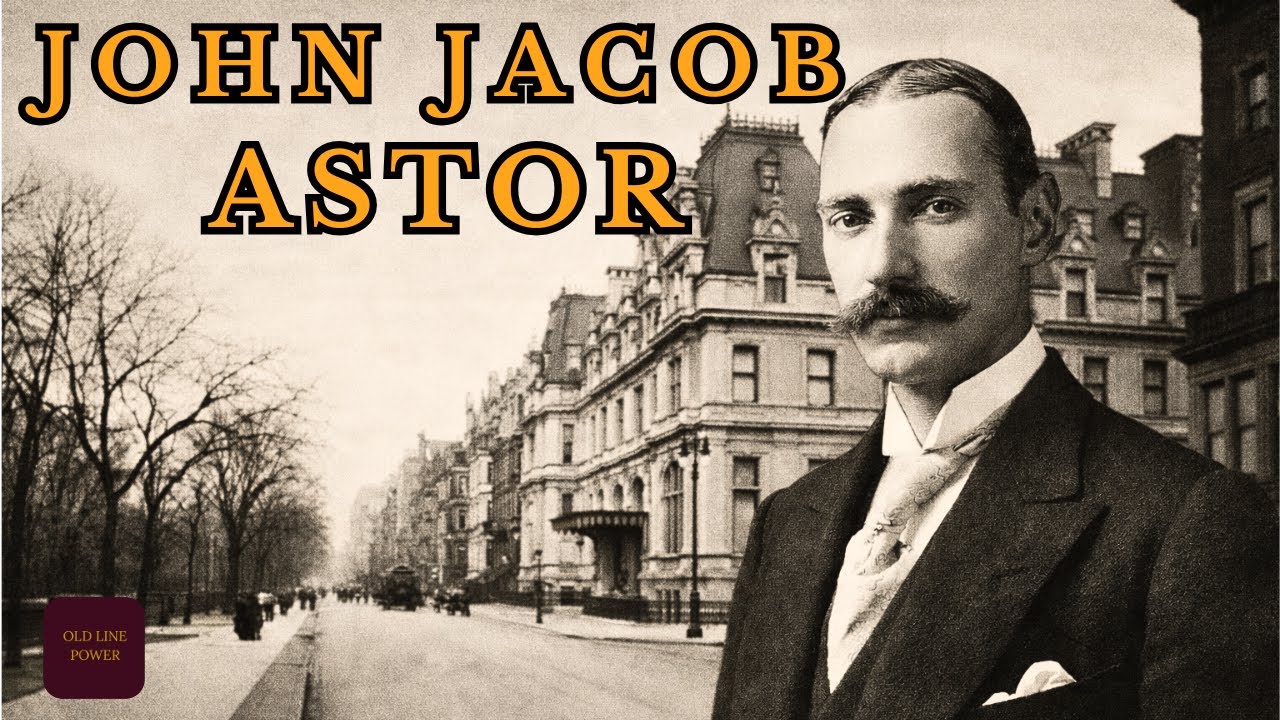
Its owner had just placed his pregnant teenage bride into a lifeboat. He asked if he could join her. The answer was no. John Jacob Astor IV possessed a fortune estimated at $87 million, approaching three billion in today’s currency.
He could have purchased the entire White Star Line and still had money left over. He owned hotels that defined luxury, had invented machines, and had written novels about the future. None of it mattered in the North Atlantic that night. The Astor fortune began with a young German immigrant who crossed the Atlantic carrying little more than ambition.
The first John Jacob Astor was born in 1763 in the small village of Waldorf. His father butchered meat for a living. At sixteen, Johann left for London to join his brother in manufacturing musical instruments. Four years later, he boarded a ship for the newly independent United States.
During the voyage, he met a fur trader who explained how beaver pelts commanded high prices in Europe. By the time he reached New York in 1784, he had decided to abandon the flute business. He started small, working for a fur dealer and learning the trade. Within a few years, he opened his own shop.
His wife Sarah ran the store while he traveled into the wilderness to negotiate directly with trappers. Astor understood that controlling the entire supply chain meant controlling the profits. He established trading posts, hired his own agents, and eventually owned the ships that carried his goods to Europe and China. When beaver populations declined in the 1830s, he sold his fur interests and redirected his capital toward something more permanent: Manhattan real estate.
He purchased his first parcel in 1799 and accumulated more over the following decades. He rarely developed his properties himself, instead leasing the land to others. When leases expired, everything on the land belonged to him. New York grew exactly as he had predicted.
By the 1840s, he was the wealthiest person in the United States, holding roughly one percent of the entire American economy. When he died in 1848, his estate passed to his children, who expanded the real estate empire further. Money alone did not guarantee social acceptance in the rigid hierarchies of nineteenth-century New York. In 1853, William Backhouse Astor Jr.
married Caroline Schermerhorn, a woman from one of New York’s oldest Dutch families. She understood something that mere millionaires did not: money could buy mansions and jewels, but it could not buy social acceptance. That required bloodlines and the right arbiter to decide who belonged. She intended to become that arbiter.
Throughout the 1860s and 70s, Caroline assembled the machinery of social power. Together with her ally Ward McAllister, she developed the concept that would define Gilded Age New York: the Four Hundred. Only four hundred people, they declared, truly constituted New York society. Everyone else, regardless of their millions, remained outside.
Her annual ball became the most anticipated event of the social calendar. The press called her simply the Mrs. Astor. For nearly forty years, nothing significant happened in the city’s upper circles without her approval.
Caroline had five children, but only one son, born in 1864. Named John Jacob Astor IV after his great-grandfather, he would inherit not just the family business but the weight of the Astor name itself. Caroline called him Jack. But Jack Astor was not like his mother.
Where she was controlled and commanding, he was awkward and introspective. Where she mastered social ritual, he preferred tinkering with mechanical devices. The heir to America’s most prominent social dynasty was profoundly uncomfortable in the world his mother had created. The newspapers did not know what to make of him.
Some journalists called him Jack Ass-tor. The cruel pun stuck. He moved through St. Paul’s School and Harvard without distinction, a tall and ungainly young man more interested in how things worked than in who knew whom.
In 1891, at twenty-six, he married Ava Lowle Willing of Philadelphia. She was beautiful, cultured, and socially accomplished. Caroline approved. Three years after his wedding, he published a novel imagining the year 2000, with predictions of airships crossing the Atlantic and moving images on screens.
He followed it with patents: a bicycle brake, a pneumatic device for improving road surfaces, a vibratory disintegrator. When the Spanish-American War broke out in 1898, he financed and equipped an entire volunteer artillery battery, applied for a military commission himself, and served in Cuba. The army brevetted him to the rank of colonel. For the rest of his life, he preferred to be called Colonel Astor.
His marriage was falling apart. Ava mocked her husband openly, calling him stupid in front of guests. By 1896, she had established herself in London. In 1909, she returned to America and filed for divorce on grounds of abandonment.
The decree was granted in March 1910. At forty-five, Jack found himself single for the first time in nearly two decades. That summer, at Bar Harbor, Maine, he met Madeleine Force. She was seventeen.
He was forty-six. She had graduated from Miss Spence’s school that spring, tall and graceful with an easy manner. By winter, they were appearing together at dinners he hosted at the St. Regis.
On August 1, 1911, her father confirmed to reporters that they were engaged. The announcement ignited a firestorm. Episcopal doctrine prohibited remarriage after divorce. Ministers of every denomination declined to perform the ceremony.
The Four Hundred gave Madeleine the cold shoulder. Jack reportedly purchased a thirty-thousand-dollar engagement ring and arranged a settlement worth five million should anything happen to him. Finally, a minister named Reverend Joseph Lambert agreed to officiate. The wedding took place on September 9, 1911 at Beachwood, Jack’s estate in Newport.
Vincent, Jack’s nineteen-year-old son, served as best man. Within hours, the newlyweds were aboard Jack’s steam yacht and heading out to sea. Within two months, Lambert resigned his position, facing criticism from his congregation. The Asteurs spent the winter abroad, sailing to Egypt, where they toured the Nile and visited Cairo.
An American named Margaret Brown, also unwelcome in polite circles, traveled with them. From Egypt, they moved to Paris. Then Madeleine realized she was pregnant. Jack wanted his child born in the United States.
They began making plans to return. A new ship was preparing for her maiden voyage: the Royal Mail Steamer Titanic. Jack booked a parlor suite, the best rooms on the best ship. On April 10, 1912, Colonel and Mrs.
John Jacob Astor IV boarded the Titanic at Cherbourg. Accompanied by Jack’s valet, Madeleine’s maid, a private nurse, and their Airedale terrier Kitty. The ship was everything the newspapers had promised. Jack reportedly pointed out features of her construction to anyone who would listen.
She is unsinkable, he told fellow passengers. A modern shipbuilding miracle. The crossing passed without incident. On the evening of April 14, Captain Smith attended a dinner party hosted by the Widener family.
Jack appeared content that evening. After dinner, the night was calm, unusually calm. The air had turned cold. The ship had received ice warnings throughout the day.
At twenty minutes before midnight, most first-class passengers had retired. Madeleine had gone to bed early. Jack stayed up reading in their sitting room. At 11:40, the lookout spotted something in the darkness directly ahead.
He rang the warning bell three times and telephoned the bridge. Iceberg right ahead. The impact woke some passengers and went unnoticed by others. Jack went to investigate.
He found Captain Smith, who advised him to wake his wife. They might have to take to the boats. Jack returned to their suite and woke Madeleine as gently as he could. They dressed warmly, put on their life belts, and made their way to the boat deck.
Jack remained composed. According to witnesses, he never raised his voice or showed fear. Madeleine noticed a young woman holding an infant and removed her own shawl to wrap around the baby. Eventually, word came that lifeboat 4 was being loaded.
Jack led Madeleine down. Her maid and nurse climbed through first. Then it was her turn. Once she was seated, Jack leaned through the window and asked Second Officer Lightoller if he might join his wife.
She was in a delicate condition, he explained. Lightoller refused. No men until all the women and children were loaded. Jack did not argue.
He did not demand special treatment or invoke his name. He simply nodded, leaned through the window, and kissed Madeleine goodbye. He told her not to worry. He would find another boat.
Then he stepped back and watched as the lifeboat descended toward the dark water. It was almost two in the morning. At twenty minutes past two, the Titanic disappeared. More than 1,500 people went into the water.
Madeleine survived. Jack did not. His body was recovered on April 22. The watch he carried had stopped at 3:20, an hour after the ship went down.
Vincent traveled to Halifax to claim the remains. The funeral was held May 4 at the Church of the Messiah in Rhinebeck. At Trinity Church Cemetery, Jack was laid to rest beside his mother. The will divided an estate valued at approximately $85 million.
Vincent received sixty-nine million. Ava Alice, Jack’s daughter, received a trust fund of ten million. For the unborn child, Jack had included a clause providing three million in trust. Madeleine received one hundred thousand outright, the income from a five-million-dollar trust, and the use of the houses and their furnishings, all with a condition: if she remarried, she would lose everything except the initial hundred thousand.
On August 14, 1912, Madeleine gave birth to a son. She named him John Jacob Astor V. For four years, she lived as the Astor widow. In 1916, she chose William Dick, a man who had known her since childhood, and walked away from the trust income, the houses, the automobiles, approximately three and a half million dollars.
When she died in 1940 at the age of forty-six, she was buried in a plot separate from the Astors. Vincent kept his father’s watch for more than two decades. In 1935, as a christening gift, he gave it to the infant son of his father’s former secretary. The family kept it for six decades.
In April 2024, the watch returned to auction. It sold for nearly one and a half million dollars, becoming the most expensive piece of Titanic memorabilia ever sold. The buyer’s name was not disclosed. The watch disappeared again into private hands, carrying with it a story that had begun in a German village in 1763 and ended in the North Atlantic 149 years later.
The newspapers made Jack Astor a hero. History made him a cautionary tale. Neither version captures the whole truth.
What remains is a gold watch that once kept time for a man who ran out of it.