Wendy Jo Sperber died on November 29, 2005, in her home in Sherman Oaks, California, five days after celebrating Thanksgiving with her family. She was 47 years old. To the general public, she was best known as Linda McFly, Marty’s older sister in Back to the Future, one of the most beloved films in American cinema history. She had spent two seasons on Bosom Buddies opposite a then-unknown Tom Hanks.
She had logged eight years as a recurring guest on Newhart. Over 27 years, she appeared in dozens of films and television programs, building a career that the industry valued without ever truly celebrating. From the outside, her career had produced everything except the spotlight it deserved. From the inside, the disease that was ending her life gave her something she had never received before: the gift of finally seeing how many people loved her.
She founded WeSPARK, a free cancer support center, and ran it while she was dying. She left behind two children, a son named Preston and a daughter named Pearl. Tom Hanks said she possessed an inexhaustible supply of goodness. This is Wendy Jo Sperber’s story.
She was born on September 15, 1958, in Hollywood, California—not the symbolic Hollywood of popular imagination, but the actual neighborhood, the grid of streets in Los Angeles that gave the entertainment industry its name. She grew up with her sisters Elise and Michelle and her brother Richard in a home not professionally connected to the industry but deeply immersed in its cultural geography. From an early age, she knew that acting was what she would do. This was not a retrospective conclusion added to her biography later; it was a constant feature of every account of her early life.
In high school, she enrolled in a drama workshop for teenagers at California State University, Northridge. The program gave young artists the technical foundation, scene work, audition techniques, and practical vocabulary of professional performance. She completed the workshop and moved directly toward professional work. What she was seeking was a specific and demanding position in the entertainment ecosystem: the role of the supporting actor, the performer whose name does not appear on the poster but without whom the poster’s stars cannot do what they need to do.
The supporting actor owns only the scene. Everything the scene requires must be established, performed, and resolved within its own limits, without the narrative scaffolding that the rest of the story provides for the lead. A supporting actor who can do this quickly, completely, and reliably is one of the most valuable professionals in the field. Wendy Jo Sperber was that kind of actor for 27 years.
She possessed what casting directors call camera familiarity, the natural absence of confusion in front of the lens. She had timing in the precise sense that timing works in comedy, that instinct for the exact rhythm that makes a joke land. And she had warmth that made supporting characters feel like real human beings rather than dramatic functions. She was also overweight in an industry that organized its relationship with women entirely around a specific and narrow physical template.
This was not a secondary biographical detail. It was a structural fact about the entirety of her career, about the roles she was offered, how she was classified, and what she was allowed to be on screen. In the late 1970s and 1980s, Hollywood had a very clear vocabulary for women who did not match the traditional physical pattern of first-tier stars. They were the best friend.
They were the sister. They were the comedic embodiment, the warm presence in the scene whose energy and timing made the lead look better while the industry’s promotional resources and top billing went to others. She was aware of this. She said in interviews over the years that she spent a large part of her life struggling with low self-esteem.
The industry she had devoted herself to since high school never gave her the front-line recognition her work warranted. She lived with it. She kept working. Then the disease came, and in one of the strangest gifts that serious illness sometimes offers, it gave her the clarity to see what the industry’s devaluation had hidden: that she was genuinely loved.
In 1978, Robert Zemeckis made his feature directorial debut with I Wanna Hold Your Hand, a period comedy about teenagers in New Jersey trying to get tickets to see the Beatles on The Ed Sullivan Show on February 9, 1964. The film required a cast of young performers capable of delivering broad comedic energy without losing the specific human reality beneath it. Wendy Jo played Rosie Petrofsky, a Beatles obsessive who screams with astonishing commitment and physical dedication, a character who climbs through elevator shafts and navigates the halls of the Ed Sullivan Theater with the intensity of someone for whom the Beatles being on the other side of a wall is the most important thing that has ever happened. She was 20 years old and in her first major film role.
That same year, she appeared in Steven Spielberg’s 1941, playing Maxine Dexheimer and continuing to build her professional reputation. In 1980, she was cast as Amy Cassidy on Bosom Buddies, a sitcom that premiered on ABC on November 27, 1980, starring Tom Hanks and Peter Scolari as two young men working at an advertising agency who discover that the only affordable apartment in New York City is in a women’s hotel, so they disguise themselves as women to secure the lease. Wendy Jo played one of the hotel’s actual residents, providing the warmth, comedy, and human realism that made the show’s absurd premise work. She was a regular for both seasons, from 1980 to 1982, until the show was canceled.
Bosom Buddies was not the most important professional achievement of her career, but it was the most important professional relationship of her life. Tom Hanks was 24 in 1980, on the threshold of a career that would produce two Academy Awards and a cultural standing few artists achieve in any generation. At that point, he had achieved none of it. He was a young actor in his first regular television role, trying to understand how to perform in front of a camera on a network schedule.
She was 22. They were colleagues on a modest sitcom trying to find its audience. The friendship that formed during those two seasons was the kind that does not fade when professional paths diverge. His path diverged spectacularly upward.
Hers continued at the level it had always occupied, substantial and valuable but never fully appreciated. The friendship lasted through all of it, for 25 years, through the WeSPARK years when she needed him to attend her charity events and he answered the call, through every annual WeSPARK gala for seven years. At her funeral in 2005, his eulogy became the definitive public statement about who she was. He said she possessed an inexhaustible supply of goodness.
Not talent, though she had that. Not commitment, though she had that too. Goodness. A quality primarily human rather than professional, the trait those who knew her experienced as most defining her identity.
After Bosom Buddies came Bachelor Party in 1984, the Tom Hanks comedy that was a major commercial success, in which she played Dr. Tina Gaskell. Then in 1985, Robert Zemeckis, who had cast her in his first film seven years earlier, cast her again in what would become one of the most beloved films in American cinema history. Back to the Future premiered on July 3, 1985.
It was the highest-grossing film of 1985, earning $381 million worldwide against a production budget of $19 million. It won the Academy Award for Best Film Editing and was selected for preservation in the National Film Registry by the Library of Congress in 2007. Wendy Jo played Linda McFly, Marty’s older sister, a character whose presence in the film’s opening scenes helps establish what Marty is escaping from and why correcting the timeline matters. She returned to the role for Back to the Future Part III in 1990.
In 1982, the same year Bosom Buddies was canceled, she joined the cast of Newhart, the CBS sitcom that ran from 1982 to 1990 and produced 184 episodes over eight seasons. She played a recurring role as Joanna Loudon’s sister, appearing intermittently throughout the run in a part that was never the narrative center but was always precisely calibrated to what the show needed when she appeared. Over eight seasons and multiple changes to the show’s creative team, she maintained the specific consistency that recurring guest characters require. The audience would have noticed her absence without necessarily being able to say what was missing.
That is the signature of the recurring supporting role performed with excellence. In 1983, she married Richard Velasquez, a producer. The marriage produced two children, a son named Preston and a daughter named Pearl. The family lived in the San Fernando Valley.
The marriage ended in divorce in 1994. She was 35, a single mother of two young children in Los Angeles, continuing to maintain her acting career and navigate the specific professional position she had occupied since 1978. She appeared in Babes in 1990, a Fox sitcom in which she played one of three sisters, her most prominent leading role. It lasted one season.
She had a recurring role on Hearts Afire in 1992 and 1993, played Wendy Richfield on Dinosaurs from 1991 to 1994, and appeared on Murphy Brown, Will and Grace, Married with Children, Who’s the Boss, and a half-dozen other series through the 1990s. She worked steadily. She worked well. She raised two children alone.
And she carried the accumulated burden of a career that never gave her the recognition her work deserved. She said it plainly: she spent many years struggling with low self-esteem. It is a simple sentence with enormous meaning—the sentence of a woman who understood the gap between her professional contribution and the professional recognition she received, who lived inside that gap for nearly two decades. The diagnosis of breast cancer came in 1997.
She was 38, a single mother, with Preston around 11 and Pearl around 8. She did not meet the diagnosis with collapse or isolation, but with the specific and resolute process of a person who decided the available response to an impossible situation was to handle it fully. She did not stop working. She underwent surgery followed by chemotherapy and radiation, and continued accepting acting roles throughout.
In 1998, she appeared in an episode of Murphy Brown in which the show’s central character was herself undergoing chemotherapy for breast cancer. Wendy Jo played the role with the authority and specificity of someone who had actually been through it. The cancer went into remission. She had time, and the first thing she did with it was advocacy work.
In 1998, she worked with the United States Postal Service on a campaign to launch and promote the breast cancer awareness stamp. In 1999, the Los Angeles County Commission for Women named her Woman of the Year, honoring her advocacy work rather than her acting career. It was the first major public honor of her life not tied to professional achievement, and the first indication of how the next phase of her life would be organized. She also said something during that period that remained in the public record for its precision and honesty: I spent many long years suffering from low self-esteem, but cancer gave me the gift of seeing how many people love me.
The disease that was ending her life gave her the clarity to see what the entertainment industry’s systematic devaluation had hidden for 20 years, that she was genuinely and deeply loved by the people who knew her. She decided to build something. WeSPARK Cancer Support Center opened in Sherman Oaks, California, in 2001. The name embodied her philosophy: SPARK stood for Support, Prevention, Acceptance, Recovery, and Knowledge.
The center offered its services free to anyone affected by cancer—not just patients but their families and caregivers. No financial means testing, no insurance requirements, no calculations of the sort that govern access to most health services in the American system. The programs were organized around the full humanity of the people they served. Tai chi classes, jewelry-making workshops, a healing garden, peer-led support groups, holistic therapies alongside traditional medical support, social events and community activities.
The design reflected an understanding that people fighting cancer are still people who want to live their lives and remain whole human beings, not just patients. She said, I didn’t want people to walk into a room and have a therapist ask them how they feel. I wanted peer support. She had needed peer support.
She had not found it in the rooms available to her. So she built the room that provided it. WeSPARK’s annual fundraising gala ran for seven consecutive years and drew the people she had worked alongside throughout her career: Tom Hanks, John Ritter, Bryan Cranston, Eric McCormack, and others. These were not celebrity appearances arranged by publicists.
They were personal responses to personal requests from a person whose relationship with each of them was genuine and lasting. In 2002, the cancer returned and spread through her body. It was no longer confined to her breast. The goal of treatment shifted from cure to management, symptom control, and extending functional life.
She underwent experimental brain radiation. It did not achieve the desired results. She kept working. She had a recurring role on 8 Simple Rules from 2002 to 2005.
She kept organizing the WeSPARK gala. She kept running the center. In September 2005, two months before her death, she hosted the seventh annual Wendy Jo Sperber Golf Classic and the fourth annual Mahjong Tournament in Santa Barbara. She was dying.
The event took place. She was present at it. She raised two children as a single mother while maintaining her acting career, managing her cancer diagnosis, founding a nonprofit, running annual fundraising events, and coping with the brutal realities of metastatic disease. These activities did not happen in sequence.
They happened simultaneously, all running in parallel, all demanding from the same body and the same mind. According to the accounts of people who knew the family, she was determined to give her children as much normalcy and presence as her circumstances allowed. She organized her professional and advocacy work around the rhythms of their lives. Preston was around 19 when she died; Pearl was around 16.
They had celebrated Thanksgiving with her five days earlier in her Sherman Oaks home. They had watched her build WeSPARK. They had watched her organize the golf tournament two months before she died. They had watched her continue, again and again, when continuing seemed impossible.
In her final months, she worked to ensure WeSPARK would continue after her death. She appointed her close friend, former actress Nancy Allen, to succeed her as executive director. The appointment was made deliberately and in advance, not hoping the center would find its way after her death but actually arranging for it, putting a leadership transition plan in place that allowed the work to continue without her. Nancy Allen took over at Wendy Jo’s request and led the center into the 2020s.
WeSPARK remains open in Sherman Oaks. Its services remain free. Her final acting credit was a voice role on American Dad, the Fox animated series created by Seth MacFarlane, in an episode titled Roger and Me that aired in 2006, several months after her death. In recognition of her passing, the producers renamed her character Wendy Jo as a tribute.
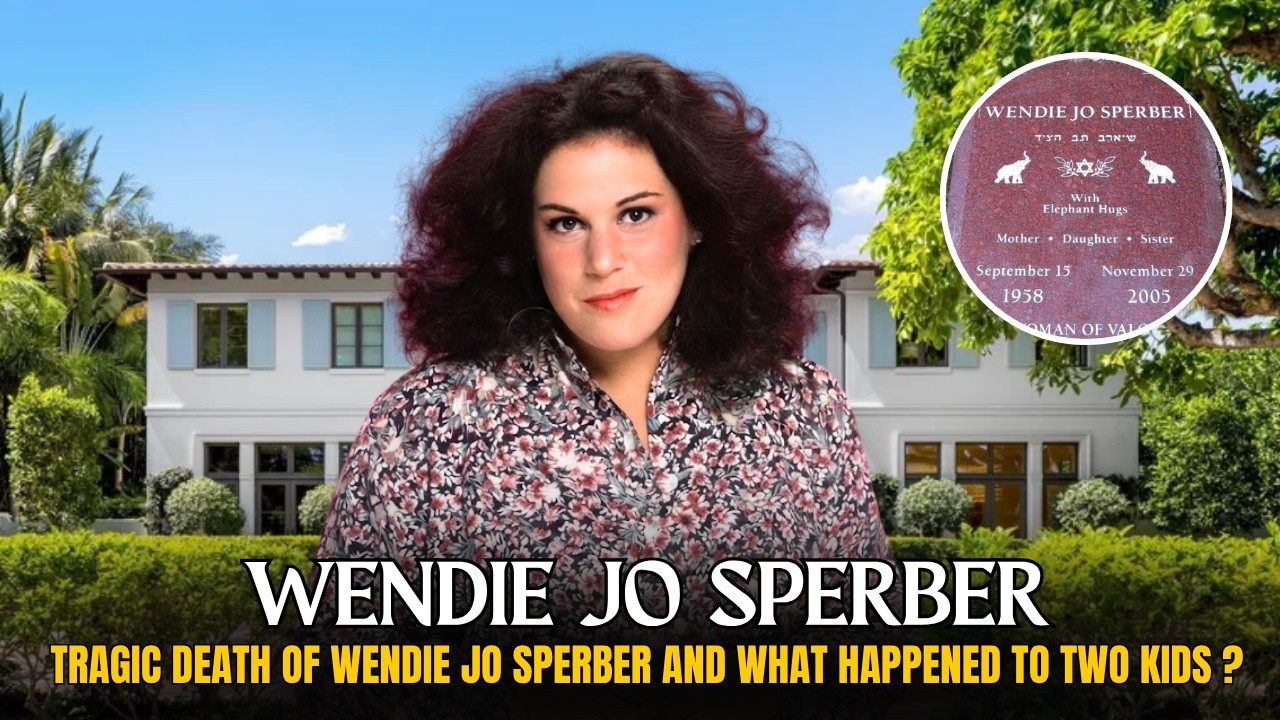
It was a small gesture, and it was the right one. She died on November 29, 2005, in her home in Sherman Oaks. She was 47. She was buried at Mount Sinai Memorial Park in Los Angeles, a few miles from Hollywood, where she had been born 47 years earlier.
She left behind her son Preston, her daughter Pearl, her parents Bert and Charlene, her siblings Elise, Michelle, and Richard. She left behind WeSPARK. She left behind the thousands of cancer patients and family members who had walked through the center’s doors and found something the healthcare system had not provided them. Tom Hanks’s eulogy became the final public characterization of who she was: a memory of inspiration walking on two legs, facing the challenges of her illness with love, joy, delight, and altruism through WeSPARK, with an inexhaustible supply of goodness.
She deserves to be remembered for the specific and genuine talent she brought to every production over 27 years. She deserves to be remembered for what Linda McFly actually does in Back to the Future, the supporting performance that made the opening scenes more effective and the film’s emotional core clearer. She deserves to be remembered for WeSPARK, not as charity work done alongside her real career but as the most significant achievement of her life. She was diagnosed in 1997.
She founded the center in 2001. She died in 2005. Over eight years, while personally living with a terminal diagnosis as a single mother of two, she built a cancer support center from nothing, ran it, funded it through annual celebrity fundraising events, was named a CNN Hero and Woman of the Year, helped launch a national breast cancer awareness stamp, was documented in a feature film, appointed her successor, and ensured the institution’s continuity after her death. The center is still open and still free today.
It is the most enduring thing she created. Who was it who organized the fundraising event in September 2005 and was present at it? Who celebrated Thanksgiving with her children five days before her death? Who made sure, before she left, that the show would go on without her?
It is still going on in Sherman Oaks, California, free to everyone who needs it, still standing on her conviction that people fighting cancer do not need a therapist asking how they feel but a peer who knows the experience. The show went on. She made sure of it herself.
Twenty years after her death, it is still going.