In July 1863, John W. Lokey was an eighteen-year-old private in Company B of the 20th Georgia Infantry. He had grown up on a small farm near Columbus, Georgia, the son of parents who owned a dozen enslaved people, one of ten children in the household. The war had felt like adventure when he enlisted on May 23, 1861, at the age of fifteen.
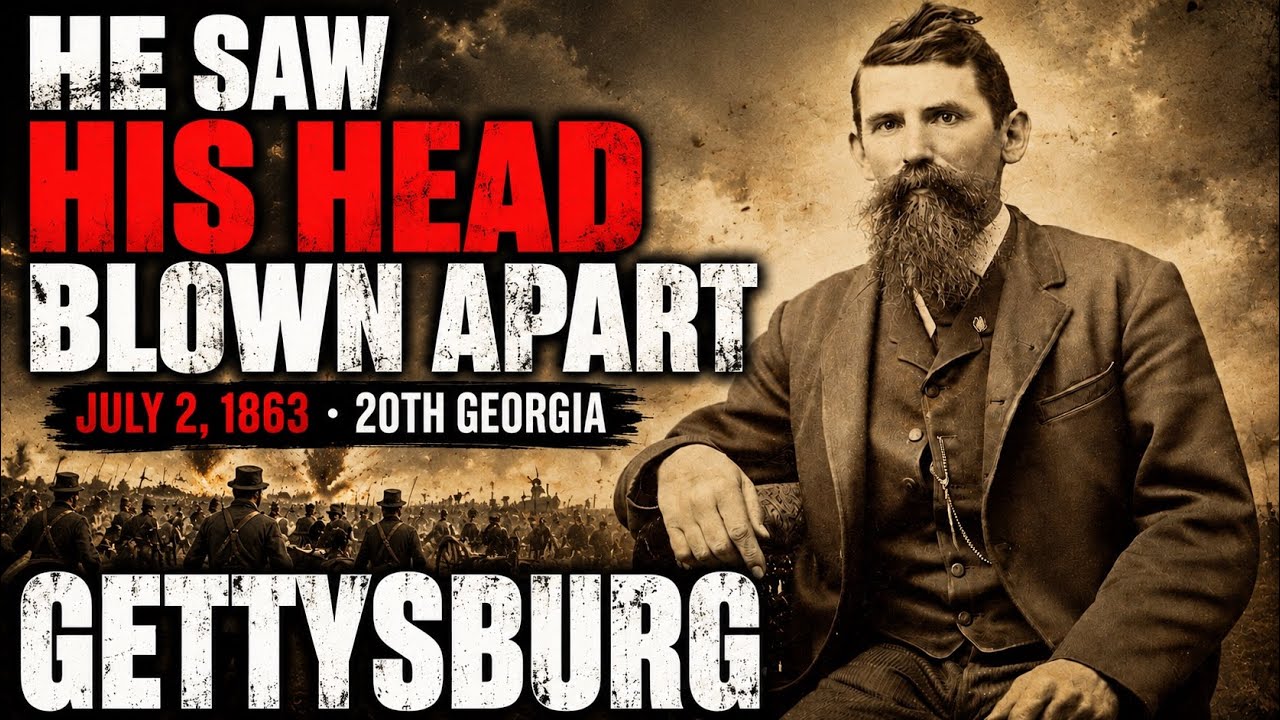
Two years later, he was climbing a rocky, fire-swept hillside in southern Pennsylvania, toward a jumble of boulders that would become known as Devil’s Den. The Confederate assault on Devil’s Den was part of the larger attack on the Union left flank on the afternoon of July 2, 1863. Benning’s brigade, which included the 20th Georgia, advanced across the open valley toward the rocky heights where Union soldiers and artillery were positioned. The ground offered little shelter.
Coming up from the ridge line, Confederate soldiers were slowed by sharpshooters before the sharpshooters were pushed back. The fighting grew heavier as the Georgians neared the Union stronghold at the top of the hill. Lokey advanced in one of the later waves, behind soldiers who had already paid heavily just to gain ground. He made his way uphill toward a stone wall and then past it toward the rocky heights.
At that point, the Georgians managed to overrun the position, capture three Union guns, and force the defending soldiers back. But taking the hill put them in a deadly position. The rocky heights were exposed to artillery from the surrounding area, and once the Confederates occupied them, enemy guns could train on them from several directions. Shells began to fly in, and musket fire came from below.
Men were being hit all around. Among those struck was Colonel Jack Jones. According to the report of General Benning, Jones was killed at the very moment of success, just as the guns were being taken. A shell fragment ricocheted off a rock, struck him, and, as Benning described it, went through his brain.
Lokey saw the aftermath when he reached the top of the hill. He crossed the field and found Jones lying on his back with about half his head shot off. The accounts of the same moment survive from two different perspectives. Benning’s official report described the colonel’s death from the vantage point of an officer watching the fight.
Lokey’s own account, written many years later, described what the private soldier on the ground saw when he passed over the same ground. The two accounts aligned, giving a detailed picture of a single, gruesome event witnessed from opposite angles. As Lokey ascended the hill, he came upon another soldier from Company K, lying on his back, wounded, and yelling at him that he had better not go up the hill or he would get shot. Lokey continued anyway.
He advanced and moved into a position where he began to take aim toward the top of the hill. That was when he was struck. He later said it felt like lightning going up his hip. The wound left him in a bad spot, caught out in the open in the middle of the fighting.
A Union soldier who was also caught in the same dangerous position came over to him and offered help. He told Lokey to wrap his arm around his neck and lean his weight on him so they could get out of the deadly situation. As a sort of black-humored joke, Lokey told the Union soldier that he was now his prisoner. They both apparently shared a laugh at the oddness of the moment, and the Union soldier helped him off the field safely.
Lokey had already seen war before Gettysburg. He had been at Antietam, his first experience fighting in the North. There, he wrote, he had to forage for food from the haversacks of dead soldiers on the ground. By the time he climbed the hill at Devil’s Den, he was an eighteen-year-old who had already witnessed more than most men his age should have.
The wound at Devil’s Den did not end his war. He continued to serve in the Confederate Army for the rest of the conflict, receiving a small promotion at some point, and he was present at Appomattox Court House in April 1865, where he surrendered along with the rest of the army. After the war, Lokey returned to civilian life. He married, raised a large family, and became a farmer again.
The records of his later years are scattered, showing him farming in Texas, returning to Georgia around 1900, and eventually living in Oklahoma, where he died. He also wrote about his experiences, drawing on the letters and details he had kept over the years, and he produced an account of his company’s service in the 20th Georgia, including the many fights it was involved in and the story of what happened at Devil’s Den. The fight for that rocky hillside was over quickly, but it left a lasting mark on the men who survived it. For Lokey, the image of Colonel Jones lying on his back with his head split open by an artillery shell never faded.
He was one of many soldiers who passed by that sight on July 2, 1863, but he was one of the few who carried it with him for the rest of his life. The killing on those fields continued until 1865, when the American Civil War finally ended.