Anne Baxter’s name became inseparable from one of cinema’s most memorable characters: Eve Harrington, the scheming young actress who claws her way to the top in All About Eve. But the woman who played that role so convincingly spent decades wrestling with the very thing Eve craved—lasting stardom—and her life ended in a quiet tragedy that left her fans stunned. Baxter was born on May 7, 1923, in Michigan City, Indiana. Her parents, Catherine and Kenneth, encouraged her early interest in theater and enrolled her in the prestigious Harley School in New York.
It was there that she saw the legendary Helen Hayes perform and decided that acting was her path. From 1934, she spent two years at the Theodora Irvine School of Theater, training under the Russian Broadway actress Maria Ouspenskaya, whose dedication to method acting left a lasting mark on the young performer. Although her mother’s family included the famous architect Frank Lloyd Wright, which may have supplied her with an artistic inheritance, it was Baxter’s own discipline that pointed her toward Hollywood. She made her Broadway debut in 1936 in a play called Seen but Not Heard, but was passed over for future roles because she was too young.
Undeterred, she spent the next two years in summer stock theater, sharpening her craft. By 1938 she returned to Broadway, appearing in productions such as There’s Always a Breeze and Madame Capet. In 1939, at sixteen, she tested for a role in Alfred Hitchcock’s Rebecca but was judged too young for the part. Still, Hollywood came calling.
She signed a seven-year contract with 20th Century Fox. Her film career began in 1940 when she was loaned to MGM for a western called 20 Mule Team. She followed with supporting roles in Fox B-movies like Charley’s Aunt in 1941 and The Pied Piper in 1942. That same year, on loan to RKO, she landed her first major role in Orson Welles’ The Magnificent Ambersons.
The film would be the first of many classics in her career, yet her home studio seemed unsure how to use her. She kept working for other studios, where the parts grew more significant. In 1943, she replaced Ingrid Bergman in Billy Wilder’s Five Graves to Cairo for Paramount. Later that year, she played an ingenue in The North Star for RKO.
Back at Fox, she took on leading roles in Crash Dive and The Fighting Sullivans. She earned a reputation as a reliable, professional actress who delivered quality performances. Her breakthrough came in 1946, when she won the Academy Award for Best Supporting Actress for her performance in The Razor’s Edge. Success followed with roles in dramas like Smoky and the comedy Angel on My Shoulder in 1946, and the western Yellow Sky alongside Gregory Peck and Richard Widmark in 1948.
Through it all, those close to her described a woman who remained humble, dedicated, and eager to improve. Then came 1950. Joseph L. Mankiewicz cast her as Eve Harrington in All About Eve.
The film was a triumph, hailed by audiences and critics alike, and it remains one of the greatest films ever made. The performances of Baxter and Bette Davis were the engine of its success. Both actresses received Best Actress nominations at that year’s Academy Awards. Their votes split, however, and the award went to Judy Holliday for Born Yesterday.
Interestingly, 20th Century Fox had wanted Baxter nominated in the supporting category, but she declined, leaving the studio shortly after the ceremony. Her fame from All About Eve did not guarantee a smooth road ahead. As a freelance actress, she received offers, but the roles she took in the early 1950s were disappointing. Movies like Follow the Sun, Full House, and My Wife’s Best Friend failed to meet expectations.
In 1953, she replaced Anna Bjork at the last minute in Alfred Hitchcock’s I Confess. Her acting earned critical praise, though the film itself is not counted among Hitchcock’s best. Her performance in the noir The Blue Gardenia that same year was well received. Yet the films that followed—Carnival Story, One Desire, and The Spoilers—were box office failures.
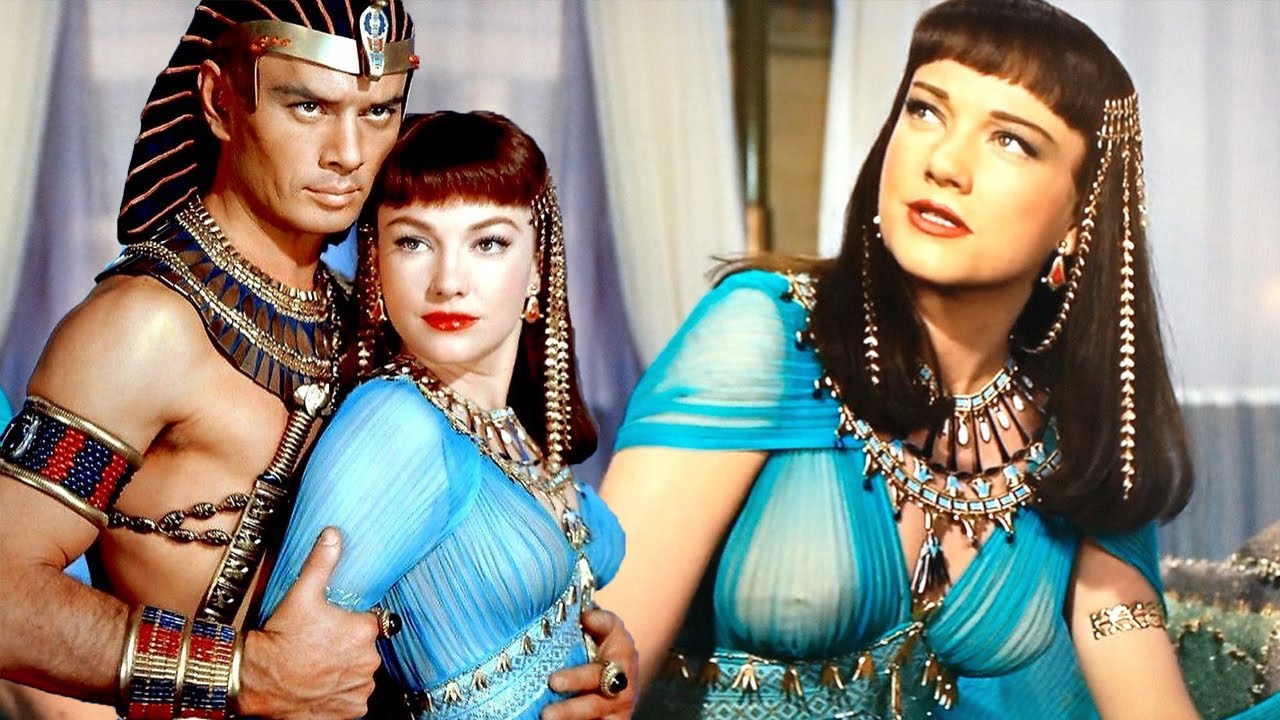
Her career saw a resurgence in 1956, when she played the sensual Egyptian princess Nefertiti in Cecil B. DeMille’s The Ten Commandments, opposite Charlton Heston and Yul Brynner. She received warm praise for her performance, but it did not open the door to better roles. For the rest of the decade, she appeared in average films: Chase a Crooked Shadow in 1958, Season of Passion in 1959, and the underwhelming Anthony Mann western Cimarron in 1960.
While critics continued to admire her acting, Baxter struggled to secure leading roles in significant pictures. Her career never regained its former heights. She found firmer footing on television. Beginning in the late 1950s, she became a regular fixture on the small screen, appearing on 77 Sunset Strip in 1958 and Wagon Train in 1959.
She acted in several episodes of General Electric Theater, then reunited with Alfred Hitchcock in 1963 for The Alfred Hitchcock Hour. She even made appearances on the Batman series in the mid-1960s. The stage continued to draw her as well. In the 1970s, she returned to Broadway for Applause, the musical adaptation of All About Eve.
She took over the role of Margo Channing from Lauren Bacall. In 1974, she co-starred with Hume Cronyn and Jessica Tandy in Noël Coward’s Two Keys on Broadway. Her television career continued into the 1980s with well-received appearances on Marcus Welby, M. D.
, East of Eden, and The Love Boat. She closed out her career by taking over the role of Bette Davis’s character in the television series Hotel in 1983. Baxter’s personal life was marked by three marriages. Her first husband was actor John Hodiak, whom she met while filming Sunday Dinner for a Soldier in 1944.
They married in 1946, had a daughter, and divorced in 1953. Her second marriage was to Australian rancher Rudolph Galt, whom she met while filming Summer of the Seventeenth Doll in Sydney in 1959. She made the bold decision to leave America and live with him at his cattle station north of Sydney. The couple had two daughters and moved together to New Mexico, Hawaii, and eventually Los Angeles.
The marriage ended in divorce in 1969, with Baxter citing extreme cruelty. In 1977, she married stockbroker David Klee. The marriage was short-lived; Klee died suddenly nine months later. She never remarried.
She continued to live on the property she and Klee had purchased in eastern Connecticut in 1976, and published her autobiography, Intermission: A True Story, which detailed her life and career in Hollywood. Her final performance came in 1984 in The Masks of Death, a Sherlock Holmes mystery television film. Anne Baxter died on December 12, 1985, in Guilford, New York, at the age of sixty-two. She had suffered a stroke eight days earlier on Madison Avenue in New York and never regained consciousness.
Her loved ones had her body cremated, and her ashes were interred in the family cemetery on the Frank Lloyd Wright estate in Wisconsin.