At eighteen years old, Consuelo Vanderbilt stood at the altar in November 1895, weeping beneath her veil. She was not weeping for joy. The marriage was not a love match but an arrangement engineered by her mother, Alva Vanderbilt, who had decided that her daughter would marry into the British aristocracy. The groom, Charles Spencer-Churchill, the ninth Duke of Marlborough, needed money to save his ancestral home, Blenheim Palace.
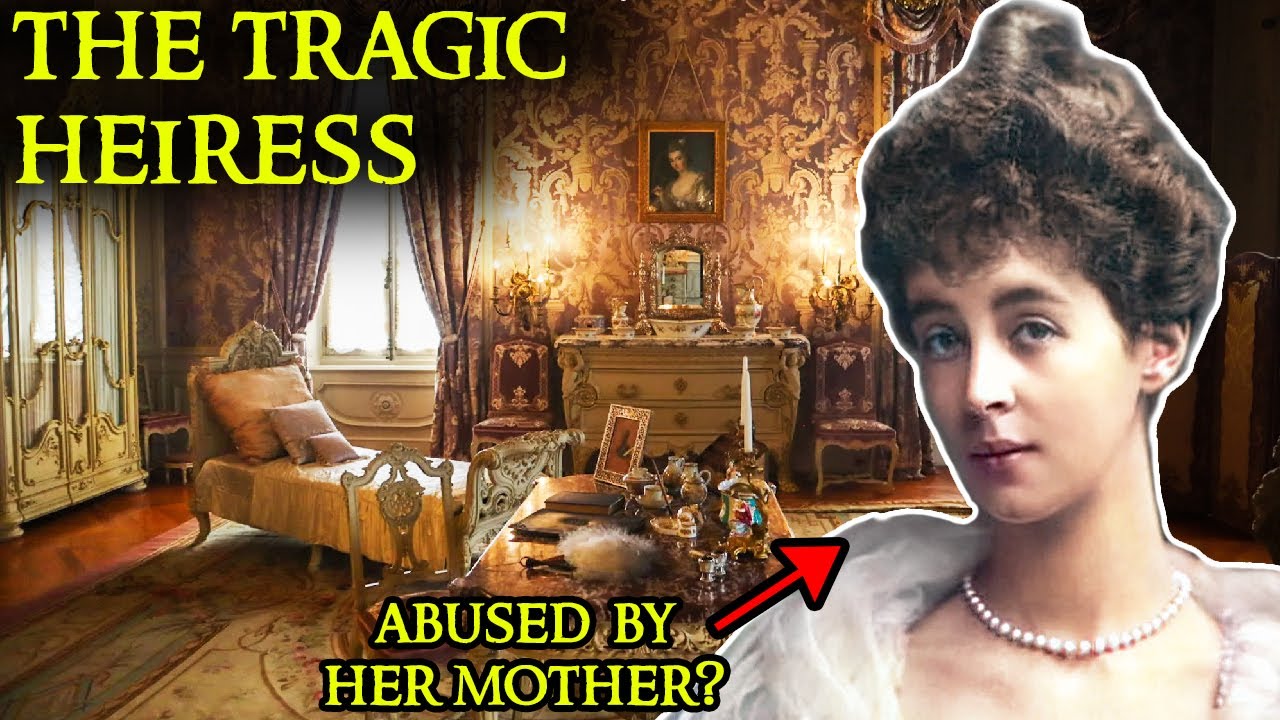
The Vanderbilts, among the wealthiest families in America, wanted the prestige of a noble title. Consuelo, young, isolated, and utterly dominated by her mother, had no real say in the matter. Consuelo had been born into extraordinary wealth on March 2, 1877, in New York City. Her father, William Kissam Vanderbilt, was a railway executive from one of the most powerful families of the Gilded Age.
Her mother, Alva, was a formidable woman who would later become a leader in the American suffrage movement. Consuelo was named after her godmother, Consuelo Yznaga, a close friend of her mother who was half Cuban. But despite the immense privilege of her birth, her childhood was not a happy one. Alva was a domineering presence, dictating everything from her daughter’s clothing to her posture.
Consuelo was required to wear a steel rod along her back to ensure the straightest possible carriage, and physical punishment was used freely when she disobeyed. She was homeschooled by a series of tutors, isolated from other children and from the outside world. The Vanderbilts owed their fortune to Consuelo’s great-grandfather, Cornelius Vanderbilt, who had built his first fortune in shipping and transport along the Hudson River in the 1830s and 1840s before diversifying into railroads. By the 1870s, he was believed to be the richest man in the world.
When he died in 1877, his fortune passed to his son, William Henry Vanderbilt, who died just a few years later in 1885. The inheritance was then divided among his heirs, with Consuelo’s father and her uncle Cornelius Vanderbilt II receiving the largest portions, sums worth nearly two billion dollars in today’s money. Consuelo grew up knowing that her wealth made her a prize. Even as a teenager, speculation swirled about who she might marry.
She was not only rich but strikingly beautiful. J. M. Barrie, the author of Peter Pan, once joked that he would stand all day in the street just to see her get into her carriage.
Her mother was intensely aware of her daughter’s value and was determined to secure a high-status match. Alva had divorced William Vanderbilt in March 1895 and, as a result, had been exiled from the upper echelons of New York society. Desperate to restore her social standing, she saw her daughter’s marriage as the solution. The chosen candidate was Charles Spencer-Churchill, the ninth Duke of Marlborough, a descendant of one of Britain’s most distinguished noble families.
His ancestor, the first Duke, had led the British war effort during the War of the Spanish Succession in the early eighteenth century and had built Blenheim Palace as one of Britain’s grandest estates. By the late nineteenth century, however, the Spencer-Churchills had fallen into economic distress. The match was one of convenience: Marlborough would gain the funds to save his ancestral home, and the Vanderbilts would buy their way into the British aristocracy. Consuelo had no interest in marrying him.
She was secretly engaged to Winthrop Rutherfurd, a socialite significantly older than herself. But she was completely intimidated by her mother and beholden to her wishes. What finally tipped her into agreeing was her mother’s emotional blackmail: Alva claimed that her health was deteriorating dramatically because of Consuelo’s refusal. As part of the arrangement, Marlborough received two and a half million dollars’ worth of Vanderbilt railway stock, a sum equivalent to nearly one hundred million dollars today.
The marriage was disastrous from the start. Both Consuelo and Charles had been forced to abandon relationships to enter it, and they did not take to one another. Alva would later freely admit that she had forced her daughter into the marriage. Both quickly became involved with other people: Consuelo entered a relationship with Reginald Fellows, a cousin of Marlborough, while the Duke took an American socialite, Gladys Marie Deacon, as his mistress.
By 1906, the couple had effectively separated, though they remained officially married for years. Despite the unhappiness of the union, it produced two sons: John Albert, born on September 18, 1897, who would become the tenth Duke of Marlborough in 1934, and Ivor, born just over a year later on October 14, 1898, who served with distinction in France during the First World War and was awarded the French Legion of Honor. Despite the misery of her marriage, Consuelo was adored by the servants and staff at Blenheim Palace and across the Oxfordshire region. She was seen as a likable and compassionate representative of the Spencer-Churchill lineage, giving generously to local maternity hospitals and charities for the poor.
When the First World War erupted in 1914, she quickly involved herself in philanthropic work. On August 5, 1914, just days after the outbreak of hostilities, she joined Lou Hoover, the wife of the future U. S. president Herbert Hoover, and Lady Randolph Churchill in establishing the American Women’s War Relief Fund.
This organization of American women worked to support the British war effort, raising money from the United States. It financed knitting factories and workshops and eventually equipped a military hospital. By the end of the war, what was known as the American Women’s War Hospital had treated more than 7,000 wounded soldiers. In 1921, Consuelo and Charles finally formalized their divorce.
By then, she had long been involved with Jacques Balsan, a pioneer of aviation who had begun his career with balloons around the turn of the century before moving on to building airplanes after working with the Wright brothers, who had achieved the first powered flight at Kitty Hawk in 1903. No sooner was the divorce finalized than Consuelo married Balsan on July 4, 1921. She was forty-four; he was fifty-two. Her second marriage was a very happy one.
In her autobiography, written in the early 1950s, she referred to her time with Balsan as golden. They lived primarily in Paris during the 1920s and 1930s and only barely escaped the French capital in the summer of 1940 as the Nazis advanced. They fled to Spain, then Portugal, before heading to the United States. They settled in Florida, living out the remainder of their lives in America.
Much of their later time was spent in Manalapan, a small community in Palm Beach County, where they constructed a large mansion named Casa Alva after Consuelo’s mother. Built on a 150-acre estate, the house spanned 26,000 square feet and was later valued at $568,000 when sold in the 1950s, a sum equivalent to millions today. In 1946, the house gained its own place in history when Winston Churchill, the former British prime minister and Consuelo’s cousin-in-law from her first marriage, stayed there on his way to deliver a speech at Westminster College in Missouri. He is believed to have practiced and polished his famous Iron Curtain speech at Consuelo’s home, the address in which he described Soviet rule in Eastern and Central Europe as an iron curtain descending across the middle of Europe.
Consuelo and Jack spent their later years between Florida, New York, and Long Island. In 1953, her autobiography, ghostwritten by the American art critic Stuart Preston, appeared under the title The Glitter and the Gold, offering an entertaining if selective account of her life and the world of a Gilded Age aristocrat. Jack died on November 4, 1956, in New York City, and his body was returned to France for burial in Paris. Sadly, Consuelo’s youngest son, Ivor, had died just weeks earlier in September 1956, before reaching his sixtieth year.
After their passing, Consuelo sold Casa Alva and largely resided in New York and Long Island. Consuelo Vanderbilt died at her home in Southampton on Long Island on December 6, 1964, at the age of eighty-seven. Her body was returned to England and buried at St. Martin’s Church at Bladon in Oxfordshire, not far from Blenheim Palace, next to her deceased son Ivor.
Much of her fortune descended to her surviving son, the tenth Duke of Marlborough.