On the night of March 18, 1882, Morgan Earp was leaning over a billiard table in the back of Campbell and Hatch’s parlor in Tombstone when two shots came through the glass of the alley door behind him. The first bullet tore through his body, shattering his spinal column. He was dead within the hour, thirty years old. The second shot passed across the room and buried itself in the wall above the head of his brother Wyatt, who was sitting nearby watching him play.
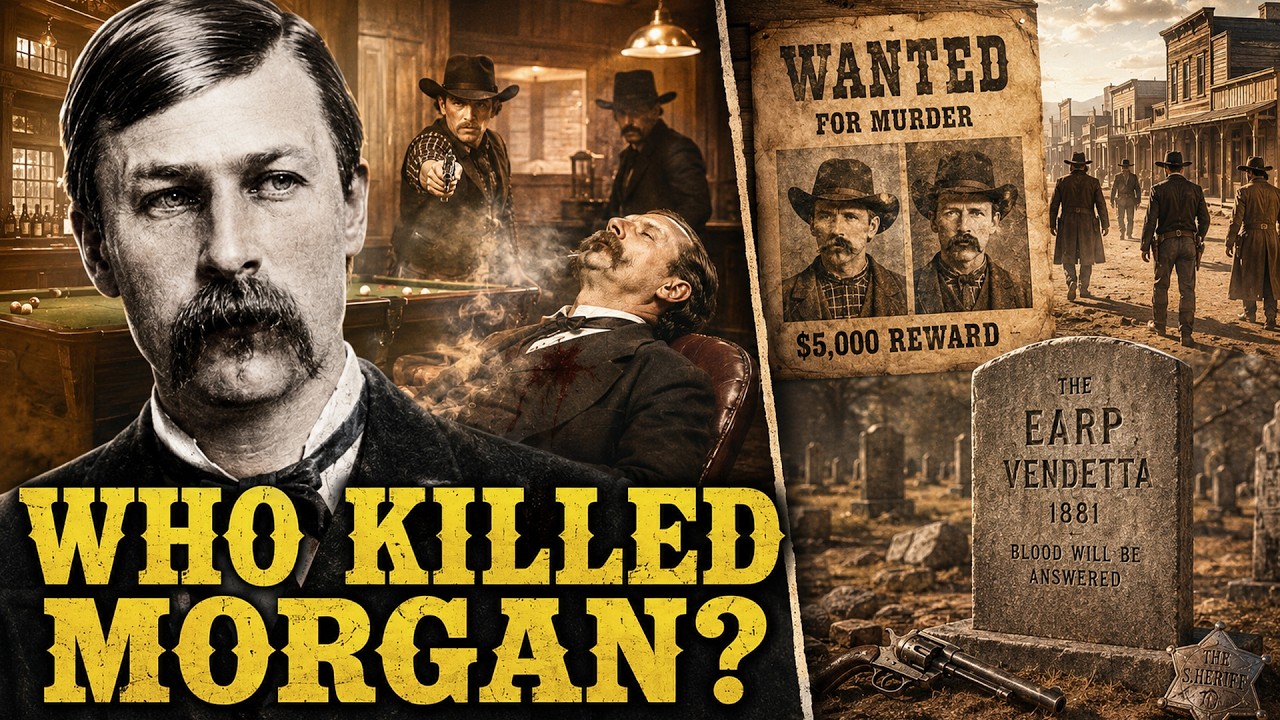
Five months earlier, the town had been the scene of the most famous gunfight in Western history. At the OK Corral, Virgil, Morgan, and Wyatt Earp, along with Doc Holliday, had faced down a group of Cowboys in a thirty-second exchange that left Billy Clanton and both McLaury brothers dead. Morgan had been wounded in the shoulders, Virgil in the leg. A lengthy hearing had cleared the Earps of criminal charges, but the friends and allies of the dead men never accepted that outcome.
They answered with the dark. On December 28, 1881, Virgil Earp was crossing Allen Street when shotgun blasts ripped out of an unfinished building, tearing buckshot into his back and left arm. He survived, but the arm was ruined for the rest of his life. Witnesses had suspects; the men had alibis.
No one was charged. Ten weeks later, the same tactic was used again. On that final Saturday night, Morgan and Wyatt had gone to a comedy called Stolen Kisses at Schieffelin Hall. Earlier, a man named Briggs Goodrick had pulled Wyatt aside and warned him that strangers were in town hunting him, and had passed along a message that Johnny Ringo wanted nothing to do with whatever was coming.
Wyatt heard all of it and went out anyway. After the show, Morgan wanted to shoot pool, so the brothers walked over to Campbell and Hatch’s billiard parlor. Morgan started a game with Bob Hatch, one of the owners, while Wyatt sat down to watch. It was close to eleven o’clock.
Morgan stood with his back to the rear door, the one opening onto a dark alley. The door had four panes of glass across the top; the two lower panes were painted over, the upper ones were not. In Bob Hatch’s own words at the inquest, two shots came almost at once. The first bullet hit Morgan just to the left of his spine, passed through his body, and came out the other side.
He went down and could not get up. When they tried to lift him, he told them to stop. According to the Tombstone Epitaph, he said, “Don’t. I can’t stand it.
This is the last game of pool I’ll ever play. ” They carried him ten feet into the card room and laid him on a couch. Three doctors came, including George Goodfellow, the frontier surgeon who probably knew more about gunshot wounds than any man in the territory. There was nothing to do.
The spine was gone. Morgan died less than an hour after the shot, a few weeks short of his thirty-first birthday. They laid him out in a borrowed blue suit that belonged to Doc Holliday. The next morning, the county coroner called an inquest.
The single most damaging witness was a woman named Marietta Spence, wife of a cowboy named Pete Spence. She told the jury that on the night of the murder, her husband came home late, shaken and white in the face, and that he and other men had talked about killing Morgan Earp. She said Pete threatened to kill her if she ever repeated a word of it. Another witness testified that Frank Stillwell had been dropping hints that trouble was coming.
The jury named their suspects: Pete Spence, Frank Stillwell, a German teamster named Frederick Bode, and Florentino Cruz, a man everyone in Tombstone called Indian Charlie. Every man on the list was a member or ally of the Cowboy faction the Earps had been at war with for half a year. The strongest evidence in the entire case came from inside a suspect’s own household. In a coroner’s inquest, that testimony was gold.
In an actual criminal trial, it was about to be worth nothing at all, for a reason that had nothing to do with whether it was true. Two days after Morgan died, the Earps put his body and their wounded brother Virgil on a train. Virgil and his wife Allie were being sent west to California, out of the line of fire. Wyatt and a handful of men rode along to Tucson to see them safely onto the connection.
At the depot, Wyatt got word that Frank Stillwell was there in the railyard in the dark, watching the passenger cars. Wyatt believed Stillwell had come to finish the job on Virgil. He had borrowed a heavy ten-gauge shotgun, went into the railyard after Stillwell, and in the morning railroad men found Frank Stillwell’s body lying beside the tracks, torn apart. The wounds came from more than one kind of weapon, meaning several men emptied their guns into him that night.
This was no duel. It was a killing by a group. With that single act, everything flipped. Up to that moment, Wyatt was a deputy United States marshal, a lawman, a victim’s brother.
The instant Stillwell stopped breathing, Wyatt was a wanted man. Pima County issued murder warrants for Wyatt, for Warren Earp, for Doc Holliday, and for two others who had been in the yard. The hunter was now also the hunted. Pete Spence responded the way almost nobody expects from a guilty man.
He did not run for Mexico. He walked into the Tombstone jail and surrendered himself into the custody of Sheriff John Behan. That was a strange choice because Behan was no neutral lawman. He was the Earp’s bitter rival, politically tied to the Cowboy faction, and when the Earps rode out on their vendetta, Behan organized the posse to chase them.
Surrendering to Behan meant handing himself to the one lawman in the territory guaranteed to protect him from Wyatt Earp. Whether Spence was innocent of the actual shooting or guilty as sin, a cell under a friendly sheriff was the safest place on Earth while Wyatt was killing everyone he suspected. In early April, Pete Spence went to trial for Morgan’s murder. The prosecution’s whole case leaned on the one devastating witness, his wife Marietta.
The defense objected that a wife cannot testify against her husband, and that most of what she knew was hearsay anyway, things she had been told rather than seen. The judge agreed. Her testimony was thrown out, and the second it was gone, the prosecution had almost nothing left. The charges against Pete Spence and against Frederick Bode were dismissed.
They walked out free men. The best lead in the case died on a legal technicality. Two of the men the coroner’s jury named walked free, cleared not by innocence, but by a rule of evidence. Meanwhile, Wyatt’s posse rode to Pete Spence’s wood camp in the Dragoon Mountains, hunting Spence.
Spence was safe in Behan’s jail. What they found instead was Florentino Cruz. There is a romantic version of what happened next, printed later by Wyatt’s admiring biographer Stuart Lake, in which Wyatt gives Cruz a fair, face-to-face gunfight. The evidence says otherwise.
The coroner who examined Cruz found him shot in the arm, the thigh, and badly through the groin and hip. Witnesses described posse members firing from horseback at a man trying to run. Florentino Cruz was gunned down as he fled. Whatever else it was, it was not a fair fight.
According to Wyatt, told years later through his biographer, Cruz confessed before he died. Wyatt said Cruz admitted to being the lookout and named the shooters as Frank Stillwell, Hank Swilling, Curly Bill Brocius, and Johnny Ringo. That confession, the closest thing this case has to a full solution, is completely unverifiable. It comes from the one man with the strongest possible reason to shape it, Wyatt Earp, right before and as the justification for killing the man he claimed said it.
A confession that conveniently names your enemies, reported only by you after you have already executed the confessor, is not something a careful person takes at face value. Two days after the killing, on March 24, came the most famous killing of the whole ride, and the one we can least confirm. At a place called Iron Springs, the posse rode into Curly Bill Brocius and a group of Cowboys. Wyatt said that in the fight that followed, badly outnumbered, he stood his ground and killed Curly Bill with both barrels of his shotgun.
But no body was ever produced. No grave was ever identified. The pro-Earp paper printed the killing as established fact. The pro-Cowboy paper flatly said Curly Bill was alive and nowhere near Iron Springs that day, and offered a reward to anyone who could produce his body.
The pro-Earp paper countered with a reward to produce him alive. Nobody ever collected either one. Most historians lean toward the killing being real, and their strongest argument is simple: Curly Bill was never seen again. But the honest answer is that we are taking Wyatt Earp’s word for the single most cinematic kill of his life, and Wyatt, as even his defenders admit, was a man who liked his own legend.
Whatever the exact truth, the effect was total. In four days, Wyatt Earp killed at least two, and probably three, of the men connected to his brother’s murder. He was certain he had them. He was also, in those same four days, destroying forever any chance that a court or history could ever prove he was right.
A trial is not just punishment. It is a test, the only machine anyone has ever built for turning suspicion into proof. Wyatt Earp took every suspect in his brother’s murder and made sure not one of them ever went through that machine. Think about what got buried with them.
Frank Stillwell died without anyone ever proving he was at that alley door. Florentino Cruz died having supposedly confessed, but the only witness to that confession was the man who killed him. Curly Bill, if he died at all, died without a courtroom ever hearing why Wyatt was so sure. The two men who actually did face a judge, Pete Spence and Frederick Bode, walked.
Of all the men named in the murder of Morgan Earp, the courts convicted exactly zero. And the man who was certain of their guilt answered that with a shotgun. Could Wyatt have been wrong about even one of them? It is possible.
He was working from motive, from faction, from a coroner’s jury, and from a confession he alone reported. If even one of those men was guilty only of being a cowboy, of standing on the enemy’s side of the line, then Wyatt killed a man for the crime of association. We cannot rule that out. We cannot rule it in either.
The proof went into the ground with them. The person who actually fired through that glass has no name we can trust. The trigger man, whoever he was, may well have died old in his own bed, while other men took the bullets that were meant, in some rough way, for him. There is a larger question underneath all of this, one that a handful of gunmen and a grieving brother cannot fully answer.
The more you look at who wanted the Earps gone, the more it looks like the men in that alley were the smallest part of the story. It was not really about five men in a gunfight. It was the surface of a much larger war. On one side were the Earps and their allies, tied to the town’s business interests, the mine owners, the Republican establishment.
On the other were the Cowboys, tied to the rural ranchers and rustlers, the Democratic county power structure, and a network of friendly officials, including in this reading Sheriff John Behan himself. In that version, the murder of Morgan Earp was not simply personal revenge. It was one faction in an economic and political war removing a soldier of the other side with protection that reached up into the very county government that was supposed to enforce the law. There are real facts that feed that reading.
Behan was politically aligned against the Earps. His undersheriff ran the newspaper that defended the Cowboys. The courts, staffed and influenced by that same network, never convicted anyone for the ambush on Virgil or the murder of Morgan. A named suspect could surrender to the sheriff and be kept safe.
But there is no document, no confession, no piece of hard evidence that proves Sheriff Behan or any county official ordered or arranged Morgan Earp’s murder. Alignment is not the same as conspiracy. A corrupt, factional, broken system that consistently failed to punish the killing of Earps is something the record clearly supports. A specific chain of command running from an alley door up to the sheriff’s office is something the record does not.
You do not need a grand conspiracy for a result like that. You just need a sheriff who looks the other way and a rule of evidence that swallows your only witness. That was Cochise County in 1882. What the record genuinely supports is this.
Morgan Earp was assassinated on March 18, 1882, shot in the back through a glass door while he played pool. The killing was almost certainly retaliation by the Cowboy faction for the OK Corral and the hearing that followed. A coroner’s jury named specific men, and their finding fit the motive perfectly. That much is solid ground.
What the record does not give us is the shooter. No reliable witness ever named the man whose finger was on the trigger. The strongest evidence anyone had, Marietta Spence’s account, was thrown out of court before a jury could weigh it. Of every man suspected, not one was ever convicted.
Whether Wyatt Earp killed the right men, all of them, only the guilty ones, is something no court and no historian can promise, because Wyatt made certain the question could never be tested. The 1993 film Tombstone gave most people the version they carry. On screen, Wyatt’s vengeance is triumphant and certain. In the record, it is effective and deeply unresolved.
The film even lets Doc Holliday kill Johnny Ringo in a duel, when in truth Ringo turned up dead months later under disputed circumstances, while Wyatt and Doc were far away in Colorado. The movie is not exactly lying. It is choosing the legend, because the legend feels better than the truth. So who killed Morgan Earp?
A group of men from the Cowboy faction, acting in revenge, one of whom fired the shot and whose name is lost to us forever. Did Wyatt kill the right men? He killed men who almost certainly included some of the guilty, without ever proving any of it. And he emptied the courtroom before the truth could be forced into it.
This was never really an unsolved murder in the way a whodunit is unsolved. The town knew the faction. The jury knew the names. What was lost was not the answer.
What was lost was the proof, and it was lost on purpose by the one man who wanted the truth most, because in the end he trusted his own certainty more than any courtroom, and he buried the case with the bodies. Justice or vengeance? Morgan Earp got one of them.
He never got the other.