In September 2023, 32-year-old Marcus Reed, a land surveyor from Missoula, Montana, set out on a week-long solo bow hunting trip for elk in the Bitterroot National Forest. He was experienced in backcountry travel, had properly registered his hunting plans with the local ranger station, and told both his employer and his brother he would check in on September 30th. On the morning of September 23rd, surveillance footage captured him fueling his truck at a gas station in Hamilton. A cashier remembered him seeming in good spirits.
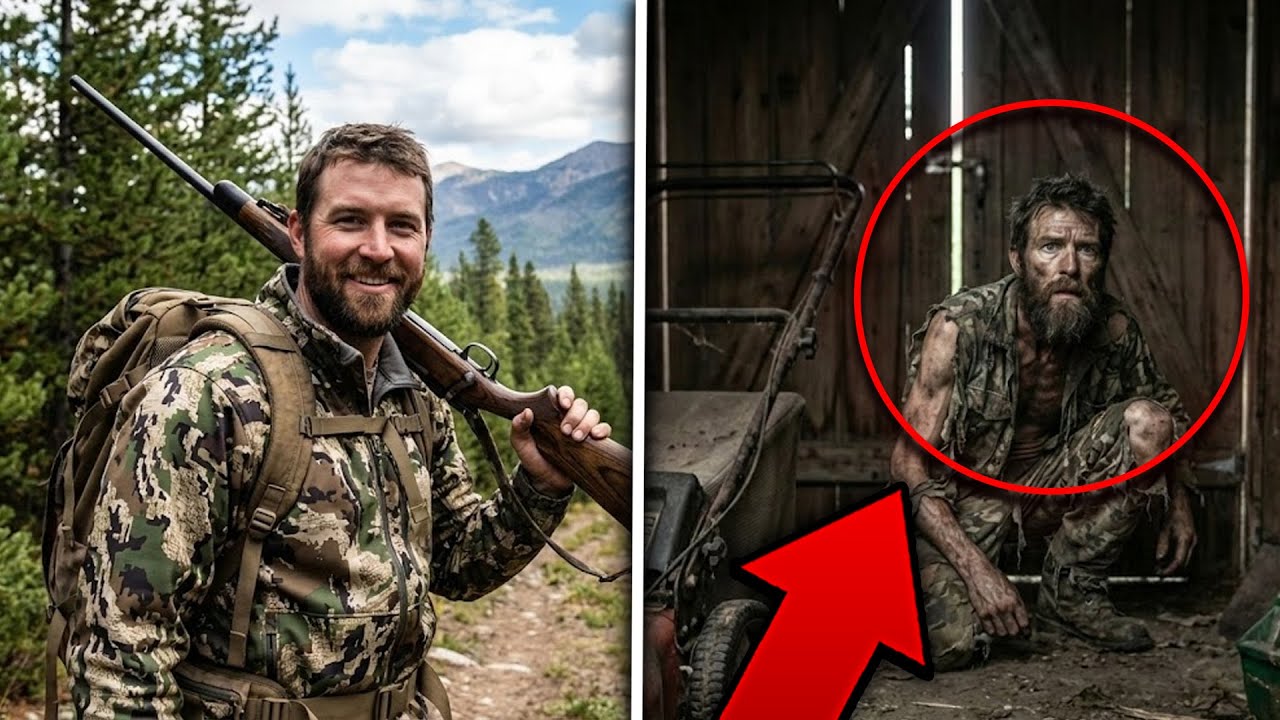
At 6:23 a. m. , a traffic camera on Highway 93 recorded his truck heading west toward the mountains. That was the last confirmed sighting of Marcus Reed.
When he failed to return, his brother, Daniel Reed, reported him missing on October 1st. Rangers found Reed’s truck locked at the Bitterroot trailhead parking area, with equipment still inside but no cell phone. There were no signs of forced entry or struggle. A ground search began immediately, focusing on the higher elevation areas of Blit Canyon where Reed had indicated he intended to hunt, approximately five to seven miles from the trailhead.
Weather conditions were favorable, with clear skies and temperatures ranging from 40 to 65 degrees Fahrenheit. The search operation expanded rapidly. By October 3rd, it involved 25 ground searchers, four dog teams, and a helicopter equipped with thermal imaging. On day three, searchers discovered a torn piece of camouflage fabric snagged on a branch approximately three miles up the canyon, matching the pattern of the clothing Reed was reported to be wearing.
Dog teams picked up a scent trail near that location but lost it about half a mile further up a rocky slope. Handlers reported the dogs showed confusion where the scent trail ended, behavior consistent with the subject having left the area by mechanical means or the scent having been contaminated. The helicopter’s thermal imaging produced only false positives, which the pilot attributed to the rocky terrain retaining heat and creating anomalies that could be misinterpreted as human signatures. After seven days of intensive searching covering roughly 30 square miles of difficult terrain, no additional evidence was found.
Weather deteriorated on October 8th, with snow beginning to fall at higher elevations. The search continued for another seven days with reduced personnel, but on October 15th, 2023, the active search was officially suspended. The sheriff’s statement cited the comprehensive nature of the efforts and weather conditions. Reed’s brother organized volunteer searches over the next several months, but no trace of him was ever found.
By the summer of 2024, the case had gone cold. Reed’s family held a memorial service, though he was not legally declared dead. Investigators had considered several theories: a fatal accident in remote terrain, an attack by wildlife, or an intentional disappearance. The latter was considered least likely given Reed’s stable employment and lack of financial or legal problems.
Then, on October 17th, 2025, a maintenance worker at the Lost Horse Creek campground, located approximately 80 miles north of where Reed had disappeared, discovered a man hiding in an equipment shed. The campground had been closed for the season on October 1st. The worker, Jason Finch, unlocked the shed and found the man crouched behind a stack of folding tables. Finch told investigators the man looked feral, skinny, with a beard down to his chest and torn clothes.
When Finch shined a flashlight on him, the man covered his eyes and pressed himself into the corner, refusing to look at him directly. The responding officers found the man in the same position, refusing to speak or make eye contact. He was transported to St. Patrick Hospital in Missoula, where a nurse recognized similarities to the missing person’s case of Marcus Reed.
Fingerprint analysis confirmed the man’s identity. His body weight was 121 pounds, compared to the 175 pounds listed on his driver’s license. The medical examination revealed severe malnourishment, multiple healed fractures in both hands and forearms consistent with defensive injuries, and circular scarring around both ankles indicating prolonged restraint with some type of binding. He showed extreme vitamin D deficiency consistent with prolonged periods without sunlight exposure.
Additional scarring was discovered around his neck and shoulders, the pattern noted as systematic rather than random, suggesting intentional infliction. His back showed evidence of repeated lacerations that had healed poorly without medical treatment. Psychologically, Marcus presented with symptoms consistent with severe trauma, including selective mutism, extreme avoidance behaviors, and a violent aversion to eye contact. When staff attempted eye contact, he became physically distressed, showing an elevated heart rate, perspiration, and in one instance, vomiting.
Three days after admission, he spoke his first complete sentence to a night shift nurse. According to the medical log, he said, “He’ll find me if I look up. He sees through the eyes. ” Security around his room was increased.
On day five, Marcus began to provide limited responses to questions, though he still refused to make eye contact. His initial account of the previous two years was fragmented. He said he got lost, that storms came, that he built shelters and moved around. He claimed to have found places where he could stay warm during the winters.
This narrative initially seemed plausible to investigators, given Reed’s hunting expertise and the reality that Montana’s wilderness could potentially support a person with survival skills. However, Detective Sarah Monahan of the Montana State Police noted inconsistencies. Reed’s hands showed no callousing consistent with prolonged wilderness survival. The pattern of vitamin D deficiency suggested long periods without sunlight exposure, contradicting his claim of outdoor survival.
No reports of cabin break-ins or food theft had been filed in the areas where he claimed to have been surviving. His described movements did not account for surviving two harsh Montana winters. Most significantly, the restraint marks on his ankles could not be explained by his narrative. Suspecting Reed might have been involved in criminal activity during his disappearance, possibly related to illegal marijuana growing operations known to exist in remote parts of the national forest, the investigation shifted to examine whether he had been involved in something that resulted in his captivity as punishment.
His brother Daniel was interviewed with pointed questions, but adamantly denied any such connection. Analysis of Reed’s bank records, phone records, and social media accounts from before his disappearance supported that denial. No evidence of criminal connections or unusual financial transactions was discovered. The breakthrough came from forensic analysis of Reed’s clothing.
Embedded in the seam of his tattered pants was a small metal object approximately the size of a grain of rice: an RFID tag similar to those used for inventory control or animal tracking. The specific model was not available commercially but matched tags used in research applications. It bore microscopic engravings reading “S17. ” When shown this information, Reed became extremely agitated.
A subsequent full body examination discovered a small healed incision at the base of his skull near the hairline, with another similar RFID tag embedded subcutaneously at that location. The investigation expanded to include potential suspects with backgrounds in wildlife research, medical implantation, or surveillance technology. A wildlife biologist who had been conducting research on wolf populations in the Bitterroot National Forest during the fall of 2023 came forward. She reported unusual interference with her tracking equipment in the northern section of her study area, which she had attributed to equipment malfunction.
The GPS coordinates she provided were approximately 12 miles north of where Reed’s hunting gear had been found. A search of that area on November 3rd, 2025, discovered an unmarked access road leading to what appeared to be an abandoned research facility. The main building was constructed into the side of the mountain with minimal external visibility, surrounded by satellite structures including what appeared to be a generator housing and several small outbuildings. There were no signs or identifying markers.
The facility was secured with heavy locks that showed signs of recent use. A search warrant was obtained, and when a tactical team executed it, they found the facility unoccupied but recently used. The main building contained laboratory equipment, living quarters, and a secure area with multiple steel reinforced cells. Evidence suggested recent occupancy, with food supplies dated within the past month.
One of the cells contained personal items later confirmed to belong to Marcus Reed, including the wallet and identification in his possession when he disappeared. DNA testing confirmed the presence of his blood in that cell. The laboratory contained equipment for implanting and monitoring RFID tags along with extensive computer systems. Recovered files included tracking logs for multiple subjects identified only by numbers.
S17 appeared in these logs with movement data corresponding to the time period of Reed’s disappearance. More disturbingly, the logs contained entries for 16 other subjects dating back approximately five years. The tracking data for 12 of these subjects terminated abruptly. The files contained fragments of research notes suggesting some form of behavioral research focused on isolation conditioning and control methodologies, specifically referencing “aversion training” and “eye contact protocols.
”
Investigators traced ownership of the land to a corporation called Behavioral Ecology Systems, registered to a fictitious name through a mail forwarding service in Delaware. Utility payments were made through an automated system from an offshore account that had been closed approximately one week before the facility was discovered. A store owner in Darby, about 25 miles from the facility, recalled a customer who made regular large purchases of shelf stable food and supplies, always paying cash, driving an older model dark green Jeep. Surveillance footage showed a man in his 50s with a beard and baseball cap.
When shown the image, Reed began trembling. “Don’t let him see me looking,” he said. “Never look at his face. Rule one is never look at his face.
”
A forensic psychiatrist established a protocol allowing Reed to communicate without eye contact using written responses. Fragments of his experience began to emerge. He indicated he had been taken while hunting, that he was darted and woke up in a cell. He initially believed he had been captured by some government entity, but later realized it was just one man.
His captor enforced strict rules, the primary one being never to look directly at his face. Eye contact was punished. Reed became highly emotional when attempting to describe the punishment, indicating it involved “the collar” and “the light room. ” His captor maintained multiple captives simultaneously, though they were kept separated.
Reed understood the purpose of captivity to be research or an experiment related to behavior modification. “He called us his subjects,” Reed wrote. “Said we were helping advance understanding of human response to isolation. ”
A former graduate student in behavioral psychology at the University of Montana identified the surveillance image as Dr.
Lawrence Heler, a research professor dismissed in 2016 over ethical concerns about his proposed research methodologies. The review board’s summary indicated concerns about extreme isolation protocols and aversion conditioning techniques. After his dismissal, Heler had disappeared from academic circles, having liquidated his retirement accounts before vanishing with approximately $1. 2 million.
On November 12th, 2025, a state trooper spotted Heler’s Jeep at a remote gas station near the Idaho border. The driver attempted to flee but crashed into a guard rail. Lawrence Heler was taken into custody. He spoke calmly, and when informed of the charges, reportedly said, “They don’t understand the significance of the work.
The protocols were necessary for valid results. ” A search of his vehicle revealed a laptop with additional research files, a tracking device receiver compatible with the RFID tags, and a notebook with handwritten observations on subjects identified only by numbers. Heler was forthcoming during questioning but showed no remorse. When asked about subjects who had died, he was clinically detached, saying they were unsuitable for the protocols and that their data was still valuable.
Investigators determined he had abducted at least 17 individuals over a five-year period, mostly from remote wilderness areas in Montana, Idaho, and Wyoming, where disappearances could be attributed to accidents or wildlife encounters. Of the 17 identified subjects, 12 were presumed deceased. Search teams located one additional survivor, a 28-year-old woman who had disappeared while hiking in Idaho. Two other subjects indicated by the tracking data had not been found.
Forensic excavation at the facility uncovered human remains from nine individuals in a ravine near the main building. Heler was charged with multiple counts of kidnapping, false imprisonment, torture, and murder. He was denied bail. A forensic psychiatrist’s report noted he demonstrated no significant psychosis but exhibited extreme callousness and a complete lack of empathy.
Recovered documents revealed his research focused on behavioral conditioning under isolation and his selection criteria: he specifically targeted people experienced in outdoor activities who were traveling alone in remote areas, observing them for several days before abduction. Six months after his rescue, Reed provided additional details. He had tried to escape twice during the first month. After the second attempt, Heler put him in the light room for three days without water, with only light and the collar.
After that, he followed the rules. He escaped when Heler failed to secure his cell properly while rushing to relocate the operation. Reed then spent several weeks hiding in the forest, afraid to approach roads or populated areas because he knew Heler could track him. He found the equipment shed when it got too cold to remain outdoors.
The psychological impact on Reed remains severe. He continues to exhibit trauma responses, persistent aversion to eye contact even with family members, nightmares centered on themes of observation and punishment, and a refusal to enter rooms without multiple exits. He maintains a packed bag near his door at all times. Despite the RFID tag having been surgically removed, he checks the back of his neck multiple times daily.
When asked about the future, he responded that there isn’t one “as long as he’s still out there watching. ”
The case led to changes in how missing persons cases in wilderness areas are investigated. The Montana State Police implemented new protocols for examining connections between disappearances in remote areas. The FBI established a task force to review cold missing persons cases from national parks and wilderness areas across the Northwest.
Their initial review identified 23 cases from the past decade sharing characteristics with known Heler abductions. Heler awaits trial, refusing plea arrangements and maintaining that his research was of significant scientific value. As Detective Monahan noted in her case summary, the case revealed how effectively remote wilderness areas can be exploited by predators, and how many other missing persons cases labeled as misadventure might represent something far more deliberate and sinister.