On April 9, 1865, Robert E. Lee walked into a small brick house in Appomattox, Virginia, and surrendered the last great army of the Confederacy. Four years of war ended inside that room. But for the men who had led that army into battle, the fighting was over and a far stranger war was just beginning.
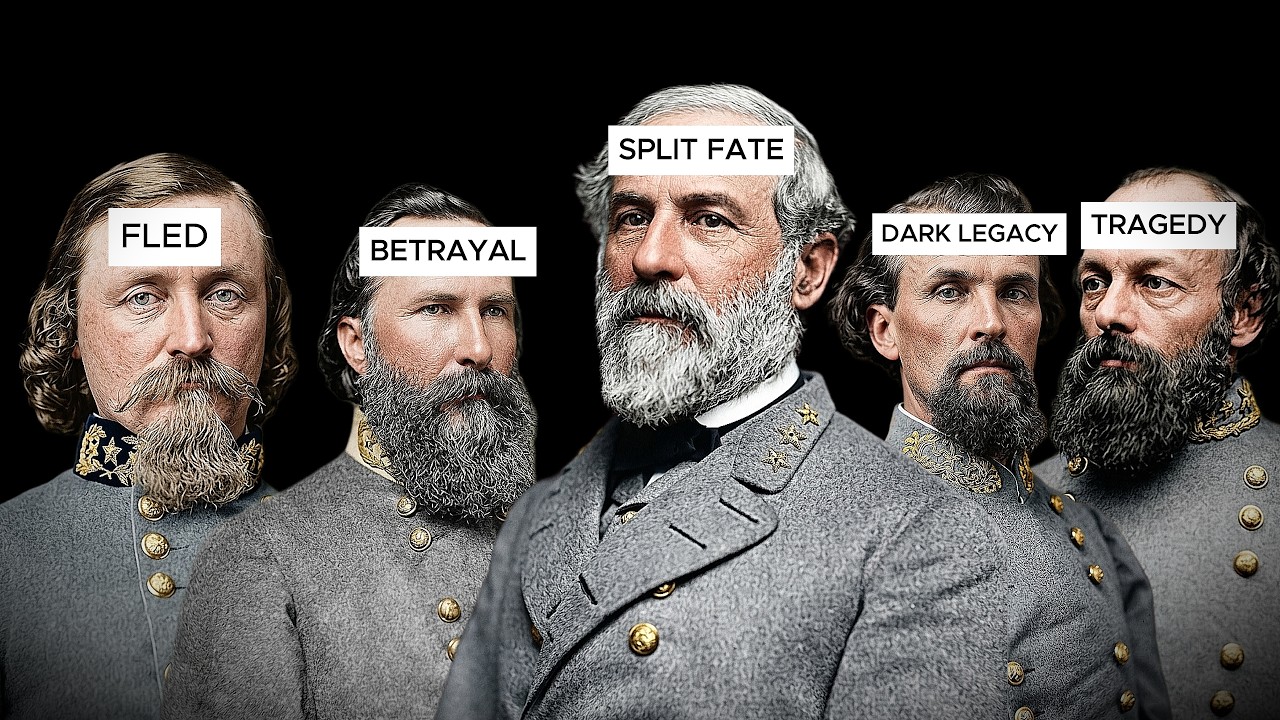
Some of those generals would go on to run universities, serve in Congress, and even lead American troops in future wars wearing a different uniform. Others would flee the country in disguise, hide in Mexico and Cuba, and spend the rest of their lives refusing to accept defeat. One would die heartbroken during a yellow fever outbreak alongside his wife and daughter within the same week. Another would become one of the most feared names in American history for reasons having nothing to do with the battlefield.
More than 400 men held the rank of Confederate general. Their fates scattered in every direction imaginable, from quiet reconciliation to defiant exile to outright tragedy. This is what actually happened to them. The terms Ulysses Grant offered at Appomattox were unusually generous for men who had just spent four years trying to kill each other.
Officers and soldiers were released on parole, promising not to take up arms again. They were allowed to keep their horses and personal property. Grant even ordered rations shared with the starving Confederate troops. There were no mass trials, no mass executions, and for most Confederate generals, no prison time at all.
But the generous terms did not mean a completely clean slate. Lee’s rank placed him outside the scope of President Andrew Johnson’s first amnesty proclamation in May 1865, and he did not sign his own pardon application until October of that year. Full political rights were not restored to most former Confederates until years later when Congress passed general amnesty acts. Lee’s citizenship was not officially restored until 1975, more than a century after the war, when his original papers were found misplaced in the National Archives.
For the man who led the Confederate armed forces, Jefferson Davis, the outcome was harsher. He was captured while fleeing through Georgia and spent two years imprisoned at Fort Monroe before all charges against him were quietly dropped. As for the generals under his command, the paths diverged almost immediately. Some returned home to rebuild farms and law practices.
Some ran for public office. A few fled toward the border, and at least one refused to accept the end of the war altogether, riding west in search of an army that no longer existed. What those men did next would shape the way the entire country remembered the war for the next 150 years. It would determine which version of the Confederacy would be written into textbooks, carved into monuments, and passed down as family legend across the South.
The choices these generals made in the months after Appomattox were nearly as important as anything they had done during the fighting itself. And it began with the most famous general of them all, walking away from that small brick house and back into a country that no longer knew what to do with him. Within weeks of the surrender, Robert E. Lee made a decision that surprised almost everyone who knew him.
Instead of fleeing the country or fighting Reconstruction from the shadows, he swore an oath of allegiance to the United States and quietly urged other former Confederates to do the same. An insurance company reportedly offered him $50,000 just to use his name, a vast sum in that era. Lee refused outright. He was said to have told them he could not accept money for services he had not actually performed.
Instead, he accepted a position that shocked many Southerners: the presidency of a small struggling college in Lexington, Virginia, called Washington College. It was not a return to power. It was a modest academic post at a school barely able to pay its bills. But Lee threw himself into the job, modernizing the curriculum, introducing new courses in science and journalism, and pushing students toward rebuilding rather than resentment.
He rarely spoke publicly about the war. When asked about Confederate monuments during his lifetime, he reportedly discouraged the idea, arguing that the country needed healing rather than re-fighting old battles in stone. Lee served as college president until his death in 1870 at age 63. His last words, according to those present, were simply: “Strike the tent.
” The school was renamed Washington and Lee University in his honor, and it still bears that name today. But history did not remember every general who chose peace with equal kindness. One of Lee’s former officers made a similar choice of reconciliation with the Union, and it cost him almost everything. Joseph Johnston commanded Confederate forces for much of the war before losing his position to John Bell Hood late in the fighting.
After the surrender, he followed a path similar to many fellow generals, moving into railroads and insurance and writing his own memoirs to defend his wartime record. He later won a seat in the U. S. House of Representatives representing Virginia, and President Grover Cleveland appointed him U.
S. Railroad Commissioner, a federal government position held by a former Confederate general only a few decades after the war ended. But the most striking part of Johnston’s postwar story had almost nothing to do with politics. It concerned the man who had spent years fighting to destroy his army: Union General William Tecumseh Sherman.
Despite everything between them on the battlefield, Johnston genuinely came to respect Sherman as a commander, and over time, as a man. When Sherman died in February 1891, Johnston insisted on being one of the pallbearers at his funeral in New York City. It was a bitterly cold day. Johnston, then in his eighties, refused to wear a hat during the procession, saying that if the roles were reversed, Sherman would have done the same for him out of respect.
He caught a severe chill from standing bareheaded in that weather. Within weeks, the cold turned into pneumonia. Joseph Johnston died shortly afterward, a death directly linked to that final gesture of respect for the man who had once been his bitter enemy. Not every general found that kind of peace with his old enemies.
Instead, some found something closer to self-reinvention. Pierre Gustave Toutant Beauregard, known simply as Beauregard, had fired the first shots of the entire war at Fort Sumter. After Appomattox, he became one of the most surprising success stories among former Confederate leaders. He moved into railroad management and civil engineering, eventually overseeing operations for major Southern rail lines.
He also took on the role of supervisor for the Louisiana State Lottery, a controversial but highly lucrative position that made him one of the wealthiest former Confederate officers. What makes Beauregard truly unusual is what happened outside the United States. According to many historical accounts, the Egyptian government and the newly formed Romanian army separately contacted him with offers to command their forces. At one point, a former Confederate general was seriously considered to help build a foreign nation’s army.
Beauregard refused both offers and chose to remain in Louisiana. His postwar political views also set him apart from most of his former colleagues. He publicly supported limited civil rights for Black citizens in Louisiana during Reconstruction, a stance that put him in conflict with much of the postwar Southern political establishment and the emerging Lost Cause movement. He died in New Orleans in 1893, having spent nearly three decades building a public reputation entirely separate from his wartime image.
Where Lee became a symbol of quiet dignity, and Johnston found an unexpected bond with a former enemy, Beauregard simply reinvented himself as a businessman and engineer who had once been a general. Not every officer who tried to move forward with his life was allowed to do so quietly. One of Lee’s most talented subordinates made a political decision that made him arguably the most hated man in the entire former Confederacy. If there was one general in this story whose postwar life seemed like a betrayal to the men he once led, it was James Longstreet.
Longstreet was Lee’s most trusted corps commander, so essential to the army that Lee reportedly called him “my old war horse. ” He fought in nearly every major battle in the Eastern theater and was still at Lee’s side when the army surrendered at Appomattox. After the war, Longstreet became a partner in a cotton brokerage firm and president of an insurance company in New Orleans, a career path similar to many of his peers. But then he made a choice no other prominent Confederate general dared to make.
He joined the Republican Party. Worse, in the eyes of many former Confederates, he openly expressed admiration for Ulysses Grant, his old friend from West Point who had led the army that defeated them. He even went so far as to publicly criticize Lee’s tactical decisions at Gettysburg, including blaming the disastrous Pickett’s Charge on Lee’s planning rather than on the troops who carried out the orders. The backlash was violent, immediate, and lasted the rest of his life.
The emerging Lost Cause movement, founded by men like Jubal Early, needed someone to blame for the defeat at Gettysburg. Longstreet, already unpopular for his political leanings, became a convenient scapegoat. Southern newspapers and former comrades turned on him openly, with some accusing him of betraying the cause he had once fought for. Despite the backlash, Longstreet accepted federal appointments from the government he had once fought against, serving as U.
S. minister to the Ottoman Empire and later as U. S. Railroad Commissioner.
He died in 1904, having spent nearly 40 years as the most reviled figure among former Confederate officers, not because of anything he did during the war, but because of the peace he chose to make with it afterward. Not every general who tried to rebuild a political career faced that kind of backlash. Two of them received a very different reception, and one ended up doing something almost no one could have predicted. While Longstreet was under attack for his political choices, two other former Confederate generals found that politics could actually restore their standing rather than destroy it.
Wade Hampton III was one of the wealthiest plantation owners in the South before the war and a formidable cavalry commander during it. He lost most of his fortune in the conflict, but he rebuilt his public life through politics, eventually becoming governor of South Carolina during Reconstruction and later a U. S. senator.
Unlike Longstreet, Hampton remained loyal to the Democratic Party and the traditional Southern political establishment, which protected him from the kind of backlash Longstreet suffered. Fitzhugh Lee, Robert E. Lee’s nephew, followed a similar early path, becoming governor of Virginia after the war. But his later career took a turn almost no one could have expected.
He was appointed U. S. consul general in Cuba in the 1890s. Then in 1898, he was commissioned as a major general of U.
S. Volunteers during the Spanish-American War. Read that again. A former Confederate general who had once fought to leave the United States by force received a general’s rank in the actual U.
S. Army barely three decades later, leading American troops in an entirely different war. The nephew of the most famous Confederate general ended his career wearing federal blue, a level of reconciliation that would have seemed almost unimaginable in the bitter years immediately after Appomattox. Yet not every general found that path back to public acceptance.
Some chose a completely different response to defeat, one that involved leaving the country entirely rather than reconciling with it. Not every Confederate general accepted the end of the war the way Lee did. Jubal Early refused to surrender at all. When Lee laid down his arms at Appomattox, Early was not there.
He had ridden west, hoping to join General Edmund Kirby Smith’s forces in Texas and somehow keep fighting. By the time he arrived, Kirby Smith’s army had already surrendered without him. With nowhere to turn inside the country, Early fled across the border into Mexico. He then moved to Cuba and eventually settled in Toronto, Canada, traveling at one point under the alias Major James Woods to avoid recognition.
While in exile, he wrote memoirs focused on his failed Shenandoah Valley campaign and began composing the articles and letters that would form the foundation of what became known as the Lost Cause movement. Early received a pardon in 1868 and returned to Virginia the following year. But unlike Lee, he did not return quietly. He became the first president of the Southern Historical Society and spent the rest of his life, in his own words, as an “unreconstructed rebel,” working hard to shape the way the war would be remembered.
Early, more than almost anyone else, helped build the myth that the Confederacy was an honorable and doomed cause, defeated only by the North’s overwhelming numbers and not by its own failures. And it was Early who led the public campaign to destroy James Longstreet’s reputation, using his platform at the Southern Historical Society to portray Longstreet as the man who caused the South to lose the Battle of Gettysburg. He died in 1894 in Lynchburg, Virginia, after falling down a staircase, having spent nearly three decades as one of the most influential voices in shaping Confederate memory. Early was not the only general who tried to keep the fight going after Appomattox.
Another leader held out longer, technically becoming the last Confederate general to surrender. While Jubal Early was heading toward Texas hoping to find him, Edmund Kirby Smith was commanding the Confederacy’s last major fighting force, the Trans-Mississippi Department. News of Lee’s surrender at Appomattox took time to reach the Western theater, and even after it arrived, Kirby Smith initially resisted surrender. He held out longer than almost any other Confederate commander, finally surrendering his forces in June 1865, more than two months after Lee laid down his arms in Virginia.
His surrender is generally regarded as the effective end of major Confederate military resistance. Facing an uncertain fate, Kirby Smith briefly fled to Mexico and then Cuba. The pattern was similar to Jubal Early’s at first, but his exile was much shorter. He soon returned to the United States under the terms of postwar amnesty and chose a second path entirely different from most of his fellow generals.
Instead of pursuing politics, business, or Lost Cause activism, Kirby Smith turned to academia. He eventually became a professor of mathematics and went on to serve as president of the University of the South in Sewanee, Tennessee. He spent his remaining decades shaping young minds rather than refighting old battles. He died in 1893, remembered not for defiance but for his quiet, almost scholarly withdrawal from the public conflicts that consumed so many of his former colleagues.
But not every general’s postwar story was as quiet as that. One name on this list carries a far darker and more consequential legacy than any classroom or courtroom. Nathan Bedford Forrest’s wartime record is truly exceptional in its own right. He enlisted as a private with no formal military training and rose to the rank of lieutenant general through battlefield performance alone, an almost unheard-of rise.
Union General William Tecumseh Sherman reportedly described him as the most remarkable man produced by the Civil War on either side, a level of respect from an enemy commander that few in this story received. But Forrest’s wartime legacy is inseparable from the Fort Pillow massacre, where troops under his command killed Black Union soldiers after they had already surrendered. That controversy followed Forrest for the rest of his life, and what came after the war made it far worse. In the years following the Confederacy’s collapse, Forrest’s name became linked with the early Ku Klux Klan, with multiple historical accounts identifying him as an early leader within the organization during its most violent period.
By the early 1870s, as Klan violence escalated, Forrest publicly stated his desire for the organization to dissolve, and there is evidence he became genuinely concerned about what it had become. Later in his life, in a widely circulated 1875 speech, he expressed reconciliatory views toward Black Americans that almost no one expected from him. None of this erased that earlier chapter, and his legacy remains one of the most controversial of any Confederate figure to this day. Financially, Forrest fared far worse than most of his fellow generals.
His postwar business ventures largely failed. He died in 1877 in Memphis, largely impoverished, in stark contrast to the wealth and battlefield fame he had once enjoyed. Financial ruin and controversy were not the only forms of tragedy awaiting these generals after the war. For at least one of them, the end was almost unbearably cruel.
Few Confederate generals paid a greater physical price for the war than John Bell Hood. He lost the use of his left arm at Gettysburg and had his right leg amputated after Chickamauga, yet he continued to lead troops from horseback despite injuries that would have ended most men’s military careers entirely. His final major command ended in disaster. At the Battle of Nashville, Hood’s army suffered one of the most catastrophic defeats of the entire war, effectively destroying it as an organized fighting force.
After the surrender, Hood moved to New Orleans and tried to rebuild his life through insurance and cotton brokerage. For a time, it seemed to work. He married and began raising a family, establishing himself within the city’s business community. Then in 1879, yellow fever swept through New Orleans.
The epidemic devastated the city, and Hood’s business collapsed under the strain like countless others. But the fever did not stop at his money. Within the same week, Hood, his wife, and his eldest daughter all died of yellow fever, one after another. He left behind 10 surviving children who were suddenly orphaned, with little financial support to care for them.
In his final months, aware of his failing health and finances, Hood worked to complete memoirs defending his wartime decisions, particularly his controversial handling of the Atlanta and Nashville campaigns. Those memoirs were published posthumously. Of all the postwar stories in this list, Hood’s may be the most tragic of all. Not every general’s decline was that dramatic.
For one of the most famous names in Confederate history, the ending was quieter, and somehow sadder for that very reason. George Pickett’s name is permanently tied to the most famous failed charge in American military history. Pickett’s Charge at Gettysburg, where roughly 12,000 Confederate soldiers advanced across open ground into devastating Union fire, only to be killed or captured within an hour. Pickett never fully recovered from that defeat, either militarily or personally.
He continued to serve for the remainder of the war, but his reputation was permanently shaped by that afternoon in Pennsylvania. After the surrender, Pickett briefly fled to Canada, fearing prosecution over accusations that he had ordered the execution of Union deserters earlier in the war during his operations in North Carolina. The threat of legal consequences was serious enough that he considered remaining in exile permanently. In the end, he was rescued by an unexpected intervention.
Robert E. Lee personally appealed to Ulysses Grant on Pickett’s behalf, and Grant agreed to drop the case. Pickett returned to Virginia and spent the rest of his life working as an insurance agent, a quiet and unremarkable career for a man whose name had become permanently synonymous with one of the most infamous military decisions in American history. He largely avoided public talk about the war and rarely gave interviews about Gettysburg.
He died in 1875, only 10 years after the surrender, spending his final decade trying to live a normal private life under the weight of a single afternoon neither he nor the country could quite move past. These twelve men took twelve entirely different paths out of the same war. But taken together, their choices did something much larger than shape their individual legacies. They shaped the way an entire nation would remember the Confederacy for the next century and a half.
Look at these twelve stories side by side and a pattern begins to emerge. It was no longer really about who won or lost individual battles. It was about who chose to accept defeat and who refused to. Lee, Johnston, Beauregard, Hampton, and Fitzhugh Lee all found ways to rebuild their lives within the country that had defeated them, some more publicly than others.
Longstreet paid a heavy personal price for doing the same thing, simply because he did it more visibly and politically than the rest. Early and Kirby Smith both fled the country briefly, but their paths diverged sharply afterward. Kirby Smith returned quietly to academic life. Early returned determined to win the peace even after losing the war, and in a very real sense, he succeeded.
The version of the Confederacy people remember as a noble lost cause that fought bravely against impossible odds rather than fighting to preserve slavery was built primarily by Jubal Early and the organization he led, the Southern Historical Society. That myth shaped monuments, textbooks, and popular memory throughout the South for generations, and its influence is still actively debated and dismantled today, more than a century later. Forrest, Hood, and Pickett each represent something different again. Men whose postwar lives were defined less by political choices and more by tragedy, controversy, or simple quiet retreat.
What connects all twelve is this. The Civil War did not really end at Appomattox Court House on April 9, 1865. It simply changed battlefields. The struggle over how America would remember the Confederacy, who its heroes and villains would be, and what the war was actually fought for, continued for decades in courtrooms, college presidencies, memoirs, and clan meetings.
In many ways, that struggle continues today. And it began with the choices these twelve men made in the confused, uncertain months directly after they laid down their swords.