Winston Churchill spent his life proving his dead father wrong. The cold, dismissive Lord Randolph Churchill had looked at his son and seen a failure, and he told the boy so before dying at forty-five in 1895. Young Winston wrote letters begging for attention and received indifference in return. The only real love he knew came from his nanny, Mrs.
Everest, the woman he called “Wee Wum,” who held him when no one else would. He spent the rest of his life chasing the approval of a man who was no longer there. That hunger built the legend. It drove him into battle, into danger, into politics, and eventually into history as the man who refused to surrender to Hitler.
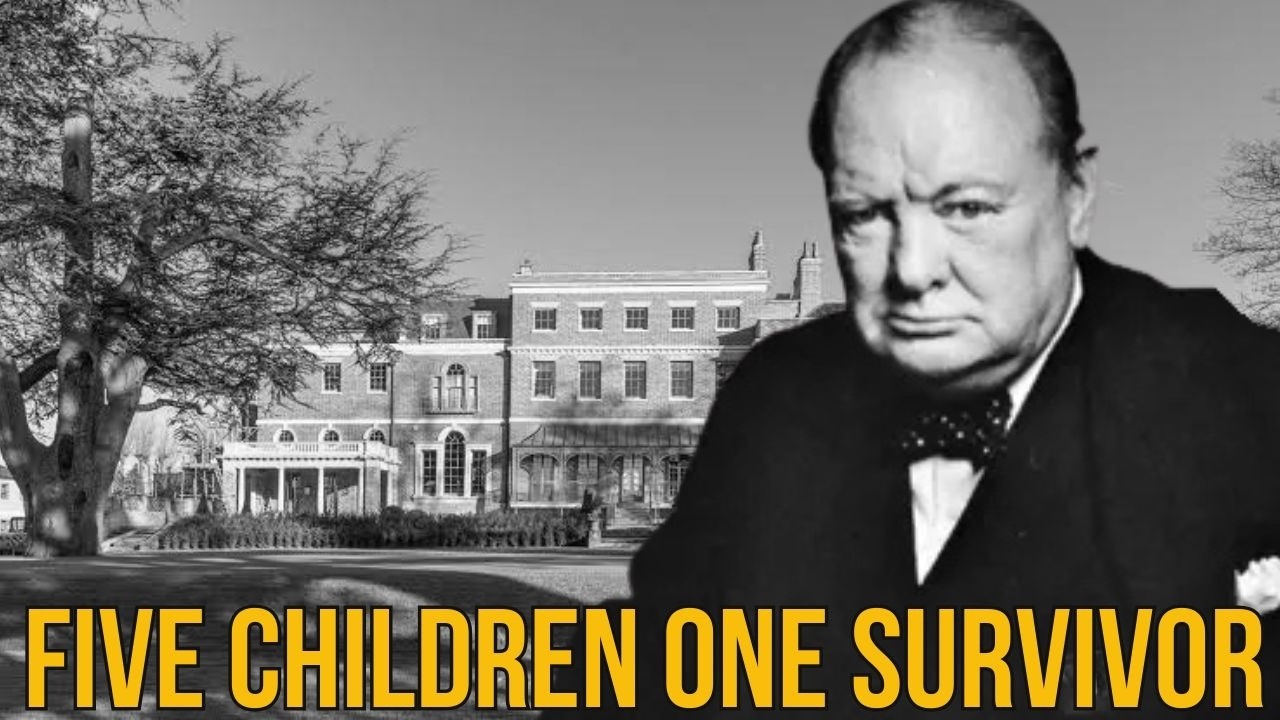
But the same engine that carried him to glory consumed nearly everything else. The wounded boy who never received his father’s love did not always know how to give his own. The world got a savior. His five children got the leftovers.
The family looked golden on the surface. Churchill married Clementine Hozier in 1908, a graceful, intelligent, principled woman who became his anchor and his conscience. Their children arrived in steady succession: Diana in 1909, Randolph in 1911, Sarah in 1914, and Marigold in 1918. A fifth child, Mary, was born in 1922.
There were photographs from those early years of Churchill surrounded by his laughing children in the gardens of their country homes. In brief flashes, he could be a magical father, building toys, inventing games, staging elaborate plays, and filling Chartwell with animals and wonder. When he turned his attention on a child, it was like sunlight, dazzling and unforgettable. But sunlight in bursts disappears for long stretches.
Churchill worked obsessively, often through the night, and his children were raised largely by nannies and governesses, seeing their parents in carefully scheduled moments rather than in daily life. Clementine was often away too, traveling or recovering from the strain of her husband’s turbulent career. There was something darker running beneath the glamour. Churchill suffered from crushing depressions he called his black dog.
The same shadow had likely haunted his own father. His children inherited its gloom, along with his intensity and appetites, but without the iron will that let him control it. The first tragedy blossomed in the summer of 1921 with the youngest child, the golden-haired little girl the family adored. Born in November 1918, in the same week the Great War ended, Marigold was a bright, cheerful toddler who loved to sing a wistful tune called “I’m Forever Blowing Bubbles.
” That August, she caught a cold that settled in her throat. In 1921 there were no antibiotics, and a simple childhood infection could still kill with terrifying speed. The young French governess apparently failed to grasp how serious the illness had become. The infection spread into Marigold’s blood.
Septicemia followed. By the time anyone understood the danger, the child was desperately ill. Clementine rushed from London. Churchill came from his work.
The most powerful family in the country gathered around a small bed in a rented seaside house and discovered that wealth, connections, and influence meant nothing. There was no cure, no surgery, only waiting and helplessness. Marigold died on August 23, 1921, at two years and nine months. According to one family account, in her final moments she asked her mother to finish singing her favorite bubble song.
Clementine broke down and could not continue. When the child died, she let out a cry that witnesses compared to a wounded animal. Churchill, the man history remembers as unbreakable, collapsed entirely. He wept.
They buried Marigold in London and then did what families of that era often did with grief too large to bear. They closed the door on it. Almost no one spoke her name again. Clementine never truly recovered, and in her old age she still wept at the mention of Marigold.
The wound healed poorly because it was never allowed to heal at all. In a cruel way, Marigold was the lucky one. She died loved and innocent before the Churchill name could destroy her. The four who survived each fell, slowly and in their own fashion, to the weight of the family legend.
Randolph, born in 1911, was the long-awaited heir, and Churchill showered him with the attention he himself had been denied. He treated the boy as an equal, argued with him at the dinner table, and insisted he was destined for greatness. That belief crushed him. Randolph grew up convinced he was extraordinary but never managed the patient work that real achievement requires.
He entered politics expecting to rival his father, and the country rejected him at the polls again and again. He was talented as a writer but unreliable, and his talent drowned in rage and drink. He was a terrible drunk, picking fights and insulting friends, burning through marriages and goodwill. One cruel joke held that when surgeons removed a benign tumor from him, they had found the only part of Randolph that was not malignant and removed it.
He spent his entire life as Winston Churchill’s son and was destroyed by the impossibility of being anything more. The darkest shadow fell on Diana, the eldest, born in 1909. She was sensitive and fragile, and through the 1950s she suffered a series of devastating breakdowns. Her marriage collapsed.
She was hospitalized, treated, broken, and rebuilt, only to break again. In her final years, struggling with her own darkness, Diana volunteered for the Samaritans, talking strangers out of suicide from a phone line in the dark. On the night of October 19, 1963, Diana Churchill took an overdose of sleeping pills and ended her life at fifty-four. The woman who spent her last energy keeping strangers alive could not save herself.
The elderly Churchill, fading at the end of his long life, had to be told that his eldest daughter had chosen death. Sarah, born in 1914, fought fiercely to be her own person. She wanted the stage, defied her parents, married the artist Vic Oliver against their wishes, and became a genuine if unsteady actress. But the family shadow reached her through the bottle.
Her drinking became full alcoholism. Her second husband killed himself. She was arrested repeatedly for drunkenness, dragged through courts, and written about in the papers. The daughter of the great Winston Churchill found drunk and disoriented in the street.
Each arrest was a public crucifixion. She was, by all accounts, warm, witty, and generous, simply a Churchill carrying the family’s gifts and demons without the armor to survive them. By the early 1960s, Churchill was a living monument and a very old, very tired man. He had outlived his enemies and most of his world.
Strokes had slowed him. The black dog that had pursued him all his life returned to feast on him at the end. He muttered that his life was over, that there was nothing left to do. Then came the news of Diana’s suicide.
The family told the frail old man gently. He received it in almost total silence. Some griefs have no words, even for history’s greatest orator. He died on January 24, 1965, at the age of ninety, in an eerie echo of the date his own father had died seventy years earlier.
The world stopped. He was given a state funeral, the first for a commoner in generations, and hundreds of thousands lined the streets of London. Cranes in the docks bowed as his coffin crossed the Thames. It was the grandest farewell a nation could offer.
The survivors of his private tragedy stood in the midst of that public grief. Randolph, destroyed by drink. Sarah, fighting alcoholism. And Mary, the youngest, the steady one, the only child of five who built a whole and happy life.
Randolph lived only three years after his father. In his final years he took on the monumental task of writing the official biography of Winston Churchill, working with real discipline for the first time, determined to tell the story of the father whose shadow had crushed him. He died on June 6, 1968, at just fifty-seven, the work unfinished, passed to other hands. Mary was the one who escaped.
Born in 1922, a year after Marigold’s death, she arrived in a family still raw with grief and grew up almost as a form of healing. By the time she was young, her older siblings had already absorbed the full heat of their parents’ expectations. She was raised with steady, loving care by a devoted cousin-nanny, Marriott White, and she missed the chaos of her brothers’ and sisters’ early years. She inherited her mother’s steadiness rather than her father’s storms.
During the Second World War she served quietly in an anti-aircraft battery, asking no special treatment as the prime minister’s daughter. In 1947 she married Christopher Soames, a solid, loyal man who became a prominent politician and diplomat in his own right. Their marriage was happy and long. They had five children.
Mary built exactly what her siblings could not, a stable, loving family of her own. She had the same name, the same blood, the same famous father, the same black dog in the family tree, and still she lived. The difference was that she alone received enough ordinary love early enough to carry the weight. Mary lived to ninety-one, dying in 2014 as the last of Churchill’s children, the guardian of the family’s memory.
She spent much of her long life telling the truth about her parents, not the marble legend but the flawed, loving, complicated humans. She wrote a deeply honest biography of her mother, Clementine, saving from history the woman who held the family together through every storm. She spoke and wrote with rare clarity about what it cost to be a Churchill, about the siblings she lost, about a father she loved without pretending he was perfect. She carried the memory of Marigold’s short life, Diana’s gentle suffering, Randolph’s tormented quest, and Sarah’s lost brilliance into the twenty-first century.
She was proof that the story did not have to end in darkness, and she made sure it was told truthfully. Here is the final irony. We remember Winston Churchill as a man who never surrendered. That is the truest thing about him.
But the deep tragedy of his life is that the very same refusal to surrender, the same absolute, rigid dedication to his great purpose, was exactly what he could not switch off when he came home. He could not give his children the time, the presence, the ordinary attention they needed. The quality that saved the world wounded his family. His greatness and his failure as a father were never two separate things.
They were a single whole. The man who stood against Hitler could not be separated from the man who was always, somehow, in the next room. The world remembers the cigar, the scowl, the V-sign, the voice that carried a free world back from the edge. That Churchill was real.
The courage was real. The greatness was real. But there was another Churchill too, a father who buried a golden-haired child and could never speak her name again, a father whose eldest daughter ended her own life, a father whose son drank himself into the grave chasing a name he could not carry. The world got everything.
The children got the silence.