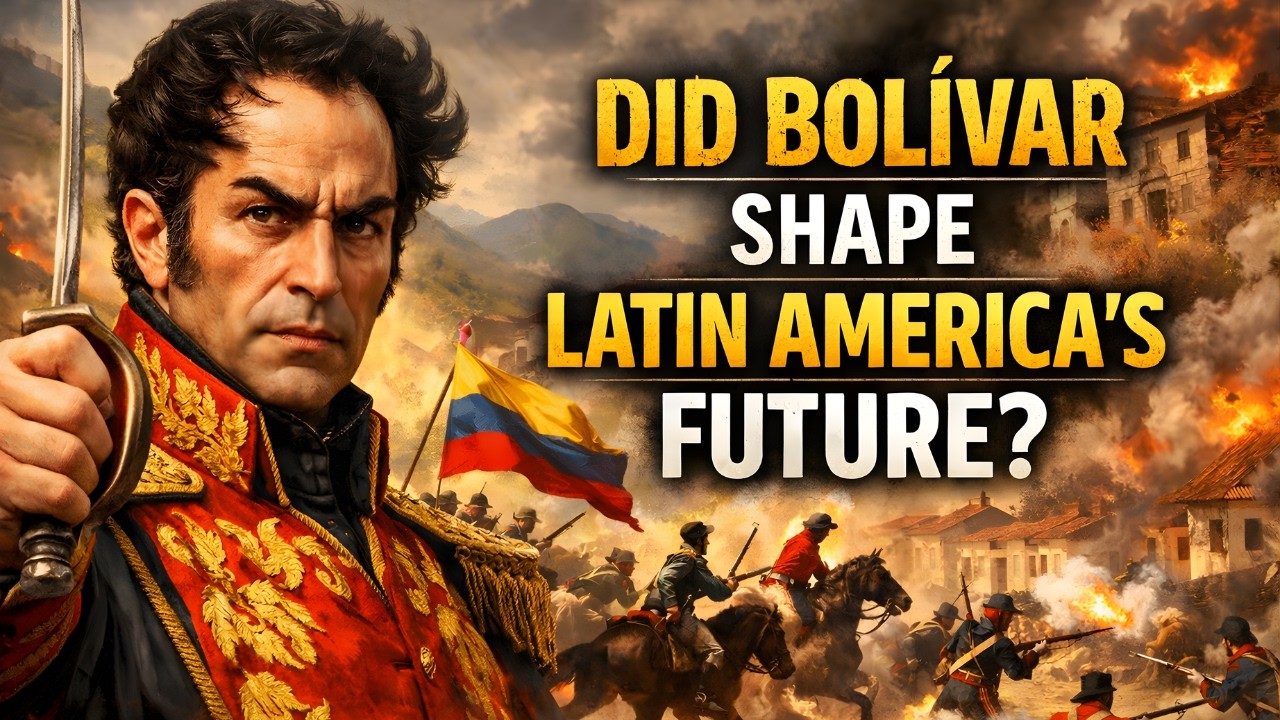
Simón Bolívar occupies a singular position in the political formation of the Western Hemisphere, yet his significance rests less on battlefield glory than on how his actions reshaped the geopolitical architecture of northern South America and exposed the structural weaknesses inherent in postcolonial states. Born in Caracas in 1783, Bolívar emerged from the uppermost tier of colonial society, inheriting wealth derived from land, mineral extraction, and the coerced labor systems that sustained the Spanish imperial economy. This background placed him inside the very structure he would later attempt to dismantle, and the contradiction between his elite status and his revolutionary objectives would define his political career and inform many of his later failures. Early bereavement removed Bolívar from traditional parental authority and placed him under fragmented guardianship, an instability that contributed to his lifelong resistance to centralized control when it was exercised over him, even as he later attempted to impose centralized authority on others.
His intellectual development accelerated under Simón Rodríguez, whose radical Enlightenment interpretations emphasized civic virtue, republicanism, and the volatility of popular rule. Rodríguez’s influence planted an enduring tension in Bolívar’s thinking between liberty as an ideal and order as a necessity. European exposure further sharpened this conflict. Bolívar observed the collapse of republican principles during the French revolutionary cycle and the transformation of Napoleon Bonaparte from reformer to autocrat.
Rather than producing simple admiration or rejection, this experience convinced him that independence movements without disciplined authority would collapse into internal armed conflict. This conclusion would later justify his support for strong executive power and lifelong presidencies. The political opportunity for rebellion emerged from imperial decay rather than ideological unanimity. Spain’s administrative paralysis during the Napoleonic Wars fractured colonial legitimacy and disrupted transatlantic governance.
Local juntas arose not from popular consensus but from elite competition for authority. Bolívar aligned himself with these movements while remaining skeptical of their durability. Militarily, Bolívar functioned less as a tactician and more as an operational strategist. He delegated battlefield command frequently while focusing on mobility, logistics, and coalition building.
His campaigns relied on speed, surprise, and exploitation of terrain rather than sustained conventional engagements. The Andes crossing succeeded not through superior numbers but through calculated risk that exploited Spanish assumptions about geographic impossibility. Attrition from disease and exposure often exceeded battlefield losses, a logistical cost rarely emphasized in celebratory accounts. A lesser-discussed factor in Bolívar’s success was his selective use of emancipation as a military instrument.
Promises of freedom to enslaved communities were frequently conditional and strategically timed to increase manpower rather than to implement immediate social transformation. This approach expanded his armies while postponing structural reforms, contributing to post-independence instability. Bolívar’s political experiment reached its apex in the creation of Gran Colombia. This state functioned as a defensive framework rather than a cohesive nation.
Its administrative weakness stemmed from incompatible regional economies, rival military elites, and divergent colonial legacies. Bolívar’s proposed constitutional model, which included a strong presidency and a hereditary Senate, reflected his belief that republican survival required insulation from mass political volatility. This design alienated former allies who equated independence with decentralization. A rarely considered downstream consequence of Gran Colombia’s collapse was the entrenchment of military-backed strong leaders across the region.
The vacuum left by Bolívar’s failed central authority normalized caudillo rule, delaying institutional development and reinforcing cycles of civil conflict throughout the nineteenth century. Bolívar’s personal relationships intersected directly with state security. Manuela Sáenz functioned not only as a companion but as an intelligence asset within elite political circles. Her intervention during the 1828 attempt on his life altered the trajectory of regional leadership and temporarily preserved the union.
Without that intervention, Gran Colombia would likely have fragmented earlier under rival claimants. By the end of his life, Bolívar confronted the paradox of revolutionary leadership. He achieved territorial liberation without securing political cohesion. His resignation reflected strategic exhaustion rather than ideological retreat.
His passing in 1830 removed the final unifying symbol from a region already in the process of fragmentation. Modern Latin America struggles with centralized power, military influence in politics, and fragile institutions, and these problems did not appear by accident. They trace back to the independence era and to decisions made under Bolívar’s command. The common narrative treats these revolutions as completed stories, but in reality they remain unfinished processes.
Bolívar’s reliance on strong executives and armed institutional authority normalized governance by force rather than consensus. The political patterns visible today are not deviations from the past; they are its continuation. Bolívar’s long-term legacy extends beyond commemoration. His career illustrates the structural limits of revolutionary authority in post-imperial societies and the difficulty of translating military victory into stable governance.
The states that emerged from his campaigns inherited independence alongside unresolved conflicts over sovereignty, citizenship, and power concentration. These unresolved tensions continue to shape Latin American political development well into the modern era, raising the question of whether nations can ever escape the structures created at their birth.