She never raised her voice. She never had to. In sixty years at the center of the British royal family, Queen Mary did not destroy careers or sever relationships with anger or confrontation. She did it with a silence so precise and so complete that those on the receiving end often said it felt worse than anything she could have shouted.
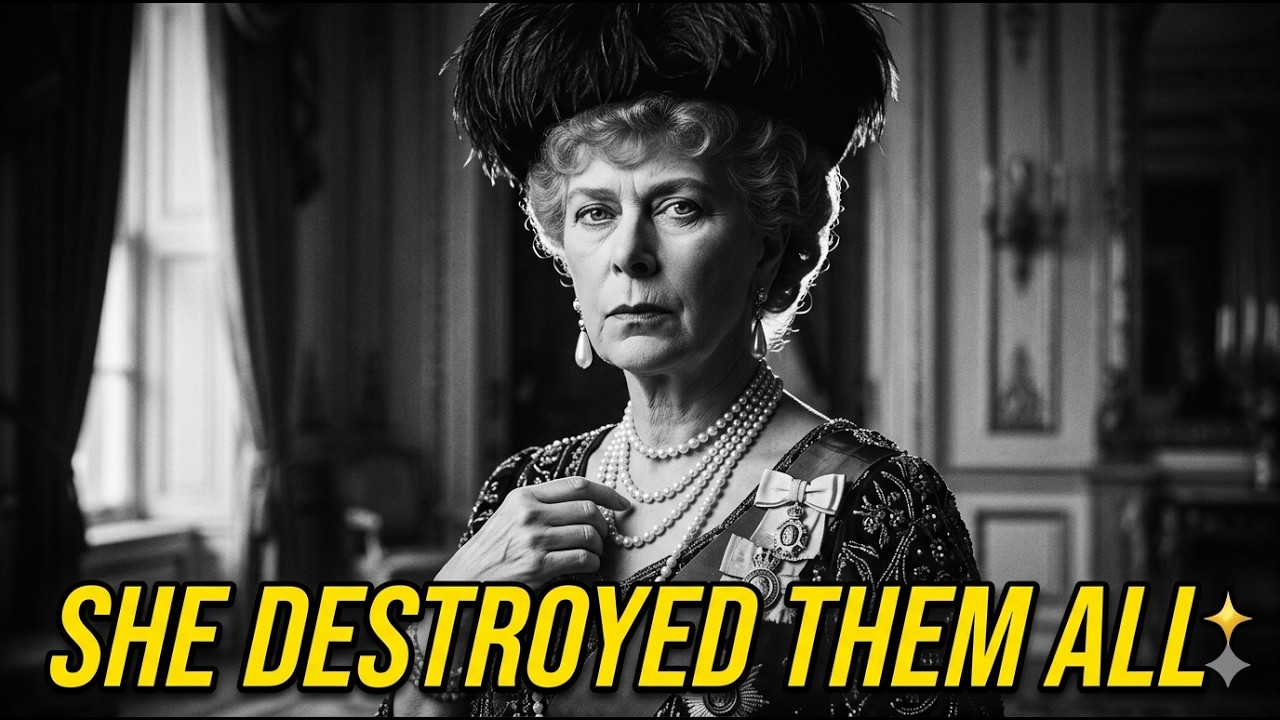
The courtiers who served her called it being put on the outside. Once you were put on the outside of Queen Mary’s regard, you did not come back. Mary Victoria Mary of Teck was born on May 26, 1867, at Kensington Palace in London. Despite that grand address, her early life was one of precariousness.
Her father, Francis, Duke of Teck, was a minor German royal with a significant title and almost no money. Her mother, Princess Mary Adelaide of Cambridge, was a granddaughter of King George III, but she shared her husband’s cheerful inability to live within any kind of budget. The family moved constantly, spending long periods abroad in Florence partly because life in Italy was cheaper and partly because their creditors in England were becoming difficult to ignore. Young Mary, called May by those close to her, grew up understanding something many children of her background never had to confront.
Appearances and reality were two entirely different things. What mattered in the world she was being prepared to enter was the appearance. The reality could be managed. The appearance had to be maintained.
What this produced in Mary was not bitterness. It produced something more durable. It produced discipline. She decided somewhere between childhood and adulthood that she would never be caught unprepared, never be caught without the right answer, the right posture, the right expression.
She would master whatever was required of her completely and without complaint, and she would expect others to do the same. It was a code she lived by for the rest of her life, and it was a code she enforced on everyone around her. The story of how Mary entered the royal family contains the first real glimpse of the iron that ran through her. In 1891, she became engaged to Prince Albert Victor, Duke of Clarence, the eldest son of the then Prince of Wales.
The engagement was, by all accounts, not a love match. It was an arrangement, practical, dynastic, appropriate. But in January of 1892, Prince Albert Victor died. He was 28.
Influenza, which progressed rapidly, took him within weeks. Mary was 24, suddenly the ex-fiancée of a dead prince, placed in an awkward position that had almost no precedent. Most women of her background and era would have retreated. Mary did not.
Queen Victoria decided that Mary of Teck was too suitable, too well prepared, too perfectly formed for the role of royal consort to be released back into ordinary life. With a pragmatism almost startling in its directness, the question was raised of whether Mary might instead marry the new heir, Prince George, Duke of York, the second son who was now unexpectedly next in line. They became engaged in May of 1893 and married in July of the same year. What this episode revealed about Mary was not simply her resilience.
It revealed her fundamental orientation toward duty. She moved through the loss of her fiancé and the uncertainty of her position with her composure entirely intact. She did not perform grief. She did not perform recovery.
She simply continued. To work for Queen Mary was to enter a world of very specific requirements. She was extraordinarily knowledgeable, having educated herself with a thoroughness that went well beyond what was expected of women of her generation and class. She knew art history with the precision of a curator.
She knew genealogy with the detail of an archivist. She knew the history of the royal family, every branch, every connection, every piece of silver, furniture, or jewelry that had passed through its various houses. And she expected you to know things too, the things relevant to your position. A lady in waiting who stumbled over a basic question of protocol was not someone Mary would visibly embarrass in the moment.
She would note it. She would file it. And the next time there was an opportunity to determine whether that person was suited to their role, the stumble would be remembered. This was what made serving her so particular.
She did not punish mistakes immediately and visibly in the way of someone with a short temper. She punished them slowly, invisibly, and completely. The mistake you made in March might be what cost you your position in September, and you might never connect the two moments. Her memory was both her greatest gift and her most formidable weapon.
She remembered everything. She remembered what you had said at a dinner years ago. She remembered the expression on your face when you delivered a piece of news she had found unpleasant. Queen Mary did not express disappointment the way most people do.
She did not sigh or complain or take someone aside for a gentle word. She expressed disapproval through signals so subtle that an outsider might miss them entirely. But to those who had spent time in her orbit, those signals were as clear as a shout. There was first the look, a particular stillness of expression that communicated with extraordinary precision exactly how far below her expectations you had fallen.
It was not a glare. It was not a frown. It was more like the expression of someone who has just encountered an unexpected object in their path and is deciding calmly what to do about it. The look contained no heat.
That was what made it so effective. Anger you could argue with. This look was beyond argument. Then there was the silence.
Mary used silence the way a conductor uses a pause in music, not as an absence of communication, but as communication itself. If you had said something that disappointed her, she would not respond immediately. She would let the silence extend and grow into the room, filling the space where your words had been until you became entirely aware of how inadequate those words had been. And when she did speak, she might say something entirely unrelated, and you would understand that the subject you had raised was, as far as she was concerned, closed.
Not resolved. Closed. Resolved would have meant there had been a conversation. Closed meant she had decided unilaterally, without appeal.
Finally, there was the withdrawal. If someone had truly and significantly disappointed her, not stumbled in a small way, but failed in a way that touched on character or loyalty, she withdrew from them. Not dramatically, not publicly, simply quietly and completely. The invitations that had previously come began not to come.
The warm acknowledgement that had marked her dealings with them became merely correct, polite, appropriate, and entirely emptied of anything personal. They were still in the room, but they had been, in every way that mattered, removed from it. At the heart of her demands was something she would not have described as perfectionism. She would have described it simply as the minimum required standard, the floor, not the ceiling.
She expected punctuality with an absoluteness that left no room for context or excuse. She expected appearance to be considered and appropriate at all times. She expected discretion so complete it was almost invisible. But above all else, she expected loyalty.
Not the simple loyalty of doing your job well, but a loyalty that was more total. The understanding that your primary allegiance was to the institution of the monarchy and to the family that embodied it, not to your own comfort or your own emotional needs. The people who disappointed her most profoundly were always those who had placed something personal above something institutional, who had let their own feelings intrude on their responsibilities, who had made a decision based on what they wanted rather than on what was required. This was for Mary the most fundamental failure, and it was one she found almost impossible to forgive.
Her children understood the weight of her expectations intimately. The eldest was Edward, called David by his family, the Prince of Wales, who would briefly become King Edward VIII before abdicating in 1936. He was in many ways the one who hurt her most. Not because he was the worst of her children in any objective sense, but because he was the heir.
Everything, the entire structure of her life’s work, was oriented toward producing a king. And David was going to be that king. And he was almost from the beginning exactly the wrong shape for it. David’s charm was specific.
It attached. It sought connection in a way that made people feel genuinely seen, which was wonderful for those people and quietly alarming for his mother. Mary saw this wanting as a kind of weakness. She had decided long ago that what you wanted was irrelevant compared to what was required.
She had applied this logic to herself. She had wanted things, comfort, security, the kind of easy warmth that her position never quite permitted, and she had set those wants aside because setting them aside was what duty demanded. Why could her son not do the same? What she could not quite access was the understanding that her son was not her, that the same discipline she had imposed on herself with something like relief was for David a kind of suffocation.
Where she experienced the palace as a place of meaning, he experienced it as a trap. In 1936, David met Wallis Simpson, and everything that had been building for decades finally arrived at its conclusion. Queen Mary told the story of the abdication to herself as a betrayal. It was not simply a personal failing.
It was a philosophical failure. It was a repudiation of the entire framework she had spent her life building and defending. The framework that said you do not choose. You do not weigh the institution against your own comfort and decide in favor of your comfort.
You simply do what is required, always, without exception. She wrote him a letter after the abdication. It was not a tender letter. It was in its way a document of prosecution, carefully, coolly written, setting out the nature of his failure in terms that left no room for alternative interpretation.
She told him that he had caused immeasurable damage, that he had failed his duty to the crown, to the family, to the country. What was notable to those who read the letter was what it did not contain. It did not contain an expression of grief. It did not invite him to explain himself.
It simply stated what he had done and what it meant. And then, as she did with all things she had decided were closed, she moved on. She remained for the rest of her life largely unwilling to engage with the question of David in any meaningful emotional way. He had disappointed her in the most fundamental way possible.
He had chosen himself, and she did not have a category for that. The second son was Albert, called Bertie, who would become King George VI after his brother’s abdication. Bertie was in many ways the child who tried hardest to meet his mother’s standards. He was earnest in a way that David was not.
He wanted genuinely to do the right thing. But Bertie was also frightened. He had been a frightened child, sensitive, anxious. The stammer was perhaps the most visible manifestation of this, but it was not the only one.
Queen Mary’s response to this anxiety was consistent with her response to everything else that fell below her standards. She did not soften expectations. She simply maintained them and trusted that the gap between his current performance and the required standard would motivate him to close it. This is not an approach that works well with anxious people.
What anxious people need is a reduction in the pressure of expectation, a sense that they are acceptable as they are. Bertie broke the cycle eventually through his relationship with his wife Elizabeth and through his work with his speech therapist, Lionel Logue. He was able, gradually and with significant effort, to build himself into a king. But the courtiers who watched both mother and son understood something that neither of them would have said aloud.
Bertie had become the king he became partly in spite of his mother’s methods, not because of them. Of all the children of Queen Mary and King George V, the one whose story is most painful is the youngest, Prince John. Born in 1905, he had epilepsy and what would now be recognized as some form of developmental difference. In the royal household of the early twentieth century, there was no framework for this.
The decision was made to remove John from the main family household. He was established with his own small household at Wood Farm on the Sandringham estate under the care of his devoted nurse, Mrs. Bill. He was not mistreated, but he was separated.
He did not appear at family events. He was not included in the family photographs released to the public. He existed to the outside world as a kind of absence. John died in January 1919 at the age of thirteen following a severe seizure.
Mary’s response to his death was characteristically controlled. She wrote in a letter to a friend that it was a great release for him and for them. Those words have been quoted many times since, almost always as evidence of coldness. But those who have tried to understand her more completely suggest that what she was expressing was not indifference, but a particular kind of grief translated into the only language she had.
The courtiers who served Queen Mary operated within a small world where nothing happened unnoticed. There was the case of a courtier who had served the household for several years with considerable competence. He made a mistake that was not in the conventional sense a professional mistake at all. He had been present at a private gathering and later mentioned something from it in what he believed was a safe social context.
He had not set out to breach a confidence. He had simply talked the way people talk without calculating the full weight of what he was saying. Mary investigated how the information had traveled and where it had originated. The standard she required was not the standard of someone who was careful when they believed they were being observed.
The standard she required was the standard of someone for whom discretion was not a conscious practice but a fundamental orientation. He was not confronted. There was no formal accusation. What happened instead was the withdrawal, subtle at first, then continuing.
The assignments that had previously come to him began to go elsewhere. The access he had accumulated over years of service began quietly to contract. He served out the remainder of his time in the household in this diminished state, never quite understanding what had happened, never given the clarity of a direct confrontation that might have allowed him to apologize or explain. This was in some ways the most cruel aspect of Queen Mary’s method.
Not that she punished, but that she punished without explaining. The First World War created for the British royal family complications that went far beyond the ordinary difficulties of wartime. The family had German roots that were deeply uncomfortable in the context of a war against Germany. The king’s own name, Saxe-Coburg and Gotha, was a German dynastic name that, as anti-German sentiment intensified, became an increasing liability.
The royal family had relatives on both sides of the conflict. The Kaiser, against whom Britain was now at war, was King George’s first cousin. Mary managed this with the same methodical precision she brought to every problem. In 1917, the family name itself was changed from Saxe-Coburg and Gotha to Windsor, a name chosen for its quintessentially English associations.
Mary did not resist any of this. She understood it as a necessity and implemented it with the same absence of visible distress that characterized her response to every difficult decision. The Second World War found Mary at seventy-two. She had been a widow for three years.
King George V had died in January of 1936, the same year as the abdication. She moved to Badminton House in Gloucestershire, the home of her niece, and remained there for the duration of the war. At Badminton, Mary worked. She did not simply reside.
She organized a program of activity that engaged both herself and her household in the practical work of wartime. Ivy and undergrowth were cleared from the estate. Timber was managed. She was in her seventies, a woman who had spent her life in palaces, supervising the clearing of ivy from walls with the same focused attention she had brought to state occasions.
The courtiers who were with her described moments when the news of losses registered in her in ways that sometimes showed, not dramatically, but in small momentary alterations of expression that those who knew her well recognized as significant precisely because they were so rare. They responded to it with the same discretion that she had always required by not acknowledging it. The relationship that mattered most in her final years was with her granddaughter Elizabeth. Elizabeth had been observing her grandmother since early childhood, studying her, absorbing an understanding of what the role required.
Not the formal requirements, but the deeper requirements, what it actually meant in the lived reality of daily existence to be the person at the center of the institution, to carry the weight of it continuously, to maintain the standard always, in the small moments and the private ones and the ones where no one was watching. Mary communicated this understanding not through instruction but through example, through the simple sustained demonstration of what it looked like to inhabit the role completely. When Elizabeth’s father died suddenly in February of 1952 and the weight of the crown descended onto her at twenty-five, those who knew both women observed a quality in the new queen’s bearing that reminded them with sometimes startling precision of her grandmother. The same composure.
The same completeness of presence. King George VI died on February 6, 1952. He was fifty-six. Mary received the news and was, by all accounts, devastated.
This was perhaps the loss that cost her more than any other because Bertie had been, of all her children, the one she felt she best understood. She survived him by seven weeks. She died on March 24, 1953, at Marlborough House at the age of eighty-five. Her granddaughter Elizabeth had been queen for seven weeks.
Mary had made it known in her final weeks that whatever happened to her, the preparations for Elizabeth’s coronation should not be interrupted. The coronation took place on June 2, 1953, as scheduled. She was not there to see it, but in another sense she was entirely there, in the bearing of the young queen who had learned from her what bearing meant, in the standards maintained by the household she had shaped across decades. She had formed them imperfectly, as all formation is imperfect, at a cost, as all formation has a cost, with losses alongside the gains, with damage alongside the development.
But she had formed them, and they carried her forward. Queen Mary destroyed anyone who disappointed her. The courtiers who watched never forgot it, but they also never forgot her.
Not simply as someone who had demanded everything and accepted nothing less, but as someone who had been in the fullest and most complicated sense of the word real.