In 1951, a young dermatologist named Albert Kligman walked through the gates of Holmesburg Prison in Philadelphia. He had been invited by the warden to treat an outbreak of athlete’s foot among the inmates. It was a routine consultation, the kind of errand that happens at prisons across the country without anyone writing it down. But Kligman later described that first walk in a single sentence that would outlive everything else about him.
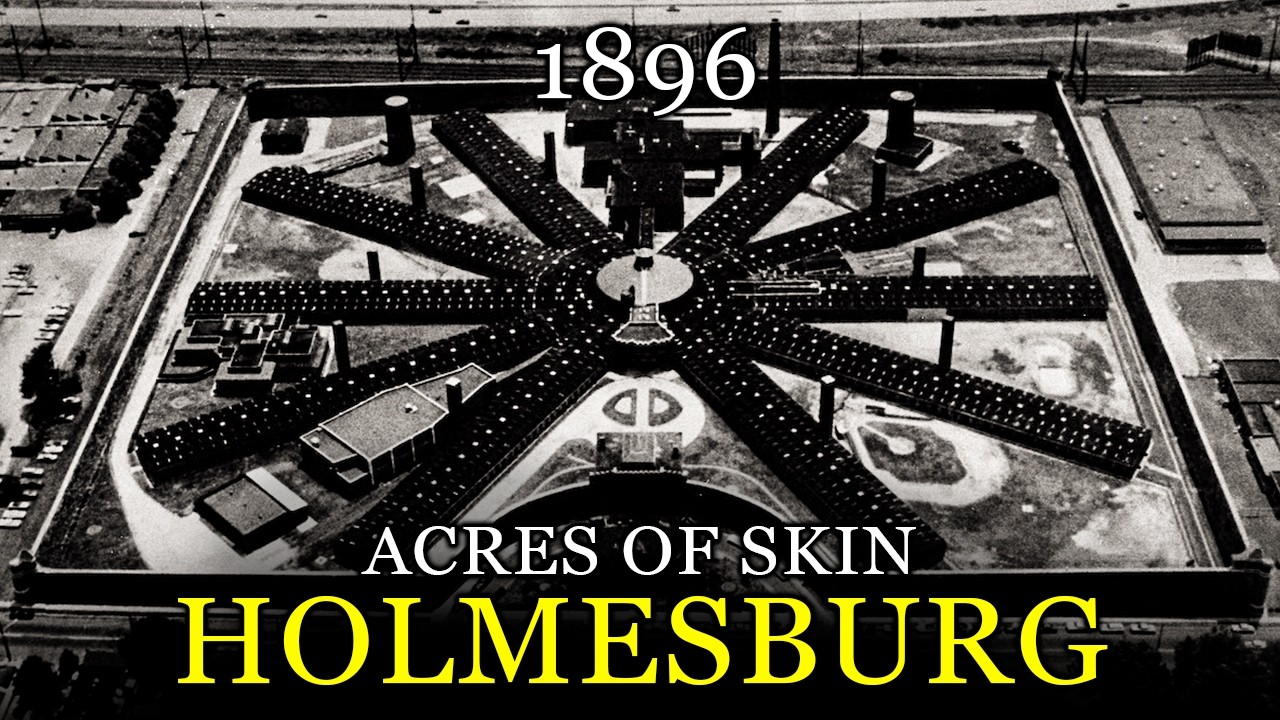
All he saw before him, he said, was acres of skin. It was, he said, like a farmer seeing a fertile field for the first time. Over the next 23 years, Kligman turned that field into one of the largest and longest-running programs of human experimentation ever conducted on American soil. Using the bodies of men held inside a single Philadelphia prison, he tested cosmetics, pharmaceuticals, radioactive isotopes, hallucinogens, chemical warfare agents, and a component of Agent Orange.
The work was done on contracts with some of the largest corporations and government agencies in the country. More than 250 different compounds were tested. Nine out of every ten men who passed through the prison during the active years of the program participated. The inmates were paid a dollar a day.
Kligman collected thousands, sometimes tens of thousands, of dollars from the companies buying access to them. The prison itself was never an original idea. It was a copy. In 1829, Philadelphia opened Eastern State Penitentiary, designed by John Haviland on a radial plan, a central hub with cell blocks extending outward like spokes on a wheel.
It was built to enforce a philosophy called the Pennsylvania system, which held that total isolation and enforced silence would produce genuine penitence. The building’s name for that idea is baked into the English language. That is where the word penitentiary comes from. Haviland’s design became enormously influential, copied across the country and around the world.
Holmesburg, designed by Wilson Brothers and Company and opened in 1896, was built on the same plan, a central rotunda with ten cell blocks radiating outward, massive fieldstone walls giving it the look of a medieval fortress. It was built to relieve overcrowding at Moyamensing Prison and was originally conceived as three separate facilities under one roof, with dedicated wings for female prisoners and for debtors, a category of confinement that was already fading from common use. The founding philosophy of separate confinement did not survive contact with overcrowding, which arrived almost immediately. By the late 1920s, cells designed to hold one man in isolation were holding three.
Riots broke out in 1928, driven in part by that compression. The original design had demanded that a single occupant live in a tiny sealed world, a narrow slit in the ceiling for a controlled ration of daylight, thick stone walls to prevent any communication with a neighbor, enough isolation that a man would have nothing to occupy his mind but reflection on his crime. Multiplying that population by three produced not solitary reflection but forced unrelieved proximity to two strangers inside a space built explicitly to prevent human contact. Holmesburg’s reputation for brutality set in early.
A 1922 expose in the Evening Public Ledger called it, in a phrase that stuck to the building for the rest of its existence, the worst prison in the United States. Inmates in that era were kept in solitary confinement and permitted only 20 minutes of exercise a day. The brutality expressed itself in ways both explosive and quietly bureaucratic. In August 1938, roughly 650 inmates, about half the prison’s total population, launched a hunger strike over the quality and repetitiveness of the food.
The superintendent, William Mills, dismissed the request outright. There is only one committee running this prison, he told reporters, a committee of one, and that’s me. The prison locked the strike leaders into an isolation unit the inmates themselves called the Klondike, a small building outfitted with oversized steam radiators. Over a single brutal August weekend, guards turned the heat up.
The temperature inside reportedly climbed to nearly 200 degrees. Four hunger strikers died in their cells, cooked in the most literal sense the word allows. When Pennsylvania’s governor personally visited to investigate, he emerged shaken enough to tell reporters that the press had, if anything, understated the horror of what had happened. Fourteen prison staff members were eventually charged.
Of those, only two were ever convicted, and both received light sentences. The Klondike stood for decades afterward as a physical monument to what had happened inside it, before it was finally torn down in the 1970s. The violence did not end there. A two-year investigation completed in 1968 documented hundreds of cases of the rape of inmates inside the prison, an epidemic of sexual violence that had been occurring largely without institutional response.
It produced remarkably little in the way of structural change. In 1970, roughly 100 prisoners armed themselves with meat cleavers, boning knives, makeshift pitchforks, and table legs, and rioted through the facility, destroying the dining hall and attacking other inmates and guards. Nearly 100 people were injured. The improvised nature of those weapons, kitchen tools and furniture legs, says something about how completely violence had become woven into the ordinary fabric of daily life inside the prison.
A subsequent lawsuit produced some limited reforms, though the population pressures that had driven Holmesburg’s problems since the 1920s were never genuinely resolved. In February 1971, an inmate named Joseph Bowen, nicknamed Jo-Jo, already notorious for having shot and killed a 16-year veteran Philadelphia police officer during his own capture weeks earlier, stabbed both the prison’s warden, Patrick Curran, and its deputy warden, Robert Fromhold, to death inside Holmesburg’s walls. The killing of two senior prison administrators inside their own facility meant that even the two men at the very top of the prison’s chain of command were not safe inside the building they were responsible for running. Eight years later, still incarcerated, Bowen forced a six-day hostage siege at a different Pennsylvania prison, ended only after tense negotiations backed by a large deployment of state police.
When the facility that eventually replaced Holmesburg opened across the road, the city named it after the two murdered men, the Curran-Fromhold Correctional Facility. But of everything that happened inside those fieldstone walls across 99 years of operation, none of it produced the lasting national reckoning that came from a program that was neither a riot nor a murder nor an act of guard brutality at all. It was medicine. What Kligman found once he was inside, and what he did with what he found, would occupy the rest of his professional life.
He looked out across the prison yard and saw four acres of skin. A farmer does not see a field of individuals. He sees an undifferentiated resource, arable land to be planted, cultivated, and harvested according to his own schedule and for his own benefit. Kligman began modestly with patch testing, applying substances like perfumes, detergents, and cosmetic formulations to small areas of inmate skin.
It did not stay modest. Over the following two decades, Kligman built out research contracts with a roster of clients that reads like a cross-section of mid-century American industry and government. Johnson & Johnson hired him to compare the effects of asbestos against talc, injecting the substances into roughly a dozen incarcerated men. Research that would resurface decades later in lawsuits over whether the company’s talc-based products caused cancer.
Dow Chemical paid Kligman $10,000 to apply dioxin, the highly toxic contaminant responsible for much of Agent Orange’s harm to human health, to the skin of Holmesburg inmates in doses that documentation later established sometimes exceeded what Dow itself had specified for the study. Approximately 75 prisoners were exposed to high doses of dioxin. The United States Army contracted with Kligman to test hallucinogenic and psychotropic substances, including LSD, on the prison’s population, alongside broader work involving chemical warfare simulants. Inmates were also inoculated with experimental vaccines and infectious agents, including herpes simplex and candida, and exposed to radioactive isotopes as part of separate research programs running in parallel with the rest.
Over the full course of the program, researchers working under Kligman’s direction tested more than 250 different chemical compounds. Some accounts suggest that as many as nine in every ten men who passed through Holmesburg during the active decades underwent some form of testing. Holmesburg had become a standing human research facility hiding in plain sight inside the walls of an ordinary city jail. The population supplying that testing infrastructure was overwhelmingly black, a demographic reality Kligman never obscured and that historians have consistently identified as central to how the program was able to operate at the scale and duration it did.
The mechanism that made all of this possible was money. Inmates who participated were paid from as little as a dollar a day up into the hundreds for the riskier or longer studies. In just one recorded year, 1959, the entire pool of participating inmates collectively earned $73,000. In a system that offered incarcerated people almost no other way to earn money for commissary items, for bail, for supporting family on the outside, the choice to participate in an experiment was rarely a free one.
Bioethicists have used a specific term for this dynamic, undue influence. Consent obtained from people who are not genuinely free to decline because the alternative is having no money at all. The consent itself, such as it was, was frequently not informed. Men who experienced adverse reactions had in some cases signed forms for experiments that did not even specify which particular chemical they were being exposed to.
Kligman did not conduct any of this in secret. The work was published, presented at conferences, cited in the scientific literature, and it built him a career of genuine professional distinction. In 1967, working from research that grew directly out of the Holmesburg testing infrastructure, Kligman developed the compound that would become Retin-A, licensed to Johnson & Johnson and brought to market in 1971 as a treatment for acne. Later marketed even more successfully as an anti-aging cream.
Retin-A made an enormous amount of money for Kligman, for the University of Pennsylvania, and for Johnson & Johnson. It remains one of the most widely used dermatological compounds in the world. Kligman received the Philadelphia College of Physicians Distinguished Achievement Award in 2003. He remained on the University of Pennsylvania’s faculty for more than 50 years.
There is a rumor about Holmesburg that circulates persistently, that Kligman and his collaborators deliberately infected inmates with lethal chemicals and that the deaths were then quietly recorded as murders committed by other prisoners. It is not supported by the documented historical record. The prison’s genuinely high death and injury rate over the decades is attributable to the combination of overcrowding, endemic violence, documented atrocities like the Klondike, and the real, extensively researched harms of the Kligman experiments themselves, none of which required any conspiracy. The true, documented history does not need an invented cover-up layered on top of it.
It already is one of the most disturbing stories in the entire history of American medical ethics. What actually ended the Kligman program was a slower convergence of forces across the early 1970s. Growing national scrutiny of research ethics, driven substantially by the public reckoning over the Tuskegee syphilis study, which broke into major national news in 1972, made prison-based human experimentation an increasingly untenable practice. Federal guidelines governing research on incarcerated populations tightened considerably.
The city of Philadelphia formally closed its prisons to human research programs in 1974. Kligman’s 23-year run came to an end, not through prosecution or a court ruling, but through a policy door the city finally closed as part of a nationwide regulatory shift. The public reckoning arrived decades late and largely without legal consequence. In 1998, a criminal justice professor named Allen Hornblum published Acres of Skin: Human Experiments at Holmesburg Prison, a book built substantially on his own first-hand experience working inside the prison system.
Hornblum had worked as a literacy volunteer at Holmesburg in the early 1970s, near the very end of Kligman’s active research period, and had personally witnessed inmates covered in patches and bandages from ongoing tests. The book’s title borrowed Kligman’s own words back to him. The same farmer surveying his field line, now presented as the epitaph for everything that followed. The book’s publication produced a genuine wave of public attention and congressional interest.
In the year 2000, close to 300 former study participants filed suit against the city of Philadelphia, the University of Pennsylvania, Kligman personally, Dow Chemical, and Johnson & Johnson, seeking damages for exposure to infectious diseases, radioactive isotopes, and psychotropic drugs without informed consent. The lawsuit never reached a jury. In 2001, a court ruled that the statute of limitations on the claims had already expired, and the case was dismissed without any of the underlying allegations ever being tested at trial. Johnson & Johnson and Dow Chemical both publicly acknowledged having conducted testing on Holmesburg prisoners while disputing specific details of the claims.
Kligman himself never faced any formal disciplinary or legal consequence. He died in 2010 at the age of 93, celebrated to the end of his life as one of the pioneering figures of modern dermatology. In 2021, the Dean of Penn Medicine issued an apology calling Kligman’s experiments disrespectful, the first formal acknowledgement the university had ever made. In October 2022, the city of Philadelphia, through the mayor’s office, issued a formal apology for the experiments, acknowledging that approximately 300 inmates had been exposed to pharmaceuticals, viruses, fungus, asbestos, LSD, and dioxin between the 1950s and the 1970s.
In January 2023, the College of Physicians of Philadelphia, America’s oldest medical society, and the same body that had honored Kligman with a lifetime achievement award two decades earlier, issued its own formal apology for its association with him. None of those apologies came with compensation. None reopened the litigation. What they amounted to, 70 years after Kligman’s first walk across that yard, was an acknowledgement that the men who supplied the acres of skin had been telling the truth the whole time.
Holmesburg Prison itself closed in 1995, 99 years after it opened. But closure never meant demolition, and it never meant a clean ending. Portions of the site were briefly reopened in 2000 to hold protesters arrested at that year’s Republican National Convention. In the mid-2000s, the city renovated the old gymnasium to hold overflow prisoners.
By 2009, city officials were seriously discussing housing hundreds more inmates inside the supposedly closed prison. A former deputy mayor for public safety put the actual status of the place bluntly. The city, he said, had never really closed it. As recently as 2025, Philadelphia’s prison administration was still describing Holmesburg in exactly those terms, shuttered since 1995 but never fully surrendered, still occasionally pressed back into service for overflow and work programs.
The Philadelphia Department of Prisons still operates a training academy on part of the grounds. Most of the original structure sits empty and deteriorating. Photographers and artists have been drawn to the decay. In 2005, the photographer Thomas Roma published a book documenting cell wall drawings and other marks left behind by the men who once lived inside those rooms.
Tally marks, names, dates, fragments of writing. A fragile human record persisting inside a building that has spent nearly three decades being neither preserved nor torn down. The distance between the tube of Retin-A on the pharmacy shelf and the man who signed a form that didn’t name the chemical is the entire moral history of Holmesburg Prison compressed into a single supply chain that nobody buying the product has ever had any reason to trace. None of it required an isolated madman or a single moment of unforgivable cruelty.
It required only an entire functioning system of universities, corporations, and government agencies agreeing for 23 consecutive years that a captive population’s consent could be purchased for a dollar a day, and then simply continuing to buy it year after year, contract after contract, compound after compound, until men whose skin had been treated by the very system responsible for their care as nothing more than acreage waiting to be worked.