The Lewis family spent five decades promising America a happy ending. Every Sunday, in living rooms across the South, Pop Lewis and his eight children delivered ninety minutes of sequins, slapstick, and machine-gun banjo that made millions forget their troubles. But no happy ending ever came. There was no plane crash, no scandalous overdose.
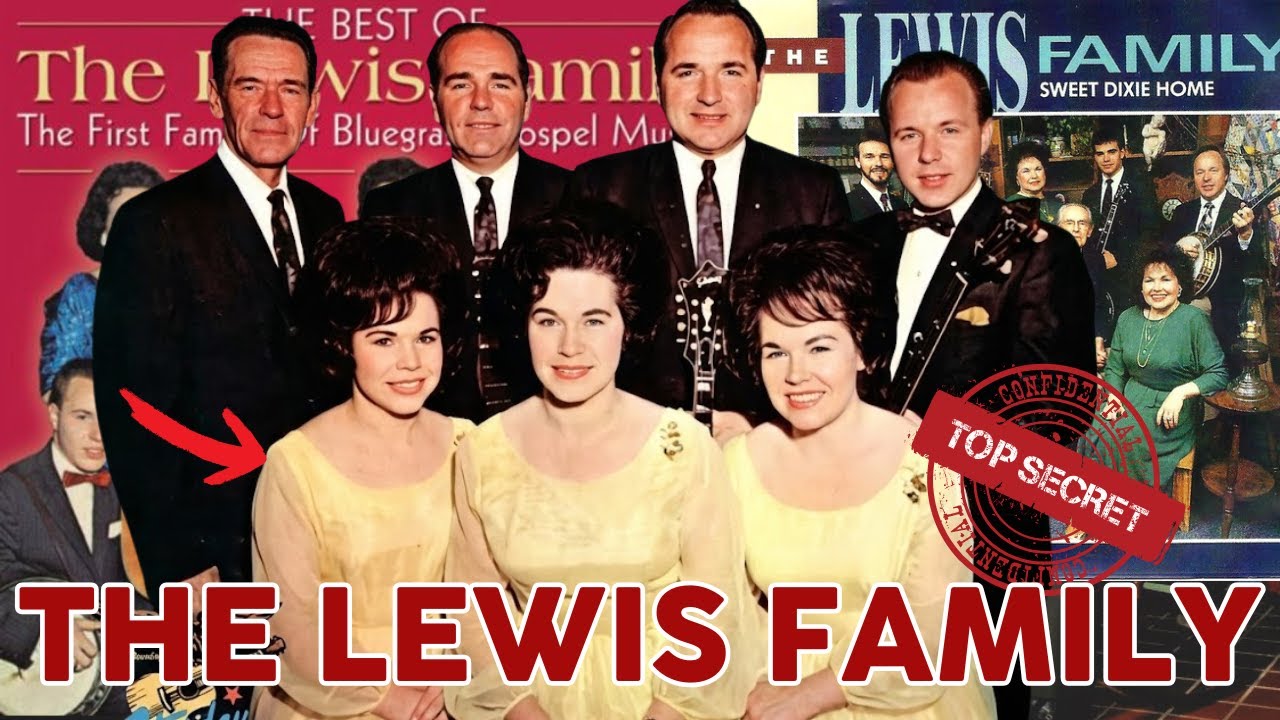
The tragedy was slower and more inescapable. Parkinson’s disease and heart failure dismantled the most joyful dynasty in bluegrass gospel, piece by piece, in full view of the audience that loved them. The family was forged not in the granite of the Appalachians but in the red dirt of Lincolnton, Georgia, deep in the cotton belt of the 1940s and 1950s. Roy “Pop” Lewis was a cotton farmer and builder, a landowner who understood the value of an asset.
With eight children, the household was chaos set to music. But unlike other families, where gospel was performed with stoic, funeral dignity, the Lewises treated it as a game. They brought the living room to the stage and realized you could praise the Lord and have a good time doing it. The lineup was a study in balance.
Pop sang the steady, rhythmic talking bass of the front porch, the straight man who kept the chaos in check. His daughters Miggy, Polly, and Janice fronted the band at a time when women in bluegrass were almost unheard of. Polly Lewis possessed a voice that was sharp, nasal, powerful, and utterly southern. She was the Sophie Tucker of bluegrass, glamorous, commanding, and fearless.
The sisters brought sequin dresses, beehive hairdos, and high heels to a genre known for men standing still in suits. And then there was the nuclear weapon: Little Roy. Born in 1942, Roy Lewis Jr. picked up the banjo at six and was playing with the ferocity of a grown man by nine.
He was not just a prodigy but a persona. In a genre of stillness, he was a blur of motion, a clown prince who learned that a gag could light up the phone lines faster than any solo. In 1954, WJBF, a television station in Augusta, offered them a slot. Television was hungry for content, and the Lewis family didn’t just perform; they hosted.
For 38 years they broadcast live every Sunday, bypassing the smoky honky-tonk circuit that killed so many other bands. They were invited into the sanctity of the American home, becoming neighbors to millions. But the glamour was a constructed reality. They worked all week, filmed the show, sewed their own costumes, loaded their own gear, and drove themselves to weekend gigs.
Musically, they occupied a strange lonely island. They were neither quite country, nor bluegrass, nor traditional gospel, but a hybrid of all three. While the mountain sound focused on death and sorrow, the Lewises focused on joy. Pop believed that Christianity was good news, so the music should sound like good news.
Songs like “Just One Rose Will Do” and “I’m Just an Old Chunk of Coal” were toe-tappers, not dirges. And Little Roy’s comedy was a Trojan horse: he got the audience laughing until their defenses dropped, then Polly stepped up and sang a song about the crucifixion that tore your heart out. By the 1960s, demand had outgrown Georgia. Pop bought a bus.
The bus culture was legendary: no drinking, no smoking, no cussing, just endless miles of asphalt, bologna sandwiches, and family arguments about who drove next. The human body is not designed to sleep in a moving vehicle for 200 nights a year, and the physical cost began to accrue early. Pop drove, managed, and carried the weight of the entire enterprise. The 1970s were the coronation.
The bluegrass festival boom turned promoters like Carlton Haney into builders of massive outdoor cathedrals of sound. Most bands stood in a semicircle and played with mathematical precision, then the Silver Eagle rolled in. The Lewises emerged like royalty from another planet. The sisters, in custom gowns shimmering under the lights, were the engine of the show.
Polly’s voice could cut through a bad sound system, a noisy crowd, and a windy day without losing a single frequency of pitch. The three sisters’ harmony wasn’t learned from a textbook; it was genetic blood harmony. Little Roy evolved into a comedic force of nature, the bluegrass Jerry Lewis. He pretended to fall asleep while picking the banjo at a hundred miles an hour, dragged Pop into skits that teetered on disrespect but always landed on affection.
But being the Funny Man carried an unspoken burden. He couldn’t have a bad day. If he was quiet, people asked what was wrong. Friends recall seeing him collapse into a chair backstage, staring at the wall, completely drained.
He burned the candle at both ends and the middle, sacrificing his reputation as a serious musician so the family got paid. The industry pressure to modernize grew in the late 70s and early 80s. Promoters hinted the Lewises needed drums, electric guitars, a slicker sound, but Pop refused. They stuck to acoustic instruments, old hymns, and the comedy.
They became living legends, respected but no longer current. Then tragedy fired a warning shot. Wallace, the quiet rhythm guitarist, the invisible backbone, began suffering serious heart problems. In the early 1980s he had to leave the road intermittently.
It was the first crack in the facade, a visual reminder that the family was biological, not immortal. Pop, a man who believed he could fix anything with a hammer, could not fix a failing heart. By the mid-1980s the family had logged over a million miles. They were tired.
But they couldn’t stop. They weren’t rolling in royalties; they were paid when they played. Mortgages, college tuition, and medical bills required constant fuel. So they kept driving, through blizzards in Pennsylvania, heat waves in Texas, while Pop dozed and Little Roy paced the aisle, dreaming up new jokes.
The 1990s should have made them extinct. Grunge and slick modern country dominated the charts. But they didn’t disappear; they became vintage. Festivals loved them as the last of the Mohicans, the unbroken link to a simpler America.
Inside the bus, however, the laughter was punctuated by the hiss of oxygen tanks and the rattle of pill bottles. Pop, approaching his late 80s, could no longer stand for a ninety-minute set. First a stool, then a chair. To the audience it was a charming concession to age; to the family it was a defeat.
The anchor was no longer holding the ship; the ship was carrying the anchor. Little Roy worked twice as hard to distract the audience from his father’s frailty, literally dancing to keep their eyes off the dying man. But what happened to Polly was Shakespearean cruelty. In the late 1990s fans noticed her smile stiffening and a tremor in her hand.
The diagnosis was Parkinson’s disease. For a vocalist, it is a thief. It steals breath control, articulation, and, most cruelly, causes facial masking, trapping a woman whose entire persona was built on joy in a face that refused to smile. She stood in her glittering gown, her left hand trembling uncontrollably, hiding it behind her back or gripping the microphone stand until her knuckles turned white.
She refused to quit. In the South, you don’t complain about your cross; you carry it. By 2000, the Silver Eagle was a rolling nursing home. Grandchildren helped Pop to the restroom, managed medications, and checked blood sugar at 2 a.
m. at truck stops. They were caregivers first, musicians second. Medical bills mounted, and cash flow only happened when they showed up.
So they kept driving, hostages to their own legacy. Wallace was the first to fully succumb. His heart condition made travel impossible, and for the first time in 50 years the lineup broke. The blood harmony had a hole in it.
Fill-in musicians were hired, but it wasn’t the same. Wallace’s retirement was a signal flare: the invincible family was dismantling itself organ by organ. In 2002 Pop played his last show. There was no farewell tour, no press conference.
His body simply said no more. He was 96 years old. The first show without him was a cultural shock. The banter between Roy and Pop, the core comedic element, was gone.
Roy was a comedian without a straight man, shouting jokes into a void. The shows became surreal; the audience came not for entertainment but as a vigil, cheering because Polly was still standing. The emotional contract had changed from entertainment to respect. Roy Pop Lewis died in 2004 at age 98.
The funeral in Lincolnton was a state event for the southern musical community; tour buses lined up for miles. But behind the eulogies lay economic terror. There was no inheritance, no royalties. The business model relied on presence.
If they didn’t play, they didn’t get paid. The grieving children got back on the bus and mourned on the highway. Polly’s decline moved from private struggle to public spectacle. Parkinson’s stole her ability to walk in heels, to hold a microphone steady.
A railing was installed on stage; then she had to sit through most of the show. Most cruelly, it stole her voice. The silver trumpet became breathy, then weak. Yet she sang.
The audience cheered not because the performance was perfect but because the effort was heroic. Wallace Lewis passed away in 2007. Then Miggy began to falter, suffering heart irregularities under the stress of the road. The front line looked like a casualty ward: Polly shaking, Miggy struggling for breath, Janice holding the harmonies together, and Little Roy running back and forth, trying to generate enough energy to keep the show afloat.
In 2009 the medical consensus was clear: the road was killing them. The decision to retire was an amputation. After 58 years, the longest-running family group in the genre’s history was ending. The farewell tour was a blur of tears and standing ovations.
When they sang “We Shall Meet Beyond the River,” it was no longer theological abstraction but literal hope. At the final official concert in the fall of 2009, the last notes faded, the lights went down, and the sisters walked slowly off the stage. They didn’t run back for an encore; they couldn’t. They climbed the bus steps one last time, and the door hissed shut.
Silence settled over Lincolnton. Polly’s world shrank from the size of a continent to the size of her living room. But Little Roy could not sit still. At 67, he formed the Little Roy and Lizzie Show with a multi-instrumentalist decades younger.
He took the bus and went back on the road. He couldn’t be a caregiver; he was born to be a clown. The family split not by anger but by the brutal divergence of health and capability. Polly Lewis Copsy died in 2018.
The bluegrass world felt grief and relief: grief because a giant had fallen, relief because the suffering was over. The voice that had defined the Lewis sound was silenced forever. Miggy followed her into the shadows, her heart finally giving out. Janice, the last of the female trio, fought her own battles with health and grief.
One by one the lights in Lincolnton went out. The sturdy brick homes Pop had built became monuments to a vanishing family. And then there was one. Little Roy, the last man standing, realized a terrifying truth: if he stopped moving, the grief would catch him.
So he ran. He toured harder than ever, played the same festivals where he once stood beside Pop and Polly, told the same jokes. To the observant fan, the comedy had become exorcism, performed to keep the ghosts at bay. The Lewis family mattered because they invented a specific lane: entertainment gospel.
They proved you could be a Christian and still be the life of the party, bridging the gap between the Saturday night barn dance and the Sunday morning pew. They represented the dignity of the working musician, building a 50-year career on ticket sales and record tables, using up their bodies to manufacture joy for others. Today the house in Lincolnton is quiet, the Silver Eagle gone. But on grainy YouTube videos from 1975, you can still see Pop slapping the bass, Polly in a pink sequined gown with her beehive touching the ceiling, and Little Roy jumping off a speaker.
You can still hear that three-part blood harmony, the sound of pure happiness. They died in silence, but they lived in volume. They spun the hard red clay of Georgia into gold and left the laughter behind, taking only the silence with them.