Gloria Guinness was born on August 27, 1912, in Guadalajara, Mexico, into a world that was crumbling around her. The Mexican Revolution had stripped her aristocratic family of land, wealth, and status, and the loss left a permanent mark on the young girl who would one day become one of the most admired women in the world. Her father, José Rafael Rubio, had been a journalist and a fervent supporter of the reformist president Francisco Madero. When Madero was assassinated in 1913, José’s political alignment put him in grave danger, and he was forced into exile.
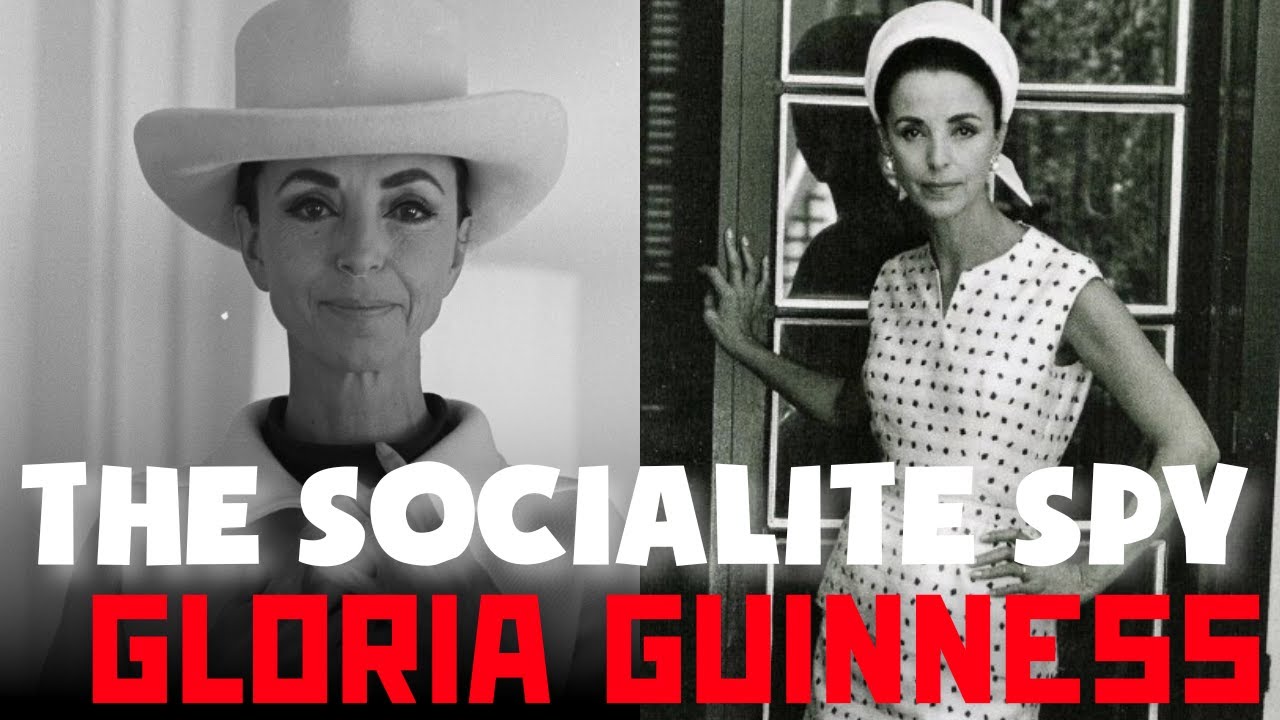
He died in 1916, when Gloria was just four years old, leaving her mother, María Luisa Alatorre, to raise the family with diminished resources but unbroken dignity. María Luisa, an aristocrat of Spanish descent, had watched her family’s holdings be confiscated and redistributed during the upheaval. She responded with resourcefulness and creativity, personally designing and sewing clothing for her daughter. This hands-on approach to fashion gave Gloria an early sense of style and self-presentation, and her mother’s constant reminders that she was the most beautiful girl in the country reinforced her high ambitions.
Educated in part by Catholic nuns, Gloria absorbed their strict discipline while also developing a fascination with the simplicity and practicality of their habits—an observation that foreshadowed her later interest in haute couture. She learned to navigate the competing forces of pious obedience and aristocratic flair, and she quickly discovered the power of a compelling personal narrative. Even at a young age, she began to cultivate and embellish aspects of her past, a habit that would define her legend. By the time she entered her twenties, Gloria had a singular vision of who she wanted to be.
Her first marriage, at age twenty, was to Jacobus Hendricus Jacques Hris, a Dutch sugar factory superintendent nearly thirty years her senior. The union offered her a way out of her tumultuous upbringing and an entry point into European society, but it lacked the depth to sustain her ambitions, and she divorced him after two years. In 1935, she married Count Franz Egon von Fürstenberg, a member of one of Germany’s oldest aristocratic families. This marriage elevated her into the German nobility and granted her access to the elite circles of pre-war Europe.
The couple had two children, Dolores in 1936 and Franz in 1939, but life in Berlin was increasingly overshadowed by the horrors of World War II. As her husband was conscripted to fight on the Russian front, Gloria remained in Berlin raising their children amid bombings and political unrest. The marriage deteriorated under the strain of wartime separations and her discontent with the rigid expectations placed on a countess, and they divorced in the early 1940s. Her time in Germany, however, left a stain that would never fully wash away.
As the wife of a German aristocrat, she moved in circles that included high-ranking Nazi officials. Reports suggest she attended events where Adolf Hitler was present, and she was rumored to have had a romantic relationship with Walter Schellenberg, a prominent Nazi intelligence officer. These associations led to speculation that she may have been involved in espionage or served as a Gestapo agent. She denied the claims, and her charm and connections helped her avoid any formal investigation, but whispers persisted after the war.
French authorities reportedly considered expelling her due to her wartime associations, and only the intervention of influential friends, including her former lover Duff Cooper, allowed her to remain in Paris. In the mid-1940s, Gloria entered her third marriage, to Ahmed Fakri Pasha, an Egyptian diplomat and heir to a prominent family. The union was a brief and colorful chapter, marked by her immersion into a different cultural environment, but it ended after just three years, reportedly because Gloria was unwilling to remain tied to a life that limited her ability to express her individuality. Her romantic entanglement with Duff Cooper, the married British ambassador, had already added scandal to her reputation.
He was reportedly infatuated with her, describing her as the most physically captivating woman he had ever known, and he remained protective of her long after their affair ended. Gloria’s fourth and final marriage, in 1951, was to Loel Guinness, a British banking heir and politician with a fortune estimated at $200 million. A decorated World War II fighter pilot who had earned the Distinguished Flying Cross, Loel provided Gloria with financial security and the platform to establish herself as a global style icon. She spent lavishly on couture, reportedly $200,000 a year on clothing alone, and hosted grand events that solidified her reputation as a paragon of elegance.
She became close friends with the Duchess of Windsor and Truman Capote, further cementing her status in elite circles. Her style was a fusion of refinement and daring. She was one of the first women to wear Emilio Pucci’s white capri pants, a bold choice that became synonymous with modern elegance, and she was also among the first to adopt the minimalist little black suit, which she famously described as a tool that, when used wisely, could garner wealth and attention. Her wardrobe, reportedly worth millions, was a testament to her dedication to fashion as both an art form and a statement of identity.
Designers like Cristóbal Balenciaga and Yves Saint Laurent admired her, and she was a regular fixture on international best-dressed lists. She was part of Truman Capote’s elite circle of swans, the glamorous women who served as his muses, and her intellectual exchanges with him inspired her to pursue her own creative work. In the 1960s, Gloria transitioned into journalism, contributing bold and provocative columns to Harper’s Bazaar. Her writing tackled themes of fashion, culture, and gender dynamics, offering sharp critiques and witty observations.
One of her most famous reflections defined style as being “original without being beginners, immodest but never vulgar, immoral but not obscene, notorious but not infamous. ” Her column titles, like “Damn Those Young Girls,” were as provocative as her insights, and her fearless expression earned her critical acclaim and awards. She also ventured briefly into playwriting, with interest in bringing her scripts to the London stage, but her husband’s insistence that she prioritize traditional marital duties curtailed that endeavor. Gloria’s life was also marked by rivalry, most notably with Babe Paley, another of Capote’s swans.
The two competed for status, elegance, and influence, and Gloria employed subtle and strategic tactics to outshine her rival. In one episode, she assured Babe that a gathering aboard her yacht would be casual, prompting Babe to dress down while Gloria arrived adorned in extravagant jewels and couture, leaving Babe visibly embarrassed. On another occasion, Gloria ensured all activities were confined to the yacht, depriving Babe of the chance to showcase her finest outfits. These rivalries highlighted Gloria’s sharp instincts and determination to maintain her position at the top of high society.
She was also a philanthropist, though her charitable activities were often overshadowed by her glamorous persona. She hosted extravagant fundraisers, sometimes aboard her yacht, to support causes such as children’s education in post-war Europe. She contributed to organizations providing medical care to underserved communities and supported initiatives promoting literacy and education for children in developing regions. Her ties to powerful figures in politics and business allowed her to act as a bridge between donors and those in need, and she partnered with designers like Balenciaga and Gucci to auction couture pieces for charitable causes.
Gloria Guinness died on November 9, 1980, in Switzerland, at the age of 68, reportedly from a heart attack. As with much of her life, her death was shrouded in speculation. Some close to her suggested she had grown increasingly disillusioned with the superficiality of her existence, and rumors of suicide or foul play circulated almost immediately. The truth remains unknown.
Her burial was a grand affair attended by members of the global elite—dignitaries, aristocrats, and influential figures from the worlds of fashion, art, and politics. Even in death, she remained a figure of fascination, a woman who had seamlessly blended luxury, intellect, and controversy. Her influence on fashion and society continued to resonate long after her passing, and her writings gained renewed appreciation for their wit and insight.
From her humble beginnings in a politically volatile Mexico to her reign as a global fashion icon, Gloria Guinness redefined what it meant to rise above circumstances, leaving behind a legacy of elegance and mystery that remains unmatched.