On June 25, 1876, more than six hundred United States Army soldiers rode in columns toward the valley of the Little Bighorn River in southern Montana. By the following morning, over 260 of them were dead, including their commanding officer, Lieutenant Colonel George Armstrong Custer. Every man under his direct command had been killed. Not one survived.
News of the disaster reached the country on July 4th, the same day Americans celebrated the nation’s centennial with parades and speeches about progress and the march of civilization westward. The timing could not have been worse. 1876 was also a presidential election year, and neither party wanted a frontier defeat blamed on an officer’s vanity. The story was quickly reshaped.
What most people were told about Little Bighorn, both then and for generations afterward, was a carefully arranged distortion. The full truth was darker and far more disturbing than the legend. George Armstrong Custer was not the gallant hero of the plains the newspapers made him. He was a vain, politically ambitious officer whose career had been built as much on self-promotion as on military accomplishment.
During the Civil War, he rose quickly through battlefield recklessness that some superiors mistook for bravery, and through a sharp instinct for the power of the press. He cultivated journalists and wrote dispatches that glorified his own actions. He wore a customized uniform with a red neckerchief and let his hair grow long, constructing a personal mythology as deliberately as any public relations effort. After the war, he was sent west, and the results were mixed at best.
At the Washita River in 1868, he attacked a peaceful Cheyenne village led by Black Kettle, a man who had survived the Sand Creek Massacre four years earlier and had worked to maintain peace with the United States government. Custer killed men, women, and children, destroyed the community’s winter food supply, and abandoned some of his own soldiers who had ridden ahead and been cut off. He called it a victory. The army largely agreed.
By 1876, the government faced a problem of its own making. The 1868 Fort Laramie Treaty had designated the Black Hills of South Dakota as unceded Lakota territory, land legally recognized as belonging to the Sioux Nation. Three years later, Custer led an expedition into those hills and reported what prospectors had long suspected: gold. His announcement set off a rush the government made only token efforts to stop.
Miners flooded onto Lakota land, and the Sioux resisted. Unwilling to enforce its own treaty or compensate the Lakota fairly for land it now wanted, the government issued an ultimatum in December 1875. All non-reservation Lakota and Cheyenne were ordered to report to their designated reservations by January 31, 1876, in the middle of winter, across hundreds of miles of open country. The deadline was physically impossible for many bands to meet, and the men who set it knew that.
It was a pretext for military action. Thousands of Lakota, Cheyenne, and Arapaho had gathered in the valley of the Little Bighorn, their total population estimated between ten and fifteen thousand people, with warriors numbering between two and four thousand. They had come together not in preparation for war, but because reservation conditions were desperate. Promised rations were routinely rotten or never delivered, and guaranteed land was being seized piece by piece.
Weeks before the battle, Sitting Bull, the Hunkpapa Lakota spiritual leader, conducted a Sun Dance ceremony, sacrificing 100 pieces of flesh cut from his arms. He reported a vision of soldiers falling into the Lakota camp upside down like grasshoppers dropping from the sky, their hats tumbling from their heads. He told his people the vision meant a great number of soldiers were coming and that many would die. General Alfred Terry organized the summer campaign against this coalition.
The plan called for three columns to converge on the suspected location of the village: Terry from the north, General George Crook from the south, and Colonel John Gibbon from the west. Custer and the 7th Cavalry served as the mobile strike force within Terry’s column. But eight days before Little Bighorn, at a creek called the Rosebud, Crazy Horse led several hundred warriors in an attack on Crook’s force that lasted most of the day and forced the general to withdraw southward. The southern column was no longer in any position to close the trap.
Custer rode toward the village without knowing the plan of which he was part had already broken down. On June 22, Terry’s orders had been explicit. Custer was to scout the area, confirm the village’s location, and wait for the coordinated movement of the other columns. He had no intention of waiting.
He was in the middle of a public feud with President Ulysses Grant and had been temporarily stripped of command earlier that year after testifying before Congress about corruption in the Indian Bureau, corruption that reached into Grant’s own family. Little Bighorn was his opportunity to rehabilitate his public standing and ride back into national favor carrying a great triumph. A coordinated victory shared with Terry and Gibbon offered him nothing. A solo victory offered him everything.
His Crow scouts, men who knew the terrain intimately, warned him the village was enormous, larger than anything they had encountered. One scout, Half Yellow Face, reportedly told Custer directly that he did not expect to survive what lay ahead. Custer dismissed these warnings as he had dismissed similar counsel his entire career. On the morning of June 25, when scouts spotted the village from an elevated position called the Crow’s Nest, Custer launched his assault immediately rather than resting his exhausted men and waiting for support.
He divided his regiment into three battalions. Captain Frederick Benteen was sent left to prevent escape. Major Marcus Reno was ordered to cross the river and strike the southern end of the village. Custer took five companies, approximately 210 men, north along the bluffs above the river, intending to attack the village from the opposite end and catch it in a pincer.
Reno’s charge revealed how badly Custer had misread the situation. Reno’s men rode toward the southern end of the village expecting a panicked camp and found instead a mass of mounted Lakota and Cheyenne warriors moving toward them with speed and organization that made an offensive push impossible. Reno halted, attempted to hold a skirmish line in the timber, then ordered a withdrawal that became a rout. Men were shot in the water crossing back, and others scattered into the bluffs.
Reno survived, barely, and his command was badly bloodied within minutes. Benteen, having found nothing, was riding to rejoin the regiment when a trumpeter arrived carrying Custer’s final written order: “Come on. Big village. Be quick.
Bring packs. ” Benteen merged his force with Reno’s survivors on the bluffs south of the main battlefield. Together they dug in and repelled repeated attacks through the rest of the 25th and most of the 26th, running low on ammunition, unable to provide adequate care for their wounded. From their position, they could hear, somewhere to the north, the sounds of fighting where Custer had gone.
Then the sound stopped entirely. What happened on the ridge now called Last Stand Hill remains a matter of reconstruction from physical evidence and oral testimony, but the broad outline is not in dispute. Custer led his five companies north intending to cross the river and strike the village at its far end. He never reached the crossing.
Warriors under Crazy Horse moved to cut him off, swinging around to attack from the north while others pressed from the riverside, creating an encirclement before the cavalry could establish any defensible ground. The ridgeline offered no natural cover, no water, no shelter. Men who had been in the saddle for two days fought dismounted on exposed ground against opponents who had every geographic advantage. Lakota and Cheyenne survivors describe the fighting coming from multiple directions at once, soldiers’ horses panicking under fire, men and animals separating in ways that destroyed unit cohesion faster than any direct assault.
The engagement may have lasted an hour. Some accounts suggest it was over in twenty minutes. When it ended, not one of Custer’s 210 men remained alive. Custer himself was found with two bullet wounds, one through the chest and one through the left temple.
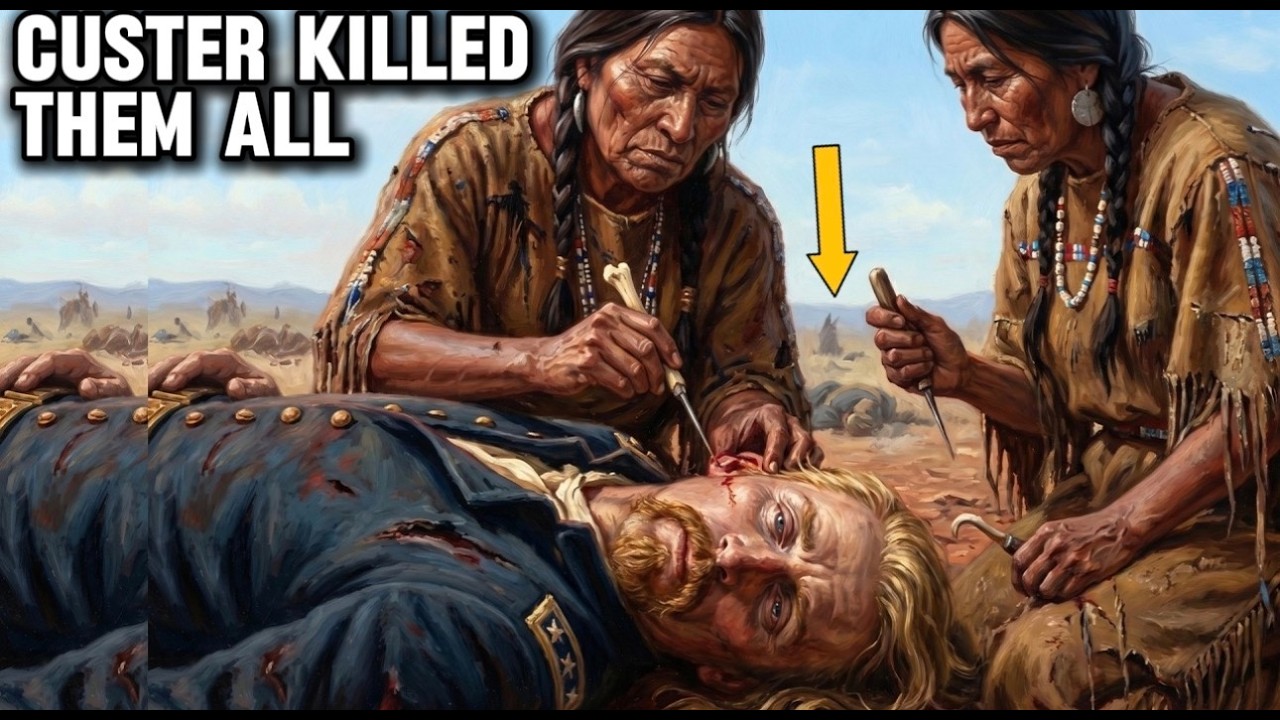
Whether the head wound was the killing shot or was inflicted after death has never been definitively established. Whether he died from enemy fire or from a shot fired by one of his own men who refused to be taken alive is a question the army chose never to pursue officially. The bodies of the dead were mutilated. Among many Plains tribes, counting coup and altering the bodies of enemies carried specific ritual meaning, intended to diminish an enemy’s standing or affect his passage into the afterlife.
Women of the tribes participated as well, and the severity of what was done sometimes reflected specific knowledge about who the dead man was and what he had done in life. Soldiers recognized from previous raids on peaceful camps, men known to have killed women and children, were treated with particular thoroughness. Custer’s own body was left comparatively intact. His men were in far worse condition.
Limbs had been severed, men disemboweled, skulls crushed. The soldiers who arrived two days later under Terry’s command encountered a scene that several officers described in ways suggesting permanent psychological damage. One wrote in his private journal that he wished he had never come to this country at all. The Lakota and Cheyenne had fought to defend land their grandparents had hunted, land where generations of their people had been buried, land promised in binding federal documents and then taken anyway.
What was done on Last Stand Hill was an expression of accumulated grief and fury shaped by a generation of dispossession, processed through cultural practices as coherent and purposeful as any human system of meaning. The military response that followed was immediate and relentless. The army intensified its campaign against the Lakota and Cheyenne through the winter of 1876 and into 1877. Crazy Horse gave himself up in May 1877 and was killed that September in a murky confrontation at Fort Robinson, Nebraska, the details of which remain disputed.
Sitting Bull fled north into Canada, returned in 1881 after years of exile, and spent the remainder of his life as a prisoner and then a reservation resident before being shot and killed during an arrest attempt by Indian police in December 1890. The Black Hills were never returned. In 1980, the Supreme Court ruled the United States had taken the land illegally and ordered financial compensation, a sum that had grown with interest to more than a billion dollars by the 2000s. The Lakota Nation refused the money.
They wanted the land itself, and the land had not been offered. The myth of Little Bighorn was assembled with extraordinary speed. Within days, newspapers framed the battle as a massacre of brave soldiers by savage enemies rather than a military defeat produced by a commander’s catastrophic misjudgment. Custer became a martyr.
Artists painted him standing defiantly on the hilltop, sword raised, a weapon he had not actually carried that day. Dime novelists turned his story into serial fiction within months. His wife Elizabeth spent the next 57 years aggressively cultivating the legend, writing memoirs, delivering lectures, and guarding her husband’s image with a ferocity that kept critics at a distance. The country needed a hero more than it needed the truth.
The army’s formal investigation in 1879 focused almost entirely on whether Reno and Benteen had failed in their duty to reach Custer more quickly. Both were cleared. The inquiry was designed structurally to avoid the central question: that Custer had disobeyed explicit orders, divided his force before an enemy of unknown size, acted on political ambition, and caused the deaths of more than 200 men. Physical evidence has done more to recover the actual battle than any official process.
A grass fire in 1983 cleared the battlefield sufficiently for archaeologists to map cartridge cases, bullets, and remains. They found the Springfield carbines used by the soldiers had a documented tendency to jam in rapid fire, forcing soldiers to extract the brass casings by hand in the middle of combat. Spent casings showing marks of improvised extraction were found across the battlefield. Men had died trying to clear their weapons.
The evidence contradicted the organized last stand of legend in nearly every detail. Rather than a disciplined defensive formation holding the high ground, the forensic picture showed fragmentation, small clusters of men scattered across a wide area, horses and riders separated, positions suggesting movement and retreat. The command fractured under pressure and died not in a heroic defensive action, but in a disintegration that left no witnesses on the losing side. Lakota and Cheyenne oral traditions recorded in the years after the battle have only recently received the serious historical engagement they warranted.
Men like Two Moons, a Cheyenne leader, and Kill Eagle, a Blackfoot Sioux chief, described coordinated warriors moving with deliberate tactical purpose. Crazy Horse appeared in multiple accounts as composed under fire, directing movement, thinking through the engagement systematically. He was 35 years old at Little Bighorn, already a veteran of a decade of warfare. These were experienced combatants on ground they knew, fighting with awareness and purpose.
Native accounts typically describe between 30 and 100 warriors killed. The army placed the number far higher because a larger enemy force explained away the scale of the defeat as impossible odds rather than failed leadership. The contrast between those figures and the 268 soldiers killed speaks plainly. This was a decisive military defeat executed with efficiency that the mythology of the battle has spent a century obscuring.
The great encampment dispersed within days of the battle because its leaders recognized that remaining concentrated gave the pursuing army exactly the kind of target it needed. The army hunted them through the winter, and within a year, most of the people who had fought at Little Bighorn were dead, imprisoned, or confined to reservations. The victory did not save the Lakota and Cheyenne way of life. It drew down a military response that arrived with the full weight of a humiliated nation and finished the destruction faster than anything else could have.
The most disturbing truth about Little Bighorn is not the mutilated bodies or the reckless general or the defeat of a regiment sent somewhere it had no business going. It is that the entire event was the foreseeable consequence of a national policy grounded in dishonesty and dispossession. And when that policy extracted its cost from the people sent to enforce it, the country chose to honor their deaths rather than examine what they had been ordered to die for.