In December 1940, Adolf Hitler signed the order for the invasion of the Soviet Union. The directive, which laid out how the campaign would be fought, never defined what victory actually meant. It named two different prizes: the industrial south and the capital, Moscow, leaving the choice between them for a later date, on the assumption that the war would be decided before anyone had to choose. That assumption proved wrong within weeks.
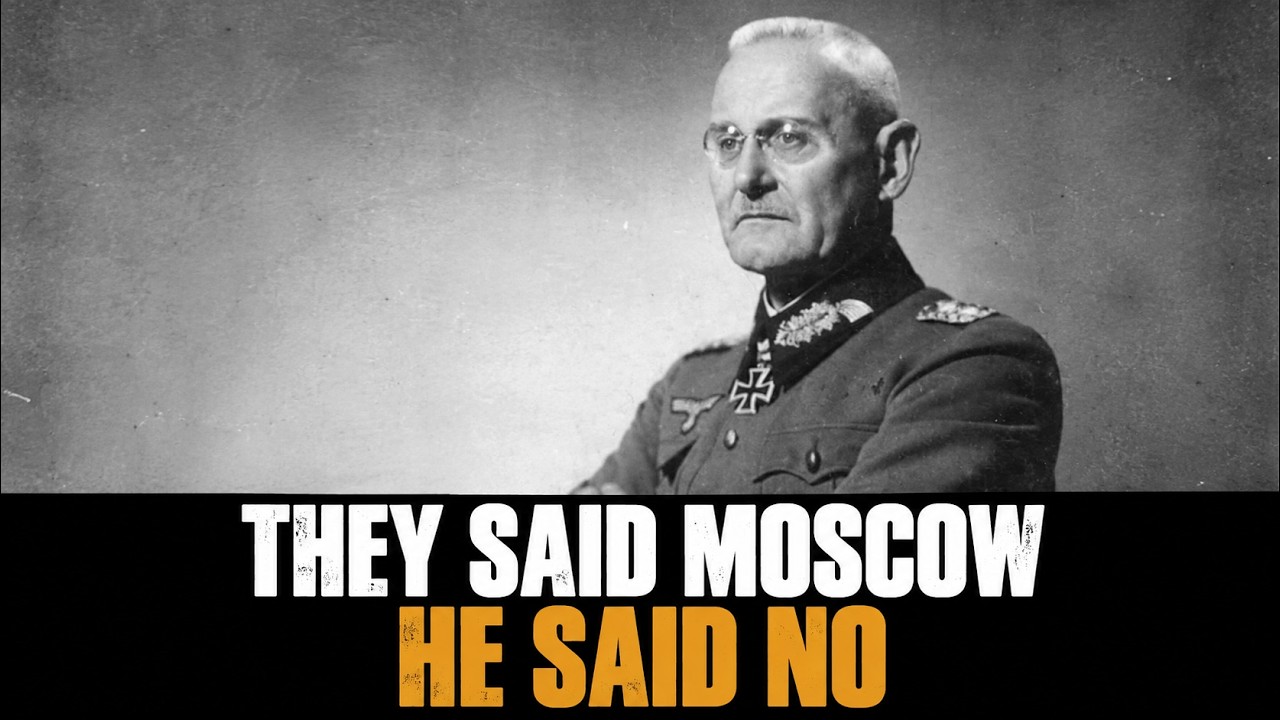
The argument that directive left unresolved overshadowed the entire campaign that followed. Most accounts of the Eastern Front in 1941 focus on the tanks, the border crossings, the encirclement battles, and the drive on Moscow that stalled in the snow. Those events are well documented and matter deeply. But behind them ran another story, fought in map rooms and over telephone lines, not in the field.
It was a dispute between four men who never agreed on the campaign’s purpose in the first place. The final word belonged to Adolf Hitler, by virtue of his absolute authority over the German war effort. Franz Halder, Fedor von Bock, and Heinz Guderian, the men who had planned the invasion and were now fighting its battles, spent 1941 failing to change Hitler’s mind. Directive No.
21, the order for Operation Barbarossa, was signed at Hitler’s headquarters on December 18, 1940, six months before a single German soldier crossed the Soviet border. It rested on months of planning in the Army High Command, work that passed through several drafts and code names before Hitler’s directive gave it its final binding form. The directive divided the invasion among three army groups: north toward Leningrad and the Baltic, center toward Moscow through Minsk and Smolensk, and south into Ukraine toward Kiev. But it did not treat these three objectives equally, and it was not obliged to.
Hitler’s word, once issued as a directive, was final. The disagreement that would last the entire following year was embedded in the document, unresolved, from the day he signed it. The directive’s own language placed Moscow last. Army Group Center’s forces were to turn north first, to help eliminate Leningrad, before any advance on the Soviet capital could resume.
The document allowed one exception: if Soviet resistance collapsed quickly enough, German forces could pursue Leningrad and Moscow simultaneously. Otherwise, economic and industrial objectives came first, and Moscow later. This was not an oversight. It was a deliberately unresolved compromise between two competing theories of how to defeat the Soviet Union, and the war planners kept that compromise in place, betting that they would never have to enforce the order it implied.
General Franz Halder, chief of the Army General Staff, had done more than anyone to shape the invasion plan that Directive No. 21 was built on. Halder argued for Moscow as the decisive objective, not for its symbolic value, but because he believed the Red Army would commit its last reserves to defend the capital, giving Germany the decisive battle of annihilation it needed to end the war in a single campaign. Field Marshal Fedor von Bock, commander of Army Group Center, agreed.
His forces were geographically and logistically closest to Moscow, better positioned than any other army group to make the fastest run at it. Heinz Guderian, commander of Bock’s armored spearhead, wanted the same thing for a different reason: deep, continuous armored thrusts toward a single objective, not repeated detours to clear flank threats. Hitler opposed all of them. He believed the Soviet Union could not continue the war without Ukraine’s grain and industry, or without the fall of Leningrad.
He saw the capture of Moscow as proving nothing if the Red Army could keep fighting on the strength of the resources available to it. Both visions of the war were defensible, and both had real evidence behind them. Halder was the officer who had written the operational plan for the invasion. Hitler was the man who had learned, in France, in Norway, and everywhere before, that his generals’ caution was often wrong.
Neither had any reason to trust the other’s judgment more than his own, and neither would yield. In the first month, the disagreement had no effect. The invasion opened on June 22, 1941, with all three army groups crossing the border at once. Army Group Center made the fastest progress of the three, and by July 9 it had closed a double encirclement around Bialystok and Minsk, capturing more than 300,000 Soviet troops in under three weeks.
This was exactly the kind of result the planners of Directive No. 21 had hoped for everywhere: fast, complete, clear proof that the entire campaign could be finished in a single summer. Optimism ran so high that the argument over Moscow versus the flanks seemed almost theoretical. The war looked like it would be decided before the decision even had to be made.
By mid-July, that confidence was invested in a battle far harder than planned. Guderian’s panzer group advanced on Smolensk from the south while Hermann Hoth’s drove from the north, and the city fell on July 16. But the pocket formed around it, with Soviet units still fighting inside, took weeks to close instead of days, tying down the tanks that Halder and Bock wanted freed for the continued advance east. By the time it closed, Smolensk had added nearly as many prisoners to the campaign total.
It was still a German victory. It was also the first sign the invasion’s timetable was slipping. On July 19, with the fighting still ongoing, Hitler issued Directive No. 33, ordering armored units shifted from the Moscow axis to reinforce the flanks.
It was the first concrete sign that the unresolved compromise of Directive No. 21 was about to be imposed against Halder’s and Bock’s wishes. Through August, the argument sharpened. On August 11, Halder recorded in his diary the scale of German intelligence’s error.
At the start of the campaign, planners had counted roughly 200 Soviet divisions. By August, they had identified more than 360. Destroying formations was no longer producing a shrinking enemy. On August 17, Halder and the army’s commander in chief, Walther von Brauchitsch, made a final written appeal to resume the drive on Moscow before the advantage they had was lost.
Hitler rejected it. On August 21, Hitler settled the argument in writing. Army Group Center’s tanks were to turn south toward Ukraine, not east toward Moscow. Halder considered resigning over the order.
Two days later, Guderian flew to Hitler’s headquarters to present his case for Moscow in person. Hitler listened, then rejected it. The turn south proceeded. The decision and its aftermath at Kiev belong to another story.
What matters here is the pattern. At every point where the army’s senior planners and field commanders agreed, Hitler’s judgment prevailed. He did not authorize the attack on Moscow under the code name Operation Typhoon until September 26, more than two months after Halder’s first written appeal. The delay was not short.
Historians still argue over whether it cost Germany the campaign. What is certain is that two months of internal disagreement could not be recovered. Operation Typhoon opened well. By the third week of October, German forces had encircled eight Soviet armies around Vyazma and Bryansk, capturing more than 600,000 troops in under two weeks.
By some estimates, it was the largest single encirclement of the entire campaign. In Berlin, Hitler told an audience that the enemy in the east had been defeated and would never rise again. Within days, his press chief, Otto Dietrich, went further, telling journalists that the war in the east was effectively over. For a moment, it seemed the delay had not mattered at all.
Then the roads turned to autumn mud. The advance slowed dramatically for more than two weeks. By the time the ground finally froze enough to resume movement, the window Halder had tried to use in August was long closed. German units reached the outer suburbs of Moscow in early December and advanced no further.
None of this proves Halder’s plan would have worked. Recent research has challenged the traditional view that Germany lost a real chance at Moscow by turning south in August. The historian David Stahel has argued that the German army’s supplies and manpower were already collapsing by mid-August, weeks before the Kiev decision became final, and that victory was impossible in any version of the campaign by that point, Moscow first or not. Other historians maintain the older view that the delay, not the calculations behind the invasion, cost Germany its best opportunity.
That debate has never been settled, and this is not the place to settle it. What is beyond dispute is how the decision itself was made. Directive No. 21 left the choice between Moscow and the flanks hanging from the start.
Through the summer and autumn of 1941, the men responsible for actually fighting the war, the army chief of staff, its most senior field commander in the center, and its most aggressive panzer commander, argued for one answer, consistently and formally. One man overruled them all, every time, without ever having to justify his position to anyone who could refuse him. By the time the German army stood outside Moscow in December 1941, the argument that had shaped their entire summer was six months old, and still unresolved to anyone but Hitler. Halder remained chief of the General Staff for another year, defending the same cause in different forms until Hitler dismissed him in September 1942.
Bock was relieved of command that same December, officially for health reasons, amid a collapse he never fully acknowledged as his responsibility. Guderian was dismissed later that month, on December 26, for ordering a withdrawal Hitler had forbidden. None of the three men who had argued for Moscow in August 1941 was still leading troops there a year later. What that year actually demonstrates is not merely a single wrong choice of direction.
It was a command structure in which the men who understood the battlefield best, those who had written the invasion plan and were now fighting it, had no real mechanism for overruling the one man who was not obliged to listen to them, no matter how unanimous they were, and no matter how clearly the records show they had said so at the time. That pattern repeated itself argument after argument through 1941, and it would continue for the rest of the war.