By the summer of 1873, the name Singer had reached the Devon coast in the most literal form wealth could take. An unfinished mansion of 115 rooms stood on roughly seventeen acres of landscaped ground above Paignton, a Channel town previously known for fishing boats and sea air. Isaac Merritt Singer, sixty-one years old, was spending the remainder of his energy and a large part of his fortune on it. Old buildings on the Fernham estate had been demolished on his orders.
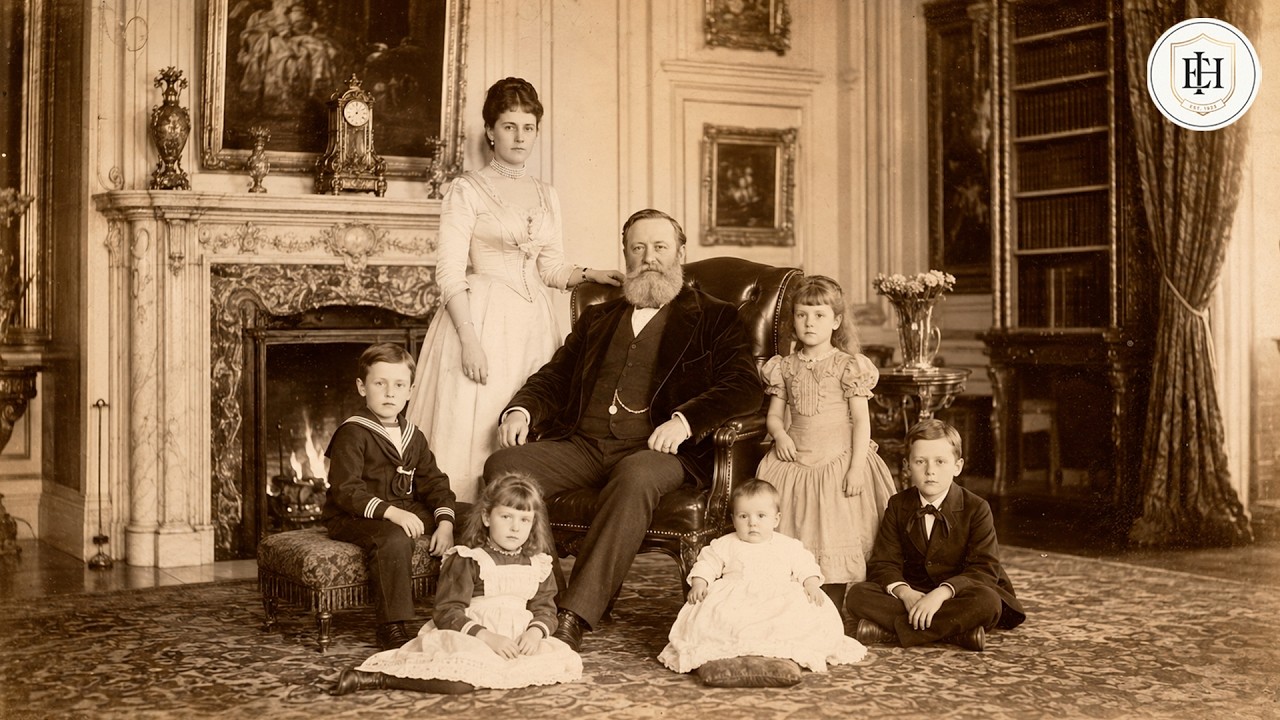
Twenty neighboring houses had been pulled down to open a panoramic sea view from the drawing-room windows. The local architect, George Soudon Bridgman, had received explicit instructions: the interior should follow an exuberant French style, and no cost should be considered excessive when a better material could be obtained from farther away. The result was a columned Greco-Roman Renaissance fusion inside and out, leaning mainly on the Petit Trianon at Versailles for its principal forms. Alongside the 115 rooms it contained a fully equipped theater, a circular coach house for fifty carriages, a marble hall with a grand marble and bronze staircase, and a huge painting by Jacques-Louis David depicting the coronation of Napoleon I.
The old star of temperance melodrama and strolling Shakespeare had quietly spent roughly half a million 1870s dollars on it, at a point in life when that sum represented recreational expense rather than a major financial event. The mansion made visible something the local gentry did not wish to see: a man who had bought a country estate in a country that did not want him, to house a family that the country he had left refused to acknowledge. The house was a ledger kept in carved stone, an accounting of arrangements made elsewhere that no one in either of the countries where he had lived was willing to forgive. That ledger begins in 1811, in a poor house in Pittstown, Rensselaer County, New York.
Isaac Merritt Singer was born there on October 27, 1811, the youngest of eight children. His father, Adam Singer, born Adam Reisinger in 1772, was a German immigrant miller and laborer who worked when there was work and drank when there was not. His mother, Ruth Benson Singer, was American-born and, by every available record, already exhausted when Isaac arrived. In 1821, when Isaac was about ten, his parents divorced.
His mother left the house and the child. The pattern of Isaac Singer’s adult life, the repeated building of families followed almost immediately by practical abandonment of them, traced back to that initial disappearance more clearly than to any other single recorded event. At twelve, he left home himself, walked to Rochester, and found work as a carpenter, joiner, and turner in a machine shop. The trade gave him a mechanical education, the only education he would ever acquire, and a technical foundation he would draw on twenty-five years later in a Boston basement.
What the trade did not give him was any patience for practicing it. He joined a local company called the Rochester Players, memorizing Shakespeare by the yard and temperance melodrama by the mile. At nineteen, in late 1830, he married fifteen-year-old Catherine Maria Haley. They had two children, William Adams Singer and Lillian Singer.
By the time the second was born, Singer had effectively returned to the road with theater companies. In Baltimore in 1836, while still legally married to Catherine, Singer met Mary Ann Sponsler, an eighteen-year-old daughter of a glass-bottle manufacturer. He proposed marriage without mentioning the marriage already on the records. When she arrived in New York pregnant and discovered the situation, he disappeared briefly, returned, and presented the arrangement that would define his life for the next twenty-four years.
He could not marry her, but they would live as though he had. She would call herself Mrs. Singer. She accepted.
The company he toured with was called the Merritt Players, performing under the family name they had invented for the stage. He was Isaac Merritt; she was Mrs. Merritt. The company lasted about five years before collapsing in ruin in Fredericksburg, Ohio, in 1844.
Between 1844 and 1850 he bounced between invention and indigence. In 1849 he patented a machine for carving wood and metal. The prototype was destroyed in 1850 by a steam boiler explosion in the workshop where it was being demonstrated. It was an episode of industrial violence that, in retrospect, proved one of the most providential events of Singer’s career.
If the machine had been salable, he would have remained a wood-carving machine man. Instead, he was ruined again and open to whatever came next. What came next was a machine shop at 19 Harvard Place in Boston, owned by an artisan named Orson C. Phelps, who repaired and manufactured sewing machines under license and needed a mechanic to diagnose why they worked so poorly.
Singer looked at the machine. His own account of his attitude at that moment, preserved by his partner and quoted ever since, was that he did not care about the machine at all and was only after the dimes. He diagnosed the central weakness within minutes. The shuttle moved in a circle, twisting the thread with every revolution.
His proposed correction was purely mechanical. Instead of a shuttle that rotated in a circle, he said, he would make it move forward and backward in a straight line. Instead of a curved needle pushed horizontally by a needle bar, he would use a straight needle moving vertically. For eleven days, the three men and two hired mechanics built the prototype.
On the eleventh night, with the last forty dollars spent and the parts assembled, the machine would not work. It moved, pushed the thread, tried to make a stitch, and the stitch failed. The workers drifted away one by one. Singer sat with the machine and despaired.
The eye of the needle was at the wrong end. Singer made that single correction, started the machine, and saw it sew a stitch that held. The resulting device was not strictly original. Ten mechanical features were required for a practical sewing machine, and Singer’s design was the first to incorporate all ten in a machine that actually worked reliably.
Elias Howe had patented the lockstitch on September 10, 1846, four years before Singer’s eleven days in Boston. Singer himself originated only the presser foot and the capacity to sew straight or curved lines. What he contributed, not on the list of ten features but the only feature that mattered commercially, was the synthesis. His was the first design that brought everything together in a form a seamstress could genuinely use, at nine hundred stitches per minute against forty per minute for skilled hand sewing.
He obtained US patent number 8294 on August 12, 1851. The firm I. M. Singer & Co.
was formally created that same year between Singer and Edward Cabot Clark, a Williams College graduate and former Sunday school teacher to whom a lawyer had referred Singer because he found him personally unpleasant. Clark’s wife, after meeting Singer, told her husband to sell his share and get away from that disgusting brute. Clark did not. He recognized that the disgusting brute held the only commercially functional sewing machine on the market and that his own legal, organizational, and promotional talents filled exactly the gaps in Singer’s character.
Within two years Singer was the leading manufacturer and seller of sewing machines in the United States. Within six, the market had dissolved into what the press called the Sewing Machine War. Elias Howe sued Singer for patent infringement and demanded twenty-five thousand dollars. From 1852 through late 1856, every major manufacturer sued every other.
By 1854 Howe had forced I. M. Singer & Co. to pay twenty-eight thousand dollars in settlement for past claims and to accept a license fee of ten dollars per machine.
Clark was simultaneously acquiring earlier sewing machine patents and filing countersuits. One night in 1856, at a hotel in Albany called Congress Hall, the major manufacturers met for a scheduled court appearance. Orlando Brunson Potter, a lawyer and president of the Grover and Baker Sewing Machine Company, proposed an alternative. Instead of exhausting one another through litigation, they would pool their patents.
The parties negotiated all night. Minutes before the court was scheduled to convene, they signed. Nine patents were contributed. All other manufacturers would pay a one-dollar license fee per machine, divided among the four main players.
Singer’s share was fifteen cents per machine. At least twenty-four manufacturers were to be licensed, so that no single firm could strangle the market. The agreement was the first patent pool in American commercial history, a legal structure that before the end of the century would be imitated by the automobile, aviation, film, and radio industries. After the pool, license fees per machine fell from five dollars, nearly half the sale price, to one.
Mass production became possible. Dozens of manufacturers entered the industry. By 1860 Singer was producing thirteen thousand machines a year in a new plant on Mott Street in Manhattan. By 1863 domestic sales reached twenty thousand units.
By 1871 the figure would be one hundred eighty thousand. By 1903 annual worldwide sales would exceed 1. 35 million. The installment payment plan Clark introduced in September 1856, the first trade-in program, the door-to-door sales force, the franchised showrooms staffed by an agent, a young demonstrator, and a mechanic all followed.
In 1852 a Broadway storefront featured a woman demonstrating the machine. The crowds rivaled those at Barnum’s Museum a few steps away. By early 1860 Isaac Singer maintained four simultaneous households in and around New York City, three of them within carriage distance of one another, each presided over by a woman who believed with varying degrees of accuracy that she was his wife. The legal wife Catherine Maria Haley remained on the records in her own address.
In early 1860 Singer obtained a divorce, alleging her supposed adultery with a man named Stephen Kent, an accusation her own lawyer urged her to accept in exchange for a settlement of ten thousand dollars. The settlement was a fiction. Singer was not in decline. The adultery also may have been a fiction.
What the divorce produced was not truth but legal clearance. After thirty years, Singer was free to marry again. The second household was on Fifth Avenue, a mansion furnished for Mary Ann Sponsler and their eight surviving children. Sponsler called herself Mrs.
Isaac M. Singer. For twenty-four years she had rehearsed the role of wife within a real though not legal marriage, and she understood the 1860 divorce from Catherine as the moment the fiction would be replaced by a certificate. When she raised that expectation to Singer, he told her he was not willing.
She stayed. She kept calling herself Mrs. Singer, and she kept waiting. The third household, in lower Manhattan, was headed by Mary Eastwood Walters, a sewing machine demonstrator with a daughter by Singer, Alice, born in 1851.
In that household Singer was not Mr. Singer; he was Mr. Merritt. Mary Eastwood called herself Mrs.
Merritt. The fourth household was headed by Mary McGonigal, an employee of I. M. Singer & Co.
He had known her for nearly a decade. She had given him seven children, five of them living, bearing the surname Matthews, because in that household Isaac Merritt Singer had presented himself as Mr. Matthews. Among those four households the children numbered eighteen, the mothers four, the aliases three: Singer, Matthews, Merritt.
On August 7, 1860, that arrangement collapsed. Singer was driving north on Fifth Avenue in one of his carriages. Beside him, according to all accounts, was Mary McGonigal. Mary Ann Sponsler, also driving north in a Singer carriage, recognized both the driver and the passenger.
Her suspicions about McGonigal were confirmed before her own eyes. She screamed, loudly and at length, attracting the attention of half the people on Fifth Avenue, making known the exact nature of her complaint against the man in the other carriage, her supposed husband, the inventor whose name appeared on roughly half the sewing machines then sold in the United States. Singer’s coachman tried to get away. Sponsler’s coachman followed.
Singer escaped down a side street. Sponsler hurried home, but Singer arrived first. There were words. There were blows.
Singer, according to the sworn complaint she filed afterward, physically assaulted her. She went to the police. Her complaint charged him not with adultery, which New York in 1860 did not consider a crime justifying arrest, but with assault, which it did, and with bigamy. Singer was arrested.
The newspapers picked up the story that same day. Edward Clark, reading the morning papers, was, in the language of the company’s internal memoranda, understandably scandalized. He had spent most of a decade positioning the Singer machine as the appliance of the virtuous home. Now he had a partner publicly accused of turning the domestic home itself into a form of organized fraud.
Singer’s own letter to Clark, preserved with its original spelling, said in part: “My private affairs, though justly merited, weigh heavily upon me and my soul sickens at the prospects before me, and for the welfare of all concerned, try and make my burden of sorrow as light as possible. ” The repentance was real within the sentence and would not survive the week. What came next, as the weeks advanced, was the complete architecture of Singer’s arrangements forced into the civil record by Sponsler’s divorce suit. The Walters household came to light.
The Matthews household came to light. The aliases came to light. The children of each woman came to light. Sponsler sued for divorce and described her husband in her complaint as a libertine of the greatest notoriety, declaring that no more dissolute man had ever lived in a civilized country.
The judge granted her eight thousand dollars a year in temporary alimony, a record at that time for any such proceeding. Singer did not stay to contest it. On September 19, 1860, he sailed from New York harbor aboard the Great Eastern, Isambard Kingdom Brunel’s huge iron steamship, on its first west-to-east Atlantic crossing. He was accompanied not by Mary McGonigal but by her younger sister Kate, whose presence in the Matthews household had been Singer’s own private arrangement.
He left behind, in four directions across New York, approximately eighteen recognized children, four women, and a volume of civil and criminal exposure that would require the rest of his life to resolve. Edward Clark considered the flight itself the most useful decision his partner had ever made. Singer in Paris was a problem at a safe distance. Singer in New York would have been a problem in the newspapers every morning.
The Great Eastern reached Liverpool in about eleven days. By early October Singer was in Paris, lodging in a pension run by a French woman named Pamela Boyer, born in England, married to a French confectioner named Louis Noel Boyer, and mother of a daughter, Isabella Eugenie, then about eighteen. Singer began a relationship with Isabella. She was already married to another man, whose name is not preserved in any surviving English-language source.
She left that husband and began the relationship that would produce six children, a legal marriage, and the rest of Isaac Singer’s life. The marriage took place on June 13, 1863, in New York City, when Isabella was already pregnant with her first child. Singer was fifty-two. Isabella was twenty-one.
Their first child, Adam Mortimer Singer, was born that same year in Yonkers. Their third child was born aboard the SS City of Washington on April 14, 1866, mid-Atlantic, as his parents fled westward from the United States for the second and last time. They named him Washington Merritt Grant Singer, after the ship, the founder, and the then commander of the Union armies. The family settled in Paris, then moved to London during the Franco-Prussian War, and in 1871 to Paignton, Devon, where Singer bought the Fernham estate and began the mansion that would be his last and greatest enterprise.
Singer died on July 23, 1875, at Oldway, the original villa on the estate. He was sixty-three. The exhaustion of his daughter Alice’s wedding, combined with his already declining health, was recorded by his doctors as the immediate cause. He was buried in Torquay cemetery inside three nested coffins, the innermost of cedar lined with satin, the middle of sealed lead, the outermost of English oak ornamented with silver.
All three were then enclosed within a marble tomb. The funeral procession extended roughly three-quarters of a mile. The hearse was drawn by twelve horses. Between seventy and eighty carriages followed.
Approximately two thousand mourners walked or rode. Flags in Paignton and Torquay flew at half-mast. In New York, Edward Clark expressed public sorrow at the loss of that distinguished inventor, then had himself elected president of the Singer Manufacturing Company, the office denied him for twelve years by the clause specifying that neither partner could hold the presidency while the other lived. Singer’s will, drawn up in 1870 and modified in 1873, divided the estate into sixty parts.
The total was valued at roughly thirteen to fourteen million dollars. Isabella Boyer, as legal widow, received four parts directly, plus all the English real estate, household effects, and personal property in trust for life. Each of the six sons she bore received six parts. Each daughter received five.
The Boyer children alone received at least forty-five of the sixty parts. The remaining fifteen were divided among the other eighteen recognized children. Most received one or two parts. Violette Teresa Singer, whose husband was already rich, received nothing.
William Adams Singer, who had publicly supported his mother during the divorce, received five hundred dollars. Catherine Haley received nothing. Mary Ann Sponsler received nothing. Mary McGonigal received nothing.
Mary Eastwood Walters received nothing. The Matthews children received nothing. Sponsler went to court, claiming a million dollars as the common-law widow and legitimate heir. She testified, and by the account preserved in American Heritage, was her own worst witness.
The defect was vindictiveness. Of her eight surviving children, only one remained loyal to her during the litigation. The other seven refused to testify in her favor. Sponsler rejected every settlement offered, clinging to the million-dollar figure.
Finally the estate offered five thousand dollars for a general release of all claims. She accepted in 1876. The family that Isabella Boyer raised, educated in English and French aristocratic tradition, received the great portion of the commercial fortune. The American family, raised through the parallel households of the 1840s and 1850s, received the remainder.
The six children Isabella Boyer gave Singer dispersed after the 1875 funeral across Europe and finally America. Winaretta Eugenie Singer, the second daughter, became the most consequential cultural figure the name ever produced. Inheriting roughly a million dollars, she married Prince Edmond de Polignac in 1893. Their salon at 43 Avenue Henri Martin in Paris functioned for the next half century as the most decisive private venue for avant-garde music in Europe.
Premieres of works by Chabrier, D’Indy, Debussy, Fauré, and Ravel took place there. Ravel dedicated his Pavane pour une infante défunte to her. Her commissions, financed directly from Isaac Singer’s inheritance, included Stravinsky’s Renard, Satie’s Socrate, Milhaud’s Les Malheurs d’Orphée, Poulenc’s concertos for two pianos and for organ, and the premiere of Falla’s El retablo de maese Pedro. Proust attended.
Cocteau, Diaghilev, and Isadora Duncan were regulars. She died in London on November 26, 1943, having converted a sewing machine fortune built on the repressed domestic labor of American women into the most durable private subsidy the modern European musical canon ever received. The Singer Building in Manhattan rose to 612 feet between 1897 and 1908, and briefly, from May 1, 1908, until the opening of the Metropolitan Life Tower a year later, was the tallest building in the world. Demolition began in September 1967 to make way for One Liberty Plaza.
At the time of its destruction it was the tallest building ever intentionally demolished by its owners, a record it held until 2019. The New York preservation movement later cited its loss as one of the events that gave rise to the movement. The Singer Manufacturing Company survived its founder by more than a century, becoming perhaps the first modern multinational industrial enterprise of any nationality. By the early twentieth century it produced more than two million machines annually, more than half of them in England.
Its global market share between 1880 and 1920 was estimated at eighty percent. Its Clybank factory near Glasgow employed 11,500 people in 1911 and produced eight thousand machines per week. The Singer Foundation established by Winaretta in Paris in 1928 continues to support scientific research, literature, and the arts. Oldway mansion still stands, its 115 rooms intact as of January 2025, inscribed on the heritage-at-risk register.
The mansion was a ledger built in stone at the summit of a fortune, by a man who had assembled five separate family histories and discovered himself incapable of conducting any of them honestly. The sewing machine assembled in Boston in September 1850 by three men for forty dollars in eleven days ended up paying, through its remote descendants, for Socrate. The machine that carried his name to every shop window in the world did one thing the man who gave it his name never managed even once.
It finished a scene.