On February 18, 1851, along the banks of the Gila River in the Arizona desert, fourteen-year-old Olive Oatman watched her family die. In roughly ninety seconds, her father, mother, and four siblings were struck down with war clubs by a group of about nineteen Yavapai warriors. Royce Oatman had knelt in the sand, exhausted after days of dwindling water and food, a broken wagon wheel behind him, and tried to negotiate. There was nothing to negotiate.
The language of the conversation meant nothing because the decision had already been made. The family had been heading west to California with a group of Mormon immigrants led by James C. Brewster, who promised a promised land called Bashan. But the wagon train split over disputes, and Royce Oatman, stubborn and hopeful, pressed on alone with his family of nine.
The Pima people had warned him to be careful as he passed through dangerous territories. He heard them, but kept going. Turning back carried its own cost, and small, reasonable decisions added up to a point of no return. When the attack came, Olive’s mother screamed and clutched her eight-month pregnant belly.
There was nothing left to protect. Olive did not run. She later could never fully explain why. Her fifteen-year-old brother Lorenzo tried to fight back with a rock, then with his fists.
A blow to his head knocked him to the ground, and Olive believed he was dead. For the next seven years, she believed he was dead. In the end, seven members of the family of nine were killed in the desert. Lorenzo survived, though no one knew it, and only Olive and her eleven-year-old sister Maryanne were taken.
They were not killed because they were worth more alive. In the brutal economics of the Southwest desert, two young girls represented labor, trade value, and a bargaining chip. The romantic version of history says the warriors were moved by innocence. The colder reality is that human beings were sometimes commodities.
Olive took Maryanne’s hand and walked after the men who had slaughtered her family, into an unknown captivity. For about a year, the sisters lived as slaves in the Yavapai village. They carried wood until scabs formed on their backs, hauled water for miles until their shoulders bruised, and gathered wild seeds and cactus fruit until their fingers bled. Their stomachs were almost never full.
At night on the bare dirt, they slept holding each other, sharing nothing but warmth. Olive hardened herself because she knew that if she collapsed, there would be no one to keep her little sister standing. Maryanne cried silently some nights. Olive forbade herself from crying.
Then, probably in the spring of 1852, two Mojave women named Topeka and another woman came to the Yavapai village to trade horses, vegetable seeds, and beads. In exchange, they wanted the two white girls. Olive and Maryanne became the subject of a bargain, priced like horses. They walked toward the Mojave, about two hundred miles to the Colorado River, an eleven-day journey on bleeding feet that eventually turned calloused.
Every step carried them toward an unknown future, but that unknown was less terrifying than the certainty of hunger and beatings left behind. When they reached the Mojave village, something unexpected happened. The chief’s wife, Espano, and her daughter took them in and treated them like human beings. Espano gave Olive a piece of her own field to plant and harvest, and during famine she tried to feed the girls even while her own children went hungry.
Maryanne later said, “Speaking of starvation, they showed us more compassion than they did their own children. ” Olive learned the Mojave language until her dreams took shape in it. She learned to cook, weave baskets, catch fish, and read the desert. She began to feel belonging.
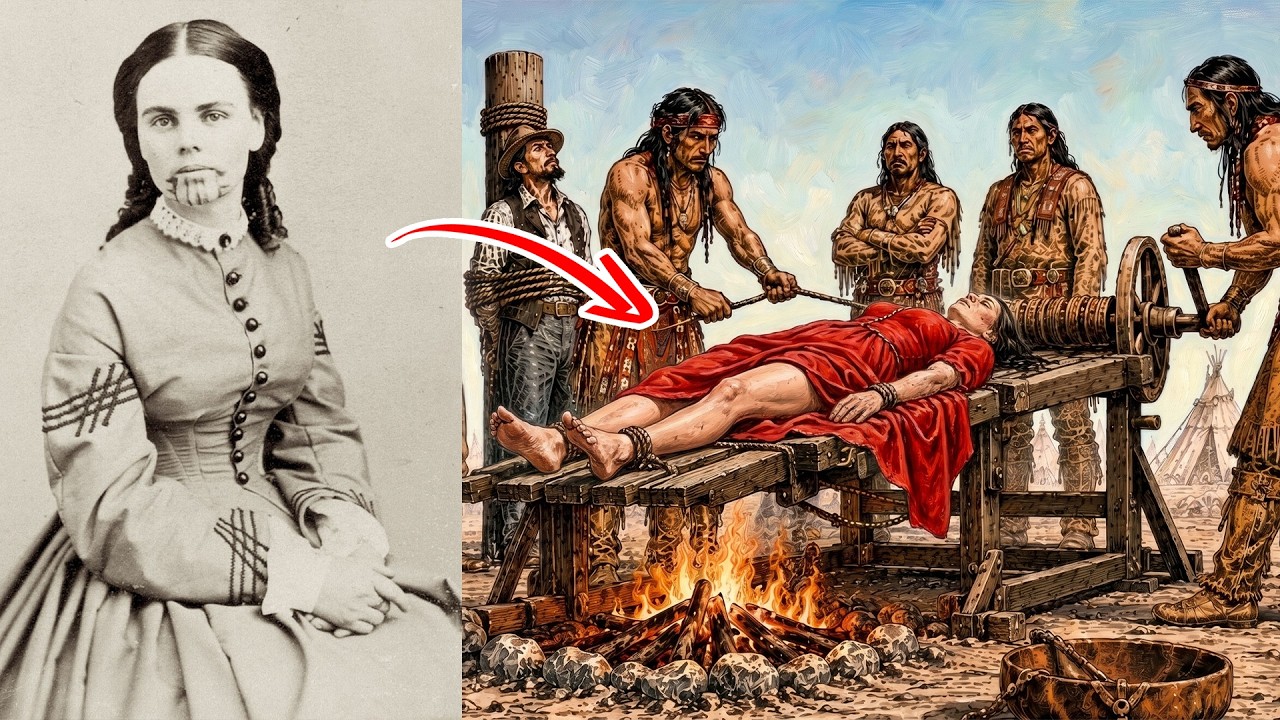
It was not a perfect life, but it was a life. One day, likely in early 1852 or 1853, the Mojave women tattooed blue-black ink into the chins of both girls, a mixture of cactus and soot. According to Mojave belief, a soul without this mark would not be accepted in the afterlife. It was a mark of identity and community, not a brand of slavery.
White America would later see only torture in those lines, but Olive herself remained strangely silent on the matter. In 1855 or 1856, famine struck along the banks of the Colorado River. The crops failed, the rains delayed, the seeds dried before sprouting, and the river waters receded. Maryanne starved to death in Olive’s arms at age fourteen.
She was already so thin, her skin thin like paper, her belly swollen. Olive was eighteen and entirely alone in the world. The only possible survivor of her family was a brother whose whereabouts she did not know. The Mojave people cremated Maryanne according to their own tradition, a farewell Olive‘s own culture would not have considered proper.
It was another layer of loss. In the summer of 1856, a Yuma man named Francisco carried news to Fort Yuma on the California border that a white woman was living among the Mojave. The commander wrote a letter demanding Olive’s release. But the Mojave people did not hand her over immediately.
Espano opposed her leaving. They had integrated Olive into their community and did not want to lose her. Negotiations lasted for weeks. Eventually, a deal was struck, and Olive was exchanged for a horse, a few blankets, and some food.
The side that had fed her for years cried for her; the side rescuing her bargained for her. On February 19, 1856, accompanied by a large group of Mojave, she began walking toward the fort. When she arrived, the soldiers and immigrants surrounded her, but they could not look at her. The blue-black tattoo on her chin had stripped her of being one of them.
She heard whispers of curiosity, disgust, and horror. A woman from the crowd brought her hand to her mouth as if she were looking at a disease. They dressed her in thick American clothes unsuited for the desert heat, combed her hair differently, and tried to teach her to speak, sit, and walk like a proper young woman. The lines on her chin did not erase.
They were the only truth left on her body. Then came the reunion with Lorenzo. He had survived the blow to his head, awakened wounded and alone in the desert, and spent years searching for his sisters, begging authorities, joining wagon trains, and raising money. For years no one believed him, or believed him but did not act.
When the news of Olive’s rescue arrived, his persistence finally gained meaning. In the dusty courtyard of Fort Yuma, two siblings struggled to recognize each other after seven years. The records do not say whether they hugged or cried. Some moments are too private for history.
In 1857, a preacher named Royal B. Stratton turned the Oatman story into a book, Captivity of the Oatman Girls. It became an instant bestseller, selling tens of thousands of copies in multiple editions. But it was not Olive’s story.
Stratton portrayed the Mojave almost entirely as savage and ruthless, reduced Espano’s compassion to a footnote, and presented the tattoos as a symbol of torture. Maryanne’s death was framed as proof of savage neglect, while Mojave children were also starving in the same famine, a detail almost entirely absent from the book. The 1850s were a time of westward expansion, of railroad plans and immigrant waves, and dehumanizing indigenous peoples made taking their lands easier. Olive‘s real, complex story became raw material for that purpose.
She was presented as a victim because victims justify occupation. In the years that followed, Olive gave public lectures. Halls filled. People bought tickets just to see those blue-black lines, the woman rescued from savagery.
Her photographs were sold like postcards. She became a circus curiosity and then an American legend. What she felt on stage no one knows. She complained of headaches for the rest of her life.
She suffered bouts of depression. According to some testimonies, she spoke Mojave in her sleep, moments she did not remember when awake. She married a businessman named John Fairchild and tried to lead a quiet life in Texas, then Nebraska. She stopped lecturing, tried to have her photographs burned, and hid the tattoo with heavy makeup or a veil.
She adopted a daughter but had no children of her own. She built a quiet life far from the public eye, living in the fracture between the myth America created and the reality she had lived. Olive Oatman died in 1903, carrying to the grave the exact meaning of those tattoos. To the end, she gave neither a full condemnation nor full praise of the Mojave people.
Her answer, when asked, was a brief, measured silence. The descendants of the Mojave people continue to tell the story of Espano, a woman who took two children into her home, gave them her own bread, and tried to feed them during a famine even as her own children went hungry. That story never found its true weight in the official accounts. Her tragedy was not confined to that one afternoon in the desert.
It continued in how the moment was remembered, how it was told, and how it was used by every generation after. The blue-black lines on her chin can still be seen in old photographs in the archives. Those who look at them continue to project their own prejudices and anxieties onto those lines.
And the real Olive Oatman, neither fully victim nor myth, a human being carrying the complex weight of loss and survival, remains waiting silently beneath them.