In November of 1871, Thomas Vain bought an ordinary ledger book and began keeping a record that no church in Kentucky has ever kept before or since. He listed forty-one seats, numbered one through forty-one, and each week he wrote down who sat in each one. For three years the book was merely strange. On most Sundays, the congregation in Vain Hollow could not fill the chapel.
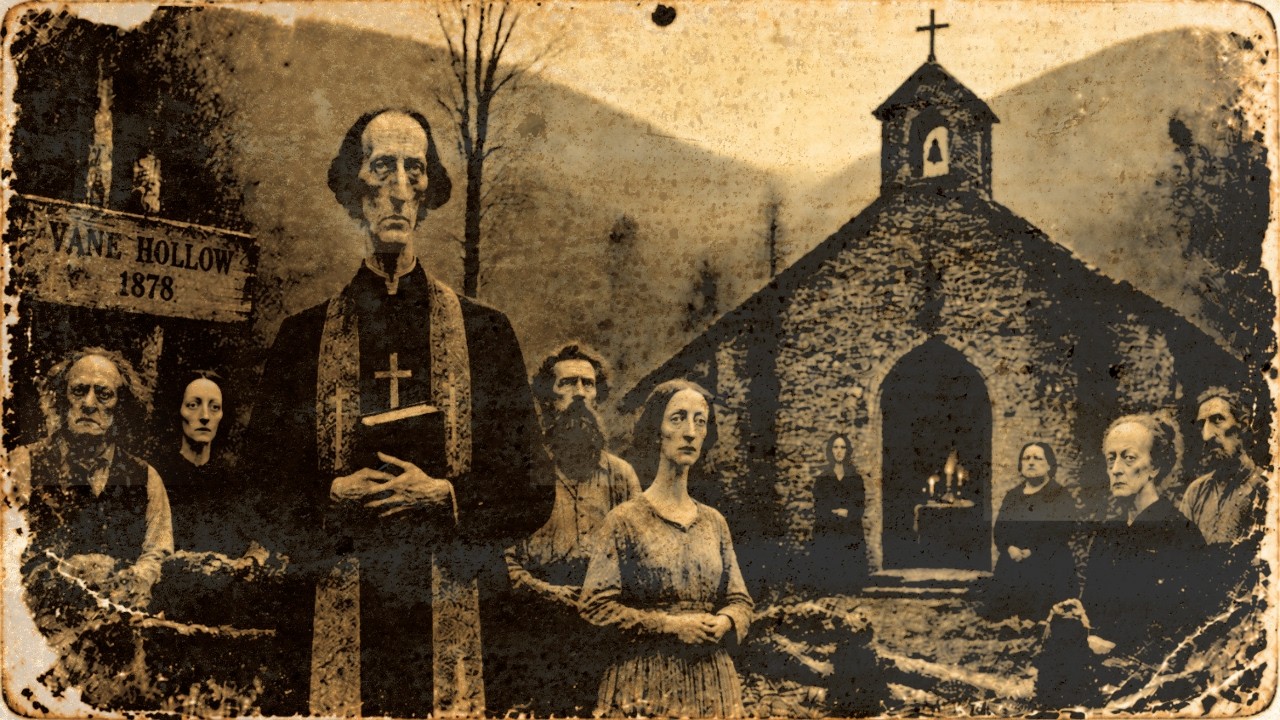
Thirty people was a good day. The rest of the pews stood empty and Thomas Vain marked them with a small dash. Then, on the third Sunday of Advent in 1874, he stopped using the dash. He drew a small circle beside the empty seats instead, and in the margin beside the first circle he wrote a single line: “Seat 19 was not empty.
I have looked at the book wrong all these years. It is not empty. It is unfilled. There is a difference and I am afraid I have found it out.
”
The difference between an empty seat and an unfilled seat became the whole history of Vain Hollow. Nobody chose to build there. The settlers who came up Poor Fork in the 1840s were looking for bottomland and mill creeks, and what they found instead was a hollow that was already finished. In 1851, a surveyor named Absalom Reed was hired to run the lines for a land grant, and his field book remains the earliest document we have.
Reed found that the hollow did not have a natural floor. Under a few inches of soil, across an area of just under two acres, there was a continuous surface of dressed stone fitted so tightly that he could not get the point of his knife between the blocks. In the center of that stone floor stood a chapel. The settlers did not build it.
Reed measured the building and found it larger than it looked from outside: forty by sixty feet, with walls of the same dressed stone, a roof that had clearly been replaced many times by settler hands, and fixed to the floor, cut from the same stone in the same operation, forty-one pews. Each pew was sized for one person. Each had a shallow depression worn into the seat by long use, wear that was not consistent with the age of the settlement. The pews were not arranged as a settler would arrange them.
Some faced the low stone table at the front, some faced the side walls, some faced each other, and four at the back faced the door, as if whoever sat in them was meant to watch who came in. Reed left, and for the rest of his long career he never accepted another job within forty miles of Poor Fork. He knew something and could not put words to it. The Vain family arrived in 1852 and took charge of the chapel.
Thomas Vain, a lay preacher of enormous conviction, saw providence in the building and opened it for worship. For twenty years the chapel did nothing. Weddings happened in it. Funerals happened in it.
Children learned their letters on its steps. People got used to the strange seats and the four watching pews at the back stayed empty because nobody wanted to sit with their back to the preacher. The hollow’s attention spent itself down to nothing, and that was exactly what the building needed. In the second week of December 1874, an old woman named Granny Suk died.
She was the oldest person in the hollow, a granny woman who had been an old woman before the first settlers arrived. On her deathbed she made her family swear to carry her body out of the hollow, across Poor Fork, and bury her on the far side of the river. She said she would not be buried on the floor, and when her grandson asked why she took such a long way around empty pews every Sunday, she told him: “An empty chair is a mouth, child, and you do not put your hand near a mouth. ”
Granny Suk had never missed a Sunday.
Her seat, seat nineteen, had never once stood empty, and now it did. Within weeks, the seat grew cold. The cold was not the ordinary cold of a stone room in a Kentucky January. It was worse exactly at the worn depression in the seat and lessened as you moved outward, which is not how a draft behaves.
The cold deepened faster every week, and Thomas Vain understood that it was heading somewhere, counting down to a moment it would arrive. He prayed over the seat and found that even the prayer seemed to go down into the emptiness like food into a hungry animal. On the last Sunday of February 1875, the congregation found seat nineteen filled. An old woman sat in Granny Suk’s place, and the cold was gone, and the seat was warm, and no one in the hollow knew her.
She had not come up the road, because the snow on the road was unbroken that morning. She had come from the seat. She did not speak, ever. She did not eat.
She did not age. She was a seat that had been filled, and the filling had a shape that looked like an old woman, and that was as far as the resemblance went. Thomas Vain gave thanks and preached a sermon about the wedding feast in which the master compels strangers to come in that his house may be filled. He did not yet understand whose house it actually was.
People did not stop dying. Each death was a seat coming empty, and each empty seat went cold, and if it was not filled by the living, it filled itself with a shape of the person whose absence had emptied it. By the middle of 1876, the silent ones were no longer one. They wore the shapes of the dead, and they sat where the dead had sat, and they were not people at all.
They were arranged rather than alive, like a made bed has the shape of sleep in it without anyone sleeping. Adeline Corse, the schoolteacher who came up from the county seat in 1875 and wrote long letters to her sister, put it best: a ghost is a person who will not leave, but these were places that would not stay empty. A ghost is too much person for the world to hold. A filled seat is too little to be one.
Thomas Vain began to manage the count. He decided who would fill the seats. The clean story told for a hundred years says the congregation starved through a bad winter and went mad. The truth, recorded in Cyrus Pauley’s store ledger down by the river, is that travelers began to vanish on that road.
Peddlers, strangers, people whose absence no one would mourn. Vain brought them up to the chapel on some pretext and seated them near a cold and hungry place, and the building took them down through the floor. Because the survey in 1961 found the truth: the chapel on the surface was only the top of a stack of chapels going down into the dark. At forty feet below the floor, the state surveyor brought up dressed stone with worked seating surfaces worn by long use.
The seats on the surface and the seats below were the same seats. A body taken from above was a seat filled below. The count was not forty-one. It was forty-one multiplied by a number no one has ever been able to establish.
A stack of filled chapels going down forever. Adeline Corse worked out the flaw. The building filled the chapels from the top down. The whole downward stack was gated by the top.
Fill every one of the forty-one seats on the surface with the living, hold the house full through an entire service so the building read a sealed count, and then have everyone rise and walk out together, all forty-one at once, so that no single seat went cold first. Empty one seat and the cold has a place to gather. Empty all forty-one in the same breath and the cold has nowhere to start. The count could be lied to, because a count only reads filled and unfilled and cannot read anything else.
But the hollow in December 1878 did not have forty-one living people left willing to sit in that chapel. Adeline counted twenty-six. She subtracted the seats the building already counted as filled by its own taken figures, and found that the remaining seats could just barely be covered if the children sat in the coldest, hungriest places in the building. Thomas Vain came to the end of himself that winter and gave her everything he knew: which seats were coldest, which had a little patience left.
And he told her the thing her clean arithmetic had missed. The four watcher seats at the back that faced the door were not part of the congregation’s count. They were the building’s own seats, and only the taken could fill them, and the taken could not walk out. So Vain added the last element to the plan.
A taken thing could be released from its seat if the person it wore was named, truly named, by someone who had loved them, so that the shape on the surface and the soul below were joined for one instant into a single thing. And a single thing can stand up and walk to a door. On the last night of Vain Hollow, they filled every congregation seat with the living, the children in the hungry seats, and the four watcher seats with four of the taken whose shapes the families knew. At the last word, all at once, the living rose, the families named their dead, and forty-one seats went from full to empty in a single instant.
The collapse ran down the stack, floor by floor, faster than the cold could follow, because the top had just done the one thing the machine had no rule for. The seating ends in the middle of a sentence. Thomas Vain’s last words were: “And when I give the word, they must all rise together, and not one of them look back at the seat, for the seat will call in the voice of—” and there the entry ends. On a morning in early January of 1879, twenty-two people walked down out of Vain Hollow, most of them children, not speaking, not stopping, walking like people who had been told not to look back and were holding to it with everything they had.
Adeline Corse went up with twenty-six living souls and an unknown number of the taken. Twenty-two came down. Adeline was not among them. Thomas Vain was not among them.
Two of the hollow’s men were not among them. Four went up who did not come down. Four seats that did not empty in time, or four who stayed on purpose to hold a seat warm so a child could reach the door. The county closed the road that spring, in an order that gave no reason beyond public safety, and never rescinded it.
To this day there is no legal road into Vain Hollow, and the county maps show it as trackless and empty. The twenty-two who walked out never said one word about what happened in that chapel, and they kept their mouths shut until they died. The top chapel is empty. The 1961 survey settled that.
But the surveyor noted something else about the seats forty feet down in the dark: the wear on those buried seats was fresh. Not ancient, not worn smooth by centuries and abandoned. Fresh. The seats below Vain Hollow had been sat in hard by something within the last hundred years, after 1879, after the night the top chapel was emptied.
The count did not stop. A count that goes down forever cannot be stopped from the top. They pulled the plug at the surface and the water at the surface ran out. Forty feet down in the dark, on seats worn fresh within living memory, the house is still filling.
It just does it quietly now, with no preacher to keep the ledger and no one left to read the account. Taking what strays too close, sitting them down in the dark, keeping count that no one is left to read. Granny Suk refused to be buried on the floor. She was the only one in the entire history of that hollow who understood from the beginning what the floor was.
She made her family carry her across the river, and she is the one soul the count never got. Buried in clean ground on the far side of Poor Fork, over nothing, under a stone that faces the sky and not the dark. In 1911, a county clerk tried to remove the page from the land records that described the chapel and its forty-one seats. He stopped himself, but before he did, he wrote four words in the margin that do not belong in a land record.
He wrote: “They are still down there. ”