On May 6, 1945, with only four days left before the war in Europe ended, General George S. Patton stood at the entrance of a displaced persons camp near the German town of Struth in Thuringia. What he saw stopped him cold.
The man who had crossed the Rhine and driven his armies faster than any other commander on the Western Front stood motionless. Around him were emaciated bodies in ragged clothes, men and women reduced by years of persecution to barely living beings.
Patton had seen camps before. He had visited the Ohrdruf concentration camp in April, weeks earlier, and left in severe distress. He vomited.
He wept. He forced German civilians from nearby towns to walk through the site and witness what had been done in their midst. He was not an emotional man, nor a gentle one, but he was a man of action.
What he saw in the weeks after liberation turned something inside him into absolute resolve.
The story of what Patton did next reveals something essential about the nature of liberation itself. Because liberation, it turned out, was not simply a matter of opening gates. It was also a battle fought in corridors, in offices, and in the silences between bureaucratic decisions about who deserved food, who deserved medicine, and who could simply be allowed to fade away.
To understand what Patton faced, one must first understand the catastrophic scale of what the Allied armies inherited when they crossed into Germany in the spring of 1945. By April and May of that year, Western Allied forces were liberating concentration camps, forced labor facilities, and transit points at a rate that exceeded all expectations. The U.
S. Army alone was responsible for thousands of people labeled displaced persons, or DPs, across a vast expanse of occupied Germany.
These were not simply people in need of a meal and a bath. They were human beings who had endured years of systematic starvation, forced labor, disease, and deliberate cruelty. Many were dying from conditions allowed to worsen to the point of being untreatable.
Others had treatable illnesses, but without immediate and serious intervention, those conditions would kill them within weeks.
The army had made plans for this. In theory, it issued directives, established chains of command, and assigned medical staffs. In practice, the situation was overwhelming, and systems were collapsing almost before they were created.
But there was something else. Something that was not merely a logistical failure. In some displaced persons camps, Jewish survivors were receiving a lower standard of care than non-Jewish DPs.
In some facilities, German civilian doctors who had been brought into the care system were providing inadequate treatment to Jewish patients. In some cases, they provided no useful treatment at all.
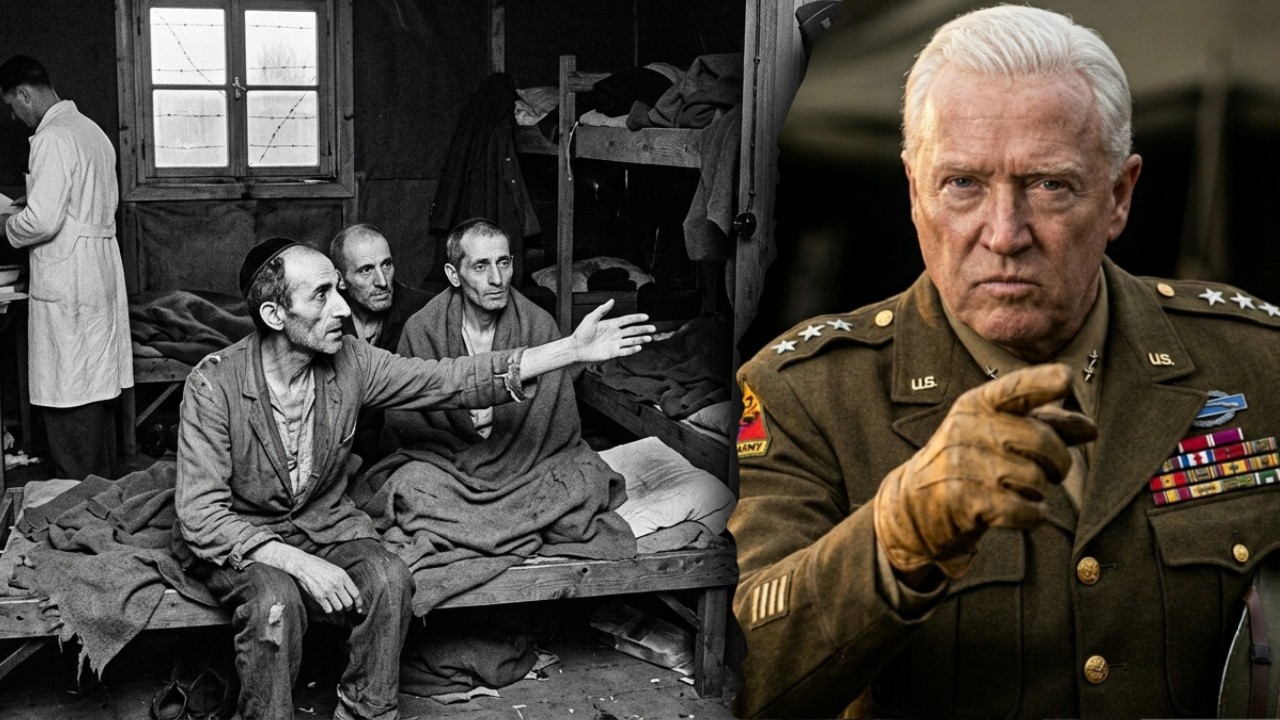
There are documented cases from that period of German doctors who continued to hold the same attitudes that had driven the Nazi medical establishment, even under Allied supervision. Jewish patients died from conditions that were clearly treatable. They died in camps that were theoretically under American protection.
Eisenhower's headquarters had been alerted to these problems. Reports were circulating. The Harrison inquiry was already underway, which by August 1945 would produce a devastating official condemnation of conditions in the DP camps.
But the problem needed someone who would not simply wait for reports.
Patton commanded the Third Army, and the Third Army's operational area included much of Bavaria and southern Germany, regions where many concentration camp survivors had ended up. He was not by nature a man who separated military command from moral authority. What happened in his area was his responsibility.
He had made that clear at Ohrdruf. He would make it clear again.
The specific incidents that prompted his intervention deserve careful study, because the historical record here is both rich and sobering. The Harrison report, commissioned by President Truman and conducted by Earl G. Harrison, dean of the University of Pennsylvania Law School, found that Jewish survivors in many DP camps under American military administration were living in conditions Harrison described as poor as those of the Germans, and in some cases worse.
The camps were often the same facilities the Nazis had used. The same barracks, the same barbed wire, the same guards, now wearing American uniforms. Jewish DPs were frequently held alongside former Nazi collaborators and even former SS members, simply because they shared the same space.
They received food rations inferior to those issued to German prisoners of war.
Medical care was the harshest indictment of all. German doctors, many of whom had actively participated in the Nazi medical establishment, were being used as care providers for the very people they had recently helped destroy. The results were exactly what one might expect.
Jewish patients were marginalized in the priority list. Treatable infections were left to become fatal. Tuberculosis, typhus, dysentery, diseases that could have been controlled with the medical resources available to Allied forces, were left to ravage Jewish patients, while German civilian patients received more intensive medical care.
Patton received the findings of the Harrison report, or at least a summary of them, and his response was typical of his character. He went to the camps himself, not via a delegation and not through an official memorandum. Patton went personally, accompanied by his aides and with his full military authority.
What he found at the Feldafing camp near Munich, one of the first DP camps designated for Jews in Germany and one of the areas within his operational range, tested even his great capacity for enduring battlefield horrors. Feldafing had been a lakeside resort before the war. The Nazis had converted it into a camp during the war.
The camp was theoretically under American supervision, but survivors were still dying at a rate that made the word liberation seem insulting.

Patton's interventions were swift, and his language was not always sensitive. His diary entries from that period contain remarks that historians have rightly scrutinized for their troubling content. But his actions told a clearer story than his words.
He ordered the German medical teams removed from positions of authority over Jewish patients. He ordered that Jewish DPs receive the same rations as German prisoners of war, then pushed to increase those rations. He ordered the seizure of better facilities to house the survivors.
German families were evicted from comfortable homes near the camps to provide housing for survivors who were sleeping in conditions no different from what they had endured under Nazi rule.
He used the only language the military bureaucracy understood without ambiguity. Direct orders backed by his military rank and delivered personally.
The contrast with the broader Allied administrative approach is tangible and stark in its condemnation. The British military administration in its occupation zone faced similar problems. The liberation of the Bergen-Belsen camp in April 1945 by British forces revealed horrifying conditions that were almost beyond belief.
Sixty thousand prisoners, fourteen thousand unburied corpses, typhus ravaging the population. British medical teams did heroic work in the weeks that followed. But the administrative systems surrounding the medical response were slow, bureaucratic, and often indifferent to the specific needs of Jewish survivors, as distinct from other DPs.
The U. S. Army at the command level was not much better.
Eisenhower himself visited the camps and appeared deeply affected. He sent telegrams to Washington and London requesting that journalists and parliamentarians come to see what had been found, specifically because he realized that without witnesses, no one might ever believe the scale of what had happened. But his headquarters issued directives.
It required leaders on the ground, men like Patton, to translate those directives into something survivors could actually feel.
The Soviet zone had its own dynamics and failures. Soviet policy toward Jewish survivors was complicated by ideological commitments that did not recognize Jews as a distinct persecuted category, and by entrenched antisemitism within the military and civilian administration. Many Jewish survivors in the eastern zone fled westward specifically to reach the American zone, which they considered, rightly though not perfectly, more likely to recognize their special status.
It is difficult to measure the precise impact of Patton's direct interventions on individual survivors. History rarely keeps precise records of lives saved by a correct order issued at the right moment. But what the record does show is this.
Feldafing and the camps in Patton's sector saw real improvement in conditions in the weeks following his personal intervention. German doctors lost their authority over Jewish patients. Food improved.
Facilities improved. The bureaucratic indifference that had allowed treatable people to die from treatable conditions was disrupted, if not entirely eliminated, by the presence of a senior commander willing to use his authority for more than signing a memorandum.

When the Harrison report was published in August 1945, it shocked President Truman and led to a formal reshaping of American policy toward displaced persons. Truman wrote to Eisenhower demanding immediate improvements. Eisenhower, embarrassed, issued new directives.
The improvements that followed owe part of their credit to Patton's earlier insistence that the situation in his sector was unacceptable.
The Jewish DP camps eventually became, in a historical irony that is almost unbearable, the cradle of a new political movement. The survivors who passed through Feldafing and the other camps in the American zone, many of them stateless, unwanted in their countries of origin, and unable to return to communities that no longer existed, became the human foundation for the push toward a Jewish national homeland. The Zionist movement found in the DP camps of Germany not only supporters but a living argument.
The diplomatic pressure that led to the establishment of the State of Israel in 1948 drew its strength directly from the world's belated recognition of what the survivors in those camps represented.
Patton did not live to see that. He died in December 1945 from injuries sustained in a car accident in Germany. He was 60 years old.
The story of what Patton did in those camps in the spring of 1945 is not a simple story of heroism. He was a complex man who oscillated between genius and cruelty, capable of genuine moral feeling and of statements that revealed the limits of his own understanding. His own writings from that period include comments about Jewish DPs that are difficult to read and impossible to justify.
The historian's duty is to hold both things together at once. The man who ordered German doctors removed from positions of authority over Jewish patients, and the man who privately wrote words reflecting some of the prejudices of his time and class.
But actions are what matter. In the spring of 1945, when the mechanisms of liberation failed to prevent survivors from continuing to die under nominal American protection, direct, material, personal intervention, backed by rank and authority, was what made the difference. Orders issued personally.
A German doctor removed. A house confiscated. Rations increased.
The liberation of Europe from Nazi rule was not a single moment. It was not merely opening a gate, signing a document, or raising a flag. It was an incomplete and ongoing process that required those in authority at every level to reject the comfortable lie that the task was finished simply because the shooting had stopped.
In the DP camps of Bavaria in the spring of 1945, the shooting had stopped, but the dying had not. And the difference for some people in those barracks was a general who drove to see for himself, who did not delegate his horror to others, and who used every tool of command available to him to make clear that what he found could not be tolerated.
Survivors described the American zone, with all its failures and shortcomings, as a place where they could breathe. Not because it was perfect, but because someone had made clear, in words no bureaucrat could misunderstand, that they had the right to survive. That is what Patton did when he discovered that the dying had not stopped.
And the insistence that liberation is not a moment but a commitment is what makes this story matter.