In the autumn of 1931, the mountains of eastern Kentucky were a hard place to live. Coal mines had been bleeding men for decades, and families scraped what they could from the earth, the earth giving back just enough to keep them hungry. In a small settlement called Cold Mount Hollow, a cabinet maker named Elmer Ashmore lived alone, worked long hours, and read whatever books the county library would lend him. He was steady and reliable, a man the community respected without particularly liking.
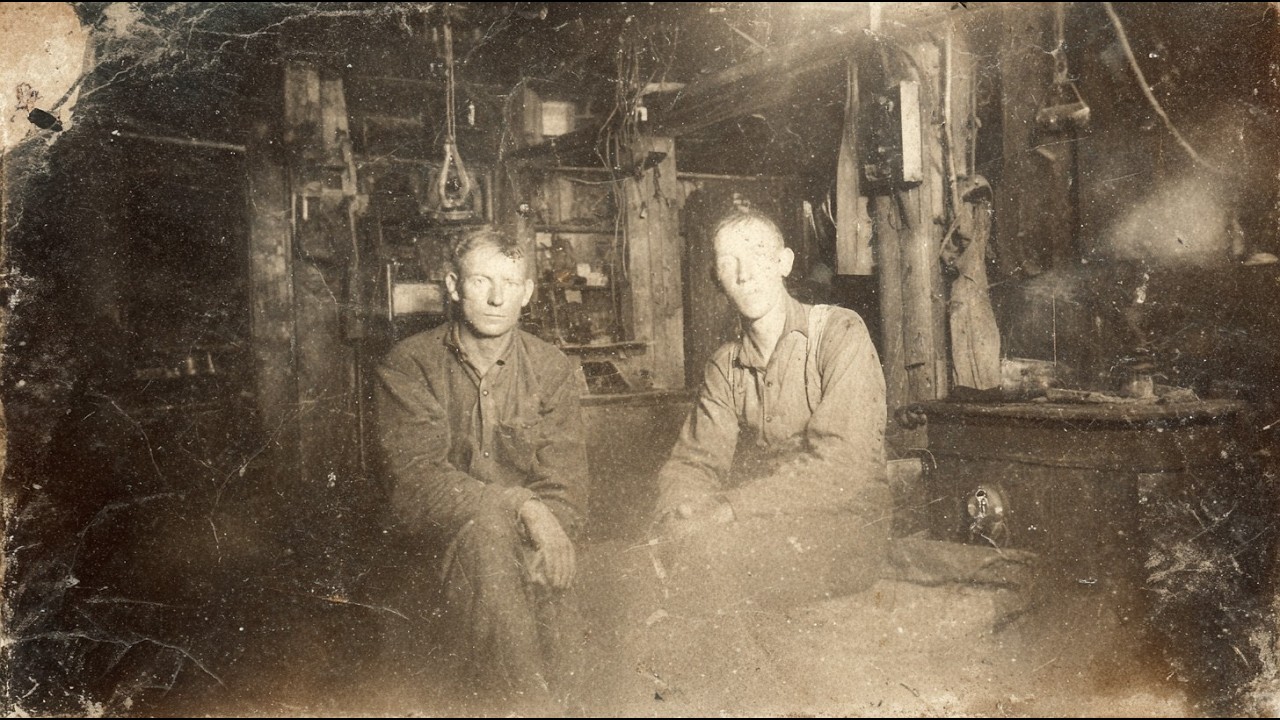
In the second week of October, a woman named Kora Winterborn came to Elmer’s shop. At sixty-two, she was the person the hollow turned to when the doctor was too far away or too expensive. She knew herbs and old ways of managing pain and fever. She did not come for furniture.
She came because she did not know where else to go. She told Elmer about a man who had appeared in the hollow three days earlier. No one knew his name. No one had seen him arrive.
He had simply appeared one morning, sitting on the stone wall outside the general store. When the storekeeper, Floyd Grimshaw, asked his business, the man said he was passing through and needed somewhere to rest. Floyd let him sleep in the back of the store. He was quiet, well-mannered, ate little, and asked for nothing except water and occasional use of the wood stove.
What brought Kora to Elmer was not the man himself. It was what had arrived with him. On the first night after the stranger appeared, she woke to a sound she could only describe as someone dragging a piece of iron across a wooden floor. The sound had not come from outside.
It had come from beneath her house, which had no cellar. On the second night, three other families reported disturbances. A miner’s wife heard slow, even breathing in the corner of her bedroom. A man named Luther Coldwell woke to find the mirror in his hallway turned to face the wall, though he lived alone.
Another woman found every window in her kitchen fogged from the inside, despite the cold. None of them could explain it. All of them shared the same feeling: something had come to Cold Mount Hollow that was paying close attention. Elmer asked Kora what she wanted him to do.
He was a cabinet maker, not sure what any of this had to do with him. She said she had been watching the stranger for three days, and there was something about him she needed another pair of eyes on. Elmer was the only person in the hollow she trusted to look at something carefully without making a decision before he had fully seen it. That was the only reason he agreed to go.
The stranger was sitting near the wood stove when Elmer arrived. He was younger than expected, perhaps twenty-five, with dark hair and hands folded in his lap with deliberate stillness. His clothes were worn but not dirty, the clothes of someone who had been traveling a long time but took care of what he had. His eyes were an unsettling shade of pale green, almost gray, and they had the look of eyes that had seen many things without being changed by them.
He said his name was Thomas, just Thomas. Elmer asked questions. Thomas answered with the careful economy of someone who had learned that the less he said, the better things went. He had come from the western part of the state.
He was heading north eventually. He did not say toward what. Elmer studied him the way he studied a piece of wood before cutting, looking for the grain, the hidden stresses, the places where it might split. What he found was not malevolence, not obvious danger.
What he found was a profound and exhausting sadness, and something else he could not name, though he would spend years afterward trying. Sitting across from Thomas, Elmer had the unshakable feeling that the young man was not entirely alone. He spent two hours with Thomas that first day. That night, he woke at an hour he could not determine.
The fire downstairs had gone out, which was unusual. There was a sound, not the iron dragging Kora had described, not breathing, not footsteps. A voice, or something close to a voice, close enough that his mind tried to make words out of it, tried to find the shape of language in it, and almost succeeded before it faded. He checked the house.
Nothing. He did not sleep. At first light he went back to the general store. Thomas was still there, awake by the cold stove.
Elmer asked directly if he was aware of the disturbances in the hollow since his arrival. Thomas looked at him for a long moment. Then he said yes. He was very sorry about it.
This was why he kept moving. Elmer pulled a chair close and asked him to explain. Thomas struggled with what looked very much like grief. He said he could not explain it fully.
He had tried with other people in other places, and the explanations never covered what was actually happening. He said he had been this way for as long as he could remember, and every person who had tried to study it or find a mechanism behind it had eventually given up or walked away. He said, “I don’t do it. I don’t make it happen.
I don’t control it. It just follows. ”
“What follows? ” Elmer asked.
Thomas looked at the floor. “I think it’s attention. ” Not spirits, not energy, but attention, as though something vast, something that existed in a way he could not describe, had turned its focus toward him. Wherever he went, that focus went with him, and whatever was near him got caught in it, the way objects get caught in the light when you turn a lamp in their direction.
He was not the source. He was the reason. Elmer asked if it was dangerous. Thomas said he had never seen it hurt anyone.
He paused. “But I’ve seen it change people. There’s a difference. ”
Elmer asked what the changed people changed into.
Thomas was quiet for a long time. “More themselves. Whatever they were most, they became more of it. Whatever they were holding back, it came forward.
Whatever they were afraid of inside themselves, they stopped being afraid of it. Or they became very afraid of it, depending on what it was. It doesn’t seem to judge. It just looks.
”
Thomas stayed three more days. On the fourth morning he was gone, gone before the hollow woke, without a note or a goodbye, just an absence where his presence had been. The disturbances stopped all at once. The mirror in Luther Coldwell’s hallway was found turned back to face the room.
The kitchen windows were clear and dry. Kora Winterborn slept through the night for the first time in a week. Elmer went back to his shop and his work. He lived in Cold Mount Hollow for another twenty-two years.
But some things were different. Small things. He started leaving his windows uncovered at night, something he had stopped doing after his brief marriage. He found himself less afraid of the particular kind of dark that a hollow gets when the clouds come down low and there is no moon.
He read his books more slowly, pausing longer, as though something in the text was still moving after he finished the sentence. And sometimes in the deep middle of the night he would lie still and feel, not with anxiety, but simply as a fact, that something was paying attention. Not to the hollow. Not to the house.
To him. He told the story once, in 1944, to a young doctor passing through, who listened with interest and said he wished he could have studied Thomas directly, that it was a shame nothing had been documented. Elmer said there are things that documentation would change. “The way that watching something changes it.
Whatever it is, I think it knows the difference between being looked at and being measured, and I think that difference matters to it. ” The doctor wrote notes anyway. Elmer never learned what became of them. He told the story a second time late in life, to Kora Winterborn’s granddaughter, who had come back to the county to settle her grandmother’s estate.
She found Elmer still in his shop, still building things from wood, his hands now mapped with age. She asked if he ever figured out what Thomas had been. He said he was not sure Thomas had been anything, in the sense she meant. Thomas had been a man, a young man who was very tired and very alone and had learned to live with something most people would have found unbearable.
She asked about the thing that followed him. Elmer set down the piece of wood he was holding. “I think it was real. I think it was present.
I think it had been around a great deal longer than any of us, and it would go on being around a great deal longer still. ” She asked if it was dangerous. He said Thomas told him he had never seen it hurt anyone. “And you believed him?
” She asked. He said he believed that Thomas believed it. “But I also think he’d learned to look at it a certain way, a way that made it bearable. And I wondered sometimes if looking at it a different way might bring you to a different answer.
”
Elmer left Cold Mount Hollow in 1953 and settled in a small town further east, where he lived quietly and built things from wood until the end. He never reported any more disturbances, but he never closed his curtains at night either. And he always slept with one window left slightly open, just a little, just enough, for reasons he kept entirely to himself.