On September 1, 1939, German tanks crossed into Poland, and Europe plunged into war for the second time in a generation. That same day, President Franklin Roosevelt made a decision that stunned the United States Army. He passed over 33 senior general officers to appoint George Catlett Marshall as Chief of Staff, a 58-year-old brigadier general who had never commanded troops in battle and was barely known outside military circles.
What Marshall inherited was an army in name only. Roughly 190,000 soldiers served in the entire force, a size that ranked below Portugal's. Warehouses held rifles left over from the First World War.
Training exercises relied on trucks with the word "tank" painted on the side because real tanks did not exist in sufficient numbers. Soldiers drilled with wooden replicas standing in for rifles. One officer summarized the state of the force in a single phrase: "All bone and no muscle."
Marshall understood the gap between what existed and what would be required. He believed the United States would eventually enter the war, and that the nation would need an army perhaps ten times larger than the one on the books. The problem was not just equipment.
It was leadership.
For decades, the army had promoted officers almost entirely by seniority. Time in service, not talent, decided who advanced. An officer could spend 15 years as a captain, 20 years as a major.
Marshall knew this reality intimately. He had held the temporary wartime rank of colonel during the First World War, then been demoted back to captain when the war ended. It took him 15 years to become a colonel again through ordinary channels.
By 1939, more than a thousand officers qualified to serve as lieutenant colonels were still wearing the rank of captain, trapped by a system that rewarded patience over performance. Many of the senior colonels were men in their 60s, trained for a war of static trench lines and cavalry charges. They did not understand blitzkrieg, the fast-moving coordination of tanks, dive bombers, and motorized infantry that Germany had just demonstrated with terrifying efficiency in Poland.
In October 1939, barely a month into the job, Marshall spoke bluntly to his staff. The present general officers of the line, he said, were for the most part too old to command troops under the terrific pressure of modern war. Most had their minds set in outmoded patterns and could not change to meet new conditions.
It was not an easy thing to say. Many of these men were colleagues he had served alongside for 30 years.
Marshall had spent years paying close attention to younger officers passing through the infantry school at Fort Benning, where he had served as assistant commandant. He noticed which lieutenants thought clearly under pressure, which ones improvised when plans fell apart, which ones led with genuine authority. He knew in considerable detail which younger officers deserved a chance the seniority system would otherwise deny them for another decade.
The political cover he needed arrived in May 1940, when Germany invaded France. Panzer divisions crashed through the Ardennes forest, terrain French planners had considered impassable to large mechanized formations. France, which had held off the German army for four brutal years during the First World War, collapsed in six weeks.
For members of Congress who had politely nodded at Marshall's warnings while doing little to fund the army, the fall of France changed everything.
Congress moved with uncharacteristic speed. Buried inside the Second Supplemental National Defense Appropriation Act of 1940 was a provision that seniority would no longer be the sole basis for promotion. Ability, performance, and demonstrated capacity for command could now count for something.
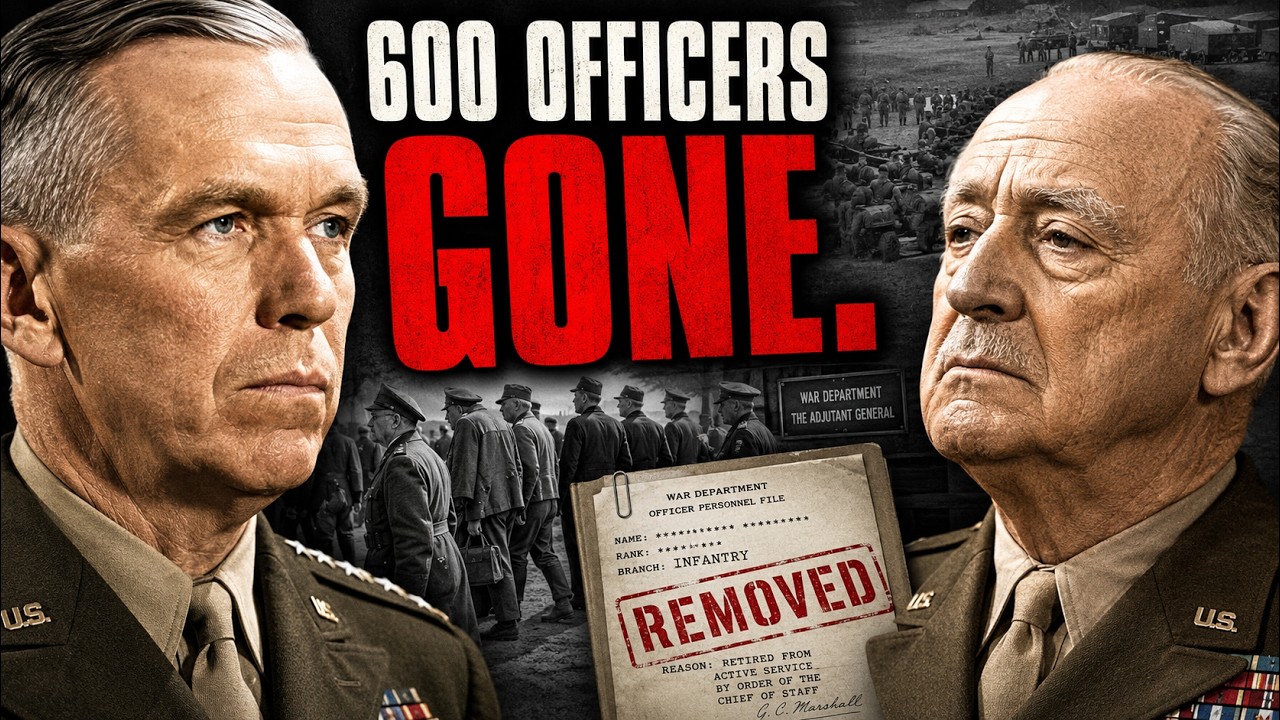
Marshall established a board of six retired officers, led by his predecessor General Malin Craig, to review the efficiency files of aging colonels and generals. Officers inside the War Department began calling it the plucking board. The name stuck because it was accurate.
Marshall's instructions left no room for sentiment. "Critical times are upon us," he told the board. "Only today's performance matters."
A distinguished record from the First World War counted for nothing. If the officer could not lead soldiers under the pressure of modern mechanized warfare, his career in active command was over. In the first six months alone, 195 officers were removed from positions of active command.
By the time the process wound down, several hundred colonels had been removed, and well over a thousand officers across all ranks had been pushed out of positions where they might have been responsible for American lives.
The process was rarely gentle. A colonel who had spent three decades in uniform might receive a short formal letter informing him that his active command was being reassigned. There was no public hearing, no opportunity to argue his case.
Some officers accepted the news quietly. Others fought back through congressmen, hometown newspapers, and personal appeals to Marshall. Marshall remained polite and immovable.
Critics accused him of gutting the army's institutional memory. One widely circulated criticism claimed Marshall had gotten rid of all the brains of the army. He never responded publicly.
He simply continued the work.
Not every officer near the danger zone of the age scale was removed. Colonel George Patton was 54 years old in 1940, squarely inside the range the board scrutinized most closely. But Patton was not tired.
He had spent his own money studying tank warfare years before most of his peers took the subject seriously. The board reviewed his file and reached a different conclusion. Patton stayed.
The distinction mattered enormously. This was never simply an assault on older officers as a category. It was an attempt to separate the men who could still adapt from the men who could not, regardless of age.
While the plucking board worked, Marshall fought a parallel battle in Congress for money. The passage of the nation's first peacetime draft in September 1940 was his most consequential legislative victory. It was later extended by a single vote in the House of Representatives in the summer of 1941.
Had that vote failed, hundreds of thousands of draftees would have been legally entitled to go home.
By June 1941, the army looked almost unrecognizable. Nearly a million men were under arms where fewer than 200,000 had stood less than two years before. But Marshall understood that an army is not simply a count of bodies.
He needed proof that his officers could actually lead.
Lieutenant General Leslie McNair, Marshall's director of training, proposed war games on a scale the army had never attempted. Three major exercises were scheduled across the second half of 1941: Tennessee in June, Louisiana in September, Carolina in November. The Louisiana maneuvers were planned on a scale that dwarfed anything that had come before.
Nearly half a million soldiers took part, more men than had existed in the entire army barely two years earlier. Fifty thousand vehicles moved across unfamiliar terrain. Thirty-two thousand horses were also present, a reminder that older cavalry traditions had not entirely disappeared.
For three weeks, two full field armies maneuvered against each other across Louisiana and East Texas, fighting a simulated campaign for control of the Mississippi River Valley.
Marshall's instructions to McNair were blunt: "I want the mistakes made down in Louisiana, not over in Europe." Unlike earlier scripted exercises, the Louisiana maneuvers were designed to be genuinely open-ended. Neutral umpires graded performance based on what actually happened on the ground.
Lieutenant General Ben Lear commanded the Red Army. Lieutenant General Walter Krueger commanded the opposing Blue Army. Krueger, in his early 60s, was one of the first senior commanders to genuinely grasp the tactical possibilities of large-scale armored warfare.
The exercise began on September 15, 1941. Within hours, it was clear this would be unlike anything the army had previously attempted. Small towns found themselves swallowed into active military operations.
Supply columns stretched for miles along narrow country roads. Communication systems buckled under the sheer volume of information.
Colonel George Patton commanded the Second Armored Division assigned to Krueger's Blue Army. In the exercise's second phase, he directed his division on a sweeping flanking maneuver that carried his tanks nearly 300 miles through East Texas, coming at Shreveport from a direction the Red Army had never seriously considered defending. When his tanks ran low on fuel, he bought gasoline directly from civilian service stations, paying cash to keep his columns rolling.
His tanks came roaring into Shreveport from the north while infantry and cavalry pressed from the south. The Red Army found itself effectively surrounded, and exercise headquarters halted the maneuver with the outcome beyond dispute.
Colonel Dwight Eisenhower served as chief of staff for Krueger's Third Army throughout the exercise. His planning was described as meticulous. His execution under pressure was calm and precise.
CBS correspondent Eric Sevareid reported that Eisenhower made more sense than any of the rest of them. Drew Pearson credited him with what he called a steel trap mind combined with unusual physical vigor. Marshall noted the name.
Lieutenant Colonel Omar Bradley performed capably during the same exercises. Lieutenant Colonel Mark Clark, who had helped plan significant portions of the exercise, reportedly relying at one point on nothing more sophisticated than a civilian gas station road map, showed a similar gift for improvisation. Colonel Joseph Stilwell had already impressed observers during earlier exercises with a fast-moving armored column that behaved nothing like the slow formations most senior officers still favored.
The Louisiana maneuvers delivered exactly the validation Marshall had been gambling on. The officers who remained after the purge could genuinely fight the kind of war that was coming. The exercises also exposed real weaknesses in communication systems, anti-tank doctrine, and supply logistics.
Marshall absorbed every lesson. These were precisely the mistakes he had hoped to surface in Louisiana rather than on an actual battlefield.
On December 7, 1941, just over two months after the maneuvers concluded, Japanese aircraft struck Pearl Harbor. The United States was suddenly and unambiguously at war. Within two weeks, Admiral Husband Kimmel and Lieutenant General Walter Short, the commanders responsible for the defense of Pearl Harbor, were relieved of their posts.
Failure at this scale ended careers immediately, exactly as Marshall's efficiency boards had been treating failure for two years.
By Marshall's own later estimate, at least 600 officers had been forced out of the army before the United States formally entered the war. The process continued throughout the conflict. Whenever a commander failed under the pressure of actual combat, Marshall's system moved to replace him.
The officers Marshall had identified during those years of careful observation now rose through the ranks at a pace the old seniority system would never have permitted. Eisenhower was promoted to Brigadier General weeks after his performance in Louisiana. Within months of Pearl Harbor, Marshall brought him to Washington to help direct Army war plans.
By late 1942, Eisenhower commanded all United States forces in the European theater. By June 1944, he commanded Operation Overlord, the largest amphibious military operation ever attempted.
In less than five years, Eisenhower rose from Lieutenant Colonel to five-star general. Under the seniority system, such a rise would have been impossible. Omar Bradley rose to command American ground forces in Normandy.
George Patton, the 54-year-old colonel the plucking board had chosen to spare, went on to command the Third Army, driving across France with a speed that made him the American general German commanders feared most. Joseph Stilwell commanded Allied forces in the China-Burma-India theater. Mark Clark commanded the Fifth Army through the Italian campaign.
When Marshall took command in 1939, the army numbered roughly 190,000 soldiers. By 1945, it had grown to approximately 8. 3 million men, an expansion of more than 40 times its original size in under six years.
That force fought and defeated Nazi Germany and Imperial Japan simultaneously across multiple theaters. It succeeded in no small part because the men leading it had been selected for their demonstrated ability to adapt under pressure rather than for how patiently they had waited their turn.
The British chiefs of staff described Marshall as the architect and builder of the finest and most powerful army in the nation's history. Winston Churchill called him the organizer of victory. President Harry Truman said simply that Marshall was the man who won the war.
After the war, Marshall served as Secretary of State. In 1947, he proposed what would become known as the Marshall Plan, pouring American resources into rebuilding the shattered economies of Western Europe. For this work, he received the Nobel Peace Prize in 1953, the only professional army general in history to be so honored.
Marshall's most enduring legacy was the underlying principle that had guided his conduct from his first weeks in office: that positions of genuine consequence should be filled by the people demonstrably best equipped to succeed in them, not simply by the people who had been waiting the longest. That ability should outweigh seniority. That measurable results should outweigh accumulated time in service.
The vindication arrived slowly, campaign by campaign, spread across six years and three continents. The men he passed over, the hundreds of colonels and generals whose careers ended in the cold language of an efficiency board's letter, mostly faded from public memory. What survived was the system itself, the underlying principle that outlasted any individual officer's personal disappointment, still shaping how the United States military selects its leaders generations later.