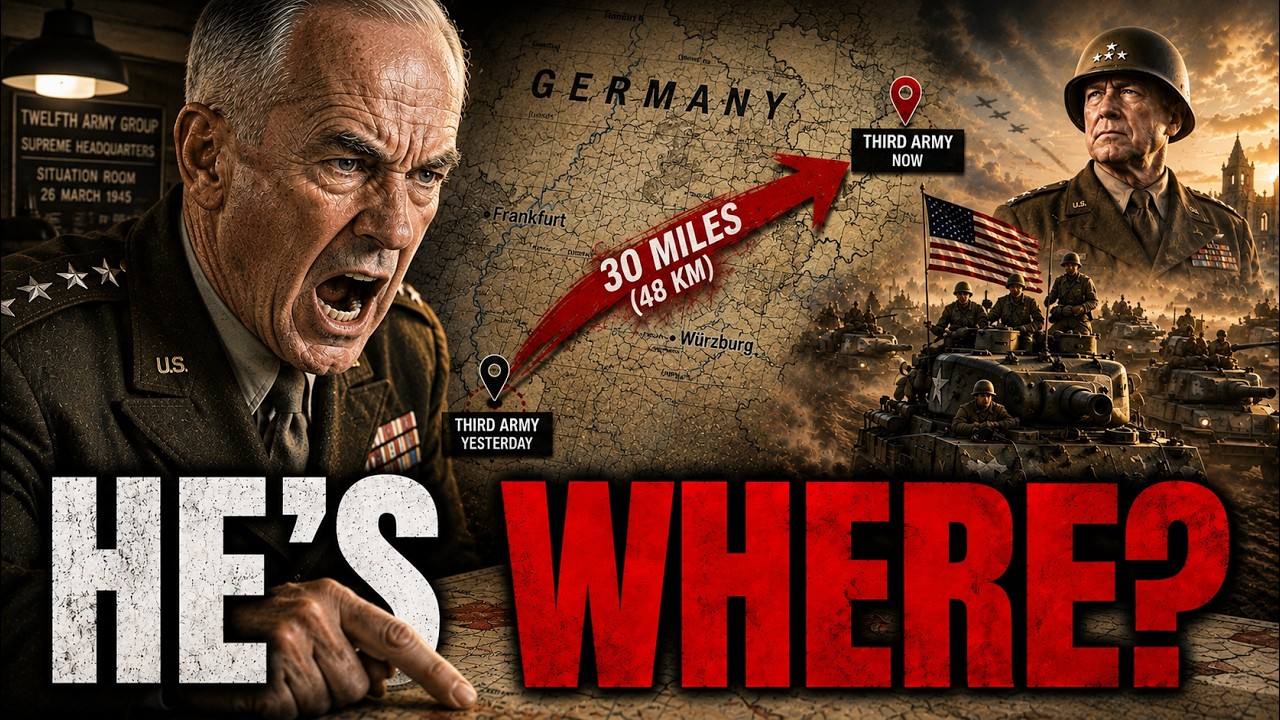
In late March 1945, General Omar Bradley was reading a routine position report at 12th Army Group headquarters when he stopped cold. The map reference in front of him placed Third Army’s lead elements somewhere it had no business being. He read the coordinates again, tracing the grid lines with his finger until it stopped.
Then he looked up at his staff and asked a quiet, disbelieving question: “He’s where?”
Nobody in the room had an answer. Somewhere past every phase line and boundary drawn the week before, an entire American army was moving through German territory that headquarters had not yet authorized.
Bradley did not shout. Men who worked under him for years later said that when something truly alarmed Omar Bradley, his voice dropped instead of rising. On that late morning, his voice had dropped almost to nothing.
The distance between Third Army’s reported position and its position 24 hours earlier was not a matter of a mile or two of careful advance. It was the distance of an army that had moved further in one day than most divisions moved in a week.
To understand the moment, you have to understand the two men at opposite ends of that command relationship.
Bradley was one of the most trusted generals in the United States Army. Methodical and careful with his men’s lives, he commanded 12th Army Group, the largest concentration of American combat power in the theater. Under his authority sat First, Ninth, and Third Armies—more than a million men.
His genius was not flash. It was the unglamorous work of making sure fuel reached the front and divisions did not outpace their own supply lines.
George S. Patton was something else entirely. His reputation had been forged in North Africa and sharpened in Sicily, where his armored columns raced across the island.
His temper, most infamously in an incident involving two shell-shocked soldiers he struck in field hospitals, nearly ended his career. Only Eisenhower’s intervention kept him in uniform. By the time the Allies broke out of Normandy, Patton commanded Third Army, and he had spent months proving no one else could move armor the way he could.
Bradley and Patton were not strangers. Bradley had once served under Patton in North Africa before their positions reversed. Patton, older and more decorated in the interwar years, occasionally chafed at reporting to a man he had once outranked.
But the partnership worked because each man supplied something the other lacked. Bradley provided discipline. Patton provided aggression.
By late March 1945, that partnership was being tested in a way it never had been before.
Two months earlier, Hitler had staked Germany’s remaining mobile reserves on one final gamble in the West. The attack through the Ardennes caught Allied lines thin, and for a handful of terrifying days, it appeared the offensive might split the American and British armies apart. It failed.
The Bulge was contained, then crushed at a terrible cost in American lives. But the cost to Germany was far worse. The Panzer divisions thrown into the Ardennes were among the last truly capable armored formations the Wehrmacht possessed.
When the battle ended, Germany had lost its last reserve and a good deal of its will to fight in any organized way.
That changed the fundamental shape of the war. German units still existed and could fight hard when cornered. But the connective tissue between them—fuel, communications, reserves—had been gutted.
What remained was not a solid wall. It was closer to a row of doors. Some locked and defended fiercely.
Others already standing open.
Eisenhower understood this shift. His broad front strategy called for Allied armies to advance together along the length of the Western Front, each protecting the flanks of the other. There were sound reasons for this caution.
The Allied effort was a coalition built on cooperation between nations with different priorities. A coordinated advance kept that coalition intact and reduced the risk of any single army becoming exposed and cut off.
Patton looked at the same battlefield and drew a very different conclusion. Where Eisenhower saw a wall that needed to be dismantled carefully, Patton saw a structure already cracked from foundation to roof. A defeated enemy, in Patton’s view, was at its most dangerous only for a brief window.
Wait too long, and soldiers who might have surrendered instead found new officers and a reason to keep fighting.
This philosophy was about to produce the boldest move of his career.
For weeks, Allied attention had been fixed on a very different river crossing. Field Marshal Bernard Montgomery was assembling one of the largest set-piece operations of the war to get forces across the Rhine near Wesel, complete with airborne drops and enough logistical buildup to move mountains. It was scheduled for the final days of March and carried the name Operation Plunder.
Patton watched the buildup with barely concealed contempt. He believed speed and audacity, not preparation and spectacle, won wars. While Montgomery’s crossing was still being assembled, Patton quietly ordered the Fifth Infantry Division to force a crossing of the Rhine near Oppenheim, well south of where anyone was watching closely.
It happened at night on March 22 with minimal preparation and almost no advanced warning to headquarters. Assault boats slipped into the water in darkness. Engineers worked through the night constructing pontoon bridges.
By morning, Patton had an entire division across the Rhine and a full day’s head start on Montgomery.
Only after the crossing was secured did Patton inform anyone above him. He reportedly told Bradley that Third Army had crossed the Rhine before Montgomery had even begun his preparatory bombardment, and asked that the fact be kept quiet so the news would land with maximum impact.
For Bradley, there was genuine professional pride. But underneath it was the first faint edge of a concern that would grow sharper every day. Patton had not asked permission.
He had informed his superiors after the fact, once there was nothing left to do but accept what had happened.
What Bradley did not yet know was that this was only the opening move.
In the days that followed, the war took on a rhythm nobody had fully prepared for. The problem was not that Patton had disobeyed a specific order. It was something harder to pin down.
Third Army’s reconnaissance elements would radio back a position report, but by the time that report traveled up through division, corps, and army headquarters to Bradley’s map table, the reality on the ground had already changed. Spearhead units were covering 30, 40, even 50 miles between confirmed positions. Bradley was not looking at where Third Army was.
He was looking at where Third Army had been.
This was the true meaning behind the moment that would become famous. It was not a joke or simple exasperation. It was a genuine realization that the tools of command—the maps, the reports, the careful staff work—were no longer keeping pace with the war they were supposed to be describing.
From Patton’s perspective, the situation looked different. He did not see himself as outrunning anyone. He saw himself as the only man who correctly understood what kind of war this had become.
The German army in the west no longer existed as a coherent fighting force. What remained was a series of isolated strong points. Momentum, in his judgment, killed more efficiently than firepower ever could.
So Patton pushed forward on multiple axes simultaneously. Some columns ran into stiff resistance. Others found empty roads and long lines of German soldiers walking west with their hands raised.
This was not chaos. It was a deliberate style of command built on trust flowing downward rather than control flowing upward.
This divergence put Patton on a collision course with the broader logic of how Eisenhower intended to win the war. The broad front strategy depended on synchronization. Patton believed that framework had become obsolete.
Germany was no longer defending a continuous front. There was nothing left to synchronize against.
There was also something more personal in Patton’s urgency. Every additional day the war continued meant more American soldiers killed in fighting that had already been strategically decided. Speed, to Patton, was a form of mercy.
While Third Army surged east, the rest of the Allied line advanced at a very different tempo. The growing distance between Third Army and the armies on its flanks was becoming a problem. If Third Army continued to outpace its neighbors, it risked becoming isolated.
But there was a second concern. The Soviet Red Army was moving west at a pace of its own. The precise line where American and Soviet forces would meet had become as much a political calculation as a military one.
An American army pushing too far into territory understood to fall within the Soviet zone risked an unplanned encounter between two massive forces that did not share a common language or much trust.
Eisenhower faced a genuinely difficult choice. He could order Patton to halt, giving German forces time to regroup. Or he could allow Patton to continue, accepting the risk of overextension in exchange for an advance that was demonstrably shortening the war.
Stopping Patton proved far harder in practice than in theory. Whenever headquarters attempted to impose tighter limits, Patton found ways to comply with the letter of his orders while continuing to push forward in substance. The front kept moving east regardless of what the map showed.
For Bradley, this was an uncomfortable truth. Patton was allowed to keep operating this way largely because he kept succeeding. Casualties were consistently lower than projected.
Cities that planners expected to cost days of hard fighting were falling in hours. Every new report confirmed the same pattern. Third Army was winning and winning cheaply.
Bradley later described the experience of commanding Patton during this period in terms that stuck with the officers who heard him. It did not feel like issuing orders to a subordinate general. It felt like standing near a force of nature and trying to hold on.
Behind the maps, the strain showed in places the official reports never mentioned. Fuel officers worked around the clock, rerouting truck columns as forward units burned through gasoline faster than any planning table had projected. Communications units lost contact with the most forward elements for stretches of time that would have been unthinkable earlier in the war.
Staff officers grew accustomed to issuing guidance they privately suspected was already outdated the moment it left their hands.
The risk that worried Eisenhower most was the question of where the war would end and who would be standing on which side of the line when it did. Every mile Third Army pushed east without careful coordination increased the odds that American and Soviet forces would run into each other unexpectedly.
It was against this backdrop that a much smaller, far more personal story had been developing inside Patton’s own headquarters.
Lieutenant Colonel John Waters was Patton’s son-in-law, married to his daughter Beatrice. By the spring of 1945, he had spent roughly two years as a prisoner of war since being captured in Tunisia in February 1943. Through the chaotic process of German prisoner relocations, Waters had eventually been transferred to Oflag 13B near Hammelburg in Bavaria, a camp holding a growing population of Allied officers.
Patton had followed reports of his son-in-law’s captivity as closely as the fragmented wartime intelligence system allowed. As Third Army’s advance carried it deeper into Bavaria, and as intelligence placed a significant population of Allied prisoners at Hammelburg, a question began to form in Patton’s mind that had nothing to do with grand strategy.
By the final days of March, that question forced its way into a decision. Patton ordered the formation of a small task force built around a company of medium tanks, a company of armored infantry, and supporting vehicles—roughly 300 men—under the command of Captain Abraham Baum. The task force was ordered to push deep behind German lines, more than 50 miles past the forward edge of Third Army’s confirmed positions, and reach the camp before German guards could move the prisoners.
Officially, the mission was framed as a raid to liberate Allied prisoners of war. Unofficially, the scale of the force and the specific camp selected bore an unmistakable relationship to the fact that Patton’s own son-in-law was believed to be held inside.
Task Force Baum set out on March 26. What followed was by almost every measure a disaster. The column encountered persistent German resistance the entire route.
Vehicles were lost to mines, ambush, and mechanical breakdown. Communication with headquarters broke down almost entirely within the first day.
The task force did reach the camp on March 27 and broke through the perimeter. But the camp held far more prisoners than the task force had vehicles to transport. There was no way to evacuate anywhere near the full population.
German forces surrounded the task force as it attempted to withdraw. Most of the remaining vehicles were destroyed or captured. Captain Baum himself was wounded and captured.
The great majority of the American soldiers who set out were killed, wounded, or taken prisoner.
Among the confusion, Lieutenant Colonel Waters was seriously wounded by German fire during the fighting and remained in German hands until Allied forces overran the area weeks later.
The cost of the raid was almost impossible to reconcile with any reasonable calculation of the objective achieved. A force of roughly 300 men had been sent 50 miles behind enemy lines, and the great majority had been killed, wounded, or captured in a mission that failed to bring back the prisoners it had been sent to rescue, including Patton’s own son-in-law.
When word of the raid’s outcome reached Bradley and Eisenhower, the reaction was sharp. Eisenhower was reportedly furious, viewing it as an example of personal judgment overriding sound military reasoning. Patton never fully acknowledged in public that personal motive had shaped the mission.
But among the officers who knew the full story, there was little doubt.
The remainder of the war in Europe unfolded quickly. Germany surrendered unconditionally in early May 1945. In the months that followed, the argument over what to make of Patton began and has never entirely settled.
His operational brilliance was never seriously disputed. But the army never held him up as a template to be replicated. His methods depended too heavily on personal instinct and a tolerance for risk that few commanders possessed.
Within months of Germany’s surrender, Patton was quietly removed from command of Third Army and reassigned to a largely ceremonial position. Not a punishment for any single act of insubordination, but a recognition that the qualities the war had needed most were no longer the qualities the peace required.
Bradley understood the paradox better than almost anyone. Commanding modern armies rested on the assumption that information could keep pace with events. Patton had shattered that assumption almost effortlessly, not through open defiance, but simply by moving faster than any system built to track him could manage.
For hours, sometimes for the better part of an entire day, Third Army existed outside the normal cycle of command and control altogether.
That gap between speed and control, however useful it proved in the final desperate weeks of a collapsing war, was not something any army could responsibly build a lasting doctrine around. The army studied Patton, admired him, taught pieces of his maneuvers, and quietly concluded that he had been above all else an exception rather than a model.
Standing in front of a map that could no longer keep pace with the war it was meant to describe, Omar Bradley had asked the only question that made any real sense in that moment. A question that was never really about geography at all.
He’s where?