Detroit, Michigan, spring 1943. Outside the gates of a war plant on the city’s edge, a young Black woman in work clothes and a headscarf walks toward the time clock for her first shift. She carries a lunch pail and an identification badge with her photo. Two years earlier, she had scrubbed floors in a white woman’s kitchen for a few dollars a week.
Now she would help build machines that would win the war. That same spring, within just two weeks, white workers walked off their jobs five separate times, halting production in the middle of the war, merely because Black women like her had been hired to work beside them. She was born in Georgia in 1915 and moved to Detroit in 1936. By 1943 she was twenty-eight, married, with two small children.
Her husband was in the army. Her mother remained in Georgia. Her younger sister worked in a shipyard in California. Her name is not important because her life was lived by hundreds of thousands of women.
Let us call her Hazel. Hazel grew up on a farm outside Macon, Georgia, the daughter of a sharecropper and a washerwoman. By age ten she was picking cotton in the fall and helping her mother boil white families’ clothes in a black iron pot in the yard. She attended school through the eighth grade, the highest level the segregated school in her county offered.
At twenty-one, in the depths of the Great Depression, she came north to Detroit, where an aunt found her work as a live-in maid for a wealthy family on the city’s east side. She cooked their meals, cleaned their house, washed their clothes, and cared for their children. She got one afternoon off a week and slept in a cramped room off the kitchen. In 1940, the year before America entered the war, roughly six out of ten Black women working for wages in the United States labored in private homes as domestic servants.
Most of the rest worked in fields or laundries. Factories did not hire them. Offices did not hire them. Department stores did not put them behind sales counters.
The kitchen was where society expected a Black woman to be. Hazel married a man named Clarence in 1938. He worked at the Ford plant in the foundry, where many Black men in Detroit found employment. They rented a small apartment on the east side near Paradise Valley, in the crowded districts where Black families were forced to live.
Hazel left her live-in job and began working by the day so she could return home to her husband. By 1941 they had a son and a daughter. On December 7, 1941, Japan attacked Pearl Harbor, and everything changed. Detroit, the city that built most of America’s cars, began building tanks, bombers, trucks, engines, weapons, and ammunition.
Automobile plants stopped making vehicles for civilians and turned every machine toward the war. People began calling Detroit the Arsenal of Democracy. At the massive new Willow Run plant outside the city, Ford built B-24 bombers, producing one every hour at the height of the war. The factories needed workers, more workers than the country had ever needed before.
The men who once held those jobs were being drafted by the millions. In 1942 Clarence was drafted and sent to a training camp in the South in a segregated army. Black soldiers trained in separate units, lived in separate barracks, ate in separate mess halls, and were usually commanded by white officers. Most were assigned to labor and supply units, driving trucks, loading ships, and building roads rather than fighting.
Clarence ended up in a quartermaster supply company, hauling supplies across England and later France. Before he left, he told Hazel she must not go back to cleaning houses. The factories were hiring, he said, and she should get a paying job. Getting that job was not as simple as walking through the door.
Even before the war, Black leaders had fought to open defense industries. In 1941 A. Philip Randolph, president of the Brotherhood of Sleeping Car Porters, threatened to bring one hundred thousand Black Americans to march on Washington to protest discrimination in defense jobs. President Franklin Roosevelt did not want that march.
In June 1941 he signed Executive Order 8802, which declared no discrimination in defense industries or government based on race, creed, color, or national origin. It created the Fair Employment Practices Committee to investigate complaints. The order was historic, but a paper order was not the same as a real job. Many employers simply ignored it.
When they needed more workers, they hired white men first. When white men ran out, they hired white women. Only when white women ran out did many finally hire Black men. Black women were last on the list.
In Detroit they went from one hiring office to another and were turned away. They were told there were no openings even when newspapers were full of help-wanted ads. They were told they were unqualified. They were offered jobs as matrons, as attendants in women’s restrooms, or as cleaners sweeping factory floors after the white workers had gone home.
Black women who completed training courses for skilled jobs were sometimes sent to cleaning work anyway. Black women did not accept this silently. In Detroit and other cities they filed complaints with the Fair Employment Practices Committee. They went to the Urban League and the NAACP.
They organized and picketed in front of hiring offices. They wrote letters to the government. They returned to the same hiring offices again and again, supported by the Black press. In early 1942 the Pittsburgh Courier, one of the most widely read Black newspapers in the country, launched a campaign called the Double V.
The first V stood for victory over fascism abroad; the second for victory over racism at home. Black Americans would fight for their country, the paper said, but they would also fight for their rights within it. The Double V symbol appeared in newspapers, on posters, on pins, and on hats. Black women stitched it onto their dresses.
Black churches preached about it. It became the rallying cry of Black America during the war. Hazel applied at four different factories in the fall of 1942. At three she was told there were no jobs.
At the fourth she was offered a position cleaning restrooms. She turned it down. Then in the winter a woman from her church told her about a training program. The government was paying for courses to teach women skills the factories needed: riveting, welding, drilling, and parts inspection.
Hazel enrolled. For eight weeks she attended classes at a vocational school, learning to handle a rivet gun, read blueprints, and use measuring tools. Her mother had never been allowed to finish school. Her grandmother had been born into slavery.
Hazel was learning to build airplanes. While she trained, her children stayed during the day with a neighbor, an elderly woman from Alabama who minded five or six children from the building for a small fee. Child care was one of the hardest problems for working mothers during the war. Daycare centers were scarce, and those that existed often would not accept Black children.
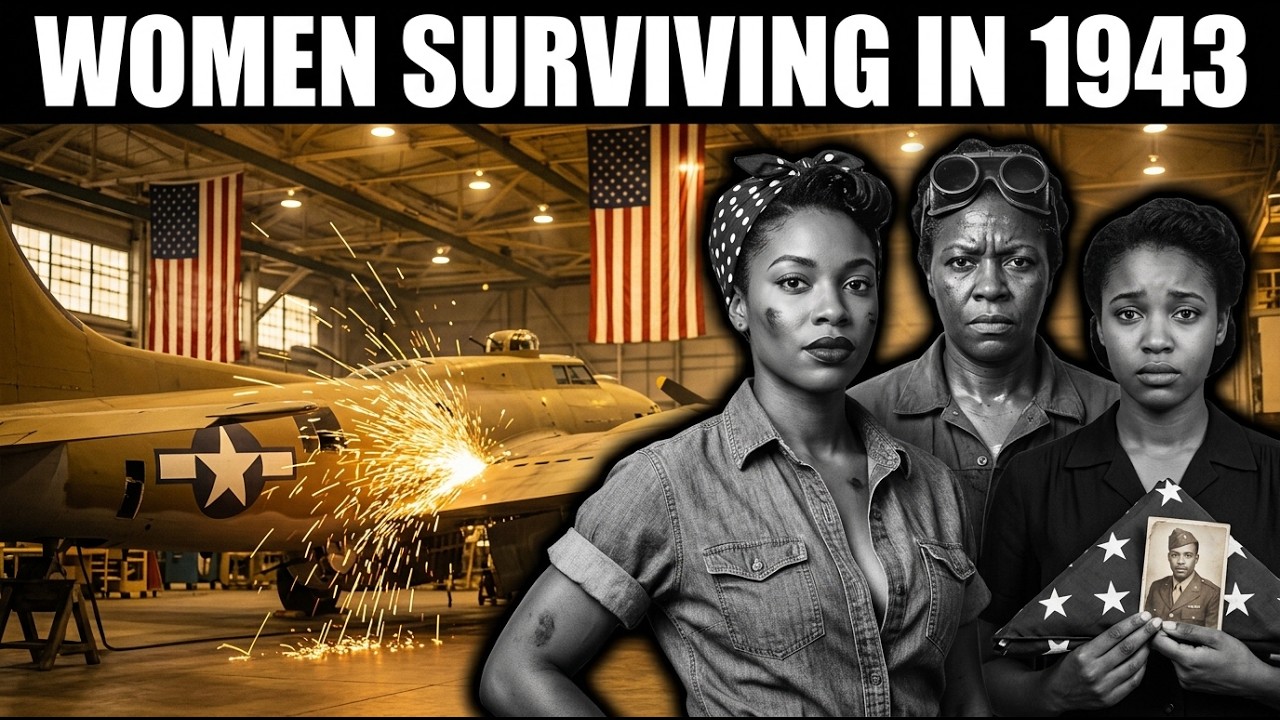
Black women did what they had always done and relied on one another. Grandmothers, aunts, neighbors, and church women raised the children while the mothers worked. In the spring of 1943 Hazel was finally hired at a plant making parts for military aircraft. On her first day she wore the uniform that women wore: heavy cotton work clothes, sturdy shoes, and a scarf tied over her hair, because loose hair could catch in machinery and tear a woman’s scalp.
She pinned her badge to her collar and rode the bus to the factory in the dark, carrying the lunch pail Clarence had left behind. The plant was enormous, rows and rows of machines stretching beyond what she could see. The noise was deafening: rivet guns, drills, hammers, and engines all at once. The air smelled of oil and hot metal.
There were thousands of workers, and for the first time in her life, many of them were women. Hazel was assigned to an assembly line where women riveted metal panels onto sections of airplane wings. She worked with a partner who held a heavy metal bar on the other side of the panel while Hazel drove the rivet through. The work was hard, loud, and precise.
One bad rivet could weaken a wing. Every piece was inspected. Her partner that first week was a white woman from Kentucky who had also come north for war work. At first the white woman barely spoke to her.
Some of the white women on the line refused to eat lunch near her. Some refused to use the same restroom. In some factories, managers set up separate restrooms, changing rooms, and lunchrooms for Black workers, just as in the South. The days were long.
Most war plants ran around the clock in three shifts, seven days a week. Hazel worked ten hours a day, six days a week, sometimes more when the plant fell behind. She woke at four-thirty in the morning, fixed breakfast for the children, dressed them, walked them to the neighbor’s apartment, and caught the bus. The buses and streetcars at shift changes were so crowded that people hung from the doors.
By the time she returned home in the evening, it was dark again. She cooked dinner, washed the children’s clothes, checked their schoolwork, and collapsed into bed. The work was dangerous. Rivet guns shook her arms until they went numb.
The noise left a ringing in her ears that lasted all night. Women on the line cut their hands on sharp metal edges, burned themselves on hot equipment, and strained their backs lifting heavy pieces. Some women lost fingers in the machines. There was a nursing clinic in the plant, never empty.
But when Hazel held up the first section she had finished and the inspector stamped it approved, she felt something she had never felt while cleaning floors. What she made would matter somewhere in the world. Somewhere over Europe or the Pacific, a young man would fly in a plane thanks to the rivets she had driven. Then there were the hate strikes.
A hate strike occurred when white workers walked off their jobs in protest over the hiring or promotion of Black workers. In Detroit in 1943 they happened again and again. In one two-week period that year, five hate strikes occurred in Detroit, each triggered specifically by the hiring of Black women. Some strikes began when Black women were moved to production-line jobs instead of cleaning.
Others began when a Black woman was assigned to work beside a white woman, or when white women objected to sharing restrooms. Sometimes the strikes lasted a few hours, sometimes days. In the middle of a war in which soldiers depended on those planes and tanks, production stopped because some white workers refused to work next to Black women. In early June 1943 at the Packard plant in Detroit, which built engines for bombers and patrol boats, the company upgraded three Black men to work on the assembly line.
In response, about twenty-five thousand white workers walked off the job, shutting down one of the most important war plants in the country. The federal government, union leadership, and the army pressured the strikers. Leaders of the United Auto Workers told them they would lose their jobs if they did not return. In many cases the strikes ended with Black workers keeping their jobs, but tension in Detroit rose every week.
The city was overcrowded. Hundreds of thousands of new workers, Black and white, many from the South, had poured into Detroit for war jobs. There was not enough housing for anyone. Black families were crammed into the same crowded neighborhoods, paying high rents for rundown apartments.
Streetcars and buses were packed. Parks and beaches were crowded. Nerves were stretched thin. On a hot Sunday night in June 1943, the twentieth, fighting broke out between Black and white youths on Belle Isle, an island park in the Detroit River where thousands of families had gone to escape the heat.
Rumors spread on both sides of the city. By morning Detroit was in the middle of one of the worst race riots in American history. Federal troops were required to restore order. Thirty-four people were killed, most of them Black.
Hazel stayed inside with her children for three days, listening to sirens and gunfire, praying that no one would come to her street. When the plant reopened, she went back to work. She did not know what else to do. The war would not wait, and neither would the bills.
Despite everything, the work changed Hazel’s life. As a maid she had earned a few dollars a week. At the plant she earned in one week more than she had earned in a month. For the first time she had a paycheck in her own name.
She opened a savings account at a bank. She bought war bonds, pasting stamps in a book until she had enough for a bond. She bought her children new shoes that had never been worn by anyone else. She sent money every month to her mother in Georgia.
And she had something money could not buy: pride. She was no longer a woman in an apron whom strangers called girl. She was part of the war effort. She was building bombers.
Between 1940 and the end of the war, the share of Black women working as domestic servants fell from about sixty percent to about forty-five percent. Hundreds of thousands of Black women moved into factories, shipyards, offices, hospitals, and government jobs. In Detroit alone the proportion of Black women working outside the home jumped dramatically. Hazel’s younger sister, whom we will call Ruby, went further.
She left Georgia in 1942 and traveled all the way to California. On the West Coast, in cities like Los Angeles, Oakland, Richmond, and Portland, enormous shipyards were building cargo ships and warships around the clock. The Kaiser shipyards in Richmond, California, employed tens of thousands of workers. Some ships were built in a matter of days.
Black workers from Texas, Louisiana, Arkansas, and Oklahoma flowed west by train to take those jobs in what some called the Second Great Migration. Ruby became a welder, wearing a heavy leather jacket and welding mask, working inside hot, cramped ship hulls with sparks flying around her. She wrote to Hazel that it was the hardest work she had ever done, but the pay was better than anything back home, and she felt the whole world was open to her. Even in California, the battle continued.
Some shipyard unions would not grant Black workers full membership, putting them in separate auxiliary unions with fewer rights and less protection while still collecting their dues. Black workers fought those unions in the courts and through the Fair Employment Practices Committee and eventually won. Back in Georgia, Hazel’s mother, whom we will call Mother Addie, experienced the war differently. She was sixty-two years old, still living in the same wooden house outside Macon where she had raised her children.
Her husband had died before the war. She took in laundry, tended her garden, and raised chickens as she always had. But the war was changing even her small corner of the South. The army built a large training camp near Macon, and thousands of soldiers passed through.
Black women in the area found work cooking, cleaning, and doing laundry at the camp, sometimes for better pay than they received from white families in town. With many young men in the army and many young women gone north to war factories, white families in town suddenly found it hard to hire help. For the first time some of them had to raise wages. Every month a money order arrived from Detroit, and every few months one arrived from California.
Mother Addie kept the envelopes in a tin box under her bed. She used the money to fix the roof, buy a new stove, and buy new shoes for grandchildren still living nearby. When neighbors asked about her daughters, she told them one was building airplanes in Detroit and the other was building ships in California. She said it slowly so they would not miss a word.
She had been born in 1881, only sixteen years after the end of slavery. She had spent her whole life washing other people’s clothes and working other people’s land. Now her daughters were building the machines that were winning the war. She did not understand exactly what a rivet or a weld was, but she understood perfectly what it meant.
In the eastern cities the same story unfolded. In Philadelphia Black women went to work in the Navy shipyard, in munitions plants, and in factories making uniforms and parachutes. In New York they found jobs in garment factories, war offices, and the Brooklyn Navy Yard. In Washington, thousands of young Black women came from the South to work as clerks and typists in the government agencies running the war, living in crowded hostels and rented rooms.
People called them government girls. Some Black women found a different way to serve. In 1942 the army created the Women’s Army Auxiliary Corps, later the Women’s Army Corps. Thousands of Black women joined, serving as clerks, drivers, mechanics, cooks, and medical technicians.
They were segregated like Black male soldiers, living in separate barracks and serving in separate units. Near the end of the war, a battalion of over eight hundred Black women, the 6888th Central Postal Directory Battalion, was sent to Europe to sort a massive backlog of mail addressed to American soldiers. They worked around the clock and finished faster than anyone expected. Black women were in the corps from the beginning, partly due to the pressure of Mary McLeod Bethune, the educator and adviser to the Roosevelt administration who insisted Black women be included.
When the first class of officers trained at Fort Des Moines, Iowa, in 1942, about forty were Black. One was a young woman from South Carolina named Charity Adams, a former math teacher. She later commanded the battalion sorting mail in Europe, becoming one of the highest-ranking Black women in the army during the war. For many Black women who joined, the uniform meant something powerful.
They walked through the streets of their hometowns in crisp khaki with their heads high, and people made way for them. Some were insulted, denied service in restaurants, or ordered to the back of buses while wearing their country’s uniform. They wrote about those experiences in letters to the Black press, and their stories fed the Double V campaign at home. Black nurses also fought to serve.
Early in the war the army imposed strict limits on how many Black nurses it would accept, and many who were accepted were assigned to care for German prisoners of war rather than American soldiers. Black nursing organizations protested repeatedly, and slowly the limits were eased. Meanwhile, life on the home front was shaped by the war in every way. Rationing came into effect.
The government issued ration books to every family with stamps needed to buy sugar, coffee, meat, butter, canned goods, and shoes. Gasoline was rationed. Tires were rationed. Families saved meat fat and turned it in because fat was used to make explosives.
Children collected scrap metal and rubber for war drives. Women planted victory gardens in backyards and empty lots, growing cabbage, tomatoes, beans, and okra. For Black women who had grown up poor in the South, rationing was nothing new. They already knew how to make do with little.
Some of them laughed and said the rest of the country was finally learning to live the way they had always lived. Hazel waited for Clarence’s letters every week. They arrived erratically, sometimes two at once, sometimes nothing for a month. They were written on thin paper, censored with words deleted.
He told her about the cold and rain in England, the long hours driving supply trucks, the English villagers who welcomed the Black soldiers with kindness, and the white American soldiers who tried to spread the same prejudice they had brought from home. He asked about the children. He told her he was proud of her. She wrote back every Sunday night after the children were asleep.
She told him about the plant, the church, the neighbors, the children. She did not tell him about the hate strikes or the riot. She did not want him to worry. There were also moments of joy in 1943.
On Sundays Hazel took the children to church, where mothers cooked their children’s meals and the minister prayed for soldiers by name, one by one. After services, church women held bake sales to buy war bonds and send care packages to Black soldiers overseas. On Saturday nights, if she had the energy, she went to Paradise Valley with friends from the plant. The clubs along Hastings Street were full of music, swing, jazz, and blues.
Soldiers on leave filled the dance floors. For a few hours the war seemed very far away. That summer a film drew crowds of Black moviegoers. It was called Stormy Weather, one of the few Hollywood films of the time with an all-Black cast.
It starred Lena Horne, Bill Robinson, Cab Calloway, Fats Waller, and the Nicholas Brothers. When Lena Horne sang the film’s title song, women in the audience cried. For Black moviegoers used to seeing themselves on screen only as servants and porters, it was a rare chance to see Black artists shine. By the end of 1943 Hazel had spent most of the year in the plant.
She was promoted to inspector, checking the work of other riveters. The white woman from Kentucky, if not quite a friend, had at least become a coworker who shared lunch with her and asked about her children. Small things had changed. But the big things had not.
The war continued for nearly two more years. When it ended in 1945, many of the women who had built the weapons of victory were laid off to make room for returning men. Black women were among the first to go. Many were forced back into domestic work, back into the same kitchens they had left.
But they did not return the same. They had learned they could do work the country had told them they could not do. They had learned what it felt like to earn a real wage. They had learned to organize, to file complaints, to fight in the courts, and to win.
They had learned what the Double V meant, and many passed that knowledge to their daughters. When the civil rights movement surged in the 1950s and 1960s, many of the women who marched, organized, boycotted, and registered voters had worked in war plants, shipyards, and war offices during World War II. Some had worn the uniform. Some had riveted the bombers.
They knew their worth because they had proven it. What happened to Hazel? Clarence came home in 1945, thinner and quieter, with a set of stories he told only once or twice. Hazel was laid off from the aircraft plant a few months after the war ended.
For a time she went back to cleaning houses, but she refused to live in. She used her savings and the war bonds she had bought to help Clarence start a small business. Later she found work in a hospital laundry, then as a nurse’s aide, and after returning to school at night, she became a licensed practical nurse. Her daughter went to college.
Her son became an engineer. If your mother, grandmother, or great-grandmother was young during World War II, there is a strong chance she lived part of this story. She may have riveted bombers in Detroit or built ships in California. She may have worked in a munitions plant in Pennsylvania, a uniform factory in Philadelphia, or a government office in Washington.
She may have joined the Women’s Army Corps. She may have kept the family together at home while her husband served in a segregated army overseas. She may have pasted war stamps in a book, a penny at a time. She was last hired and first fired.
She was told to go back to the kitchen, but she refused to believe that was all she was meant for. Because of women like her, the doors that were barely open in 1943 eventually swung wide for the generations that followed.