In the late summer of 1995, in a corridor of a west London hospital, a tired junior surgeon left the operating room without noticing the woman waiting by the elevators. He had spent half the night in surgery and was thinking only of going home. He did not know her name.
He did not know that a servant would one day stand in court and tell the world that this exhausted doctor, not Dodi Fayed, was the man Princess Diana wanted to marry.
The story begins not with a wedding or an accident, but in a hospital hallway with a man who did not notice her in time.
Diana had a friend named Oona Shanley-Toffolo, an acupuncturist she trusted completely. In the late summer of 1995, Oona’s husband, Joe, underwent a triple coronary bypass. Diana went with her friend to the hospital, not for publicity, but to sit with someone she cared about while a man she had never met operated on her friend’s husband.
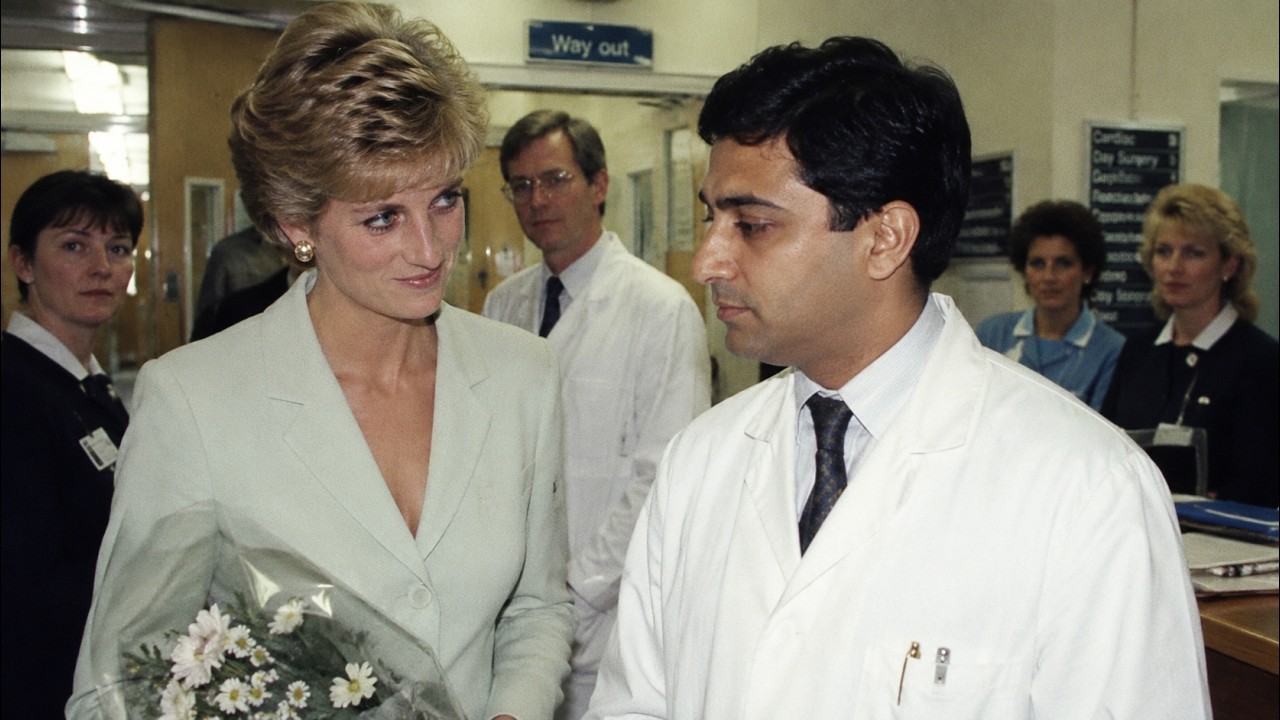
The surgeon who came out to update them was the assistant in the operation. His name was Hasnat Khan, a British-Pakistani man in his late thirties who worked long, exhausting hours at Royal Brompton Hospital, one of the country’s best heart and lung centers. He spoke to Oona routinely and professionally.
But Diana noticed him.
As soon as Khan left the room, Diana turned to Oona and said something that stayed in every account of that day: “Isn’t he gorgeous?” She added that his name was Hasnat Khan, and that it was written on his shoes.
It was a simple, human moment. Diana, the most photographed woman on earth, had noticed a man’s name embroidered on his surgical footwear.
In the weeks that followed, Diana kept returning to the hospital. She had always visited patients, but now there was another reason. One day, as Khan was leaving, she called out to him: “Hey, where are you going?”
He told her he was driving to Stratford-upon-Avon to pick up some books from his uncle’s house. Then, before thinking it through, he invited her along. He never expected her to accept.
She did.
They drove to Warwickshire, collected the books, and returned to London. Two people who seemingly had nothing in common found something neither expected. Khan described it simply: they found a connection.
She was, in his words, a very ordinary person with great warmth. In that car, she was not a princess. She was a woman laughing at his reckless driving on the M40.
Khan was not a man who spent his life around celebrities. He had trained in Pakistan, then Sydney, then came to London to specialize in heart surgery, working weeks that sometimes exceeded 90 hours. This kind of focus, this complete immersion in something other than his own image, was the opposite of royal life.
For Diana, that distance was not a problem to overcome. It was the attraction itself.
As the friendship deepened, the relationship became something more. And both were about to discover how difficult it is to fall in love when one person is the most photographed person alive.
The relationship required military-level planning. Diana wore dark wigs and sunglasses just to enter the hospital and quietly watch Khan work. When she wanted to see him outside the hospital, she had to be smuggled.
Paul Burrell, her former butler, spoke openly about this. He would hide Khan in the trunk of his car to get him into Kensington Palace without being seen.
When Diana needed to call Khan at the hospital, she could not simply leave a message saying Princess of Wales was on the line. She disguised her voice on the hospital switchboard, pretending to be someone else, just to reach a junior doctor on a ward phone. The most photographed woman on earth had to pretend to be another person just to hear his voice for two minutes.
They spent most of their time together in two places: Kensington Palace, where Diana had some control over who saw what, or Khan’s small, cluttered one-bedroom flat in Chelsea. Burrell described the flat as genuinely messy. And here is a detail that reveals everything about the true nature of the relationship: Diana, who had staff for most things, used to iron Khan’s clothes.
Not her own. His. No one irons a man’s shirts secretly in his cramped Chelsea flat for show.
She did it because, for the first time in her adult life, she felt ordinary.
Khan himself told a story that captures this perfectly. They went to a pub in London where no one recognized her. Diana asked if she could order the drinks because she had never done it before.
In her entire life, she had never walked up to a bar and ordered drinks like an ordinary person. She did it that night, chatted with the barman, and was absolutely delighted.
Another time, they had to queue to get into Ronnie Scott’s, the jazz club in Soho. Diana later told Khan she loved it, not despite the wait but because of it. Standing in line meant standing among ordinary people, and she got the chance to talk to them.
Khan met Diana’s sons. William and Harry were aware of him. Khan stated openly that Diana wanted her sons to understand what was happening in her life, not to hide it from them.
This was a level of trust she did not give to most people she dated.
A friend who watched the relationship unfold told Vanity Fair that, given everyone Diana could have been with, this man was completely devoted. Diana herself told a close friend, Lady Elsa Bowker, something equally telling: “I have found my peace. He has given me everything I need.”
But the secrecy that made all this possible was a clock already ticking. By November 1995, two months after that first trip to Stratford, the relationship was about to become public knowledge, whether either of them wanted it or not.
Behind the scenes, something else was happening. In November 1995, Diana sat down with journalist Martin Bashir for the BBC’s Panorama program. That interview changed everything.
It was the one where she said there were three people in her marriage, referring to Camilla Parker Bowles.
What almost no one knew for years was that Khan was involved in this story long before filming began. He stated publicly that he met Bashir in early 1995, before all of this, and that he warned Diana about him directly. He described Bashir as manipulative and said he did not trust him.
Diana did not listen.
She recorded the interview in secret, then showed it to Khan almost immediately. Khan said he watched the broadcast alone, during a night shift at the hospital, while Diana’s words were transmitted to millions of people across the country. A man who loved her, watching alone the most controversial interview of her life on a hospital television between patients.
Diana also decided to win over Khan’s family. She began writing letters, not to Khan, but to his grandmother in Pakistan, a woman she had never met. For months, she wrote to this elderly woman, trying to win over the family before they even agreed to meet her properly.
In May 1996, she went further. She flew to Pakistan. The official reason was simple: she was there to support Imran Khan, the former cricket star and Hasnat’s distant cousin, who was building a cancer hospital in Lahore.
She visited sick children and did fundraising.
But there was a second visit happening secretly, one Khan did not know about in advance. While in Lahore, Diana went to his family home and sat down for tea with his aunts, uncles, and grandmother, the same woman she had been writing to for months. According to accounts from people close to both families, the relatives were stunned to find the Princess of Wales sitting in their garden, drinking tea, asking questions about their lives as if she had known them for years.
Khan learned about it later and was not happy. He was described as very angry that she had done this without telling him first. Not because he did not care for her, but because he understood what it would mean if the story leaked before he was ready.
But the trip worked in its own way. Jemima Goldsmith, Imran Khan’s wife at the time, later stated clearly that Diana was “very in love with Hasnat and very serious about living in Pakistan if it came to that.” Khan’s mother, Naheed, said years later that the whole family knew Diana wanted to marry him.

According to her account, Hasnat himself was the only one standing in the way, because he believed such a marriage would never work.
In May 1997, Diana returned to Pakistan for the official opening of the cancer hospital. She visited patients, attended events, and again made time to see Khan’s family. Imran Khan himself stated that during this last visit, he had private conversations with Diana and genuinely felt that she and Hasnat were making real plans for marriage.
So why did it not happen? Because under all that hope and effort, there was one person who never stopped fearing what this life would cost. And it was not Diana.
It was Hasnat.
As he said years later, his fear was never about whether he loved her. It was about what his love for her would do to any life they tried to build together. His biggest fear about marrying her was that his life would turn into hell because of her celebrity.
He knew with certainty that he would never live a normal life again. If they had children, he said, he could not even take them to a normal place without the whole world watching.
This fear had been building since November 1995, when news of their relationship first appeared in a British tabloid. From then on, Khan lived under media attention he never asked for. He began receiving threats.
Strangers offered opinions about his entire life based on a few blurry photographs.
The two talked seriously about building a new life somewhere else entirely. South Africa emerged as a possibility, a place far enough from both London and Lahore that perhaps their previous lives could not reach them. It never went beyond talk, but the fact that they had the conversation showed how willing they were to make the relationship work.
While Diana was fighting for the relationship, writing to his grandmother, traveling to Pakistan twice, trying to prove herself to a family she barely knew, Khan was quietly deciding the whole thing was impossible. Not because he stopped loving her, but because he understood clearly what marriage would do to the rest of his life.
By the summer of 1997, the end came. It happened in Battersea Park, of all places. Not in a palace, not in a hospital, but in a public park in south London.
According to Khan’s own account, it took two separate meetings to end the relationship. In the first meeting, Khan felt something was wrong. In the second meeting, shortly after, Diana finally expressed her feelings out loud.
It was over. Diana ended the relationship, not Khan. This detail matters because many popular accounts assume he was the one who left.
He did not. She did.
Around the same time, photos began to appear of Diana with a new man: Dodi Fayed, son of the Egyptian billionaire Mohamed Fayed. The relationship had begun weeks earlier, in June 1997, when Diana, recently divorced from Charles, accepted an invitation from Mohamed Fayed to spend a week at his villa in Saint-Tropez. She brought William and Harry.
While there, she spent time on the Fayed family yacht, Jonikal, with Dodi, who was still engaged to another woman, model Kelly Fisher.
Khan stated publicly that he believed this new relationship played a part in the breakup. His explanation was simple: Diana wanted, for once, to be with someone who was happy to be seen with her in public, something he could not give her after everything with the press.
Then Khan said something that, in hindsight, feels incredibly heavy. He told her, in that conversation, “You are dead,” meaning her reputation, not her life. He believed with certainty that getting involved with anyone connected to Mohamed Fayed’s world would be the end of how the public saw her.
He was not trying to be cruel. He was trying to warn her.
The relationship that had survived disguises, secret trips to Pakistan, hidden phone calls, and two years of immense pressure ended quietly in a public park, with a warning neither of them yet understood the weight of.

What happened after the breakup was something almost no one knew outside Diana’s inner circle, until a court compelled it to be revealed more than ten years later.
In January 2008, Paul Burrell, Diana’s former butler, stood as a witness at the official inquest into her death. He was not there to talk about Dodi Fayed, though most of the public assumed the inquest was about him. He was there, in part, to talk about Hasnat Khan.
Burrell told the court that Diana asked him whether it would be possible to arrange a private marriage between her and Hasnat Khan, a wedding secret enough to avoid all royal protocol procedures. He said he took the question seriously enough to consult his parish priest about it.
Then Burrell spoke the words that have followed this story ever since. He told the court, under oath, that Diana considered Khan her soulmate, the man she loved more than anyone else, in a relationship he described as deeply spiritual. He said he witnessed it himself.
He told the court that the two of them were, in his words, madly in love with each other.
This was not gossip. This was a man who spent years in Diana’s daily life, standing in a courtroom under legal oath, choosing the word “soulmate” deliberately.
He was not the only one. Rosa Monckton, a close friend who accompanied Diana on a holiday to Greece in the weeks before her death, testified at the same inquest. She said she believed Diana was missing Hasnat terribly during that trip, and that what was happening with Dodi Fayed at the time seemed more like a distraction from the pain of the breakup than a real, stable relationship.
Two separate witnesses, in two separate testimonies under oath, pointing to the exact same truth. The breakup in Battersea Park did not end what Diana actually felt. It only ended the relationship itself.
Khan did not seek the spotlight after Diana’s death. He ran from it. He spent decades deliberately staying out of view, refusing what were described as tempting offers to tell his story for money.
When a film about Diana was released in 2013, depicting parts of their relationship, he did not stay silent. He called it cruel lies, said it completely misunderstood their relationship, and made clear he had no intention of ever watching it.
He continued working, continuing to perform heart operations, the same work that had brought them together in the first place. He moved between positions at several London hospitals before eventually settling into a long career as a consultant cardiothoracic surgeon in Essex.
Years later, reflecting on everything that never happened between them, he said something quietly painful: “There are a hundred possibilities of what could have been. She could have been alive, happily married, raising more children, with me or with someone else entirely.”
He made another statement to police in 2004. He believed that if Diana had lived, they would have remained close friends, no matter what she did or who she ended up with. It was not bitterness, not regret disguised as resentment.
It was the quiet certainty of a surgeon that any other change would have remained the same.
On the day of her funeral, in September 1997, while the world watched Westminster Abbey on television, Hasnat Khan was also present. Quietly. Without making any statement.
Without anyone in the crowd of mourners knowing that the man standing among them was the one Diana’s former butler would later swear under oath was the love of her life.
No newspaper mentioned him that day. There was no camera. He stood there the same way he lived most of the relationship: present, devoted, and completely invisible.
This is the real story. Not a scandal. Not a secret affair designed for tabloid front pages.
It is the story of a woman who spent her adult life under everyone’s gaze, finally finding someone who looked at her as a person. Someone who held other people’s lives in his hands every day and did not need her fame to feel important.
She ironed his clothes. She ordered drinks at a pub for the first time at age 34. She wrote letters to his grandmother in Pakistan for months, hoping that people who had never seen her photo would love her before deciding who she really was.
She traveled around the world twice, not for headlines, but to sit in a garden and drink tea with people who had no idea what to think of her at first.
In the end, it was not scandal that ended everything. It was not the palace. It was not Charles or Camilla or any of the forces usually blamed for what went wrong in Diana’s life.
It was quieter and sadder than that. A man who loved her deeply and was honest enough to say out loud that his love for her might cost them everything.