In late September 1944, American signal corpsmen strung cables through a bank building in Luxembourg City, hung field telephones on walls built for clerks, and pinned situation maps where account ledgers once sat. They gave the place a code name: Eagle. From those rooms, the 12th Army Group controlled more soldiers than any American commander in history.
The building was freezing. Coal was rationed that winter, radiators barely warmed, and staff officers worked in overcoats with collars up. The main map room smelled of wet wool, cigarette smoke, and marking wax.
Teleprinters clattered day and night while clerks climbed wooden ladders to shift unit symbols two inches left because a battalion had taken a village.
The man in charge slept a few streets away in a hotel room smaller than his aides expected. Omar Nelson Bradley was 51 years old. He wore steel-rimmed glasses and had the look of a high school principal.
Journalists called him the G. I. General, but the man behind the quiet manner was an accountant at heart.
He thought in divisions, supply tonnages, and miles of front line divided by rifle companies. He never shouted. He didn’t need to.
Across the ocean, in a modest office in the War Department, a 64-year-old man had spent five years deciding which American officers would lead and which would sit at desks in Kansas. George Catlett Marshall kept a personal notebook. He had watched Bradley teach at the Infantry School at Fort Benning.
He had watched him take command in North Africa after another commander failed. He had pushed him through Sicily, Normandy, and France until Bradley stood in a Luxembourg bank building commanding more than a million men.
Marshall rarely told his chosen commanders what to do. That was the point of careful selection. He gave a commander a battlefield and stayed away from it.
Officers under him learned the method quickly. Marshall asked questions, listened to full answers, and let the man in the field own his decisions. It was not warmth.
It was a system, and Bradley had grown up inside it.
That was why the map on Eagle’s wall was entirely Bradley’s. In November 1944, the American front stretched from the North Sea to the Swiss border, and Bradley’s portion ran more than 200 miles. He was attacking at both ends.
In the north, the First Army was pushing into the Hürtgen Forest, a place of pine trees and mud that consumed regiments one battalion at a time. In the south, the Third Army was driving toward the Saar. Both attacks needed infantry.
Both wanted more.
Between them lay the Ardennes. It was steep woodland, narrow valleys, and roads that turned to mud in December. Two American divisions were sent there to recover from being shattered elsewhere.
Two more were sent because they had just come off the boats and needed a quiet place to learn what front-line duty meant. The soldiers had a nickname for the sector: the Ghost Front. Men slept there, wrote letters, and bought beer from Belgian farmers who had waited four years to sell it.
Major General Troy Middleton commanded the sector. The 55-year-old Mississippian had been a university administrator before the war, which sounded odd for a corps commander until you understood the rest of his file. Middleton had enlisted as a private and led a regiment in the last war before he turned 30.
He left the army, returned to a college campus, then came back. He was not a gambler. He liked calculations.
Middleton’s VIII Corps held 88 miles of front. To hold it, he had three infantry divisions, most of an armored division, and a cavalry group watching the northern flank. In theory, an infantry division normally defended about five miles.
His divisions were covering nearly three times that. Bradley knew every one of these numbers. Nobody had hidden them from him.
He accepted them anyway, and he was clear about why. If he wanted heavy strength at Hürtgen and the Saar, somewhere in the middle had to be thin. The Ardennes was the least important place on his front.
No port, no industry, no river worth crossing. Bradley judged that if any German force ever came through there, it would take days to reach anything useful, and by then he could send armor from both sides to close the gap. He had a name for this strategy.
A calculated risk. Those three words followed him for the rest of his life.
Through the autumn, the warnings came. Allied intelligence gathered fragments. Rail traffic was moving west when it should have moved east.
A new German panzer army had appeared in order of battle where no such force should exist. Prisoners captured in November spoke of a major blow. A rescue operation.
Something coming in the west before Christmas. Civilians in Belgium and Luxembourg reported engine noise in the forests at night. The Sixth Panzer Army could not be located.
None of it was hidden. All of it was reported. It went up the chain of command to Bradley’s intelligence staff and to Supreme Headquarters outside Paris.
And it was read. It was read through a defensive lens. Every piece of evidence about German strength was arranged to fit a picture already fixed in the minds of the readers.
That picture said Germany was finished as an offensive force. Germany had lost France. Germany had lost most of its oil.
Germany was fighting for survival on two fronts. A rational German command would keep its last armor behind the Rhine and make the Allies pay for every yard. So the panzers gathering in the west were a reserve.
The radio silence was caution. The rail traffic was logistics.
Every fact was correct. The conclusion drawn from them was wrong.
In early November, Eisenhower and Bradley discussed the possibility of a German counterattack through the Ardennes and reached the same conclusion. It would not pay the enemy to try it. The two most experienced American field commanders in Europe looked directly at the danger and missed it, not because they were careless, but because they reasoned from the assumption that the man in Berlin would reason the same way.
He did not. Adolf Hitler personally ordered an offensive his own senior generals thought fantastical, and he ordered it wrapped in secrecy the German army had never attempted before. Officers were briefed under threat of death.
Orders were passed by hand, never by radio. Units moved only at night. Near the front, horse-drawn wagons replaced trucks so engine noise would not carry across the valleys.
Aircraft flew over assembly areas at night to mask the sound of tank tracks.
More than 200,000 men and hundreds of armored vehicles gathered opposite the quietest sector of the Allied line, and enemy surveillance saw only a defensive force.
At 5 a. m. on December 16, 1944, the forest across the Our River erupted.
Nearly 1,600 guns opened fire at once. The men of the 106th Infantry Division, most of them under 22, woke to a sound they could never explain to anyone else. Telephone wires were cut in the first minutes.
Searchlights reflected off low clouds to create artificial moonlight on the snow, and from that gray light came white-clad grenadiers. Then assault guns. Then the tanks that Allied planners had said could not move on those roads.
The American defense broke in five places at once. In the first hour, no one above regimental level understood what was happening because the men who could explain it had already lost their phone lines. Company commanders tried their radios and got static.
Battalions told regiments they were under attack. Regiments told divisions the attack seemed large. By the time the news reached corps headquarters, two hours had passed and the information had lost much of its value.
In those two hours, German infantry had moved behind positions still thought to be intact.
That same day in Washington, the Senate confirmed a promotion. George Marshall became the first officer in American history to hold the rank of General of the Army. Five stars.
There was no notable ceremony. He was at his desk at the regular hour, and the cables from Europe were beginning to carry bad news.
When the attack began, Bradley was not in Luxembourg. He was in a staff car heading to Versailles to argue about manpower shortages. He spent the whole morning in that meeting.
The first word reached him on a scrap of paper passed across the table. By evening, he stood with Eisenhower in the war room at Versailles watching a duty officer mark a situation map. Bradley gave his interpretation.
The Germans were hitting the Ardennes to force him to stop the Third Army’s attack in the south. A spoiling attack. Expensive, annoying, temporary.
Eisenhower kept looking at the map. Five separate penetrations in one sector. Nobody would choose that unless they meant to go far.
He said, “This is not a spoiling attack.”
Bradley drove back to Luxembourg that night. The map on the bank building wall was being redrawn while he slept, and every hour it looked less like the map he had approved.
On December 17, the clerks on the ladders could not keep up. Units that had sat in the same place for six weeks were lifted and repositioned miles to the rear. Whole battalions were erased from the board because nobody could say where they were.
Two regiments of the 106th Infantry Division were on high ground east of St. Vith one morning and surrounded by the next. More than 6,000 Americans were captured in that single pocket.
It was one of the largest mass surrenders in American history, and it happened in less than three days in a place chosen because it was quiet.
That same day, near the Belgian village of Malmedy, an SS battle group commanded by Joachim Peiper attacked a small American convoy. Prisoners were disarmed and gathered in a field. Then machine guns opened fire.
Eighty-four Americans died in that field. Those who escaped carried the news across the lines by nightfall. It spread faster than the tanks.
By the 18th, every American unit at the front knew that surrender might mean death. Something hardened in the American army that week. Stragglers fleeing west turned around.
Cooks, clerks, and truck drivers picked up rifles they had not touched since basic training. The atrocity meant to break American morale had the opposite effect.
But the map showed none of this. The map showed geometry, and the geometry was terrible.
There was a second problem, and Bradley understood it before anyone else because his job depended entirely on that wall. The German penetration was not just taking ground. It was cutting telephone lines.
Bradley commanded three field armies. The First Army under Lieutenant General Courtney Hodges was north of the breakthrough at Spa. The Third Army under Lieutenant General George Patton was far to the south.
The Ninth Army under Lieutenant General William Simpson was farther north. Bradley himself was in Luxembourg, on the southern edge of the disaster, with a German wall growing between him and everything to the north.
In 1944, telephone wires ran above ground. They went through the Ardennes. When German tanks crossed a road junction, they tore out the main lines.
By December 18, Bradley’s headquarters had lost reliable contact with the First Army. Not disrupted. Gone.
For nearly two days, the American commander responsible for the northern half of the battle could not speak to the army fighting it. Messages went by jeep with liaison officers over roads where it was not certain Americans still existed. An officer who left at dawn and arrived carried information at least six hours old.
Hodges had a terrible week. His headquarters at Spa was nearly overrun. Maps were burned.
Some staff left so fast they abandoned hot meals on the tables for the Germans. Hodges, a 57-year-old infantryman who had failed as a cadet at West Point, enlisted as a private, and worked his way to three stars, went quiet for nearly 48 hours. Officers around him described a man giving no orders.
He recovered. He fought the rest of the battle and the rest of the war well. But in the third week of December, the First Army became a force without a voice at the top and without contact with its own army group.
Stand in front of that wall in Luxembourg and think about what it meant. Bradley could see the bulge growing westward on the map. He could not talk to the northern half of his command.
He could not be certain where his own divisions were. And he was sitting in a city toward which German troops were advancing.
On December 19, he rode to Verdun. The conference was held in a squad room of a French barracks, with a corner stove that could not handle the cold. Eisenhower came from Versailles.
Bradley came from Luxembourg. Patton came from Nancy. Tedder, Devers, Bedell Smith, and many staff officers were there, standing against the walls for lack of chairs.
Someone had put a large map on an easel. Everyone in the room knew what it showed.
Verdun was chosen deliberately. Every senior officer in that room knew what had happened outside those windows 28 years before, when French and German armies fought for ten months, suffered over 700,000 casualties, and moved the line almost not at all. Nobody mentioned it.
Nobody had to.
Eisenhower opened the meeting by saying the present situation should be regarded as an opportunity, not a disaster. No gloomy faces in this room. Then he turned to Patton and asked how fast he could attack the flank of the German penetration.
Patton was 59. For two days he had been doing what Bradley had no time to do: sitting with his staff and planning for exactly this question before anyone asked it. He had already written three separate plans, each with a code name, so that one telephone call could turn 100,000 men 90 degrees.
He said he could attack with three divisions on the 22nd. Someone laughed. Patton did it.
Bradley sat in that room watching his own subordinate solve the southern half of the problem. The Third Army was Bradley’s. The plan was Patton’s.
It was a good plan, and Bradley approved it. But no one in that room could solve the northern half, because the northern half could not be solved by attacking. It could only be solved by someone who could talk to the men up there.
That evening in Versailles, two officers went to see the Supreme Headquarters chief of staff. Major General Kenneth Strong was the intelligence chief. Major General John Whiteley was the deputy chief of operations.
Both were British. Both looked at the same map and reached the same conclusion at the same time, and neither wanted to say it because the matter was enormous. The German penetration had physically split the American command.
Everything north of the bulge was effectively cut off from Bradley. Someone had to take control of it. The only army group commander who could reach those forces, whose communications ran to that part of the front, and whose 21st Army Group sat directly behind them, was Field Marshal Bernard Montgomery.
The proposal was simple and vast. Give the American First Army and the American Ninth Army to a British commander.
Lieutenant General Walter Bedell Smith was Eisenhower’s chief of staff, age 49. He had an ulcer and a temper that made officers plan their days around avoiding him. He listened, then lost his temper.
He accused the two men of being British before being Allies. He used language that was discussed at headquarters for months. Then he went to bed and thought about it.
In the morning he checked the situation reports, confirmed that Bradley had not been able to reach the First Army for two days, and went to Eisenhower and recommended exactly what the two British officers had proposed the night before. He also withdrew what he had said to them, which was not easy for a man like him.
On December 20, Eisenhower picked up the telephone and called Luxembourg. Bradley took the call in the map room. Eisenhower explained the situation and the reasoning.
The bulge had cut the front in half. Command must follow communications. Montgomery would take temporary operational command of all Allied forces north of the penetration, meaning the First Army and the Ninth Army, meaning about two-thirds of everything Omar Bradley had.
The room around him went silent. Staff officers found things to do. Bradley did not shout.
He made his argument for about a minute, then said something that shows what kind of officer he was. He said that if Montgomery’s command had been American, he would agree completely. It would be logical.
Read that sentence again. It is a confession. Bradley was telling the Supreme Commander that the military logic was correct.
He was not disputing the map. He was saying that the world would see it a certain way. In the middle of the worst American setback of the European campaign, handing two American armies to a British field marshal could mean only one thing, and by the end of the week every newspaper in London would say it.
Eisenhower listened and made the change anyway. It was the right decision. Someone had to take responsibility for talking to the First Army, and that someone was not Bradley.
That same day, December 20, 1944, word came of Eisenhower’s own promotion. He became General of the Army, five stars, the same rank Marshall had received four days earlier. On the day he received the highest rank in the American army, he had to take two American armies away from the general he trusted most.
Before that telephone call, Omar Bradley commanded three field armies and more than a million American soldiers. After it, he commanded one: Patton’s Third Army in the south, plus a headquarters building another force that did not yet exist. The First Army and the Ninth Army, and every division inside them, and every casualty they suffered from that moment, passed operationally under a British field marshal.
The wall in Luxembourg had to be redrawn, this time not because of the enemy. A staff officer took a grease pencil and drew a line across the American front. Everything above that line was no longer Bradley’s responsibility.
His staff reacted worse than he did. Officers who had come with him from Normandy walked into the map room, saw the new boundary, and walked out without speaking. One was heard to say that the 12th Army Group had been reduced to a corps.
That was not true, but on the morning of December 20 it felt that way.
Bradley himself went cold. That was his way. He wrote no angry letter.
He made no call to Washington. He leaked nothing to any correspondent. He went back to work with the one army he had left and kept his accounts quietly.
Think about that for a moment, because it is the core of his character and it cuts both ways. This steadiness was what made Marshall choose him from a thousand colonels. The refusal to complain, the willingness to be the dullest man in any room, was the same quality that had let him accept an 88-mile thin line in November without acting on his worry.
Bradley’s greatest strength and his greatest failure in this campaign were the same trait in two different forms. He trusted his calculations. When the calculations stopped describing reality, he trusted them anyway.
And now he had to sit quietly while others solved the problem he had created, accepting the blame in his own name without saying anything. There is a kind of courage in that which does not show up in photographs and almost never makes it into movies.
Then the map insulted him again. For three months, Eagle had operated from the bank building in Luxembourg City. Bradley had a reputation as a commander who never moved his command post back.
Moving a headquarters back told every soldier at the front what the general thought of them, and Bradley knew it. But German spearheads were now close enough to Luxembourg City that they could be reached by a morning drive. And a second threat was added to the first.
An SS officer named Otto Skorzeny had formed a special unit of German soldiers who spoke American English. They wore American uniforms, drove captured American jeeps, and carried American papers. On the first day of the attack they slipped through the broken front, cut wires, changed road signs, and spread confusion in the rear.
Only a few of these teams were active. Their military effect was almost nothing. The psychological effect was enormous, because the rumor spread that one of the teams had been tasked with killing Dwight Eisenhower.
The Supreme Commander was kept under heavy guard at Versailles, effectively a prisoner in his own compound, which he hated so much his staff never forgot it.
Roadblocks went up across the rear areas, manned by nervous military police with orders to test every officer with questions only a real American could answer. Bradley, a lieutenant general commanding an army group, was stopped repeatedly on his own roads. He was asked the capital of Illinois.
He said Springfield, which was correct, but the guard said the right answer was Chicago and held him anyway. He was asked what position sits between the tackle and the center on a football line. He was asked whose wife Betty Grable was.
He got that one wrong, and the guards let him go because a man who did not know that answer could not possibly be a German spy.
It is a funny story. Bradley told it himself and told it well. But look at the situation behind it.
The commander of the 12th Army Group, four days after the largest surprise attack on American forces, stood at a roadblock in the snow, being questioned about a movie star while leaving a city, having lost two-thirds of his command, holding a map he had approved but could no longer read. That was the lowest moment. The date was December 22, 1944.
Omar Bradley was 51 years old.
Now stop the clock, because this is the moment to answer the question that determines whether any of this mattered. Why did the Ardennes matter so much? The German plan had a name and a goal.
The armored spearheads were to cross the Meuse River, turn northwest, and seize the port of Antwerp. Antwerp had been captured intact in September, and its approaches had been cleared in November at great cost to the Canadians. It was the only deep-water port close enough to the front to sustain the Allied supply effort.
Everything the Allies needed to keep fighting came through it. Taking Antwerp would not just cut a supply line. It would geographically split the Allied forces in two.
The British and Canadian forces of the 21st Army Group would be trapped north of the German corridor. The Americans would be south of it. Four Allied armies would be caught in a kind of trap.
But Antwerp was not the real objective. Hitler himself told his generals that. The real objective was to break the Alliance.
The German high command had no way left to defeat the Allied armies in the field. What Hitler believed, and his reasons were not entirely absurd, was that the thing holding those armies together was newer and far more fragile than the armies themselves. The Americans and British had spent two years arguing over strategy, credit, and who would command the campaign.
Hit them hard enough, kill enough Americans quickly enough, and humiliate the command structure enough, and maybe the political union would crack. A separate peace in the west. A negotiated end to the war.
Anything was better than unconditional surrender.
That was the real target. Not a port. A relationship.
And on December 20, with no German soldier having crossed the Meuse, that plan had scored its first major success. Two American armies had been placed under British command. Every newspaper in Britain was about to learn it.
Four thousand miles away, at a desk in Washington, the man who had built the American army did almost nothing. It was deliberate, and it was harder than it sounds. George Marshall had spent five years building an army of eight million men from a country whose ground forces in 1939 ranked below Portugal’s.
He knew the divisions in the Ardennes by name. He knew their commanding officers, because he had personally approved most of them. He had a war room in the Pentagon with the same map on the wall, and he was watching the same red arrows grow.
He sent Eisenhower no tactical advice. He did not demand hourly reports. He did not recall anyone to Washington for explanations.
The War Department did not try to run the battle of the Ardennes from Washington. In an American government where many people were very eager to do exactly that, holding that restraint was a decision that had to be made and enforced every day.
What Marshall did do was accelerate the logistics. Divisions in England crossed the Channel ahead of schedule. Replacement troops were pushed through the pipeline faster than its designed rate.
Shipping was reallocated. The machinery behind the front was told to give Eisenhower whatever he asked for and to stop asking why. Then Marshall went back to waiting.
That part was unbearable to everyone else in Washington.
On the map, meanwhile, the arrows had begun to slow. They slowed for reasons that had nothing to do with generals. Bastogne, a road junction where seven roads met in a country with almost no roads, was held by the 101st Airborne Division and elements of the 10th Armored.
They were surrounded, short on ammunition and medical supplies, and freezing in cold so severe that blood froze before it could be transfused. On December 22, a German officer came forward under a white flag with a written demand for surrender. Brigadier General Anthony McAuliffe wrote a one-word answer that became more memorable than any other document of the battle.
Think about what the cold was doing to the defense while Paris and London argued over command. Temperatures in the Ardennes that week stayed far below freezing day and night. The men holding Bastogne dug into ground so hard their entrenching tools bounced off it.
Many paratroopers had been rushed from rest camps in France and arrived without overcoats or overshoes. Surgeons operated in cellars by lamplight, sterilizing instruments in cooking pots. Plasma froze in its bottles and had to be thawed against human bodies before it could be given.
Artillery batteries were limited to a few rounds a day with orders to fire only at targets they could see.
On December 23, the weather changed. For a week, clouds had pressed down on the Ardennes like a lid, grounding the Allied air forces, which were the greatest single advantage the Western Allies had. Then a high-pressure system moved in from the east, the sky cleared, and it turned a cold blue.
Thousands of aircraft took off. Fighter-bombers found German columns stuck on roads they could not leave and attacked them. Transport planes flew over Bastogne and dropped supplies to men who were nearly out of ammunition.
On December 26, tanks of Patton’s Third Army, Fourth Armored Division, broke through from the south and opened the road to Bastogne. The siege was over. On the wall in Luxembourg, the enemy shape was no longer growing.
By the last days of December, the military problem was largely solved. The Germans had not crossed the Meuse. They had not reached Antwerp.
They had spent their last strategic reserve of armor, their trained pilots, and their last fuel in a narrow slice of forest, and now the American army was closing in from both sides with the weather clear. The battle was won. And right then, the other problem surfaced.
On December 29, 1944, Field Marshal Bernard Montgomery sat down and wrote a letter to Dwight Eisenhower. Montgomery was 57. Whatever else was said about him, he was a highly professional soldier who had beaten Rommel in the desert and handled the northern front competently since taking command.
He had straightened out the chaos at the front, consolidated reserves, and stabilized a shaky situation. He was not a fool. He was a man who had spent four months telling Eisenhower that the Allied command structure was wrong, that the broad-front strategy was wrong, and that the Western Allies needed a single ground commander to run the land battle, with Eisenhower above him as a chairman.
He had said it in September. He had said it in October. He had said it in November.
Each time he was refused.
Now, with two American armies already under his hand, he wrote it again. He wanted a commander with full operational direction, control, and coordination of the northern thrust into Germany. He named the forces involved.
He made clear who that commander should be. He sent it in writing to a man who had just spent two weeks watching his own front fall apart.
The letter also contained a detail that made it worse. Montgomery wrote a paragraph describing how the new command arrangement would work, and he suggested that Eisenhower issue it as a directive. In effect, he wrote his own appointment order and sent it over for signature.
Montgomery believed he was making a professional argument about competence. He genuinely could not understand what he had done. He had spent his adult life inside the British army, where a direct technical opinion from a competent professional was given priority over almost everything else.
He could not grasp that a correct argument delivered at the wrong time to the wrong person, in a century of national pride, was not a correct argument. It was an act of provocation. What he had done was hand Hitler the thing Hitler was actually fighting for, the fracture of the Allied command, four days after the German army had failed to achieve it with a quarter of a million men.
The letter reached Versailles on December 30. Eisenhower read it in his office with guards posted outside his door because of the assassination rumors that still had not died. He was 54.
He had been Supreme Commander for a year. In that year he had held together a coalition of two proud countries, several exiled governments, three military branches, and the most difficult personalities in the Western world, largely by absorbing insults and pretending not to notice them. His patience had run out.
Bedell Smith came in and they discussed it. Behind Montgomery’s letter was something bigger than Montgomery. For two weeks, the British press had been running a campaign that had been building since the attack began.
The tone was always the same. The Americans had been caught off guard. Montgomery had come south and saved them.
Eisenhower had taken too much on himself and should hand the land war to a professional soldier. Some papers named that professional soldier.
If the Combined Chiefs of Staff in Washington and London agreed, the command structure of the Western Alliance would permanently change. For the rest of the war, an American army in Europe would operate under a British ground commander. Every subsequent operation, the crossing of the Rhine, the encirclement of the Ruhr, the drive to the Elbe, the meeting with the Soviets, which city would be taken and which would be left, would be decided through a British headquarters.
And the men deciding it would not be soldiers standing in the Ardennes. They would be a committee in a warm room an ocean away, weighing national emotion alongside military logic, at a moment when British newspapers were writing the script for them every morning.
So Eisenhower sat down and drafted a message to the Combined Chiefs of Staff. There was no compromise in it. He laid out the problem, said he could no longer lead a theater where one of his army group commanders refused to accept his authority, and asked the Combined Chiefs to choose between them.
In essence he said, “Either Montgomery goes or I go. Decide.”
No document like that had ever been read from a Supreme Commander in the middle of a war. If it had been sent, the war effort would have stalled while two governments argued over who controlled it.
That same day, a cable arrived from Washington. It had not been requested. Eisenhower had not written home for help.
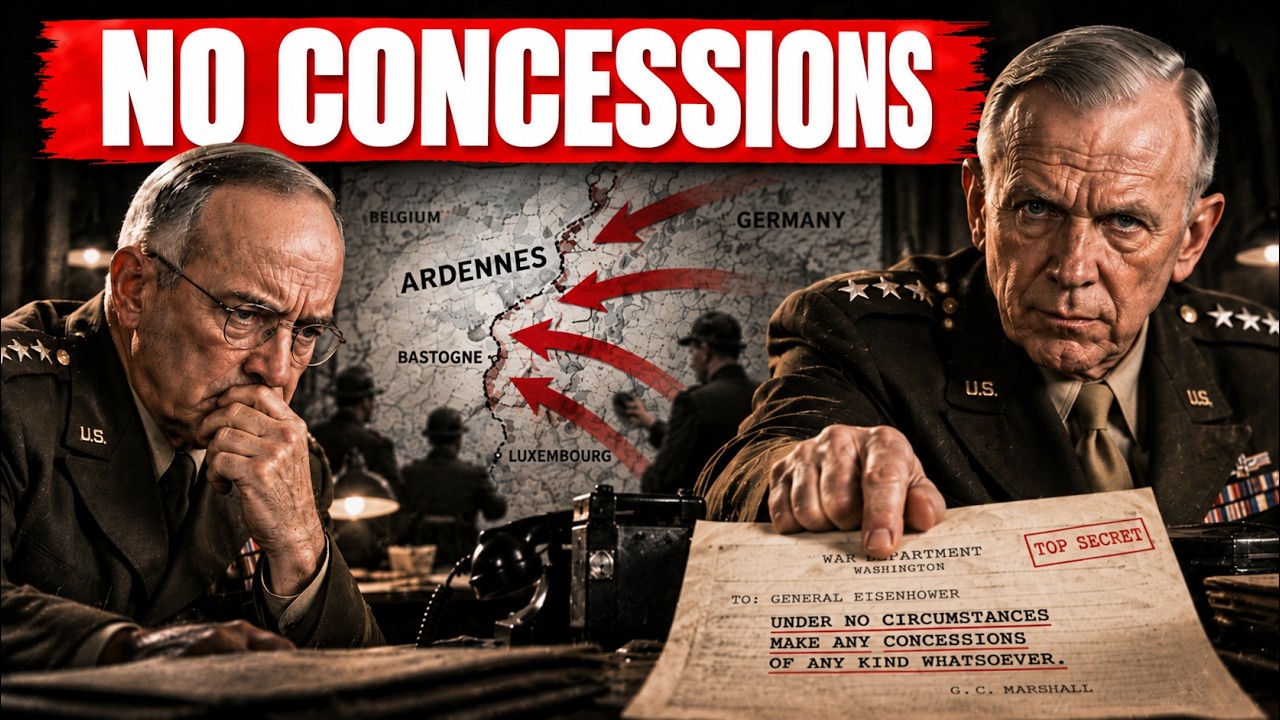
Marshall had been reading the London papers, the way he read everything, and he understood before the people inside the storm what the campaign was for and where it was heading. The message noted the articles proposing a British deputy commander for all ground forces and the questions raised about Eisenhower’s competence. Then came the line.
Under no circumstances make any concession. He added that he did not think Eisenhower had any intention of making such a concession. He simply wanted Eisenhower to know, with certainty, where the Chief of Staff stood.
And he told him he was doing a great job, to keep going, and to teach them a lesson.
Now understand why this mattered, because the wording is the whole point. Marshall did not tell Eisenhower to fire Montgomery. He did not tell him to send the message to the Combined Chiefs or to withhold it.
He did not mention a division, an objective, or a river. He gave no order that any soldier anywhere could execute. He issued a prohibition.
Make no concessions. And it came from the one man in the American government whose entire method was never to do this. Marshall had never intervened in a theater during the whole war.
He had never touched a commander’s decision. He picked men, supported them, and stayed away. That was the deal.
Every general in the United States knew that was the deal.
On December 30, 1944, with the American army in its worst position since the fall of the Philippines, George Marshall reached across the Atlantic and put his hand on the scale. Once. On one issue.
The question of who would command. He had watched the same disaster as everyone else for two weeks and said almost nothing. There was plenty of excuse to intervene.
American divisions were being destroyed. Congress wanted answers. The newspapers wanted to know how an army of eight million had been surprised in a forest.
Any other chief of staff would have called Versailles four times a day and felt entirely justified.
Marshall stayed away from the phone for a reason. He understood that the day a chief of staff starts running a war from another continent, the commander in the field is no longer a commander. He becomes a messenger.
And every officer below him feels it within a day. So when he finally broke his silence, that message carried a weight that a month of advice could not have carried. It was the only thing he said.
That is exactly why it worked.
Eisenhower now knew something he had not known that morning. Whatever happened next, Washington was fully behind him, and there was no middle path where he would be asked to give up half his authority to keep the peace. The ground under his feet was solid.
He left the draft message on his desk.
What saved Montgomery before he knew how close it was came by air in weather no sensible pilot would have risked. Major General Francis de Guingand was 44 years old and had been Montgomery’s chief of staff since the desert campaign. He had everything his commander lacked.
Warm, humorous, sociable, and liked at American headquarters, where his principal was not liked at all. For two years he had worked as a translator between Montgomery and the rest of the world. He flew through low cloud and freezing rain to Versailles, where nobody wanted to see him.
Bedell Smith told him what was on the Supreme Commander’s desk. De Guingand asked to see Eisenhower and was granted it. Eisenhower showed him the draft.
He even mentioned the name being discussed as Montgomery’s replacement, another British field marshal, Harold Alexander, which meant the British government would have very little room to object.
De Guingand asked for 24 hours. He got it, and flew back north through the same terrible weather. On December 31, he walked into Montgomery’s headquarters and told his commander he was being relieved.
Montgomery did not believe it at first. Then he did, and something fundamental changed in him. Officers present described him going pale and barely able to sit.
All the confidence drained out of him in a moment. He asked de Guingand what he should do. De Guingand had a draft already in his pocket.
He had written it on the flight. Montgomery signed it. Whatever else he was, he had the capacity to understand when a friend was pulling him back from the edge, and he did not argue for long.
The letter was sent to Eisenhower that same day, from headquarters in Belgium on the last afternoon of the year, while the battle in the Ardennes was still raging and most of the soldiers fighting it had never heard the names involved. It said his message had embarrassed Eisenhower, that Eisenhower could rely on him with absolute confidence in any decision, and that the earlier letter should be torn up. He signed it as a very devoted and loyal subordinate.
Montgomery never sent that message to the Combined Chiefs. No single ground commander was ever appointed. Not that winter, not that spring, not ever before Germany surrendered.
One more insult remained. On January 7, 1945, Montgomery held a press conference. He meant it to be generous.
He praised the American soldiers. He praised the fighting qualities of the divisions under his command. He called for Allied unity.
He also said that he himself had taken certain steps the moment he saw what was happening. He presented the whole thing in a way that put him at the center of the rescue, while American soldiers were still fighting in the snow in front of the world’s press. Bradley heard about it before he read it.
He had been silent for three weeks. He broke his silence. He told Eisenhower directly that if the American army was permanently placed under Montgomery, he would ask to be relieved and go home.
He was not the only one saying it that week. None of it was necessary, because the matter had already been settled by a cable that almost no one outside a few offices had ever seen.
On January 16, 1945, patrols of the First Army coming south met patrols of the Third Army coming north at the wrecked crossroads of Houffalize and cut the bulge in two. On January 17, the First Army returned to Omar Bradley’s command. The grease pencil line on the map was erased, and the front looked again like November, except for the towns that were no longer there and the nearly 80,000 Americans who did not come back to see it.
So what did Marshall’s order actually save? Be precise here, because the honest answer is stronger than the exaggerated one. It did not save Bastogne.
Cooks, clerks, paratroopers, and the Fourth Armored Division saved Bastogne. It did not stop a single German tank. It did not free a single square mile of Belgium.
It did not move a single soldier.
What it saved was the answer to a single question. The question was, who commands American forces in Europe? Because of ten words sent from a desk in Washington, that answer never changed from December 1944 until the last shot was fired.
The crossing of the Rhine, the encirclement of the Ruhr, the drive to the Elbe, the meeting with the Soviets, which city would be taken and which would be left, all of it was conducted under an American Supreme Commander with American army group commanders reporting to him, inside an alliance that had just taken the hardest blow an alliance can take and did not break.
Hitler had bet a quarter of a million men on the belief that a hard enough blow would crack the Western Alliance. Most people are not comfortable admitting how close he came. He came within one signature.
That signature was never made because a 64-year-old man in Washington broke his own lifetime rule once, for the length of a single sentence, and told the commander in the field to make no concessions.
Bradley ended the war commanding a force larger than any American general had ever been given. He never fully forgave Montgomery. He never fully forgave himself for the map.
But the thing I keep coming back to is this. We remember wars through the loud events. The bombardment at 5 a.
m. The one-word answer at Bastogne. The tanks turning north in the snow.
Those events deserve remembering. But the decision that shaped the last four months of the war in Europe was a piece of paper that ordered nobody to do anything, written by a man who was not in Europe, about a war he was not fighting, and almost no one who survived that week knew it had been written.