Just after 3:30 on the afternoon of July 3, 1863, Robert E. Lee watched his army die. From Seminary Ridge, through drifting walls of gunpowder smoke, he could see them: hundreds of men, then thousands, stumbling back across the same fields they had crossed in perfect formation less than an hour before. Some were alone, some dragged wounded comrades between them, some crawled.
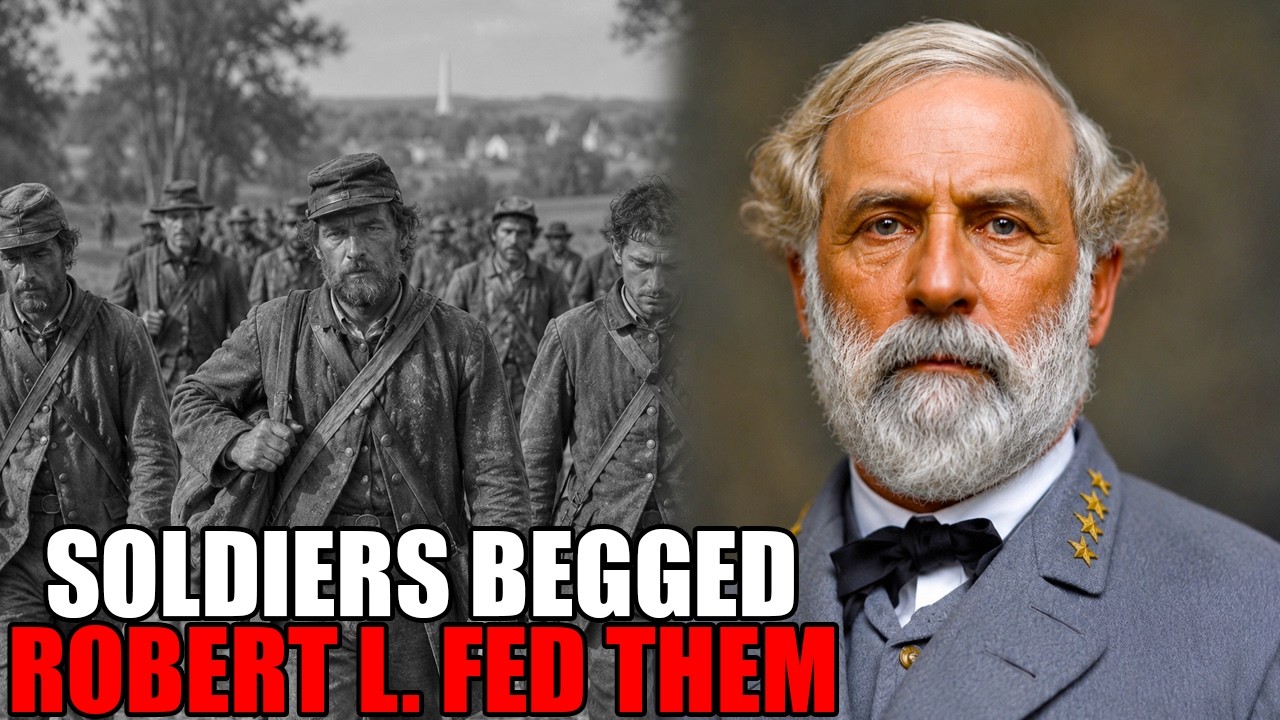
The mile-wide lines were gone. What came back was not an army but a collection of broken human beings. Lee was a 56-year-old Virginian, the son of Revolutionary War hero Light-Horse Harry Lee, a graduate of West Point who had finished second in his class. His entire pre-war career had been spent as a military engineer, a man who built fortifications and understood the mathematics of defensive warfare better than almost anyone alive.
Yet he had just sent 12,000 men across three-quarters of a mile of open ground into massed artillery and entrenched infantry on the belief that the enemy center was weak. It was not weak. In roughly thirty minutes, between six and seven thousand of those men had been killed, wounded, or captured. Some regiments crossed the fields with three hundred men and returned with fewer than thirty.
As the shattered survivors staggered back to his position, Lee reportedly told them, “It is all my fault. It is I that have lost this fight. ” Those words would become one of the most famous moments of the Civil War. But whether he spoke them exactly that way remains uncertain.
Nearly every account of Lee’s behavior that afternoon comes from memoirs written decades later, shaped by grief, politics, and a deliberate campaign to transform a flawed general into a saint. The night before the charge, Lee could not sleep. He had spent two days throwing his army at the Union flanks at Gettysburg, and both times the line bent but did not break. Devil’s Den, the Wheatfield, the Peach Orchard, Little Round Top—names that already meant slaughter.
Confederate casualties over the first two days approached seven thousand; Union losses were worse, close to ten thousand. But the Union army held the high ground, dug in along Cemetery Ridge in a line shaped like a fishhook. Lee was running out of options. His reasoning was not irrational.
He had struck both flanks and believed Union commander George Meade had pulled men from the center to reinforce them. If the center was hollow, a concentrated blow could punch through and split the Union army in two. He had seen his men do the impossible before. At Chancellorsville, just two months earlier, they had routed a force twice their size.
The Army of Northern Virginia had not lost a major battle in nearly a year. Lee trusted his soldiers, perhaps too much. Across those dark fields, the Union soldiers were not sleeping either. They were stacking stones, dragging fence rails into position, digging shallow trenches.
Many were boys from Pennsylvania, New York, and Massachusetts—farmers, clerks, immigrants from Ireland and Germany who had crossed an ocean only to find themselves behind a low stone wall waiting for dawn. They had fought at Antietam and Fredericksburg. They knew what a Confederate charge looked like, and they had spent two days watching one come apart. The force Lee assembled for the assault numbered between twelve and thirteen thousand men, divided into three commands.
On the right, George Pickett’s division of roughly six thousand Virginians, organized into three brigades under Brigadier Generals Richard Garnett, James Kemper, and Lewis Armistead. Pickett was 38, a flamboyant officer who had graduated last in his West Point class. His division had never fought a major engagement with the Army of Northern Virginia. This would be their first and their last as a coherent fighting force.
On the left stood Johnston Pettigrew’s division, roughly six thousand North Carolinians and Tennesseans, men already badly bloodied in the fighting of July 1. Behind them came two brigades under Isaac Trimble, another three thousand men. These were not fresh troops. Many had been fighting for two days.
The man tasked with sending these twelve thousand men forward did not believe they would succeed. James Longstreet, Lee’s senior corps commander, known as Old Pete, had argued since dawn for a flanking maneuver around the Union left to get between Meade and Washington. Lee listened, then pointed toward Cemetery Ridge. “The enemy is there, and I am going to strike him there.
” The conversation was over. The ground between the two ridges was three-quarters of a mile of open, gently rolling Pennsylvania farmland, wheat fields and meadow grass knee-high in the July heat. No cover, no trees, no ravines. Roughly halfway across sat the Emmitsburg Road, lined with sturdy post-and-rail fences that would force every man to stop, climb, or tear down the rails under fire.
Beyond the road, the ground rose gently toward a low stone wall running along Cemetery Ridge. Near the center of that wall, a slight kink in the stonework beside a clump of trees marked the target every Confederate officer had been told to guide on. It would become known as the high-water mark of the Confederacy. Among the men waiting in the tree line was Brigadier General Lewis Armistead, a career soldier commanding roughly fourteen hundred Virginians.
But Armistead was thinking of the man on the other side of that field: Winfield Scott Hancock, his closest friend from the old army. Before the war they had served together in California, inseparable, their families close. On the night Armistead left to join the Confederacy, he had wept openly, pressing a small prayer book into the hands of Hancock’s wife and saying, “Please forgive me. I can never be so happy again.
” Now he was preparing to lead a charge directly into the sector commanded by that same friend. When the time came, he placed his hat on the tip of his sword and held it high so his brigade could see him above the smoke. Just past noon on July 3, the temperature climbing past eighty degrees, 150 Confederate cannons opened fire in the largest artillery bombardment of the entire war. For nearly two hours, the two ridges hammered each other in what participants called the heaviest cannonade of the conflict.
The Confederate gunners fired blind through their own smoke, many shells sailing over the crest to explode harmlessly in the rear. The Union batteries answered. At approximately 2:20, Union artillery chief Henry Hunt made a decision that shaped everything that followed: he ordered his batteries to slow their fire and then stop entirely. If the Confederates believed they had silenced the Union guns, they would signal the infantry to advance.
When those infantry stepped into the open, Hunt’s guns, with ammunition deliberately conserved, would be waiting. The Confederates took the bait. Behind the Confederate guns, Colonel Edward Porter Alexander, watching his ammunition dwindle, sent a desperate message to Pickett: if you are coming at all, you must come at once, or I cannot give you proper support. Pickett rode to Longstreet.
“General, shall I advance? ” Longstreet could not speak. He had argued against this moment for hours. He believed the charge would fail.
But Lee had given the order, and the army was waiting. He simply bowed his head. One nod. Pickett saluted and rode back.
At approximately three in the afternoon, the tree line erupted with movement. Twelve thousand men stepped into the sunlight, forming lines that stretched a mile from end to end. From Cemetery Ridge, Union soldiers watched them emerge through the haze, one officer later writing that the line came on with alignments as perfect as on dress parade. For a moment, there was an almost terrible beauty to it.
Then Cemetery Ridge came alive. The Union artillery opened up, not the weakened batteries the Confederates expected, but guns at full strength, crews rested, ammunition conserved. The first rounds tore through the line at distance. From Cemetery Hill and Little Round Top, guns poured enfilade fire down the length of the formation.
The men kept walking. They had been told the guns were destroyed. They could see now that this was not true, but there was nowhere to go except forward. Every hundred yards cost the line dozens of men.
Roughly halfway across, they reached the Emmitsburg Road, and the formation began to die. The sturdy fences forced men to stop, climb, or tear down rails under close-range fire from Union riflemen who had been holding their shot until the enemy reached 250 yards. Men bunched up at the fences, jammed together, unable to move forward or back. Confederate accounts describe this as the worst moment of the charge, worse than the artillery, worse than the final rush.
In many Civil War engagements, casualty rates of fifteen to twenty percent were considered devastating. Some regiments crossing those fences lost sixty to seventy percent of their men in thirty minutes. What remained of the assault converged on the stone wall near the clump of trees. Out of the smoke, Lewis Armistead was unmistakable, hat still on the tip of his sword, screaming for his men to follow.
He reached the wall, and perhaps 150 men followed him over the stones into a desperate close-range fight that lasted only minutes. Armistead reached a Union cannon, placed his hand on the barrel, and went down, mortally wounded. At almost the same moment, Hancock was hit, a bullet passing through his saddle and driving a bent nail and wood fragments deep into his thigh. He slumped but did not fall, staying in the saddle long enough to see the breakthrough contained.
Two old friends struck down within minutes of each other on opposite sides of the same stone wall. Armistead died two days later in a Union field hospital. Among his last words were messages for Hancock, regret, and something that sounded like an apology for the whole war. The high-water mark lasted no more than a few minutes.
Union reserves rushed forward. The Confederates who crossed the wall were killed, wounded, or captured. The breach was sealed. The charge was over.
Across the field, the assault fell apart all at once. Garnett was dead, shot from his horse near the wall, his body so mangled it was difficult to identify. Kemper was down, grievously wounded. Trimble was hit, losing a leg.
The mile-wide formation no longer existed. Survivors walked back alone or in twos and threes, picking their way through a field covered with the dead and dying. Confederate accounts describe not gunfire but groaning—the low, continuous moan of thousands of wounded men lying in the July sun, calling for water, calling for their mothers. This is the field Robert E.
Lee was looking at. He rode out from the tree line on his gray horse, Traveler, alone, moving toward the stream of broken men. The survivors saw him before he spoke. Some stopped walking.
Some straightened up. Some began to cry. He rode among them, speaking calmly, repeating words that survivors later called gentle: “It is all my fault. ” He told the men to rally, to form up, to be ready, because the enemy might counterattack.
Then George Pickett appeared. His division had been destroyed; all three brigade commanders were gone. Lee looked at him and spoke the words that would be repeated in every history book for the next century and a half: “You must look after your division. ” Pickett’s answer came back: “General Lee, I have no division.
” Whether those were his exact words is a matter of genuine historical debate; much of what we know of Pickett’s voice comes from his widow, who spent decades shaping his image in the romantic, tragic mold of the Lost Cause. But the core is corroborated. There was nothing left to look after. Weeks after Gettysburg, Lee wrote to Confederate President Jefferson Davis, offering his resignation.
“The general remedy for the want of success in a military commander is his removal,” he wrote. Davis refused. Lee stayed in command, fighting for two more years, but he never again attempted anything like Pickett’s Charge. The numbers tell the rest.
Confederate casualties in the charge are estimated at six to seven thousand, roughly half the men who crossed those fields. Union losses repelling the assault numbered approximately 1,500 to 2,000. For the three days of Gettysburg as a whole, the Army of Northern Virginia suffered between twenty and twenty-eight thousand casualties; the Army of the Potomac lost around twenty-three thousand. Combined, nearly fifty thousand men in three days, in a town with a peacetime population of about 2,400.
Meade declined to counterattack, his army battered and the extent of Confederate reserves unclear. That night rain began to fall, and under its cover Lee withdrew the Army of Northern Virginia south toward the Potomac. The invasion of the north was over. The retreat stretched over muddy roads, the wounded forming a wagon train seventeen miles long.
The groans of men jolting over rutted roads could be heard, witnesses said, from a mile away. Before Gettysburg, the Army of Northern Virginia believed it could not be beaten in a major battle. After Gettysburg, that belief was gone. Pickett never forgave Lee, carrying the bitterness of July 3 for the rest of his life.
He died in 1875 at the age of fifty. Hancock survived his wound but was never the same physically, the bullet fragments and saddle nail lodged in his body for the rest of his life; he ran for president in 1880 and lost by fewer than ten thousand votes. Longstreet, who had argued against the charge and been unable to speak the order to send Pickett forward, became the scapegoat of the Lost Cause mythology, blamed for the very disaster he tried to prevent, while Lee, who made the decision, was shielded by the myth his words on Seminary Ridge helped create. And the charge was not just Pickett’s.
Of the twelve to thirteen thousand men who crossed that field, roughly half came from Pettigrew’s and Trimble’s divisions—North Carolinians and Tennesseans largely forgotten, written out of the name if not the history. The 26th North Carolina, which suffered some of the highest casualty rates of any regiment in the entire war, marched across those same fields and hit those same defenses. They do not have a charge named after them. The field is still there, quieter now.
Three-quarters of a mile of Pennsylvania farmland where the Confederacy broke apart, where seven thousand men fell in thirty minutes, and where a general rode out alone to meet the wreckage of his own certainty.