The morning of May 19, 1836, began quietly for nine-year-old Cynthia Anne Parker. She was playing near the open gate of Fort Parker, a small stockade of split-timber walls on the Navasota River in central Texas, when the horizon changed. A line of dust, then a line of horses, then a line of warriors painted for war. Fifteen minutes later, her family was gone.
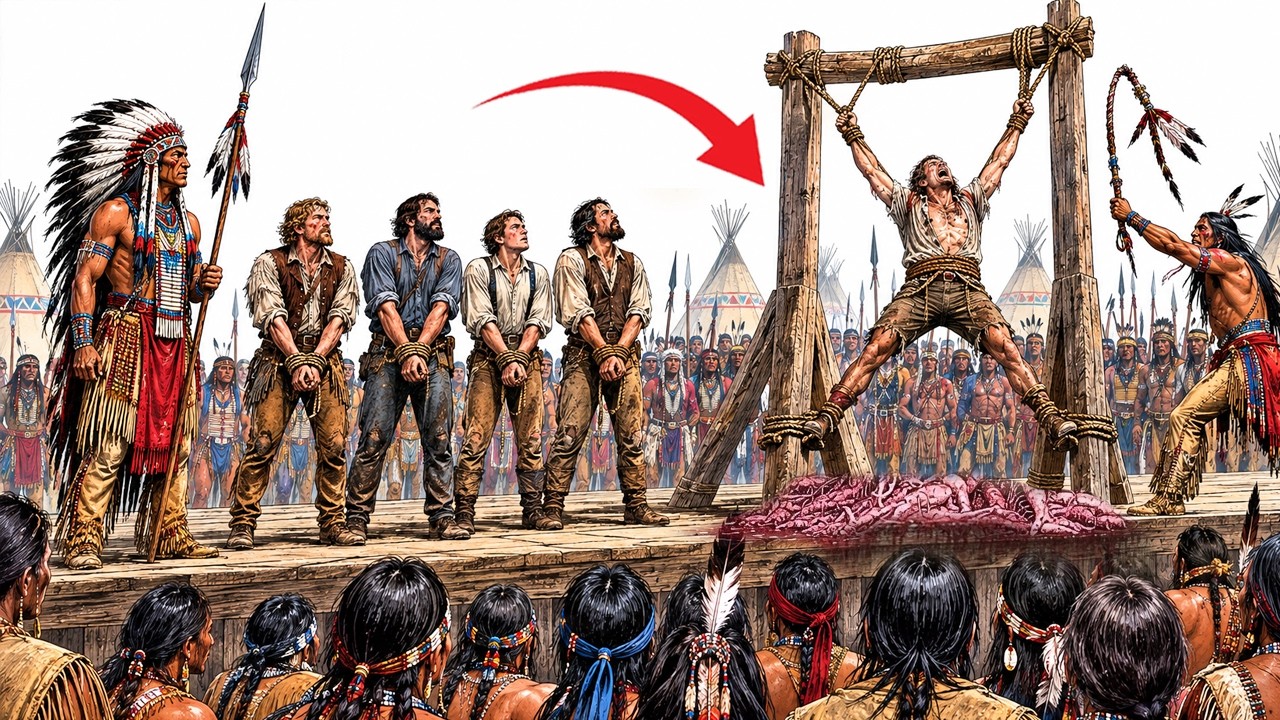
Her uncle Benjamin was lanced and scalped at the gate. Her father Silas was cut down in the cornfield. Five members of the Parker family were dead, five were carried off, and the riders vanished north into the prairie. Among the taken was Cynthia Anne, tied across the back of a Comanche warhorse.
The Parker family had moved to Texas from Illinois in 1833, a large Baptist clan. By the spring of 1836, roughly thirty-four of them lived in the fort. Texas had just won its independence from Mexico. The Alamo had fallen the month before, San Jacinto had been won weeks after, and elder John Parker, the family patriarch in his seventies, believed the killing was over.
He was wrong. On the night of May 18, rider brought word that Comanche and Kiowa raiders had been seen north of the settlement. Benjamin Parker argued for sending the women and children to Fort Houston, forty miles away. His father refused.
God had brought them to this land. God would keep them. The gate would stay open as it was. The Comanche were not a tribe in the sense the settlers understood.
They were a mounted nation that controlled roughly 240,000 square miles of the American interior, an expanse larger than France, running from Kansas through Oklahoma and West Texas into northern Mexico. They had driven out the Apache and other tribes, held off the Spanish, the Mexicans, and the Americans, and done it all in four generations after acquiring horses around 1700. A Comanche warrior could fire twenty arrows from horseback in the time it took a settler to load a single-shot rifle. It was survival math, and the settlers were losing.
They were also not what the frontier wanted to believe. These were fathers and sons who played with their children and doted on their infants. Many had watched their own villages burned. That does not excuse what they did.
It only means the story had two sides, and both bled. On the morning of the raid, the men were half a mile from the walls working the corn. The women were washing and cooking. Rachel Plummer, seventeen years old, pregnant, and holding her toddler son James Pratt, was inside a cabin.
Cynthia Anne and her little brother John were near the gate. Benjamin saw them first. He saw a line of horsemen carrying a white flag, a piece of dirty cloth on a lance. It was a false flag, a trick used before.
He ran back to the fort, told his brother Silas to gather the men, told the women to get inside, and walked out through the open gate alone and unarmed to buy them time. They surrounded him the moment he stepped through. Rachel later wrote what she saw: they thrust their lances into him, scalped him while he was still struggling, and left him where he lay. The warriors poured through the gate.
Elder John was stripped and killed. His wife Sarah was stabbed and left for dead. Silas was killed in the field. Elizabeth Kellogg was seized.
Rachel was dragged from the cabin, beaten, and her toddler torn from her hands. Near the gate, a warrior swept up Cynthia Anne and her brother onto a horse. The whole thing took less than fifteen minutes. The raiders rode until well after dark, pushing the horses hard, because pursuit was the greatest danger.
When they finally stopped, the captives were stripped and beaten. Rachel was tied face down to the ground, wrists bound so tight the scars would stay with her for life. Around her, the warriors danced with the scalps taken that day. She saw her uncle’s hair in the firelight.
Cynthia Anne was not beaten as badly. Children were valuable. Children could be assimilated. The march into Comancheria lasted six days.
Rachel, pregnant and tied to a horse’s back, later wrote that her wrists bled so badly her hands stuck together. She could hear her son crying somewhere in the column but could not reach him. Cynthia Anne was already being spoken to in Comanche. At the end of the march, the captives were separated.
Rachel was given to one band, Elizabeth to another, James Pratt to a third, and Cynthia Anne with her brother to a fourth. They never saw each other again. Rachel’s captivity was one of the hardest. She was made a slave to an older woman, beaten for offenses she could not understand because she could not yet speak the language.
In the winter of 1836, she gave birth in a Comanche lodge. Six weeks later, the women of the band decided the infant was slowing her work. They tied a rope around its neck and dragged it behind a horse. When they gave her the body, she buried it herself.
She survived another eighteen months, fought back physically against her captor, and earned a kind of respect. Eventually she was traded to Mexican merchants and ransomed for about $150. She reached her father in 1838, weighing less than eighty pounds, wrote her narrative, and died a year later. She was twenty.
Not every captivity followed the same path. In 1855, a Texas Ranger named Nelson Lee was captured by a Comanche war party. The other two men taken with him were tortured to death. Lee lived three years.
The reason was a pocket watch. When the warriors searched him, the watch was ticking. They passed it around, and when Lee set the alarm, they fell silent. They believed a spirit lived inside it, and that Lee commanded it.
He was kept as a slave and a curiosity, forced to demonstrate the watch at feasts. He escaped in 1858 and wrote a narrative that historians have debated ever since. Cynthia Anne Parker did not escape. She was under ten, so she was not made a slave.
She was adopted. Within a year she could no longer speak English. Within two, she could no longer remember it. She was given a new name, Naduah, roughly “someone found.
” She was raised in the band of Peta Nocona, a rising war chief. She married him in her teens and bore him three children. The eldest was a boy she named Quanah, “the fragrant one. ”
By 1860, she had lived among the Comanche for twenty-four years.
When Texas Rangers attacked a small camp on the Pease River in December of that year, they found a woman on horseback, trying to flee with an infant, crying out in Comanche. Her eyes were blue. They did not know who she was at first. When they brought her to her uncle Isaac Parker, and he said her name, Cynthia Anne, she broke down.
But she told them through her tears that she wanted to go home, and she meant back to the plains. She was returned to East Texas and treated as a rescue. She treated it as a second kidnapping. She tried repeatedly to escape.
She refused to speak. She refused to eat. She waited for her sons to come and take her back. They never did.
Her infant daughter, Prairie Flower, died of influenza in 1864. Cynthia Anne, the little girl captured at nine, the woman who had become Naduah, turned her face to the wall in a white man’s house and refused food and water until she died, around 1870. She did not know what her son would become. Quanah Parker, the boy she raised on the plains, became the last great war chief of the Comanche, the final free chief to lead his people in.
In 1875, after the Comanche military collapse, he rode into Fort Sill on his own terms. Then he did something few expected: he learned English, learned law, learned real estate. He became a rancher, a tribal judge, a founder of the Native American Church, a negotiator who won more rights for his people in Washington than anyone had a right to hope. He hosted Theodore Roosevelt on a wolf hunt.
And for the rest of his life, he carried one photograph with him into every treaty room and every governor’s office. It was a picture of his mother. Fort Parker, 1836. Five dead, five taken.
Of those taken, two were ransomed within a year. James Pratt, Rachel’s son, was recovered after six years and never fully adjusted. John Parker, Cynthia Anne’s brother, was raised Comanche and chose to return to the tribe when he was finally found. And Cynthia Anne, the one everyone searched for longest, was the one who did not want to be found.
The Comanche did not just take people. They rewrote them. The captivity the frontier called its greatest horror had produced, one generation later, the man who negotiated the Comanche future.
The people caught in the middle, the children who forgot their own names, carried for the rest of their lives the marks of both worlds.