In the summer of 1864, the newspapers of the North were filled with long columns of fine print—lists of the dead and missing. City by city, family by family, people bent close to the pages, searching for a name they prayed they would not find. As those names accumulated week after week, a single word began to stick to the man running the war in Virginia. Critics called Ulysses S.
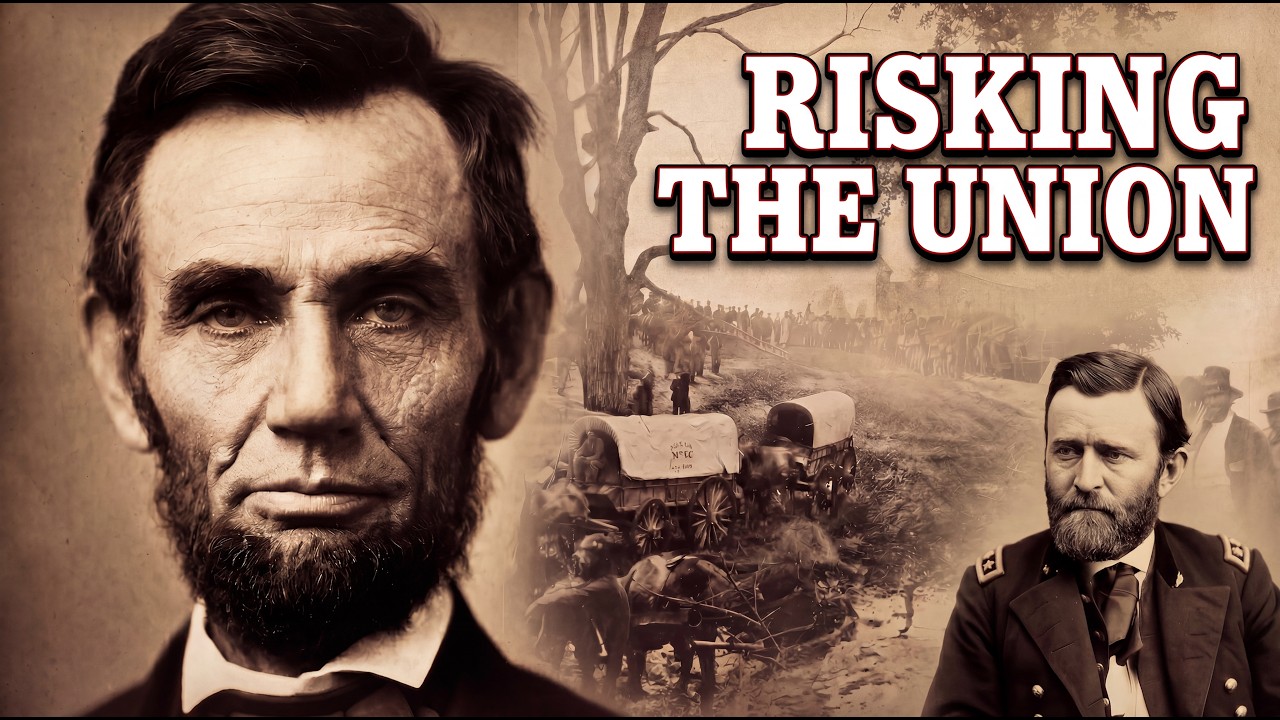
Grant a butcher. He had pushed tens of thousands of young men straight at Robert E. Lee’s guns and would not stop. Demands for his removal grew daily, but Abraham Lincoln made a difficult decision and staked his presidency on him.
This is the story of that decision. By that summer, the war had entered its third year, and the country was exhausted to the bone. Lincoln had promoted Grant to command all U. S.
armies only months earlier. Almost immediately, the bill for that decision arrived by mail in the form of those terrible lists. The casualties of the Overland Campaign were unlike anything the North had faced before. Entire communities went into mourning at the same hour.
And here was what made it so dangerous for the president: an election was coming in November—the first presidential election held during the Civil War. If voters turned against the war, they would turn against the man conducting it. Lincoln stood at a crossroads as harsh as any his generals faced. To stand by Grant meant facing public grief and daring voters to remove him.
To remove Grant meant abandoning the only strategy that finally seemed capable of weakening Lee. Lincoln read the same casualty lists everyone else read. He heard the word *butcher* in the streets, in the press, and, as we shall see, inside his own home. One question hung over the White House that summer, simple and merciless: Would Lincoln lose the presidency before Grant could win the war?
He did not yet know the answer. No one alive did. To understand why he refused to back down, one must go to a tangled stretch of Virginia forest—and to a night when an army that seemed beaten discovered that everything had changed. To understand the anger, you must first understand the strategy, because the strategy was what made Grant look so frightening.
In March 1864, Lincoln gave Grant command of all U. S. armies and the revived rank of lieutenant general, a rank previously held only by George Washington. Grant had won victories in the West at places like Vicksburg and was known for the blunt, stubborn determination the president desperately needed.
For three years, the main Union army in the East had fought Lee, bled, then retreated to rest and refit, surrendering the initiative each time. Grant was determined to break that pattern. He planned to pressure the Confederacy on several fronts at once, and he decided to accompany the Army of the Potomac himself. His objective was not really a city.
It was Lee’s army, and he intended to seize it and never let go. On May 4, 1864, that army crossed the Rapidan River and entered a region of central Virginia so thick with trees and brush that the men simply called it the Wilderness. It was nearly the same ground where Lee had wrecked a Union army the year before, and it was the worst possible terrain for the larger Northern force. Cannons could not find targets in the undergrowth.
Battle lines dissolved in the dense vegetation. For two days, May 5 and 6, the armies fought nearly blind in thick smoke, firing at muzzle flashes and moving shapes. Fire broke out in the dry timber, and the burning woods became an additional horror for the wounded who could not crawl away. When it ended, the battle was a draw on the map.
But under the map, it was a slaughter. Grant’s army lost nearly 17,000 to 18,000 men in two days—thousands more than Lee’s. Every exhausted soldier in that army knew what was supposed to happen next. It always happened next.
After such a defeat, the army would crawl north across the rivers to heal and wait for a new commander. That had been the bitter rhythm of the war in the East, followed by many generals. Then, on the night of May 7, the columns formed in the darkness and began to move. And here something happened that the men would remember for the rest of their lives.
At a major crossroads, the head of the column did not turn north toward safety. It turned south, deeper into Virginia, straight toward Lee. The general riding at the front was Grant. The word spread through the ranks like a current through water.
They were not retreating. The exhausted men, who had every reason to collapse, began to cheer him in the darkness, and some started singing a marching tune out of joy at leaving the Wilderness behind. The noise grew so loud that Grant, who needed the secrecy of the night march, fell silent, worried that his movement would be revealed to the enemy. That cheer is the entire campaign in a single sound.
These men had just been through hell, and they were cheering because they sensed, for the first time, a commander determined to finish the matter rather than merely survive it. Here is the perspective the home front struggled to grasp. Grant’s losses were not proof of indifference. They were the price of a deliberate idea.
Keep pressing. Never let Lee set the pace. Never give the smaller Confederate army time to rest, repair, or choose the battlefield. The North could replace its losses more easily.
The South could not. It was a brutal calculation, but if carried to its conclusion, it pointed to Union victory. Grant told Washington he would not turn back no matter the cost of the early battles. But calculations are no comfort to a mother reading a name in the morning paper.
And the bill for this strategy was about to come due faster and more publicly than anyone in Washington expected. The march south led to two more weeks of carnage, then to a word that would haunt Grant for the rest of his life. At Spotsylvania Court House, the armies collided again. For nearly two weeks they struggled along a line of earthen trenches the Confederates had built in the shape of an inverted U.
On May 10, a young colonel named Emory Upton briefly broke the line, and Grant saw the opportunity and tried it on a much larger scale. At dawn on May 12, thousands of Winfield Scott Hancock’s men stormed into a bend in the fortifications. For nearly twenty-two hours under cold rain, men fought hand-to-hand on that narrow ground with a level of exhausted horror veterans could barely describe in words afterward. They called it the Bloody Angle.
Spotsylvania became one of the campaign’s costliest battles, with combined losses near 30,000 men. Then came Cold Harbor. On the morning of June 3, 1864, Grant ordered a frontal assault against Lee’s entrenched position—a mistake he openly regretted for the rest of his life. The attack was destroyed within about an hour; traditional figures put Union losses in that disastrous, brief assault at up to 7,000 men.
For days afterward, the armies could not even agree on a truce to recover the fallen between the lines. It was a grim confrontation that deepened the campaign’s reputation as a symbol of horror. Some historians now argue that the actual losses in that assault were lower, and that the legend grew as accounts were passed down. But the public of 1864 was not dealing with fine-tuned revisions.
It was dealing with the lists, and the lists were stunning. Over six weeks, the Union’s Overland Campaign had cost nearly 55,000 men. Fifty-five thousand. The number is so large it almost loses meaning—which was exactly the problem.
Behind it stood tens of thousands of families, each with an empty chair at its table. In Washington, the anxiety reached the top of the government. Secretary of the Navy Gideon Welles recorded in his diary dark talk of Grant as a man who cared little for human life. The day after Cold Harbor, Welles wrote that the losses were enormous and that the country was beginning, in a chilling phrase, to grow accustomed to sacrifice.
That was the quiet worry of insiders behind closed doors. In public, the word had become a weapon: Grant the butcher. It echoed in speeches and on the front pages of opposition newspapers, aimed not merely at one general’s tactics but at the war itself and at the president conducting it. The faction that wanted peace, even at the price of a divided country, used the casualty lists as proof that Lincoln’s war had become a weary, pointless horror that must be stopped at once.
After the war, a famous Union officer claimed the Army of the Potomac had not been allowed to report its full losses during that campaign for fear the country could not bear reading them. It must be stated clearly that later historians have strongly refuted that characterization. Compared with the size of the armies, Lee actually lost a higher percentage of his men than Grant. Serious studies have argued that Grant was a winner, not a butcher, and no more careless with life than commanders the public admired.
But none of those studies existed in the summer of 1864. That summer, the word did its work. It turned grief into politics. Every new list was an argument against Lincoln.
His enemies hoped every funeral would be an electoral vote. The most painful part for the president was this: the criticism did not stay confined to the press and public squares, where he could answer it as politics. It was about to enter his own front door. If the word *butcher* had remained only in opposition newspapers, Lincoln might have dealt with it as he dealt with everything else.
But it reached him in the one place a president cannot escape: his home. Our window into that house comes from an extraordinary woman named Elizabeth Keckley. Born into slavery in Virginia, she endured years of cruel treatment, bought her freedom and that of her two sons, moved to Washington, and built a successful dressmaking business serving the wives of the capital’s most powerful men. Over time, she became the personal modiste and trusted confidante of the First Lady, Mary Todd Lincoln, close enough to the family to sit beside Lincoln’s son Willie as he died.
After the war, she wrote her memoir, *Behind the Scenes*, published in 1868, recording the private opinions she heard spoken in the family rooms. A word of caution must be offered here, because honesty requires it. Keckley wrote from memory years later. Her book caused a scandal when it appeared, and what she set down is one woman’s recollection, not a verbatim text or an official record.
But scholars have long relied on it as the closest thing we have to what went on in the Lincoln family’s private sessions. On the subject of Grant, her account is unforgettable. According to Keckley, the First Lady could not stand the general. Mary Lincoln called him a *butcher*, unfit to command any army.
When the president pointed out that Grant was successful in the field, she answered him with the same mathematics the entire North was repeating. She said he lost two men for every one of the enemy. He had no management and did not care for human life. She warned that if the war continued much longer under Grant, it would drain the Northern population.
She called him a stubborn fool and a butcher, repeating the word as if to confirm her point. She even declared that if Grant were elected president, she would want to leave the country. How did Lincoln answer this storm in his own parlor? Not with anger.
According to Keckley, he replied with dry humor. “Well, Mother, suppose we give you the command of the army. No doubt you would do much better than any general who has yet been tried. ” Keckley remembered a gleam in his eye and a tone of irony in his voice.
That small moment tells you almost everything about the man. The pressure had reached his dining table, voiced by the person closest to him, and he absorbed it with a joke and a steady hand. But do not mistake that calm for comfort. Lincoln was being squeezed from every direction at once, and he could see all three of his bad options simultaneously.
If he removed Grant, he abandoned the strategy he believed was the only road to victory. If he kept Grant, he had to keep paying the price in public grief and private criticism. And behind those two options loomed a third, even larger danger approaching every week. Put yourself in his place for a moment.
If your most successful general is also the one filling the papers with the names of the dead, and an election that could push the country toward a negotiated peace is only months away, would you keep him? It is easier to know the answer now. That summer, no one did, because the deepest fear was not in his house. It was at the ballot box.
By August 1864, morale across the North had collapsed into something like despair. The casualty lists had not stopped. Grant was stuck in a long siege at Petersburg with no clear end, and the Confederate capital still stood in defiance. War-weariness turned into open talk of giving up entirely, and above all loomed a harsh political reality: no American president had been re-elected since Andrew Jackson more than thirty years earlier.
History itself seemed to stand against Lincoln. His own party was fracturing. Thurlow Weed, one of the shrewdest political operators of the age, told the administration plainly that Lincoln’s re-election had become impossible. On August 22, Henry J.
Raymond, chairman of the Republican National Committee and editor of a major New York paper, wrote to the president with a grim report gathered from across the country. Raymond said the tide was running strongly against them. He urged a desperate gamble: appoint a commission to offer peace to the Confederate president on the sole condition of restoring the Union, leaving everything else for later. Lincoln actually drafted authorization for such a mission.
Then he pulled back and stopped it, because he realized such an offer meant abandoning emancipation and the very goals for which so many had already died. Lincoln saw the trap his opponents were setting and could even joke about it. He noted that the Democrats would have to nominate a peace man on a war platform, or a war man on a peace platform, and he did not care much which they chose. In late August, in Chicago, they chose the second option.
With the most prominent peace men in the country dominating their platform committee, the Democrats declared the war a failure and demanded an immediate cessation of hostilities. Then they nominated General George B. McClellan, the very soldier Lincoln had earlier removed from command. McClellan disliked the peace platform and tried to distance himself from it, but the message to the grieving public was unmistakable: a vote for the opposition was a vote to end the war whatever the cost to the nation.
In this atmosphere of near-certain defeat, Lincoln performed one of the strangest and most telling acts of his presidency. On the morning of August 23, 1864, he sat at his desk and wrote a short private memorandum. He wrote: “This morning, as for some days past, it seems exceedingly probable that this Administration will not be re-elected. ” He then pledged that if he lost, he would cooperate with the president-elect to save the Union in the brief interval before the new man took office, because afterward it might be impossible to save it at all.
Then he did something stranger still. He folded the paper so the words inside could not be read, carried it to a cabinet meeting, and asked each secretary to sign his name on the back without knowing what they were signing. They signed it in ignorance. This is the document history calls the “Blind Memorandum,” and it is the strongest evidence we have of one astonishing fact: in late summer 1864, the President of the United States genuinely believed he was about to lose.
He did not reveal what the folded paper said until after the votes were counted. And at that very moment, believing his defeat was imminent, Lincoln had to decide once and for all what to do about the general everyone was calling the butcher. This is the moment the whole story had been building toward, and it did not come in a great speech but in a brief telegram. Go back to that room and feel the full weight pressing on him.
The newspapers were furious. The public was exhausted. His wife, according to Keckley’s account, was calling Grant a butcher inside the White House. His party chairman was warning him everything was lost.
He had just written in his own hand that he expected to be turned out of office. Every political self-preservation instinct pointed one way: distance yourself from the bloodshed, find a new general, give the country a sign that the slaughter would change. Lincoln did the exact opposite. In August 1864, while Grant was entrenched before Petersburg, a proposal reached Washington to withdraw some of his soldiers from the siege and send them north, fearing draft-related unrest might require troops at home.
Grant refused outright. He sent word that he was not ready to give up his hold on the enemy he had finally cornered after so much blood. When that message reached the president, Lincoln did not overrule his general or hesitate. On August 17, 1864, he sent a telegram to Grant with a reply that has outlived almost anything either man said that summer.
The president wrote that he had seen Grant’s message expressing unwillingness to give up his grip. Lincoln said he too was not ready for that. Then came the words: “Hold on with a bulldog grip, and chew and choke as much as possible. ” That telegram, preserved to this day in the National Archives, is the beating heart of this story.
It is simple, almost instinctive, yet hard as steel. In one sentence, the President of the United States told his most criticized general not to retreat but to tighten his grip further. The “bulldog grip” telegram was not merely Lincoln enduring Grant. It was Lincoln putting his own name on the very strategy that was costing him so much at home.
Grant understood immediately what he had received. When he read it, according to one account, he laughed aloud and remarked to the men around him that the president had more nerve than any of his advisers. He was right. Everyone around Lincoln was urging caution and distance.
Instead, Lincoln offered two simple things: encouragement and resolve. Let us be clear about what he was risking, because it is easy to miss when telling the story. The newspapers were calling his general a slaughterer. The casualty lists arrived daily.
His household was unhappy. His party was frightened. The election looked like certain defeat. And in the middle of it all, Lincoln chose the harder path.
He kept his general. He blessed the strategy. And he prepared to live with what the voters might do to him because of it. But here is the harsh truth of that August: a private telegram, however courageous, could not be read by the voters.
It could not lift the spirits of a grieving country or answer the charge that the war was a failure. For that, Lincoln needed something the entire North could see with its own eyes. He needed a victory, and time was running out to get one. The victory came, from hundreds of miles away, at a railroad city in Georgia.
While Grant tightened his grip on Lee in Virginia, another Union army under General William T. Sherman had spent the summer advancing south from Tennessee toward Atlanta, a vital center of Confederate rail and manufacturing. The campaign had been long and grueling, a precise series of flanking maneuvers and sharp battles. Frustrated with a cautious Confederate commander, Confederate leadership replaced him in July with the aggressive John Bell Hood, who immediately threw his army at Sherman in a series of attacks, only to be beaten each time.
By the end of August, with his supply lines cut and his army in danger of being trapped inside the city, Hood had no options left. On the night of September 1, Confederate forces evacuated Atlanta, destroying what they could not take with them. On September 2, 1864, Union troops entered the city. Sherman sent north a telegram of six simple words that did for the country’s morale what the casualty lists had done for its despair.
He announced: “Atlanta is ours, and fairly won. ” Consider the timing, because timing is everything. Only days earlier, the opposition had met in Chicago and told the entire country the war was a failure. Now, almost simultaneously, one of the Confederacy’s greatest cities had fallen.
The peace platform suddenly faced a war that was clearly being won, and it looked absurd. For Lincoln’s supporters, this was the answer to the convention that had declared the war hopeless. The shift in national mood was sudden and dramatic. The gloom of the long summer vanished almost overnight.
The Republican rival challenging Lincoln from within his own coalition abandoned his campaign and withdrew. Hesitant newspapers and platforms returned to firm support of the president. Within weeks, new victories in Virginia’s Shenandoah Valley under General Philip Sheridan added to the growing sense that the tide had turned for good. It is important to be careful here and not overstate the claims.
Atlanta did not decide the election by itself. The soldiers’ votes, the deep divisions among his enemies, the broader string of Union successes that autumn, and Lincoln’s own personal steadiness all played their part. But there is no serious doubt that the fall of Atlanta was the major turning point of that political season. It restored the North’s belief that the immense sacrifice was producing something real, and it shifted Lincoln’s chances from probable defeat to likely victory.
And notice what it also did: it began to prove the very strategy Lincoln had refused to abandon. The relentless pressure, the iron grip, the insistence on moving forward despite the terrible cost—these were finally yielding results the whole country could read on the front pages. The man they had called the butcher, and the president who refused to dismiss him, were about to face the voters at last. On November 8, 1864, the country delivered its verdict, and it was not close.
Abraham Lincoln won a second term in a landslide, taking 212 electoral votes to his opponent’s 21, and about 55 percent of the popular vote, a margin of hundreds of thousands of ballots. His opponent carried only three states. Perhaps the most telling result of all: the soldiers themselves, who had marched through the Wilderness and stood in the trenches at Cold Harbor, voted for Lincoln by a margin of more than three to one. Those men who had paid for Grant’s strategy with their blood gave their commander-in-chief their strongest endorsement.
With this, Lincoln became the first president re-elected in more than three decades. But it would be wrong to end on the cheers, because the price was real and it was permanent. The decision Lincoln made that summer cost names on the casualty lists—tens of thousands of young men who never came home from Virginia. Steadfastness was not a pure or painless act of courage.
It was a choice to keep absorbing terrible losses, believing that stopping would cost far more in the end. Nor did the election end the war. The grip held, the pressure continued, and the siege of Petersburg dragged on through the winter. The long fighting in Virginia only ended the following spring, in April 1865, when Lee finally surrendered the Army of Northern Virginia.
Return for a moment to where we began: the casualty lists in the Northern papers and the word *butcher* echoing in the streets. The entire summer is compressed into those two opposite things. The public horror printed in long columns of the dead, against the resolve of one man written in a folded note and a ten-word telegram. Lincoln did not win that argument by denying the grief.
He won by holding on until the end. Two years earlier, after the shock of the Battle of Shiloh in 1862, public demands had risen to remove Grant, and Lincoln—the president who had never met the man—quietly refused to give him up. That took a kind of nerve. But what he did in 1864 was far harder.
In 1862, he had protected a general he did not know. In 1864, he protected the general he himself had chosen and promoted. He did so when that choice could have cost him the presidency, the war, and the Union all at once. He tied his future to Grant’s bloody, relentless strategy, and the nation’s history turned on that single decision.
That is the weight behind a quiet telegram and a few simple words. A president who believed he was about to lose everything told his general to hold on. And then he held on himself.