On the morning of August 6, 1945, the most powerful weapon in human history erased the center of a Japanese city. For the next 31 hours, Japanese radio did not say a single word about it.
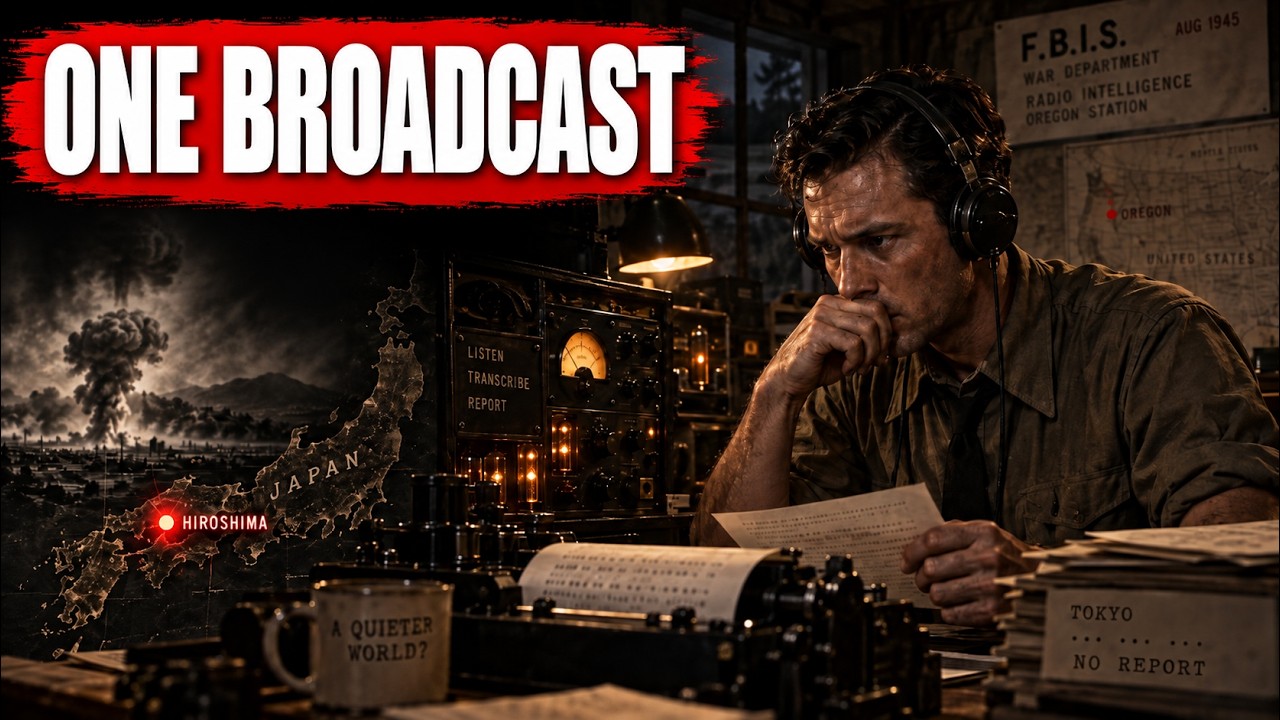
The Americans in a position to notice were sitting in a converted farmhouse on the eastern edge of Portland, Oregon. From the street, it looked like a property abandoned long ago. Inside were rows of shortwave receivers, desks stacked with carbon pads, and headphone-wearing men and women pulling Japanese voices out of the static, word by word.
They had been doing this for nearly four years. Steel production, war morale, the struggle for the homeland—the usual hum of a government talking to its own people. That morning, the usual hum continued.
It was still coming through when a technician in Tokyo held a dead telephone line, hoping to reach a Hiroshima radio station that no longer existed. It was still coming through when the President of the United States told the world what had been dropped. It continued through the evening and into the long dark of night.
When Tokyo finally spoke, the response to the war’s biggest event came in three sentences. The men in the farmhouse typed all three and sent them east. What Washington decided those three sentences meant cost another city.
—
The address was 1305 Northeast Gleason Street, where Portland faded into fields and the pavement ended. It had once been a farmhouse. By the summer of 1945, antennas filled the land behind it, the building was leased by the federal government, and staff were hired who did not discuss their work at home.
The operation belonged to the Foreign Broadcast Intelligence Service. It was not under the Army. It was not under the Navy.
It was under the Federal Communications Commission, a civilian agency that licensed radio stations and settled signal disputes between broadcasters.
In February 1941, ten months before Pearl Harbor, Congress gave the FCC money for something new. The job was simple to describe and brutally hard to do: listen to what the enemy tells its own people, write it down, translate it, and get it to the right people fast enough to matter.
The Portland bureau opened on October 1, 1941. About twenty people arrived by train, most of them Japanese and Chinese linguists from the Washington staff. Within weeks, receivers were running day and night for Japanese transmissions.
Ten weeks later, Pearl Harbor was bombed, and the farmhouse on Gleason Street was no longer an experiment.
By 1945, the service had listening posts across the country and beyond: Silver Hill, Maryland; San Francisco; Kingsville, Texas; San Juan, Puerto Rico; London. Portland was aimed at Japan.
The work was so monotonous that its purpose could get lost. A monitor would sit down, put on headphones, find the assigned frequency, and type out Radio Tokyo or Domei news agency wire traffic. Whatever could be pulled from the shortwave band through weather, signal fading, and 5,000 miles of open ocean went onto carbon pads.
From pads it went to teletype. From teletype it went east.
That part almost no one understood at the time. The United States could not put an intelligence officer inside Japan. No embassy, no trusted neutral journalist, no way to walk the streets of Osaka and see the fire damage.
Across the entire Pacific war, the American government was trying to understand a country it could not enter. Radio was the way in. Radio was the only way in.
A government cannot fight a war in silence. Factories must be told what to produce. Cities must be told when to take shelter.
Soldiers must be told they are winning. Every one of those messages went out over the airwaves. Every one of them could be caught by a man with headphones in Oregon.
And every one of them said something about the country that sent them—not just in the words, but in what the words avoided.
—
By August 1945, the daily digest from Portland was read at the highest levels. It went to the White House map room, the War Department, the Navy, and the Office of Strategic Services. When the President wanted to know what Japan was saying, this was where the answer came from.
The service needed something the country was short of: Americans who could listen to fast, garbled Japanese and translate it instantly into formal English, usable the same day. There was one place to find them. Before the war, the largest Japanese-speaking population in America lived on the West Coast—Seattle, Portland, Los Angeles, and the farm valleys between them.
By the spring of 1942, most of them were behind barbed wire. Executive Order 9066 had moved more than 100,000 people of Japanese ancestry inland to relocation centers. Nearly two-thirds were American citizens.
They lost businesses, farms, homes, and years of their lives. And while they were imprisoned in those camps, recruiters from the same government came to the barracks looking for men and women who could read and speak the enemy’s language.
Thousands volunteered. They joined military intelligence. They translated captured diaries, interrogated prisoners, and read documents no one else in the American war effort could read.
In 1942, the United States made a bargain with itself and never stood face to face with what it had done. The country imprisoned the very people who best understood the enemy, then came back to them for help.
—
On the afternoon of August 5, 1945, the monitors in Portland were doing their regular work. Radio Tokyo was talking about production quotas and home-front morale. Nothing notable.
The Oregon wall clock read 3:45 p. m. In Hiroshima it was August 6, 8:15 a.
m. The bomb detonated about 2,000 feet above the center of the city.
The Japan Broadcasting Corporation’s Hiroshima station was about 1,100 meters from the blast point. It was a busy morning, announcers and engineers and clerks at their desks. Thirty-six staff members were killed.
The building collapsed. Every line connecting it to the outside world went dead.
One minute later, a man in the Tokyo control room found his telephone unresponsive. He was a technician. His job that morning was routine—handing the network over to the Hiroshima station.
He listened to the silence. No tone, no crackle, no distant room hum. Nothing to assure him someone was on the other end.
He tried the backup circuit. Also dead.
He sat there with the receiver in his hand, thinking the things a technician thinks. A broken wire. A failed relay.
A fault somewhere on the line. Everything except the truth: there was no building left at the other end, and no one alive inside it.
Twenty minutes later, Tokyo’s railway telegraph center noticed that the main southbound line had stopped working just past Hiroshima. Two systems, two different technologies, two separate failures at the same point on the map within the same twenty minutes. A handful of people in Tokyo had just received the first proof that Hiroshima had been destroyed.
None of them saw it that way. No one would have.
The Second General Army headquarters, responsible for the defense of southern Japan, lost contact that morning. Its officers waited for the line to come back. It never did, because the headquarters itself was inside the city, and the city was burning.
Then fragmentary reports began arriving from units outside the blast area. They were confusing and brief. One plane.
A flash of light. A pillar of smoke standing over what had been a city of a few hundred thousand people an hour earlier. Staff officers assumed a signaling error.
Hiroshima had been left largely untouched through the summer fire raids. One plane could not do that.
Tokyo had to see it for itself. Around noon, a staff officer flew south. He was still about 100 miles out when he and his pilot saw smoke coiling over the horizon.
Not the flat, smeared haze of a burning city seen from above. A column, distinct in shape, standing proudly over the coast. It was the capital’s first confirmation that the reports were not exaggerated.
—
On the other side of the world, the President of the United States was eating lunch. Harry Truman was 61 years old, president for less than four months. He was aboard the heavy cruiser USS Augusta in the Atlantic, returning from the Potsdam Conference.
Captain Frank Graham of the White House map room entered the mess with a message from Secretary of War Henry Stimson, 77 years old, who had carried this program longer than anyone else in the cabinet.
The message said the bomb had been dropped, the results were clear and successful, more visible than the test in the New Mexico desert three weeks earlier, and the plane had returned safely. Truman read it, then read it again. He took Captain Graham’s hand and said, “This is the greatest thing in history.”
Then he stood before the sailors around him and told them what had happened. Within minutes the news spread through the ship. People came up on deck.
It felt like the war was over.
Sitting near him was Secretary of State James Byrnes, 63, once a rival and now Truman’s most trusted advisor on how to end the war. Byrnes had argued all summer that the bomb should be used before the Soviet Union entered the Pacific fight, so they could not claim territory. He was no longer thinking about the weapon.
He was thinking about the announcement.
The statement was released at 11 a. m. Washington time on August 6.
Truman had approved it before leaving for Potsdam. Scientists and War Department officials had written and revised it for months, keeping it in a drawer awaiting an event.
It said an American plane had dropped a bomb on Hiroshima, an important Japanese army base. It said the bomb had more power than 20,000 tons of TNT. It said it had cost $2 billion in secret.
It said Japan had started the war from the air and was now being paid back in kind. It said that if Japan did not accept the terms laid down at Potsdam, they could expect a rain of ruin from the air, the like of which had never been seen on this earth.
NBC interrupted its programming to read it. CBS did the same. Mutual did the same.
Within hours it was on the front page of every newspaper in the world. Every word was aimed at a specific address. Portland had started its night shift, loaded fresh carbon, and was ready.
Tokyo would have to answer.
—
Tokyo answered the President of the United States before it answered its own people. It happened after midnight, in a monitoring room of the Domei news agency. Domei had its own listening operation, a mirror image of the one in Oregon—staff sitting at receivers, pulling foreign broadcasts out of the night sky so the government could know what the rest of the world was saying about them.
On that night, they caught the statement from Washington. An American plane. A bomb.
20,000 tons of TNT. $2 billion. A rain of ruin.
It was read in a chair in Tokyo in the early hours of August 7. The Second General Army had gone silent the previous morning, and no one in the capital could say why. A staff officer had flown south and returned describing a column of smoke.
Now the enemy was broadcasting the details, the numbers, what they had used and what they would use again.
The Japanese government learned what had destroyed the center of one of its cities from an American broadcast. Not from the army. Not from Hiroshima.
From the radio.
By morning, the gist had spread through the ministries. Shigenori Togo, 62, a career diplomat who had opposed war with the United States in 1941 and spent most of the war out of government, had returned to power in April with a major portfolio. Now he had the enemy’s own account of the weapon.
He had nothing from his own side.
Across the Pacific, the night watch in Portland was still waiting. This kind of work carried a particular strain. A man sits in a chair.
He wears headphones. He types what he hears, most of it things no one will ever read twice. The room is hot from the receiver tubes.
The air smells of warm dust and carbon paper. And all the while, part of him waits for something beyond the ordinary news.
They had been at it since October 1941. They had copied Tokyo’s broadcasts through the fall of Singapore, the Battle of Midway, the island campaigns that turned the war. They had learned that what a government repeats and what it avoids reveals its true intentions.
When production figures went vague, something had happened to a factory. When a place name vanished from bulletins, something had happened to that place.
Now a place name had vanished from the bulletins, and the men in Oregon did not yet know the President had just told the world why.
Hours passed. Radio Tokyo talked about home-front morale. It talked about enemy losses.
It played music. It finished one schedule and started the next. None of it mentioned Hiroshima.
Not once. Not in passing. Not as a correction.
Not even as a denial.
Thirty-one hours is a very long time for a country to stay silent about something.
—
The bulletin came over the shortwave on the Domei overseas service. The monitor who caught it knew immediately he had something important, because it was the first time in more than a day that the name Hiroshima had appeared in a message at all.
It was issued by Imperial General Headquarters at 3 p. m. Tokyo time on August 7, 31 hours after the explosion.
It was a statement of three sentences.
The first said that a small number of B-29s had attacked Hiroshima the previous day, causing considerable damage. The second said the enemy appeared to have used a new type of bomb in the attack. The third said details were under investigation.
That was all. The entire official response of the Empire of Japan to the first use of nuclear weapons against a human population.
The monitor typed it. The transcript went onto the teletype and was relayed east before sunrise, reaching the War Department and the White House map room by morning.
Washington’s interpretation was not difficult. That was the problem. Tokyo had not used the word “atomic.”
Tokyo had not acknowledged the scale of anything. Tokyo had not asked for terms, had not approached a neutral government, had not signaled through Switzerland or Sweden or any other channel. A small number of planes.
Considerable damage. A new type of bomb.
A government waiting to surrender does not respond that way. This was not a rejection. It was ignorance, arranged for the public through the censorship office so they had no way to acknowledge what they did not know.
But no one in Washington understood the difference, because their only window into Japan was controlled by the Japanese government itself. You cannot hear a cabinet frozen in confusion. You only hear what they decide to broadcast.
And what they decided to broadcast was three sentences that revealed nothing.
On Tinian, a second bomb was already being assembled.
—
That same morning in Tokyo, the cabinet met. The debate that would consume the next eight days took shape in the first hour.
Togo spoke first, and he was clear. The enemy possessed a weapon that could destroy a city with a single bomb. They had already used one.
They had announced they would use more, in front of the whole world, which meant they were committed. Japan should accept the Potsdam terms now, not next week. Every day of delay would cost a city.
Then the War Minister answered, and his answer carried more weight than it would eighty years later. Korechika Anami was a 58-year-old infantry officer who had risen through the China campaigns and now held the most dangerous political position in Japan.
He did not deny the American announcement. He raised a question about it. What was the announcement worth?
Any losing side claims weapons it does not have to try to end the war. Japan had done it. Germany had done it until the final week.
The Americans had every reason to exaggerate what happened at Hiroshima, because the fear of an exaggerated weapon might produce a surrender that no ordinary weapon could force.
Until Japanese scientists stood on the ground and examined the cause of the destruction, the cabinet had only one piece of evidence: the enemy’s word. Anami wanted proof. He was entitled to ask for it.
He knew he was buying time. He was not merely protecting his pride, though pride was present in that room.
The Japanese army had spent the summer building a specific plan for the defense of the home islands. The Americans would have to come ashore. When they did, they would face prepared defenses, massed artillery, thousands of planes held in reserve, and armed civilians.
The army did not expect to win that battle. They wanted to make it so costly that Washington would prefer negotiation over payment.
Everything in that plan depended on the Americans landing. A weapon that erased a city without a landing did not just defeat the plan. It made the plan meaningless, which was worse.
And it happened at the moment when millions of soldiers sat in trenches on the beaches of Kyushu, waiting for a battle that would never come.
When Anami asked what the announcement was worth, he was asking for his entire institution. If the American claim was true, every soldier in Japan was prepared for a war that would never happen, and the surrender the army had promised would never occur was now the only inevitable outcome. People could not accept that on the basis of one enemy press release.
Some of them would not accept it on any basis.
Between them sat the Prime Minister. Kantaro Suzuki, 77, was a retired admiral who had survived assassination attempts in the 1930s and taken office in April with the goal of ending the war, which he could not discuss openly without risking his life from the army. Suzuki took no side.
He deferred the decision to an investigation. The army would send its own men to Hiroshima and report back. Until then, nothing would change.
—
That afternoon, Lieutenant General Seizo Arisue flew south. He was 50, chief of the Second Bureau of the Army General Staff, making him Japan’s senior military intelligence officer. He brought radiation measuring instruments and photographers to record the scene.
He also brought his institutional interest: they wanted to find out whether the American claim matched American results.
While Arisue was in the air, Japanese radio did something no one in Tokyo had fully thought through. The censors were holding a line. The word “atomic” would not be broadcast.
The public would be told only of a new type of bomb, nothing more. That decision had been made and would be carried out.
But the same government had to keep its people alive. So the broadcast service began giving civil defense instructions for the thing they would not name. Protect your eyes and skin from the flash.
Take shelter under earth or concrete. Keep your mouth open to survive the pressure wave.
These were not instructions for an ordinary large bomb. There is no reason to tell people to protect exposed skin from light. Radio Tokyo was telling its own people, in plain terms, that a single plane could now produce a flash of light capable of burning bodies from a distance.
On the same frequency, the bulletins stopped at “new type of bomb.”
In Portland, the monitors copied both, because copying both was their job. They made no editorial comments. They offered no explanations.
They typed what they heard and sent it east, and let Washington decide what it meant.
Washington decided quickly. A government that would not say the word “atomic” on its own broadcasts was trying to keep its population from breaking. That was not a government preparing to surrender.
No telegram came. No approach was made through neutral countries. Nothing came from Tinian.
General Leslie Groves needed no new instructions from the White House. He was 48. He had run the Manhattan Project since 1942, and he had learned in three years that speed was the only thing that protected a program from people with other priorities.
The second weapon was scheduled for August 11. Then weather forecasters came back with predictions that closed the window. Five days of bad weather were moving over the Japanese islands.
Once it started, nothing could fly.
Groves moved the mission up. August 9. That meant rushing the assembly crews on the island.
It meant accepting conditions over the target that might be no better than the escape conditions. It required no one’s permission, and no new decision from the President of the United States, because the standing order remained in effect until Japan surrendered.
Japan had not surrendered. The proof was in the three-sentence teletype from Oregon.
—
On the morning of August 8, a second Japanese plane flew toward Hiroshima. On board was the one man who could settle the question.
Yoshio Nishina was 54. He was the most important physicist Japan had ever produced. He had brought quantum mechanics from Copenhagen and built a generation of researchers around himself at the Riken Institute in Tokyo.
Since the beginning of the war, he had led Japan’s own effort to build a uranium bomb. That work had gone nowhere. Five years of effort had produced nothing close to a weapon.
The country did not have the industry, the raw materials, or the time.
In April, American bombers had burned down the Tokyo laboratory where the work was happening. What remained of the Japanese nuclear program was a handful of men. So the question that came to Nishina on August 8 was the cruelest one a living scientist can receive: Go there and tell us whether the Americans have built what you could not.
Think about what he knew on that flight. He knew physics. He had known it for years, better than almost anyone in Asia.
He knew it was possible, which is a burden that works differently on a man when someone else has done it. He knew what his own program had lacked, and he knew those lacks were not a failure of understanding. Japan simply could not do it.
He had effectively told that to the people who did not want to hear it.
He also knew, the way a scientist knows things that are not yet confirmed, what he was going to see.
The plane came in along the coast in the early morning light. Below, the country looked like it had all summer—green, terraced, exhausted by four years of war. He had his answer before the plane landed.
From the air, he could see this was not like other fire raids. The line of destruction radiated out from a single point, mile after mile in every direction. One source of shock wave, not many sources of fire.
And in the rubble below were shadows. Burned outlines on stone, as if something had stood in front of a light, leaving the stone around the shape blackened and the stone behind it untouched. Only an intense burst of radiation could create such shadows.
No chemical explosive could do it.
That afternoon he sent a preliminary confirmation to Tokyo and began work on a full report for the cabinet. The proof the army had demanded on the 7th arrived on the 8th. The delay Anami had bought was less than two days.
It had done one thing: it removed the last rational reason to wait. It could not remove the disagreement.
—
Before the report reached paper, Togo acted. On the morning of August 8, he went to the Imperial Palace with what he had and requested an audience.
Hirohito was 44. In the structure of the Japanese state, he was sovereign, but for decades he had been a figure who did not intervene in cabinet decisions. Ministers decided, and the throne approved.
That was the system, and everyone in the Japanese government had built their careers inside it.
He received Togo. He listened, and he said that the war must be ended quickly on the Potsdam terms, and that Togo should take the matter to the Prime Minister. For the first time in this crisis, authority above the cabinet had spoken.
It spoke to a cabinet that still had to decide for itself.
Suzuki arranged for the Supreme War Council—the six men whose unanimous agreement controlled any decision of war or peace under the army’s own rules. He scheduled the meeting for 10 a. m.
on the 9th.
The council would not arrive on time. Four thousand miles to the west, in Moscow, a matter that had been building for weeks was about to be read aloud.
Naotake Sato had been Japan’s ambassador to the Soviet Union since 1942. He was 62, a career diplomat, fluent in Russian. For six weeks, he had been carrying Tokyo’s instructions to the Soviet Foreign Ministry like a man carrying a leaking bucket.
Japan wanted Moscow to mediate. Japan wanted to send Prince Konoe as a special envoy to negotiate an end to the war.
Sato had told his own government the truth, then sent his messages in language a diplomat rarely uses to his own foreign ministry. The Soviets would not mediate. The effort was not just failing; it was being used.
Tokyo kept ordering him to keep asking. His position across those weeks explains how a country can walk toward disaster with its eyes open.
Sato was the man watching the reality. He could see the traffic moving through Moscow. He could see what the Soviets were moving east on the Trans-Siberian Railway, because a movement of that size cannot be hidden from an embassy in the capital.
He could hear the tone in the rooms he was allowed into. Everything he observed pointed in one direction, and he wrote it down and sent it home. The answer that came back was always a variation of the same answer: keep asking.
Tokyo needed Moscow as a channel because if Moscow was not a channel, Japan had nothing left. A government in that position trusts its own needs more than its ambassador’s reports. That is not a Japanese failure.
It is a human weakness, and the price for it was about to come due at a border 4,000 miles away.
On August 8, Sato requested another meeting with Soviet Foreign Commissar Vyacheslav Molotov. It was granted for 5 p. m.
Moscow time. Sato came prepared to discuss the Konoe mission again. Molotov did not discuss the mission.
He read a statement. As of August 9, the Soviet Union considered itself at war with Japan.
Sato returned to his embassy and composed the telegram his government needed, with little chance it would arrive in time. He had been standing inside a countdown for six weeks. He had said so.
Tokyo had insisted it was a mediation channel until the clock ran out.
At 12:01 a. m. Manchurian time on August 9, Soviet forces attacked across a border more than 2,000 miles wide.
The Kwantung Army was the pride of the Japanese military and the foundation of the entire strategy for ending the war on acceptable terms. The plan had always been that Japan would hold Manchuria, keep the Soviets neutral, and bargain from a position that still had something left.
But the Kwantung Army had been stripped for years to supply the Pacific war. Its best divisions were gone. Its equipment had been sent south.
What remained held a line whose security had been guaranteed by the neutrality of the country now crossing it.
Through the night, fragmentary reports reached Tokyo from Manchuria. Radio Tokyo said nothing. The domestic broadcasts continued on their scheduled programs.
Civil defense instructions. War news. Cheerful talks about fighting spirit on the home islands.
The night watch in Portland copied the transmissions and noted that the largest land operation of the Pacific war went completely unmentioned. That absence was itself a message, though the men writing it down were not yet in a position to read it. It was the silence of a government that had lost two wars in three days and could not say either one aloud.
—
By then, the second plane was already in the air. Bockscar took off from Tinian in the pre-dawn darkness of August 9, with Fat Man in its belly and Major Charles Sweeney at the controls. The primary target was Kokura, an arsenal city on the northern coast of Kyushu.
The secondary target was Nagasaki.
Sweeney circled Kokura three times and could not see the city. Smoke from conventional bombing raids on a neighboring city the previous day had settled over the target, and the orders required a visual drop. With fuel running low, he turned for the secondary target.
At 11:02 a.m., the bomb detonated over the Urakami Valley on the northern edge of Nagasaki.
In Tokyo, an hour earlier, six men had sat down to find their answer to Hiroshima. The Supreme War Council met in an air raid shelter beside the Imperial Palace. Suzuki presided.
With him were Togo, Anami, Navy Minister Mitsumasa Yonai, Army Chief of Staff General Yoshijiro Umezu, and Navy Chief of Staff Admiral Soemu Toyoda. The subject was Hiroshima. Manchuria had happened overnight and was on the table alongside it.
Within the first hour, positions had hardened and would not move. Togo, supported by Yonai, argued for accepting the Potsdam Declaration with one condition: preservation of the imperial system. Anami, supported by Umezu and Toyoda, held firm on four conditions.
The throne must be preserved. Japanese forces must be disarmed by Japanese officers. The home islands must not be occupied.
Japanese war criminals must be tried in Japanese courts.
Three against three.
The news of Nagasaki reached the shelter within the hour. The council did not adjourn. The second explosion destroyed the argument that Washington might have only one bomb, but it changed nothing, because the debate was no longer about the bomb.
It was about what would remain of Japan after it.
That afternoon, Japanese radio began to change. For the first time in the war, broadcasts began to reflect the scale of what had happened. They spoke of enormous loss of life.
They spoke of a weapon that could erase a city in an instant. They acknowledged that earlier reports had understated the event. The word “atomic” began to appear on the air.
The censors had authorized none of it. They had simply lost the race. When two cities have been erased and a nation is watching survivors arrive at its railway stations, sentences written by a censorship office do not hold.
In Portland, the transcripts went east all afternoon. Washington’s interpretation was as simple as ever and again incomplete. Tokyo was preparing its people for something.
A broadcast could not tell Washington whether the government was preparing its people for surrender. It had lost control of its own story, and that was not the same thing.
—
The Supreme War Council broke up without a decision. The full cabinet met that afternoon and debated for nine hours. Nine hours of concrete walls, stale air, and one day’s news.
A second city destroyed and a border lost that the empire had held long before most men in the room had reached high office.
Outside was a capital that had burned across vast areas in the March fire raids, where people lived in the frames of their destroyed homes on ever-reduced rations. The ministers raised food supply. They raised civil defense, the condition of the cities, the transport network.
They argued about the rice harvest. They discussed everything except the question in front of them, which is what people do when they face a question they do not want to answer aloud.
Every one of them understood that accepting the Potsdam terms meant handing the country to a foreign force. Every one of them also understood, by that evening, that there was no path to continuing the war that would get the country through the month. Both things were true at the same time, and the human mind handles that by talking about the rice harvest.
Around 11 p. m. , the cabinet had split three ways.
Three supported Togo’s one condition. Three supported Anami’s four conditions. Three were waiting to see which way the balance would tip, in a room that could not move itself.
Just before midnight, Suzuki did something no prime minister had done in living memory. He requested an imperial conference and asked that the question be put directly before the throne. Anami did not stop him.
The War Minister, who had held firm all day for four conditions, sat quietly and let the process proceed that would rule against him, because in Japan it was the one process the army could not refuse.
They reconvened in the shelter before midnight, and the Emperor took the seat at the head of the room while his ministers said again what they had already said. Three for one condition. Three for four conditions.
The same sentences, the same faces, in a concrete room built to survive the weapons falling on the country.
At 2 a. m. on August 10, Suzuki rose and did the second unprecedented thing of the night.
He turned to the throne and asked for a decision.
The Emperor spoke. He said he had heard all the arguments, and that continuing the war was impossible. He would endure what must be endured.
He approved Togo’s position: accept the Potsdam terms with the understanding that the declaration would not prejudice the Emperor’s prerogatives as sovereign ruler.
The council accepted it. Before dawn, the notification began going out through Switzerland and Sweden, the neutral governments that carried Japan’s diplomatic traffic when Japan had no other way to speak to its enemies.
Those messages took hours to arrive. They had to be coded in Tokyo, sent to an embassy in a neutral capital, decoded, carried across town to an American diplomat, recoded, and sent to Washington. The men on duty in Portland did not have to wait for any of that.
Within hours, the Domei overseas service broadcast Japan’s answer in English on the open shortwave, available to anyone in the world who tuned to the right frequency. It was not addressed directly to the American government. It was broadcast like ordinary news, because a country that has decided to surrender wants the whole world to know quickly.
The men in Oregon collected it and sent it east. By the morning of August 10, the transcript reached the White House map room. Japan had accepted the Potsdam Declaration on the understanding that it did not prejudice the Emperor’s prerogatives.
The wire services grabbed the translation. It spread across their tickers before the official messages had arrived through the neutral capitals. By noon, a crowd had gathered outside the White House.
By evening, the first pages of American newspapers told the country the war was over.
The war was not over.
—
The message was being read, and in the same building that same morning, two men read it and reached opposite conclusions.
Henry Stimson, the Secretary of War, took the Japanese message as the only form of surrender Tokyo could offer. In his view, preserving the throne was not a concession. It was the mechanism by which millions of armed soldiers across Asia could be made to surrender.
James Byrnes saw the same words as the opening step of a negotiation, and he did not believe the United States had the capacity to take that step. Unconditional surrender had been their public position for years. Accepting any condition now meant explaining it to the American people.
Truman handed the pen to Byrnes. Byrnes drafted the reply through Saturday morning, and he wrote it so that one sentence contained two contradictory things. From the moment of surrender, the authority of the Emperor and the Japanese government to rule the state would be subject to the Supreme Commander of the Allied Powers.
The throne would survive. It would survive under an occupation. The clause accepted the condition and swallowed it whole.
Whether the war ended depended entirely on which part of it Tokyo chose to see.
The reply left Washington on the evening of the 11th and reached Tokyo the next day, dropping directly into the argument that had paralyzed the cabinet since the start of the week. Togo and Suzuki thought it was enough. The institution would survive under this structure.
Anami, Umezu, and Toyoda read the word “subject” and saw the end of the imperial state—everything gone but the name. They had held for four conditions. They were now offered one, with a trap in it.
The cabinet debated through the 12th and 13th. Japanese radio began broadcasting notices that a very important announcement would be made, without saying what it was. The monitors in Portland copied those notices on the night shift and sent them east like everything else, and no one in Washington could tell from them whether the announcement would be surrender or a call to fight on the beaches.
Meanwhile, the bombers kept flying. No order had been given to stop conventional operations, and none would be given until Japan’s answer arrived in a form the President could accept. Through that second week of August, cities that had survived all summer joined the list of those that had not.
On the morning of August 14, Hirohito called a second imperial conference. No one had asked him to. He heard the same arguments from men who had nothing new to say.
Then he gave his decision again. Japan would accept the written reply. He would issue an imperial decree ending the war, and he would read it to the nation himself.
That last part had no precedent. No emperor had ever spoken to the Japanese people on the radio. Most of his subjects had never heard his voice.
—
On the evening of August 14, engineers from the broadcasting service brought a portable disc recorder and a stack of blank lacquer discs to the Imperial Household Ministry. The Emperor read the decree. The first attempt had some flaw, so he read it a second time.
The engineers kept the second recording, cut it onto two 10-inch discs, boxed them, and locked them in a safe inside the ministry building.
What happened the next day depended on two gramophone records surviving the night. They almost did not.
Just before midnight, a group of officers from the War Ministry moved to stop the broadcast. At the center was 33-year-old Major Kenji Hatanaka, a staff officer in the Military Affairs Bureau. For a week, he had been pressing Anami to lead a coup to continue the war.
Anami had refused, but he had not ordered his subordinates to stand down, and Hatanaka took the silence as permission.
Shortly after 1 a. m. on August 15, Hatanaka and a small group went to the headquarters of the First Imperial Guards Division inside the palace grounds and asked its commander, Lieutenant General Takeshi Mori, to join them.
Mori refused. Hatanaka shot him at his desk. With Mori dead, they forged an order in his name summoning the guard regiments inside the palace.
The guards, believing they were following their own division’s orders, closed the gates.
All night, the rebel officers and guards searched the palace buildings for the recordings. They cut telephone lines. They stopped and interrogated the Emperor’s personal staff.
They searched offices, storerooms, and ministry corridors. They never found the safe.
Lord Keeper of the Privy Seal Koichi Kido hid in a vault beneath the ministry. Chamberlain Yoshihiro Tokugawa was beaten and interrogated in a corridor and told them nothing. By dawn, the one thing the coup needed had run out: time.
General Shizuichi Tanaka, commanding the Eastern District Army, entered the palace grounds shortly after 5 a. m. and ordered the guards back to their barracks.
Faced with a general in front of them, the soldiers obeyed the general, and the forged order collapsed.
Hatanaka rode a motorcycle to the plaza, spent a few hours scattering leaflets, and shot himself before noon.
Across town, in his official residence, Korechika Anami had spent the same night alone with paper and ink. Nine days earlier, he had stood in the cabinet room demanding proof. Since then, he had argued for four conditions and watched each one fail.
And then he had signed the surrender document he had opposed to the end, because a War Minister does not rebel against a decision of the throne.
Before dawn on August 15, he wrote his final message and took his own life in the traditional manner.
—
At noon Tokyo time on August 15, the broadcasting station told the nation to prepare. Then, for the first time in the history of modern Japan, the Emperor’s voice came over the radio.
He read the decree in the formal court language of the imperial household, a form of Japanese most people had never heard and many struggled to understand. He spoke of the state of the war. He spoke of the enemy’s use of a new and most cruel bomb.
He spoke of what would be lost if the war continued. He never used the word “surrender.” He said Japan must endure the unendurable and suffer what cannot be suffered.
In the farmhouse on Gleason Street, the day watch copied it as it came in. The same pads, the same receivers, the same room that nine days earlier had captured the three sentences about a small number of planes and considerable damage.
For several hours, the Foreign Broadcast Intelligence Service was the American government’s only source for what the Emperor had said. The translation was in front of the President before Japan’s formal messages had arrived through the neutral capitals.
What America heard on Japanese radio did not decide who won. The Second General Army had already lost the city it existed to defend. The Kwantung Army had already ceased to exist.
Those outcomes were determined by force, not by transcripts. What the transcripts determined was time.
When Japanese radio said only that a new type of bomb had caused considerable damage, Washington saw a government that was not moving, and Fat Man was dropped on Nagasaki on the 9th. When Japanese radio broadcast the Potsdam acceptance on the 10th, Washington heard it before any diplomat’s note arrived, and Byrnes was drafting the American reply that same morning. When the Emperor spoke on the 15th, the first Americans in the world to know the war was over were sitting in a converted farmhouse in Oregon.
Nine days. Two cities. A war that had run since 1941.
Its fastest channel was a shortwave receiver and a person who could type.
—
The accounting came later. By the end of 1945, the death toll in Hiroshima was about 140,000, from the blast, the fires, and the radiation that Yoshio Nishina had identified from the air and could do nothing about. In Nagasaki, it was about 70,000.
Nishina survived into the occupation. He lived long enough to watch American forces dismantle the cyclotrons he had built at Riken in the 1930s, cut them into pieces, and dump them into Tokyo Bay in November 1945. The equipment of the Japanese nuclear program, which had never come close to a weapon, was destroyed by the only country that had managed to build one.
Suzuki’s cabinet resigned on August 17. In December of that year, the Foreign Broadcast Intelligence Service was moved out of the Federal Communications Commission, and the following year it was absorbed into the Central Intelligence Group, which soon became the Central Intelligence Agency. The wartime experiment of listening to the enemy’s voice did not end with the war.
It became permanent.
The farmhouse on Northeast Gleason Street kept its antennas up for a while longer, then closed. The people who worked there returned to civilian jobs—universities, radio stations, offices—carrying a memory of the war they could not explain to anyone and that almost no one believed mattered. They had never fired a weapon.
They typed.
One last thing, which almost no one knows, and which the people in Oregon never heard. On the morning of August 6, the Hiroshima broadcasting station lost its 36 staff members. The building was destroyed.
The lines were dead. That silence was what started everything.
But the survivors gathered in a borrowed room in a small station outside the city with whatever equipment they could assemble. And on the morning after Hiroshima, Hiroshima came back on the air.