In the summer of 1843, in the stifling heat of St. Landry Parish, whispers began to spread through the cane fields of Brandham Plantation. They spoke of a woman brought to the big house to nurse the master’s sons, a woman who was not their mother. They called her the Milk Seller.
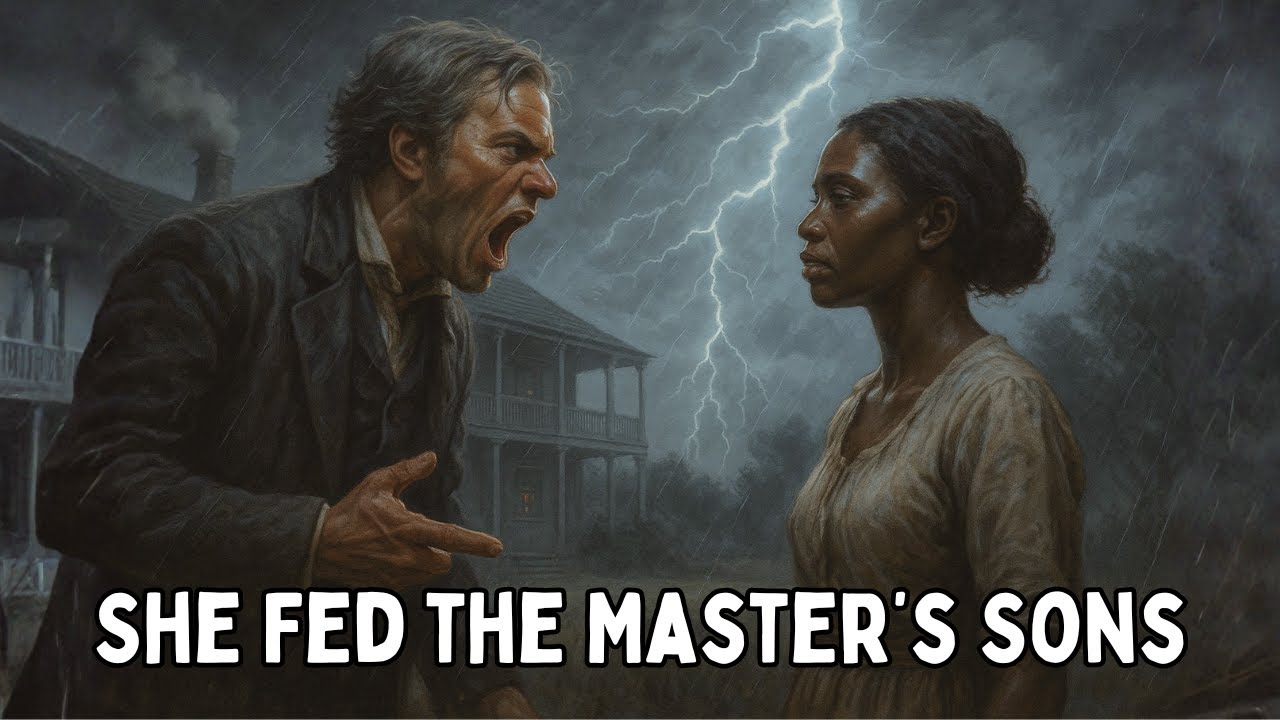
Some said her milk had curdled with grief after her own child died, and that it was souring the white children from the inside. The plantation was 600 acres of heat and human misery, owned by Thomas Brandham, a man whose name carried weight only because others were forced to bear it for him. His wife, Eleanor, had died of fever nearly a year before, leaving him with two ailing sons, Henry and Silas. They were pale, hollow-eyed boys, ghosts drifting through rooms that no longer smelled of lilac and tobacco.
The local doctor blamed swamp air and prescribed strength and vitality. Thomas, taking the advice with brutal literalness, dismissed the older nursemaids and demanded a new wet nurse, young and strong enough to produce milk. He did not care that every woman he was offered was in mourning, that most had lost their own children to the winter fever. To him, milk was milk.
The overseer, Leal Carter, brought him a woman named Mercy. She had given birth to a son two weeks prior; the child had died three days later. Her eyes were red from crying, but her body still held the weight of motherhood. When Carter told her she would feed the master’s children, she did not speak.
She simply nodded. The first feeding took place in the nursery under a portrait of Eleanor Brandham. Mercy sat rigid on a rocking chair, her own son gone, but her body still a prisoner to his memory. Thomas stood nearby, watching without shame as his sons drank.
When it was over, the boys slept peacefully for the first time in weeks. Thomas called it a miracle. An older housemaid made the sign of the cross and whispered, “God help the milk seller. ” By nightfall, the name had spread through the house.
In the weeks that followed, Mercy remained in the big house, sleeping on a small bed by the nursery door. With each feeding, a sharp pain pulled in her belly, something more than ache, something that made her want to scream. The other enslaved women began to avoid her as if she carried a disease. “You should have said no,” Hester, an old cook, muttered.
“A mother’s milk remembers who it was made for. ” Mercy did not answer. The last woman who defied a household order had been whipped until her back resembled lace. By the third week, Mercy began to tremble after every feeding.
She felt dizzy, her breath shallow. She ate more, drank broth, prayed earnestly. Nothing relieved the internal ache that followed her like a shadow. Her body was giving everything, and yet the boys did not thrive.
By mid-June, the nursery air was thick and sour, heavy with the smell of sweet milk and sick flesh. Silas, the younger boy, was the first to fall ill. He shivered beneath the blankets, his breathing like a broken reed. The plantation doctor declared it summer fever and left a bottle of quinine.
Thomas, too proud to seek another opinion, ordered more feedings. “Keep them suckling,” he commanded. “Do it until they are fully healed. ”
Mercy obeyed, though the child’s skin burned her chest and his lips bled as he nursed.
When she tried to pull away, Thomas’s boots would thud on the floor behind her, watching, measuring. One day, Silas vomited after a feeding. The vomit was white and curdled, like spoiled cream. Thomas slapped Mercy across the face and accused her of negligence, of her black sickness killing his sons.
The overseer dragged her to the washroom and forced her to clean the mess. When she finished, she looked in the mirror. Her eyes seemed strange, too bright, too sunken. For the first time, she wondered what exactly she was feeding them, and what was feeding on her in return.
By July, the air inside Brandham House felt alive, pulsing with heat and rot. Flies stuck to the window glass. The smell of spoiled milk drifted through the halls, sour and sweet at once, like death disguised as life. The servants crossed themselves when they passed the nursery door.
Mercy’s skin around her breasts turned pale and veined, faintly blue. When she leaned over the cradle, Henry, the older boy, stared at her with wide, glassy eyes. Once, he whispered in a trembling voice, “Mama Mercy, why do you cry when you give us good milk? ” She did not answer.
The doctor stopped visiting. Thomas demanded more feedings, insisting the boys would recover if Mercy fulfilled her duty. But Mercy no longer prayed to her master’s God. Her prayers turned backward, fevered whispers in the dark.
She began lighting candles in the storeroom, melting wax on the floor, whispering to her dead child. Hester found her one night, kneeling over a basin of milk with a strand of hair floating in it. “You’re touched by something you can’t get rid of,” Hester said. Mercy raised her head, her eyes red.
“It’s already here. ”
That week, Mercy’s body began to change. Her appetite vanished. Her skin grew damp.
Her breath smelled like sour cream. She heard faint sounds from beneath the floorboards, soft sucking sounds, like a child nursing. At first, she thought it was rats. On the second night, she realized the sound matched her own heartbeat.
When Silas vomited blood one afternoon, dark pink like milk mixed with crimson, Thomas broke a picture against the wall and screamed that she was poisoning them with her grief. Mercy did not argue. She wiped the child’s mouth, her face expressionless. By mid-July, no one in the big house slept.
The heat pressed down like a living thing. The servants whispered that they smelled death on Mercy’s skin. The boys no longer called her “Mama Mercy. ” They only stared, wide-eyed and unblinking, as if something behind her had their attention.
When she held Silas to her breast, he whimpered and tried to pull away, but Thomas stood over them, his face red with drink, shouting, “Feed him! Do it! ” The child only nursed when she began to hum the lullaby she had sung to her own son. When she pulled him away, a thin white line clung to his lip and dripped onto her hand.
It looked like milk, but when it touched her skin, it burned. In the hallway mirror, she saw a small, glistening blister rise where the drop had fallen. That evening, Thomas hosted the Reverend Gaines for dinner. The preacher’s expression soured as soon as he entered.
“The air in here is not right,” he whispered. Thomas laughed and said the reverend was not used to Louisiana heat. During dinner, Gaines asked about the boys’ health. Thomas described it as a passing illness, calling the nurse’s milk a blessing in disguise.
The reverend frowned, looking toward Mercy, who stood at the door holding a tray. He saw her hands trembling. As he was leaving, Gaines took Thomas aside. “You must send that woman away,” he said quietly.
“She is grieving. Grief fills her body and seeps into your house. ” Thomas scoffed. “She is a slave, not a witch.
”
After midnight, Mercy was awakened by the sound of shattering glass. She rushed to the nursery to find Silas standing by his brother’s bed, trembling, blood running from his nose. “He tried to bite me,” the boy gasped. Henry lay pale and still, his teeth red, his eyes half open.
Thomas burst in and slapped Mercy so hard she fell to the ground. “This is your doing! ” he roared. “You and your cursed milk!
” He locked her in the washroom until morning. Through the crack in the door, she watched the light change from pale gold to sickly gray. Morning came slowly. Mercy sat on the washroom floor, her wrists swollen from the ropes that bound them.
Through the thin boards, she heard the boys coughing again, deep, wet sounds that made the walls seem to vibrate. The smells of the house were worse than ever, sweet and metallic, as if something inside had died and refused to acknowledge it. The door opened. Overseer Leal Carter stood there, his face hard with discomfort.
“The master says you must tend the children again,” he muttered. “He says the Lord will hold you accountable if you refuse. ” Mercy rose slowly. “The Lord has already judged this house,” she said quietly.
Carter flinched but said nothing. Upstairs, Thomas Brandham paced beside the boys’ beds. Henry’s lips had gone pale. Silas’s belly was swollen, his eyes bloodshot.
“You will fix them,” Thomas said. “You will feed them well this time. ” Mercy knelt beside Silas. “Enough, master.
Their bodies cannot take it. ” Thomas slapped her cheek before she could finish. “Do as you are told. ” She sat trembling and pulled the boy to her.
His skin burned. When he nursed, a faint groan escaped his throat. The room fell silent except for the wet sound of feeding. Thomas turned away, muttering a prayer.
That night, the heat broke. A storm swept through the parish, rattling windows, pounding rain. Mercy crawled from her bed and walked barefoot through the hall. She stopped outside the nursery door and listened.
Between thunderclaps, a soft sound came, like faint laughter, childish, breathless. When she opened the door, Henry was sitting upright, smiling through blood-stained teeth. “Mama,” he said, pointing to an empty corner, “he is playing with us. ” “What child?
” Mercy whispered. “The one you sing to,” Henry said. “He says he is hungry. ” Thomas burst in at the noise.
He saw only Mercy in the dark and Henry shivering, babbling nonsense. “Get away from them! ” he shouted, grabbing her arm and pushing her aside. “You have poisoned their minds with your heathen speech!
” Mercy crawled toward the door, holding her bruised ribs. She looked back once. The candlelight flickered over the pale boys, one laughing, one trembling. She whispered, almost tenderly, “They are no longer your sons.
”
The storm passed by dawn. In the nursery, Mercy sat on the floor by the bed, staring at her hands. They trembled slightly, a precise rhythm that would not stop. The boys slept, but their skin was pale, shiny, and greasy as wax.
Their breath smelled sweet and rotten, like curdled milk. Thomas did not return to the nursery that morning. He spent the day drinking. The overseer was sent to town for a doctor, though Mercy knew no physician could fix what was inside them.
At noon, Hester slipped into the room with a cup of tea. “This sickness is not natural,” she whispered. “Stop feeding them, Mercy. Let them go.
If you keep giving them yourself, they will take all of you. ” Mercy’s voice was calm but firm. “It is too late. They have already drunk what was meant for my child.
My milk remembers. ”
That night, the new doctor arrived from Lafayette. He was young, with shiny boots and confidence. He entered the nursery with a handkerchief pressed to his nose.
The smell nearly drove him out. He examined the boys, frowning. “I do not know this sickness,” he muttered. “It is not fever.
It is not cholera. Their blood has turned thin. ” He turned to Mercy. “What are you feeding them?
” She looked at him steadily. “Only what their father asked of me. ” Thomas flinched. The doctor hesitated.
“It is not natural, sir. ” Thomas slammed his fist against a cabinet. “Then find a cure, or I will have you flogged as well. ” There was no cure.
That night, Henry began to whimper in his sleep, clutching his stomach. Mercy stayed beside him, humming softly. When dawn broke, his breathing stopped. His mouth was still wet with white.
Mercy touched his face gently. “One is full now,” she whispered. Silence fell over the plantation on the morning of Henry’s death. The field workers stopped when they saw Thomas Brandham carry his eldest son’s body down the front steps, wrapped in a linen sheet.
His face was pale, not from grief but from shock. By noon, the undertaker’s cart had come and gone. Thomas spent the afternoon drinking. He refused the reverend’s pleas about salvation.
“God has already turned his face away,” he spat. The reverend left before sunset. Mercy went to the kitchen, where Hester sat by the fire. “He is gone,” Mercy said coldly.
Hester nodded. “You must run, child. He will blame you. He will tell everyone you cursed his blood.
” Mercy stared into the flames. If she ran, he would hunt her. If she stayed, it would all be over. That night, she was ordered to feed the remaining child again.
Thomas burst into the nursery, reeking of whiskey. “You will suckle him until he is strong,” he slurred. “Or I will see you skinned. ” Mercy did not answer.
She sat on the rocking chair, Silas on her chest, his small body trembling with fever. He nursed with difficulty, his eyes rolling. When the boy finally released, Mercy noticed white lines at the corners of his mouth, thicker than before, clinging to his lips like glue. His breath smelled sweet, almost floral.
Thomas did not notice. He had staggered into the hall, muttering about burying one son and saving another. Mercy laid the child in his crib and brushed the damp hair off his forehead. “Sleep now,” she whispered.
“Dream of fields without fences. ” Before leaving the room, she went to the hearth and knelt beside a small iron kettle she had hidden there. She lifted the lid. Inside, half full with a thick, pale liquid, the milk swirled without any breeze.
She dipped her finger and touched it to her tongue. It tasted of salt and ash. A faint smile crossed her face, then vanished. At midnight, thunder rolled again over St.
Landry Parish. In the nursery, Silas whimpered and clawed at his throat. Mercy stood at the door, watching until his cries stopped. Thomas Brandham did not sleep that night.
The house creaked and groaned as if the storm outside had seeped into its bones. By dawn, the overseer found Thomas at his desk, hands trembling, holding a half-written letter. It read, “This line must end with me. ” He crumpled it before Leal could see more.
“Go and get that woman,” he ordered. “Bring her to me now. ”
Mercy entered the study quietly. Her dress hung loose on her shoulders.
Her eyes were calm, detached. Thomas rose unsteadily. “What did you do to them? ” he demanded.
She did not answer. He crossed the room in three strides and grabbed her chin. “You poisoned my bloodline,” he hissed. “You put a devil’s sickness in my sons.
” Mercy’s voice was faint. “I gave them what was left of me. ” Thomas slapped her, a violent open palm that knocked her to the floor. “You think you are a witch?
” he snarled. “You will hang for this. ” Mercy saw the family Bible on his desk. She pointed to it.
“Do you think that book ever spoke your name? ” she asked quietly. “It was written for men who think mercy is weakness. ” He froze, the words cutting through his rage.
Then he laughed, a desperate sound. “You have killed my sons, and you preach mercy to me? ” Mercy rose slowly, blood dripping from her lip. “I did not kill them,” she said.
“You did, the day you took what was mine. Milk turns bitter when it is stolen. ” Thomas’s laughter faded. His face became something hard and pitiable.
“You will feed the worms before sunrise,” he whispered. He called for Leal and ordered Mercy locked in the smoking room. The air in the smoking room was thick with the smell of old grease. Mercy sat on the dirt floor, listening to the rain return.
She thought of her child’s small fingers, of Silas choking on his final breaths. She closed her eyes and began to hum again, the lullaby her mother had sung on nights when the world was cruel. When Leal returned with her supper, she was still humming. The bowl of corn mush trembled in his hands.
“Stop that,” he said. “Stop singing now. ” But she did not stop. As the last light faded, the overseer swore he heard another voice join hers, faint and high, like a child learning to cry.
Three nights passed before Thomas called for her again. Mercy remained in the smoking room, locked away to dry out like meat. By the third night, the overseer began drinking too, muttering to himself about sounds in the cane fields, something moving between the rows at moonrise, a child’s cry followed by silence. Thomas ignored him.
When he finally ordered her released, it was not out of mercy but necessity. Silas had worsened. The boy screamed at night, clutching his stomach, his small body convulsing. No doctor would come.
The reverend stayed away. Thomas said to Leal, “Bring her. If she has cursed us, she can undo it. ”
They pulled Mercy from the smoking room at dawn.
Her lips were cracked, her eyes red, but she did not resist. When she entered the nursery, the air hit her like a slap. The smell was unbearable, spoiled milk and rot, thick enough to coat her tongue. Silas lay twisted in his sheets, his breathing ragged.
When he saw Mercy, his face crumpled. “Mama,” he said faintly. Thomas froze. “Do not call her that,” he snapped.
But Mercy stepped forward and knelt by the bed. “Hush, little one,” she whispered, stroking his hair. She unbuttoned her dress slowly. Thomas turned away, pacing.
“If he dies, I will have you flogged until your skin hangs in strips,” he said. Mercy bowed her head. “Then let us pray he does not die. ” The boy nursed with difficulty, his lips trembling against her skin.
Mercy felt no pain this time, only cold, a deep chill creeping from her stomach to her chest. When he stopped, she laid him back on the pillow and crossed his hands over his chest. His breathing became shallow, his eyelids fluttering. Thomas approached, staring at the boy.
“Is it done? ” he whispered. Mercy did not answer. Her face was pale as bone.
She rose to leave, but before she reached the door, Silas began to convulse. Foam flowed from his mouth, thick and white. His eyes rolled back. Thomas screamed, lifting the boy in his arms, shaking him as if he could force life back into him.
“Do something! ” he shouted at Mercy. She turned slowly, her voice calm and steady. “I have already done it.
” Thunder rolled again outside, although the sky was clear, and from somewhere beneath the earth, faint and rhythmic, came the sound of something sucking air through wet lips. The plantation doctor came for the last time. He arrived after sunset, sweating and trembling, a half-empty bottle of rum beside him. He did not want to enter the house, saying he could smell it from the gate.
Thomas dragged him inside by his collar. “You will see, boy,” Thomas barked. The doctor entered the nursery and felt his throat close. The walls were damp with condensation.
The air was foul. Silas lay motionless, his body thin and stiff. The doctor reached for the boy’s wrist. His fingers recoiled.
The skin was cold, slick, slightly sticky, like something freshly washed and not yet dry. “He is dying,” the doctor whispered. Thomas shook his head violently. He looked at Mercy, who stood silent by the window.
“What have you been feeding him? ” the doctor asked her quietly. She turned to face him, her eyes bright, almost fevered. “Only what was taken from me,” she said.
The doctor gathered his bag and retreated. Thomas lunged forward, grabbing his sleeve. “You will stay until he breathes naturally again. ” The doctor tore himself free and fled down the hall.
Thomas turned to Mercy. “You will not leave this room. You will stay and pray until God Himself answers. ” When he left, Mercy sat by the bed and hummed softly.
Silas moved slightly at the sound. A thin line of white slipped from the corner of his mouth. Mercy wiped it with her thumb. “Sleep, little one,” she whispered.
“Sleep before it takes what is left. ”
By morning, the boy’s breathing had stopped. Thomas found them in that state, Mercy sitting by the bed, her back straight, the child in her lap, eyes closed. He lunged forward to snatch the body, but she held on.
“He is mine now,” she said, her voice barely audible. When he finally let go, Thomas stumbled back, clutching the dead weight to his chest. “You cursed me,” he gasped. Mercy rose, wiping her hands on her dress.
“You cursed yourself,” she said. “You made me the witness. ” Before he could respond, she walked out of the nursery without looking back. Brandham House remained closed for three days after Silas’s death.
Thomas built the two small coffins with his own hands, refusing to let a mortician touch his sons. He did not eat, barely spoke, and drank from morning till dusk. Mercy was kept under guard, locked in a small kitchen room. The other servants brought her food but refused to look at her.
On the morning of the fourth day, Thomas called for her. He sat in the parlor between the two coffins, their lids still open. The boys looked like wax figures, their skin white and taut, their lips stained a faint yellow. Thomas’s hands trembled as he pointed at them.
“Tell me,” he said, his voice ragged. “What was it? What did you do? ” Mercy looked at the bodies, then at him.
“They devoured me until there was nothing left. What they took was theirs. What remained was mine. ” Thomas frowned.
“You poisoned them. You gave them death through your cursed milk. ” Mercy shook her head. “No, master.
I gave them what you made me carry. ” He stared at her, uncomprehending. “You speak like the devil himself,” he whispered. She stepped closer, her voice low and calm.
“You made me hold my dead child in one hand and your living children in the other. You made me feed what I was never meant to love. And now you want me to tell you it was God’s will? No.
It was your will. ” Thomas rose unsteadily, his grief turning to rage. “You will hang for this. ” Mercy smiled faintly.
“If I do, I will be lighter than what you carry. ” He struck her then, hard enough to split her lip, but she did not flinch. Blood mixed with milk on her chin, dripping to the floor. She looked at him and said, “There is no difference now between what is inside me and what is inside them.
You cannot bury what is already part of you. ”
That evening, the Reverend Gaines refused to enter the house. He stood on the porch, his hat in his hand, his eyes fixed on the closed windows. “This place,” he said.
“There is nothing here that God can see. ” That night, the servants heard the crash of glass and Thomas screaming Bible verses at the walls. Mercy sat quietly in her room, staring at her hands. The bruises on her wrists had begun to fade, leaving pale white marks that gleamed in the candlelight, like scars or the beginnings of something new trying to grow beneath the skin.
By the end of that week, no hymn or prayer could ease the corruption of the house. The walls themselves seemed to breathe, the air thick and still, heavy with the smell of spoiled milk and sweat. The servants began calling the estate “the House of Curdled Mercy. ” Thomas barely ate, barely slept.
He wandered from room to room like a man searching for something that was no longer there. Sometimes he would stop before the coffins and whisper songs his wife used to sing. Other times he would scream into the empty halls, swearing he heard footsteps upstairs or a child crying behind the walls. In the slave quarters, the whispers turned from pity to fear.
Field hands said the cows had dried up. The hens had stopped laying. Some claimed they saw her at night by the well, whispering into the bucket before drawing water white as cream. The overseer, Leal Carter, tried to quiet the rumors, but even he began making the sign of the cross when he heard her humming.
One night, Thomas staggered to the quarters, drunk and wild-eyed. He kicked open Mercy’s door and grabbed her arm. “You will fix what you did,” he slurred. “You will make it right.
” Mercy did not resist. Her eyes were calm, almost pitying. “It is already right,” she said softly. “They are free now.
” Thomas’s grip tightened. “Free? You think you freed them by killing them? ” Her voice barely rose above a whisper.
“You freed them long before I touched them. ” He pushed her onto the bed. “You talk as if you are not human,” he spat. Mercy smiled faintly, the candlelight reflecting off her teeth.
“You made sure of that. ”
Leal arrived moments later, drawn by the shouting. He hesitated at the door, torn between duty and fear. “Sir,” he said carefully, “you must leave her alone.
The men will not work if they see you beating her again. They say she is marked. ” Thomas turned to him, his face flushed, veins bulging. “She is a whore, not a witch.
Do you hear me? ” But Leal’s eyes remained fixed on Mercy, who now sat upright, her shadow stretching long and thin across the wall behind her. Too long, too thin, its head bent at the wrong angle. That night, the fields filled with the sound of cattle moaning.
At dawn, three were found dead near the fence line, their mouths foaming white. Thomas blamed Mercy, of course. He stormed into the kitchen, screaming that she was poisoning everything she touched. The servants scattered.
Hester held her ground long enough to say, “Master, the poison is in you. ” Thomas slapped her and ordered Mercy locked in the attic this time, where she could not spread her sickness. Mercy did not speak a word as they dragged her up the narrow stairs. But when they closed the door behind her, she whispered through the wood, “You can lock me up, but you cannot stop what is growing.
”
The attic was suffocating, dusty as ash, the air so hot it stung the lungs. Mercy sat beneath the slanted roof, her back against a beam, staring at the single shuttered window. The boards creaked when the wind pressed against them. She did not move for hours.
At night, she heard the house below her groaning. The walls were damp with a strange moisture that smelled faintly of milk. Sometimes she swore she heard small footsteps padding across the floorboards and a faint giggle. “Be the living,” she began to whisper to them, the children she had lost and the ones taken from her.
“You do not need to rest,” she whispered. “Not yet. Not until the world remembers. ”
On the second day, her thirst became unbearable.
She found an old metal basin near a pile of broken furniture and used it to catch droplets of condensation dripping from the beams. The water looked cloudy, but she drank it anyway. It tasted faintly sweet, like cream that had soured just a little. When she set the basin down, she saw something floating in it.
A strand of pale hair. The heat pressed down. She began scratching at the floorboards with a nail she had pried from the wall, carving words into the wood. At first, she carved her child’s name, then small prayers she vaguely remembered from before she was bought.
But as the hours passed, the words grew strange, loops and symbols she did not recognize but felt more than knew. From below, she heard Thomas screaming again, cursing the servants, God, and the world that no longer obeyed him. His rage made her smile. “You cannot ask the milk to turn sweet again,” she whispered.
On the third night, she woke to a sound like dripping water. But when she looked up, the ceiling beams were glistening. The wood was sweating, a pale, sticky liquid seeping from the cracks. It pooled on the floor in small puddles, each one reflecting the candle flame in trembling ripples.
She touched one with her finger. It was warm, almost alive. Then a sound came from below, a door slamming, boots on the stairs. Thomas shouted, drunk and slurring, “You will tell me what you did.
You will confess before God. ” He reached the attic door and began pounding on the lock. “I will burn this house down if I have to. ” Mercy retreated to the corner, her face calm, her body still.
The liquid on the floor rippled at the sound of his voice. When the lock broke and the door swung open, a foul stench poured out, sweet and rotten. The floor gleamed as if covered in cream. Thomas froze in the doorway.
The candlelight danced across Mercy’s face. She caught the flame with her eyes, reflecting it back in white. “I told you it was already growing,” she said. Thomas stepped back, his boots slipping on the wet floor.
He did not notice the nail still in her hand, nor the words she had carved into the boards beneath him. Mercy’s milk remembers. Thomas Brandham had never known a fear that lingered. But this was different.
It moved slowly, like mold under fresh paint. When he looked at the woman crouched in the corner of the attic, her face half-lit by candlelight, he felt it settle deep in his bones. “What have you done, in God’s name? ” he whispered.
Mercy did not answer. The candle flame wavered in the thick air, and the floor beneath them glistened like spilled cream. The carved words seemed to breathe. Mercy’s milk remembers.
A faint bubbling sound rose from between the boards, soft but steady. Thomas stepped forward, raising the candle. His boot sank slightly, and when he pulled it back, something white clung to the leather, thick, sticky, almost glowing. Then the smell hit him, sweetness turned to rot.
“You have poisoned my house,” he said hoarsely. “You have brought sickness and evil. ” Mercy tilted her head. “Your house was sick before I ever entered it,” she said, her voice soft, almost sad.
“All I did was feed it. ” The candle wavered, the flame stretched tall, then died. The room went dark. Thomas cursed and struck a match, but his hands shook too badly.
When the flame finally caught, she was standing closer than before. Her eyes gleamed in the dim light. “Do you hear them? ” she whispered.
He did. Faint sounds beneath the floor, like suckling and gurgling, a child trying to nurse. They were everywhere now, rising from the beams, from the walls themselves. Thomas stumbled back.
“Stop it! Stop this thing! ” Mercy’s voice stayed calm. “It is not me you hear, master.
It is what remains of them. You kept taking, and now they are taking back. ” The candle wavered again. Something small rolled from the shadows near the wall.
A glass jar, its wax seal cracked. It bumped against Thomas’s boot. Inside, a cloudy liquid sloshed, tinged with red. There were things floating in it, small shapes the size of a child’s fingers.
Thomas dropped the candle. It went out, plunging the room into darkness. The jar shattered. Warm liquid splattered across his hands and face.
He vomited from the smell, sweet, metallic, human. From the corner, Mercy began to hum, the same lullabies she had sung to his sons to sleep. Thomas screamed, fumbling for the door, but the handle was slick. His palm slipped again and again.
Behind him, her voice grew louder, joined by smaller voices, a chorus rising from the cracks. When he finally burst into the hallway, gasping, the sound followed him. A hundred small mouths breathing at once. Downstairs, the servants looked up from their prayers.
The master stumbled down the stairs, his shirt soaked, his face pale, his eyes wide as coins. He did not speak. He just kept wiping his hands, whispering over and over, “It will not come off. ”
The next morning, no one dared enter the big house until the sun was high.
The overseer, Leal Carter, found Thomas Brandham sitting in the parlor, his hands submerged in a basin of murky white water. His sleeves were rolled up, his skin raw from scrubbing. He did not look up. “The men will not work in the fields,” Leal said quietly.
“They say the air smells wrong. ” Thomas kept washing. “It is the milk,” he whispered. “It is in everything.
” Leal frowned. “What milk, sir? ” Thomas raised his hands. The skin of his palms was pale and raw, as if scalded.
“It came out of the walls,” he whispered. “Out of the boards. It is inside the house now. ” Leal stepped back.
“You need rest, sir. You need the reverend. ” “The reverend will not come,” Thomas said, finally looking up. His eyes were bloodshot, his pupils dilated.
“God is no longer in this house. ”
That night, the servants heard Thomas’s footsteps pacing overhead until nearly dawn, when the sound changed. A stumble, a drag, then silence. Leal climbed the stairs with a lantern.
The smell hit him before he opened the door. Sweet, suffocating, foul. He found Thomas collapsed in the chair beside the boys’ coffins, his mouth open, thin streams of white foam slipping from his lips. His body was still warm.
The lantern light caught the empty cup beside him. On the table, there was a small clay jar. Its wax seal was broken. Inside, sticky residue clung to the rim.
Leal stumbled back, crossing himself. He called for the other servants, but none came. When he turned around, Mercy was standing in the doorway. Her dress was torn, her skin gleaming with sweat, but her face was calm, almost still.
“You did this,” Leal whispered. Mercy shook her head. “He did it to himself. I just gave him what he wanted.
” Leal raised the lantern, trembling. “You are cursed. ” Mercy stepped closer, the light catching her face. “No,” she said.
“I am what is left when mercy runs out. ” Leal dropped the lantern. It hit the floor and burst, scattering flames across the boards. Mercy did not move.
The fire spread quickly, too quickly, as if the wood had been waiting for it. Leal fled downstairs, shouting for the others. But by the time they reached the yard, Brandham House was already burning. The flames rose fast and fierce.
The sound was strange, not the crackle of wood, but a low, wet hiss, steady as boiling milk. Someone shouted that Mercy was still inside. No one went back for her. They stood in the fields, watching the house collapse in on itself, the smoke rising thick and white against the dawn.
When the last beam fell, the flames died abruptly, leaving only steam and a faint sweetness in the air. And from the ashes, a lullaby rose, soft, steady, endless. When the fire finally burned out, ash settled over the fields like pale snow. The house was gone.
Every beam, every wall, every trace of the Brandham name burned to dust. Only the stone chimney remained, charred and cracked. The enslaved people stood at a distance, their faces lit by the last orange glow. No one spoke.
When dawn broke, Leal Carter led a few men through the wreckage. They found Thomas Brandham’s bones first, charred, curled in on themselves like a child. His jaw was open, his teeth stained white. The doctor later said he had not died from the fire but from suffocation.
His lungs had filled with a thick, curdled substance that hardened as it cooled. There was no trace of Mercy, not a bone, not a scrap of cloth, only a ring of charred floorboards where the attic had been, smooth and glossy as glass. The men crossed themselves and left. Rain began that night, a light, steady drizzle that turned the ash to paste.
It rained for three days straight, flooding the fields. The cane rotted in the ground. The overseer tried to rally the men, but no one would touch the fields. They said the soil was so poisoned it wept white when you pressed your hand into it.
Within a week, Brandham Plantation was abandoned. Neighboring farmers came to look at the ruins, muttering about God’s wrath and sins that would be answered for. But when one man tried to salvage bricks from the chimney, he fell ill before nightfall, vomiting, feverish, his breath sour as curdled milk. By morning, his tongue had turned white.
The land was left to rot. Vines crept over the fences. The road to the main house disappeared under weeds. Travelers began avoiding the area, saying they heard crying in the fog or smelled something sweet when the wind blew east.
Months passed before anyone dared return. When a group of freedmen came looking for shelter, they found the ruins still warm beneath the surface. In the ash, they discovered something strange. Shards of glass had fused into the earth, forming small jars melted together.
Inside one, a single piece remained intact, a chalky white residue. They buried what they found under a cypress tree by the river and marked the spot with stones. As they were leaving, one of the men swore he heard a hum coming from the water. By the next spring, new growth covered the ruins.
Wildflowers bloomed where the house had stood, their petals pale and waxy, their scent faintly sweet. The locals stopped calling it Brandham Plantation. They called it Milk Land, and no one ever farmed it again. Years passed before anyone dared set foot on Brandham land again.
The road to it vanished under creeping vines. The fences sank into the mud. When the war came and ended, soldiers passing through St. Landry Parish heard the story too.
Union men laughed at first, calling it a silly superstition, but none of them camped near the ruins. They said the horses were too quiet there, and the ground too soft, as if something were breathing underneath. By 1865, all that remained of the plantation was a low mound of stones and moss. One evening, a preacher from Lafayette arrived with a Bible and a shovel, declaring he would cleanse the land.
He was found the next morning on the riverbank, his horse gone, his hands and mouth stained white. The current took his body. For the freedmen who lived nearby, the Milk Seller had become more than a story. She had become a warning.
Mothers whispered her name to keep their children close after dark. “Do not wander far,” they said. “She is still looking for her child, and if she finds you first, she will take you in her arms and never let you go. ”
Some swore they saw her, a pale figure standing knee-deep in the shallows, rocking something wrapped in cloth.
Others said they heard her humming on nights when the fog crept in from the cane fields, a faint, mournful tune, strangely comforting. But among the older freedwomen, her story carried something else, a quiet reverence. They said she was justice wearing a mother’s face, that she gave back what the masters took and turned their greed into sickness. She did not curse them, one old woman told her granddaughter.
She just fed them the truth. Over the decades, the land resisted every attempt to reclaim it. In the 1880s, a white landowner tried to clear the fields. His oxen refused to move.
The soil under the plow was soft as wet bread, slick and white, clinging to the tools. His youngest daughter woke screaming, her nightgown soaked. A woman had stood by her bed, singing. Her baby is hungry, the girl wept.
By morning, the cane sprouts withered. The well water turned foul. The man abandoned the project within a week. In 1911, an academic from Chicago arrived to document the folklore.
He found an old freedwoman named Esther King, whose mother had worked in the house. She told him everything: the fire, the white fields, the humming that still came from the river at night. He wrote to a historical society, fascinated, but his colleagues dismissed it as Gothic fiction. He began keeping a bowl of milk on his desk, changing it every morning.
When asked why, he said it was for remembrance. In 1913, he was found dead in his office, his notes soaked and smeared with a sticky white residue. On the last page, he had written in a trembling hand: “The milk of mercy still remembers. ”
A researcher from Tulane took up the story in 1938, collecting accounts from families who had settled near the ruins.
He found a pattern. Children born there were sickly, pale, with cloudy eyes. Mother’s milk spoiled early or turned thin. Locals called it “milk sickness,” but doctors never agreed on a cause.
The researcher wrote that it was a hereditary illness passed not through blood but through memory. He found a letter in a family Bible, dated 1843, from the Reverend Gaines, who had disappeared from the parish. The ink was faded, but one sentence remained clear: “Some sins turn the body’s mercy into punishment. ” The researcher never published his findings.
He wrote of seeing a figure by the river at dusk, a shape rocking something small. He left the parish the next morning, abandoning his equipment. His assistant retrieved it weeks later, finding the typewriter keys rusted shut and the ribbon white as bone. She said she dreamed of the woman too.
She was not angry, the assistant told her friends. Just tired. As if she had been carrying the same hunger for a very long time. By the 1970s, the land was a dense swamp swallowed by cypress and cane.
Developers from Baton Rouge planned to drain it and build a sugar mill. Work began in August 1974. On the fifth day, the smell came. Sweet, clinging, unmistakable.
Like warm milk, one supervisor said before vomiting. The soil itself seemed to sweat, a pale film rising on the puddles left by the machines. By noon, the first man fell ill, dizzy, vomiting thick white foam. Two more followed.
Work stopped. Environmental inspectors found glass shards fused into the earth and small, brittle bones in the soil. Lab reports found traces of lactic acid, of human origin. The company halted construction.
Within a month, all investors withdrew. The local papers ran the story for three days before parish officials ordered coverage stopped. The headline read: “Project Suspended Due to Weather. ” But the workers told a different story.
They said the land bled white when you dug deep enough, and the smell never left their clothes no matter how they washed them. Now, when storms sweep through St. Landry Parish and the river floods, the ground near the old Brandham site glows faintly in the dark, just enough to see from the highway. Drivers slow down without knowing why.
If they roll down their windows even for a moment, the air carries a faint sweetness, like milk. Today, nothing remains of Brandham Plantation but memory and mud. Cypress trees have grown thick again, their roots winding like black veins through the white soil. Every few years, someone talks about draining the swamp, clearing it for pasture or a new road.
But the plans never last. Machinery breaks down. Workers fall ill. One foreman swore the ground itself breathed beneath his feet.
The parish stopped approving permits altogether. And yet the legend endures. People tell the story in whispers on porch lights and around campfires. They call her the Milk Seller, Mercy Brandham, the mother beneath the mud.
Every name changes the story a little, but the core remains the same. A wronged mother. A burned house. A hunger that has never known death.
Historians classify it as folklore. Skeptics say it is just a swamp trick. But every generation finds it anew somehow, a faint lullaby caught in the fog, a newborn refusing its mother’s breast, a white film spreading across the river after rain. Some say she still walks the water’s edge, searching not for revenge now, but for something smaller, someone who remembers her, who knows her name without fear.
Others believe she has become part of the land itself, that every blade of pale grass and every ripple of white mud is her body renewed, still feeding, still forgiving nothing. The visitors who come to the site today, tourists, thrill-seekers, ghost hunters, arrive expecting screams and specters, something cinematic. But what they find is silence. The kind that presses on the chest.
They say if you stand there long enough, you will begin to hear breathing, slow, rhythmic, patient, like something sleeping just beneath the earth, dreaming in the dark. And sometimes, when the wind changes, you can smell it again. Not rot. Not death.
Just milk. Faint, sweet, waiting.