On September 1, 1939, German armored columns invaded Poland, dragging the world into a new era of industrial slaughter. On that same day, a quiet man from Virginia named George C. Marshall took the oath as Chief of Staff of the United States Army.
What he inherited was almost a joke: 174,000 soldiers, an army smaller than Portugal’s, ranking outside the top fifteen fighting forces on Earth. Troops drilled with wooden rifles. Officers rode horses for lack of trucks.
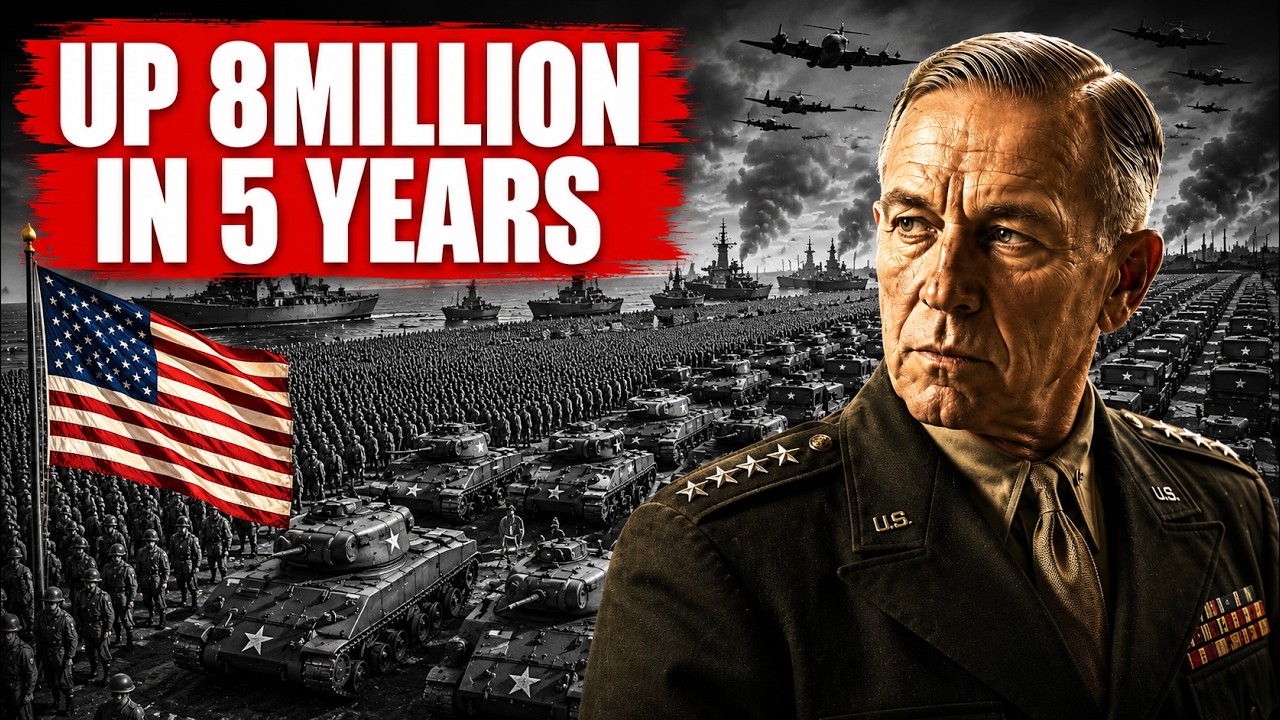
By every logical measure, what happened next should have been impossible. Yet Marshall was about to attempt exactly that: building the most powerful fighting force in human history from the remnants of a neglected peacetime army in just five years.
Marshall did not look like a man about to reinvent the American military. He was 58, gray-haired, precise, and famously lacking in humor. He rarely raised his voice and never called anyone by their first name, not even Franklin Roosevelt.
Under that rigid exterior, however, was a mind built entirely for organization, systems, and the unglamorous machinery that makes armies actually work. He would need every ounce of that discipline, because the force he commanded barely deserved the name of an army.
In the fall of 1939, the U. S. Army had around 174,000 active-duty soldiers scattered across coastal forts and obsolete western outposts.
Infantry units trained with stovepipes as mortar substitutes because there were not enough real weapons. Cavalry regiments still rode horses, not for tactical advantage but because there was no money for tanks. The officer corps was aging dangerously, with men in their late fifties and sixties leading regiments, promoted by seniority alone.
It was a peacetime army designed for peacetime, and Adolf Hitler had just made peacetime obsolete.
Marshall understood the arithmetic before almost anyone else in Washington. German panzer divisions crushed Poland in weeks. France, widely considered to have one of the best armies on the continent, would fall the following spring in six weeks.
If war eventually reached American shores or American allies, the country would need millions of trained soldiers, thousands of tanks, tens of thousands of aircraft, and a supply chain capable of moving it all across oceans. What America actually had was negligible by comparison.
His first obstacle was not German steel but the United States Congress. Two decades earlier, the nation had entered World War I promising to make the world safe for democracy, then returned disillusioned. During the 1930s, that disappointment hardened into strict laws.
A series of Neutrality Acts restricted arms sales and discouraged loans to warring nations. When Marshall entered Capitol Hill committee rooms asking for money to modernize artillery or expand training bases, he was met with skepticism, not urgency. Why did the army need to grow at all, lawmakers wondered, when thousands of miles of open water separated America from Germany and Japan?
Marshall had no dramatic answer, only cold logic delivered in the same calm, controlled tone. Oceans did not stop airplanes. Oceans did not stop submarines.
Behind the political resistance was an even harder problem: the American economy of 1939 was built for consumer comfort, not war. Detroit’s assembly lines produced millions of civilian cars. The idea of retooling those machines for tanks and aircraft engines seemed a distant hypothesis to most industrialists.
Converting an entire capitalist economy from peace to war without emergency executive powers, which would not exist until Pearl Harbor, was measured in years, not weeks.
In this atmosphere of chill, skepticism, and dangerous slowness, Marshall took his first radical step. He demanded something the United States had never done in its history during peacetime: conscription of its citizens into military service. The idea was almost unbelievable to many Americans.
Peacetime conscription seemed less like American democracy and more like the authoritarian systems the country claimed to oppose. Marshall pushed forward anyway because he had done the math, and the numbers left him no choice. An army of 174,000 could not become an army of millions through voluntary enlistment alone, not in the time available.
Throughout the spring of 1940, while Marshall made his case in Washington, the war in Europe answered every skeptical question Congress raised. In April, German forces overran Denmark in a single day. In May, the German army invaded France, sweeping through the Low Countries with speed that stunned military observers on both sides of the Atlantic.
France, with one of the largest standing armies in the world, collapsed in six weeks. Paris fell in June. For isolationists who had insisted the oceans made America safe, the fall of France was a blow.
If the larger, better-equipped French army could break that fast, comfortable calculations of distance and geography suddenly looked like wishful thinking.
In September 1940, Congress passed the Selective Training and Service Act, the first peacetime draft in American history. Young men aged 21 to 35 were required to register, and the first numbers were drawn in a public lottery in October. For the first time since Marshall took office, the expansion mechanism had a legal engine.
But passing a law and building an army were entirely different problems, and Marshall knew the second was immeasurably harder. The army did not just lack rifles and tanks. It lacked leaders capable of training and commanding a modern military force.
The interwar promotion system had rewarded patience over talent, loyalty over innovation, survival over ambition.
Marshall began quietly reviewing personnel files late at night, alone in his office, marking names, some for promotion, many for retirement. He knew the men now flowing toward newly built training camps deserved better than officers still thinking in terms of static trench lines while German panzer divisions redefined the speed of modern combat. The test came in the summer of 1941, through the pine forests and cypress swamps of Louisiana.
Marshall ordered nearly half a million soldiers into the largest peacetime military exercise the United States had ever attempted. Two phantom armies maneuvered against each other for weeks across more than 3,000 square miles of hot, mosquito-infested terrain.
The results were embarrassing almost immediately. Soldiers carried broomsticks instead of machine guns. Civilian delivery trucks rolled down dirt roads with the word “tank” crudely painted on their doors.
Convoys caused traffic jams stretching fifty miles, paralyzing entire divisions. Radio communications failed repeatedly. Supply officers, inexperienced and overwhelmed, left advancing units stranded without food or fuel for days.
Senior commanders, mostly aging colonels and generals, proved utterly incapable of thinking beyond World War I trench doctrine. The umpires who observed the maneuvers reached a collective and disturbing conclusion: against a real German panzer division, many American formations would have been destroyed within hours.
Marshall read every report that reached his desk without visible emotion. Then he did the opposite of what most officers would have done. He did not bury the results in secret files.
He used the humiliation as a weapon. In the weeks that followed, Marshall moved with a ruthlessness that surprised even his own staff. Colonels and generals who failed to adapt were quietly retired, transferred to administrative posts, or simply passed over for promotions their decades of seniority would have guaranteed.
It was a peaceful purge, carried out entirely through paperwork and reassignment orders. For the officers affected, it was harsh and silent. Men who had spent 30 years climbing toward general rank learned of their transfer through a terse memo, with no public explanation and no appeal.
Marshall filled the vacancies by jumping over hundreds of more senior officers, a deliberate and controversial move. He was looking for a specific trait that the Louisiana maneuvers had revealed in only a few men: the ability to think in terms of speed, coordination, and modern combined-arms warfare rather than the static defense doctrine of 1918. One name appeared consistently in after-action reports: a lieutenant colonel who had served as chief of staff of the Third Army during the maneuvers, showing a surprising talent for managing complex, fast-moving operational plans under pressure.
His name was Dwight D. Eisenhower, virtually unknown outside a narrow circle of army planners. Marshall kept the name in a small private notebook of promising officers he updated after every major exercise.
Within days of the Pearl Harbor attack, Marshall summoned Eisenhower to Washington and placed him in the War Plans Division, the office responsible for drafting the army’s global strategy at the very moment that strategy had to be built from scratch. It was a striking decision. Dozens of officers senior to Eisenhower remained in their posts across the country while a lieutenant colonel, unknown to the public, was given an office in the heart of the war planning apparatus.
The attack on December 7, 1941, evaporated the last remnants of isolationist resistance in Congress. The political battles Marshall had fought for two exhausting years simply stopped mattering. What replaced them was a different kind of pressure: the urgent demand to mobilize the entire nation for a two-front world war on a timeline now measured in weeks, not years.
The draft was opened fully. But Marshall knew, perhaps more clearly than anyone in Washington, that drafting a man was merely a legal formality. Turning that man into an equipped, trained, combat-ready soldier was an industrial process about to be tested on a scale no nation had ever attempted.
The first crisis after Pearl Harbor was not weapons but physical space. You cannot house 3 million recruits if there is nowhere to put them. The Army Corps of Engineers responded with a construction campaign that defied normal logic, building entire training camps in weeks instead of years.
These were not tent cities but complete small towns with their own generators, water treatment systems, rail lines, and field hospitals. Yet the flood of humanity into these new facilities created constant, exhausting administrative chaos. Recruits arrived before their barracks were finished.
Units were formed on paper before they had enough mess kits to feed a single company. It was a daily slog against bottlenecks at every level.
Arming this expanding sea of new uniforms required something far more radical than adding factory shifts. It required a forced, comprehensive restructuring of the American civilian economy. The War Production Board, working closely with Marshall and the rest of the military command, effectively compelled American industry to convert entirely.
Detroit automakers stopped civilian car production almost completely, retooling presses and precision machine shops that had made Buicks and Fords the previous year to produce Sherman tanks and aircraft engines. Typewriter companies found themselves manufacturing machine gun components. Toy makers, whose factories were already equipped for small-scale precision assembly, began producing navigational compasses.
Building the weapons was only half the equation. Moving them across the ocean at exactly the right time and place was in many ways a harder problem. Every convoy required a carefully calculated mix of ammunition, spare parts, rations, and medical supplies.
A single 24-hour delay at a Chicago rail yard could cause a convoy to miss its departure in New York, leaving an armored division in North Africa waiting weeks for replacement artillery shells. Marshall and his staff lived increasingly inside a world defined by cargo tonnage, rail capacity, and port turnaround times.
The building from which Marshall ran this expanding global operation was itself a monument to wartime emergency. Construction of the Pentagon began in September 1941 and was substantially completed in about 16 months, an incredible pace for what remained for decades one of the largest office buildings on Earth. Marshall insisted on a structure so efficient that anyone could walk between any two points inside it within minutes, a design obsession that reflected his broader philosophy that speed and efficiency were not luxuries in wartime but the very currency of survival.
This expanding administrative machine created a mathematical problem of its own. Every soldier assigned to operate a switchboard, manage a supply depot, or drive a truck in a rear area was a soldier who could not be armed with a rifle and sent to the front lines. Facing this drain, Marshall pushed a solution that met fierce resistance from conservative lawmakers and traditional officers alike: the formal, large-scale integration of women into the army’s administrative and technical structure.
The Women’s Army Auxiliary Corps, later reorganized as the Women’s Army Corps, was not created as a symbolic gesture. By Marshall’s cold calculations, it was a matter of pure operational necessity. Women served as radio operators, aircraft mechanics, codebreakers, air traffic controllers, and supply clerks, freeing the equivalent of several full combat divisions of men for front-line duty.
While American industry began proving Axis estimates wrong, Marshall faced a mathematical limit of his own, having nothing to do with factories and everything to do with people. Early War Department plans estimated that defeating Germany and Japan simultaneously would require a ground force approaching 200 combat divisions, a number comparable to what Germany or the Soviet Union had already mobilized. Marshall studied those numbers and rejected them.
He realized something that purely military planners sometimes miss: every additional division meant pulling hundreds of thousands of men from factories, shipyards, and farms, which were simultaneously needed to arm and supply this expanding army. A machine operator cannot be installing an aircraft frame in Michigan and carrying a rifle across Europe at the same time.
Marshall made a cold, controversial decision to cap the U. S. Army at 90 combat divisions, a fraction of what other great powers had mobilized, betting instead on heavy mechanization, overwhelming synchronized artillery, and absolute air superiority to make each division worth far more than its raw numbers suggested.
This decision would become known in the narrow circle of planners who understood its full dimensions as the “90-Division Gamble.” With only 90 divisions spread across multiple global theaters, the United States had virtually no strategic reserves. For infantrymen, this meant a brutally exceptional reality: there would be no scheduled rotation out of the front lines, no extended rest periods.
Once an American division entered combat, it generally stayed there, absorbing its losses through a steady, impersonal stream of individual replacements.
In May 1944, Marshall’s adopted son, Lieutenant Allen Tupper Brown, was killed in action in Italy. Marshall received the news as he received almost everything, with little visible change in behavior, continuing his scheduled meetings just hours after learning his family had paid the price he was asking of millions of other families. Whatever grief he carried, he carried privately, folded inside the same disciplined exterior that had defined his entire career.
The carefully calculated equations of the 90-division gamble collided with reality in the frozen final weeks of 1944. On the morning of December 16, 1944, from a thick frozen fog covering the Ardennes forest, more than 200,000 German soldiers and nearly a thousand tanks slammed into a weakly defended sector of the American front line. This was the opening blow of what would become known as the Battle of the Bulge, and it fell precisely on the point where Marshall’s gamble had left the American line most vulnerable.
The ferocity and surprise of the German attack tore a huge gap in the Allied lines within hours. There was no significant strategic reserve in the rear ready to plug the hole.
With available combat infantry already exhausted elsewhere along the front, the burden of emergency defense fell increasingly on the vast logistical and administrative apparatus Marshall had spent five years building. Supply clerks, garage mechanics, switchboard operators, and army cooks were handed rifles and anti-tank weapons and ordered into the frozen forest to hold critical road junctions against battle-hardened German armored formations. On paper, these hastily assembled rear-echelon troops should have been crushed within hours.
They were not. The survival of the Allied front during those chaotic first days depended not primarily on brilliant maneuvers by famous generals but on the brutal standardization the army had been drilled in since the humiliation of the Louisiana maneuvers three years earlier.
In the town of Bastogne, a vital crossroads, surrounded American paratroopers of the 101st Airborne Division found themselves completely encircled, cut off from supplies, and heavily outnumbered. When a German officer approached under a flag of truce on December 22 to demand surrender, the acting division commander, Brigadier General Anthony McAuliffe, reportedly replied with a single written word sent to the German lines: “Nuts.” A blunt refusal that embodied in miniature the same stubborn determination to hold that was holding the American defensive line together elsewhere across the Ardennes.
When the German offensive finally stalled in the last days of December, denied the fuel its planners had gambled on capturing from American depots, it became clear the American line had held not through some inexplicable stroke of luck. It held because the administrative and logistical machine built with precision from almost nothing since 1939 was, at its most severe moment of testing, finally capable of absorbing the full force of the blow.
When the dust settled over the Ardennes in the early weeks of 1945, the ghost of the small, underfunded U. S. Army of September 1939 was effectively buried.
In just over five years, that geographically isolated force of about 174,000 soldiers had been completely erased and replaced by a coordinated global combat entity of more than 8 million men and women. Germany surrendered unconditionally in early May 1945, less than five months after the German offensive that nearly broke Marshall’s carefully built line. British Prime Minister Winston Churchill, who had worked closely with Marshall throughout the war, later publicly described him as the “true organizer of victory,” a phrase that accurately summarized the role Marshall had played for nearly six years: largely invisible to the public, absolutely essential to the outcome.
Yet the man most responsible for that transformation was denied the one command that would have crowned his career. Throughout 1943, as planning accelerated for the invasion of German-occupied France, it was widely assumed Marshall himself would be appointed to lead it. Franklin Roosevelt struggled with the decision personally.
In the end, Roosevelt chose to keep Marshall in Washington rather than send him to London, reportedly telling him he could not sleep at night with Marshall out of the country. The honor of commanding Operation Overlord went instead to Dwight Eisenhower, the formerly obscure lieutenant colonel Marshall had personally promoted after the Louisiana maneuvers. Marshall accepted the decision quietly, with the same outward discipline he had shown throughout the war.
By the time Japan formally surrendered in late summer 1945, the U. S. Army Marshall had inherited as a broken, underfunded security force of 174,000 had grown into a global fighting force of more than 8 million, backed by an industrial and logistical apparatus without historical precedent.
Marshall stepped down as Chief of Staff later that year, ending one of the most consequential tenures of any American military officer. His career in public service was not over. President Harry Truman soon called him back to government, first as a special envoy to China, then as Secretary of State, where Marshall applied the same practical, systems-based thinking that had rebuilt the American army to the problem of war-shattered Europe.
The economic recovery program that bore his name, known simply as the Marshall Plan, pumped billions of dollars of American aid into rebuilding the industrial and agricultural capacity of Western Europe.
Years later, with American forces fighting in Korea, Truman called Marshall back once more, this time as Secretary of Defense. In recognition of the broader arc of that postwar work, Marshall became the only professional soldier ever to receive the Nobel Peace Prize. He finally retired from public life in the mid-1950s.
History would remember the beaches, the battles, and the generals who led those battles in the field. It would remember Eisenhower crossing the English Channel, Patton racing across France, Bradley commanding the largest body of American soldiers ever under a single field general. But it would struggle more to remember that quiet, grave man from Virginia who made it all possible: the man who never led troops in battle himself; who buried his own grief in silence while asking millions of other families to bear the same loss; who spent five uninterrupted years of relentless work converting hearings, shipping schedules, and stacks of paper into the greatest mobilization of national power the world had ever seen.
George C. Marshall did not win World War II on any battlefield, and he never claimed to. He built, from almost nothing, in barely five years, against congressional opposition and public skepticism, and against the ticking of a clock that never slowed for him, the machine without which no victory celebrated by the nation could ever have been achieved.