In the winter of 2015, a genealogist scanning a 1911 group photograph at high resolution noticed something the naked eye had missed for over a century. Every single patient in the front row of the Elmore County Home for the Incurable had the same mark on the left side of the neck: a pale, raised line roughly two inches long, curved slightly downward, sitting just above the collarbone. Not similar marks. Identical marks.
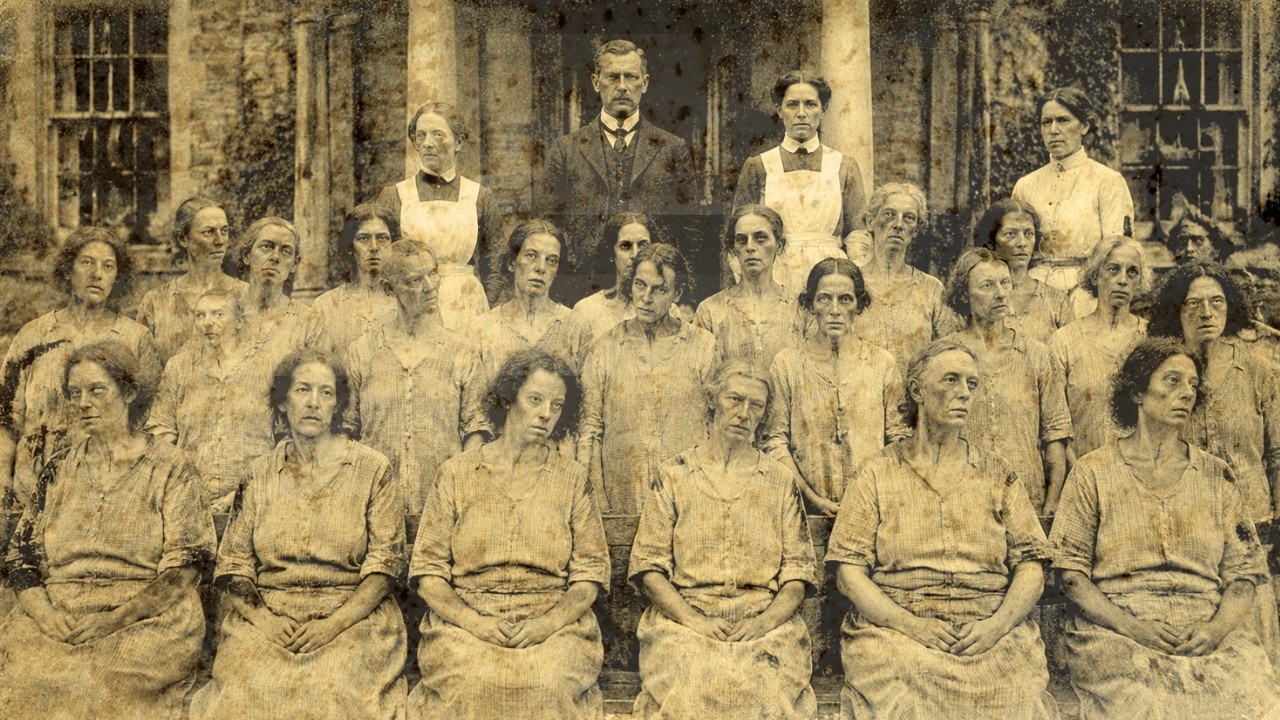
She counted 47 patients. There were 47 identical scars. The photograph, taken on the south lawn of the West Wing in the autumn of 1911, showed 47 patients in identical gray ticking gowns, three attendants in white aprons, and the assistant superintendent standing behind them. It was the kind of institutional image that survives by the thousands, filed and forgotten.
But the genealogist sent the scan to a colleague at the state historical society, who sent it to a friend at the medical archives. Within a week, the image reached a retired forensic pathologist, who spent three days examining it before concluding that the marks were surgical. They had been made deliberately, with a blade, on all 47 people, in the same place, at approximately the same age. And nowhere in the surviving records of the home was there any mention of surgery performed on any patient.
The Elmore County Home sat on a low ridge above the confluence of two creeks, six miles from the nearest town. The land had been deeded to the county in 1861 by a timber merchant named Silas Elmore, who stipulated that the land be used for the care of persons of unsound mind in perpetuity, and that any structure built upon it must be constructed of stone quarried within a two-mile radius of the property line. That second stipulation was the first thread. The stone quarried from within that radius was a specific type of banded quartz interlaced with veins of a mineral the surveyors could not identify.
When samples were sent to the state assay office, they came back with a single annotation: not consistent with any known regional formation. The home was built between 1863 and 1867, four wings arranged around a central rotunda. The east wing housed men, the west wing housed women, and the north wing housed what the intake ledgers called children of defective birth. The south wing, according to every surviving architectural drawing, did not exist.
It had a foundation, load-bearing walls, and a roofline visible in aerial photographs, but no floor plan, no door schedule, no patient assignments. It appeared on the outside of the building but not on the inside of any document produced by the institution that operated it for 71 years. The first superintendent was a physician named Dr. Arasmus Wickham, who arrived from Philadelphia in 1867 with his wife, three trunks, and a small locked cedar box he carried personally.
Wickham had trained under eastern alienists and had published monographs on what he called the derangement of the ancestral memory, a phrase that appears in no medical vocabulary before or after him. He was given full authority over admissions, treatment, and discharge, and answered only to a board of three men who lived elsewhere and visited roughly twice a decade. Wickham’s early intake ledgers were unremarkable, full of farmers whose wives had ceased to speak and old men seeing dead brothers in barn corners. Then, in the summer of 1870, a patient arrived who changed everything.
Bertha Luella Ketering, 26 years old, from a farm 90 miles to the west, walked into the intake office on her own two feet, well-dressed, calm, and articulate, and asked for Dr. Wickham by name. She produced a folded piece of paper from her handbag. Wickham came out of his office within two minutes, escorted her upstairs personally, and gave her a private cell on the third floor of the West Wing, diagnosed with melancholia of long duration.
She never left. Six months later, a second young woman arrived, unaccompanied, well-dressed, calm, and articulate. She produced a folded paper. She was escorted upstairs by Wickham and given a private cell on the third floor, one door down from Ketering.
She also never left. By the end of 1875, there were seven of them. By the end of the decade, fourteen. All women, all between 20 and 30 on arrival, all having traveled alone from farms in different counties, all producing the paper, all on the third floor of the West Wing.
None was ever discharged. The board of trustees knew about it. A note in the board minutes for 1878 in the chairman’s handwriting read only: W’s project proceeding as understood, expenses justified, discretion continued. In 71 years of board minutes, that project is mentioned exactly once.
By 1890, the population of women on the third floor had stabilized at 31. From that point forward, the number never changed. If one died, another arrived within weeks, always unaccompanied, always producing the folded paper, always asking for the superintendent by name. Wickham died in 1893, complaining in his last weeks of hearing the war between the second and third floors of the West Wing speaking to him in what he called the old tongue.
His successor was appointed within a week, carried the same cedar box, and continued the project without visible interruption. The photograph that started the investigation was taken on the 16th of October 1911 by a commercial photographer named Adler Vink, hired to produce a formal group portrait for the institution’s 50th anniversary. It took four hours. Vink made six exposures on six plates.
Five survive. The sixth does not. In his working ledger, in hurried pencil, Vink made a note: marks on necks of subjects uniform was told not for reproduction will not print six plate have destroyed same God forgive me. What Vink saw on that sixth plate, he destroyed.
The five surviving plates were taken from angles that concealed the necks of the patients behind the shoulders of staff, or exposed too briefly to bring out fine detail. The sixth, a close-in, well-lit exposure of the front row, would have rendered the marks in sharp detail. It never left his darkroom. He broke it on the 18th of October, two days before delivering the prints to the assistant superintendent, Dr.
Frank Cornelius Krun. The genealogist, whose great-grandmother appeared alive in the 1911 photograph three years after her family was told she had died, spent four months cross-referencing the faces with intake ledgers. She found her great-grandmother in the third row, seventh from the left, wearing the gray gown of an incurable, aged 52. The family had been lied to.
And the question that followed pulled the investigation down into the ground. The retired pathologist, Dr. Rutherford Elias Peabody, concluded that the marks were consistent with an operation described in exactly one published paper, an obscure 1881 journal of experimental neurology in Vienna. The procedure, known in the German literature as the sub-occipital insertion, involved the insertion through a small incision at the base of the skull of a foreign object: a piece of metal shaped to specification, not to exceed 19 millimeters in length and 4 millimeters in width.
The paper gave as its justification a phrase: for the correction of the ancestral disturbance. It was the same phrase Wickham had used in his own writings, in translation, three years earlier: the derangement of the ancestral memory. Peabody’s team exhumed the institutional cemetery in the summer of 2016. The official burial register listed 183 interments.
Ground-penetrating radar identified 241 grave shafts. Fifty-eight burials had been made that did not appear in the register, arranged in three tight rows in a second area behind a low stone wall, oriented north to south rather than east to west. The team exhumed thirteen of them. Every one was the same: a young adult female, buried without a coffin, wrapped in gray ticking cloth, with a thin band of copper alloy laid across the collarbones, engraved with markings no one could read.
The registered graves were worse. In those that showed evidence of the procedure, small metallic objects were recovered from the soft tissue at the base of the skull, thin rectangular pieces of a copper alloy of unusual composition containing a rare earth element inconsistent with any known 19th-century American metallurgy, engraved with a repeating pattern of marks that did not correspond to any known script. The team then breached the sealed south wing. Five successive walls, each separated by layers of crushed bone, led to a single open room three stories tall.
In the center of the earthen floor was a low ring of the same banded quartz. Inside, dug to a depth of four feet and filled with fine sand, were human bones arranged in a spiral, the remains of approximately 31 individuals, all adult female, all showing evidence of the procedure. Around the ring, carved into the interior wall, were 47 niches. Each contained a folded letter.
The letters, written in the hands of the women themselves, read some version of the same text: I have completed the preparation. I am ready to be received. I understand what I am to be, and I have chosen it. A small cedar box sat at the center of the ring.
It contained a list of 58 names, arranged by year from 1870 to 1935. At the top it read: The vessels prepared for the reopening. Return them intact when the time comes. The 58 names matched the 58 unregistered graves exactly.
The women had come voluntarily. They had asked to be admitted. They had asked to be given new names and to be marked. They had not been victims of an asylum’s cruelty.
They had been sent, prepared in advance, and they had agreed to what would happen to them. Peabody made inquiries at eleven other former asylum sites in nine other states. In seven, he found the same pattern: a stone ring, unregistered burials, a population of long-term female patients admitted voluntarily, never discharged. In one, a sealed wing with an identical construction had been opened in 1994; the demolition crew signed affidavits attesting they had found nothing of note and then moved out of state within a year.
Koviaak, the one specialist willing to translate the script, provided eight sets of coordinates. Every one fell within one of the states on Peabody’s map, within fifteen miles of an institution matching the pattern, on formations of the same banded quartz. Koviaak translated the concluding phrase of the inscription as: they are kept here so that they will not be kept there. The south wing has been resealed.
The bones remain in place. The site has been placed on a list of protected properties, and no further entry has been authorized since 2017. Peabody died in 2021; his papers were sealed for fifty years. The genealogist who started it all gave up her practice.
The archivist retired to an unlisted life. The editor of the journal that published the findings asked that his name not be printed. But the mark did not end with the Elmore home. In September of 2024, a 71-year-old woman died in her sleep in a small town eighty miles away, alone in a spotlessly clean house.
During a routine death investigation, the coroner found on the left side of her neck a fine two-inch surgical scar of considerable age. Embedded in the soft tissue at the base of her skull was a small rectangular plate of the same copper alloy, engraved with the same markings. The plate had been in her neck for at least fifty years. She had been marked as a child.
Beside her front door stood a packed suitcase. It contained a change of clothes, a small amount of cash, a folded piece of paper on which was written a single glyph of the same script, and a train ticket dated for the following week to a small town in the state where the Elmore County Home stands. Neighbors said she had kept to herself, attended no church, belonged to no club, and that in the last month of her life she had been seen sitting on her porch in the evening, watching the road as if expecting a car that never came.