In Gilded Age America, a wealthy widow inherited a contract written in black crepe. Her husband’s will did not merely distribute his fortune. It dictated the length of her seclusion, the color of her dress, and the unmarried state of her bed.
Break the contract and you forfeited millions. Keep it and you forfeited your life. Four women refused to choose.
One was 19 and pregnant when the Atlantic took her husband. One buried two husbands and funded a revolution. One emptied her palace in a single night.
And one died in a hotel suite with $3,500 to her name.
Madeleine Talmadge Force was born into comfortable Brooklyn society. Her family was not Astor rich, but they kept a townhouse, summered in Bar Harbor, and sent their daughters to Miss Spence’s School. She was quiet, polite, and not especially beautiful.
What she had was a stillness that older men often mistook for wisdom.
Colonel John Jacob Astor IV noticed her at Bar Harbor in 1910. He was the richest man on the eastern seaboard, with a fortune equivalent to more than $2. 5 billion today.
He owned the St. Regis, the Knickerbocker, and the land beneath other people’s wealth. He had also, three years before, divorced his first wife.
That was the fact that mattered. Divorce in Edith Wharton’s New York was a social disease, and the Episcopal Church refused to remarry divorced men while their former wives still lived.
The press called the engagement a scandal. One paper called it wicked lust. Another called it the purchase of a daughter by a man old enough to be her father twice over.
The colonel was refused by the rectors of Trinity Church, Grace Church, and St. Thomas. He found his man in Providence, Rhode Island, a Congregationalist minister who accepted $2,000 to perform the wedding.
On September 7, 1911, in the ballroom of the Astor cottage Beechwood in Newport, Madeleine Force became Madeleine Astor. The prenuptial settlement put $5 million in her name. But buried in the fine print of the colonel’s existing will was a clause he believed no teenager would ever test.
Should his wife remarry after his death, the $5 million trust was to dissolve, returning the capital to his heirs by blood. She could have his money. She could have his name.
She could not have both his money and another man.
That winter, the colonel announced the solution to the social freeze. They would travel abroad until New York grew tired of disapproving. By early April 1912, Madeleine was five months pregnant and wanted to give birth on American soil.
The colonel booked two first-class staterooms on the maiden voyage of the newest and largest ocean liner in the world. On the night of April 10, they boarded at Cherbourg. They had exactly four nights left together.
The collision came at 11:40 on the night of April 14. In suite C-62, the colonel had been reading. The shudder was so gentle he initially assumed a propeller had thrown a blade.
Within 20 minutes, he was standing on the boat deck watching stewards uncover lifeboats. He came back for her. He helped her into her fur coat, fixed around her neck the diamond and emerald pendant he had given her in Cairo, and fastened her life vest.
Then he took a penknife and calmly cut open another vest to show her the cork inside. It was the last piece of husbandly instruction he would ever give her.
Madeleine stepped into lifeboat 4 at around 1:20 in the morning. When the colonel asked if he might accompany his pregnant wife, Second Officer Lightoller said no. The colonel tipped his hat, stepped back, waved, and lit a cigarette.
In the ten minutes before the ship went down, he unfastened his wife’s fur stole, which she had left on her seat, and handed it down over the rail to a third-class woman with a baby. The stole was later valued at $2,000. The baby wore it through the cold night.
Madeleine watched the ship go down from a thousand feet of black water. She heard the sound every survivor described in the same inadequate words: 1,500 human beings screaming in water that was 28 degrees Fahrenheit. The screams lasted about 20 minutes.
Then they stopped.
The rescue ship Carpathia picked up lifeboat 4 at around 8:00 in the morning. Madeleine spent four days in a stranger’s cabin on the way to New York. The cable ship Mackay-Bennett found the colonel’s body on April 22.
His pockets held $2,500 in cash, a gold watch, a diamond ring, and a silver flask. He was identified by the initials on the flask.
When probate concluded in the summer of 1912, the Astor estate was valued at between $85 and $90 million. The 19-year-old widow inherited the Fifth Avenue mansion, the Newport cottage, furniture, silver, paintings, and a vault containing a gold snuffbox given to the first John Jacob Astor by Napoleon. What she did not inherit was freedom.
The bulk of the estate passed to the colonel’s adult son Vincent. Another $3 million went into a trust for the unborn child, a boy born on August 14, 1912, and christened John Jacob Astor VI. To Madeleine, the colonel left the use of the houses and the income on a $5 million trust fund.
The catch was printed one sentence deep. The trust would be hers only so long as she remained the widow of John Jacob Astor. If she remarried, the trust dissolved.
The remarriage clause was a standard instrument of the Gilded Age widower. A survey of Surrogate’s Court records in Manhattan between 1890 and 1920 suggests nearly one in three major estates included some form of conditional widowhood. The legal philosophy was simple.
A woman could not be trusted with money. A mother could be trusted only as long as her children’s father still reached her from beyond the grave.
For the first two years, Madeleine wore it. She gave birth to Jackie, took him to Bar Harbor, and spent winters in the city dressed in black. A society reporter called her the loneliest girl in the United States.
In the third year of her mourning, a man began to appear at her side. His name was William Carl Dick. He was 32, the heir to a respectable Brooklyn banking fortune, and deeply in love with her.
When he asked her to marry him, she said yes.
Her lawyers ran the math. She would lose roughly $7 million in capital value and roughly $200,000 a year in income for the rest of her life. On June 22, 1916, she walked away from all of it.
The wedding was held in Bar Harbor with 20 guests. She wore pale gray instead of black. The New York Times noted with a kind of awe the exact dollar amount she had surrendered to do it.
Alva Erskine Smith was born in Mobile, Alabama, in 1853. When the Civil War erased her father’s fortune, the family moved to Paris, where Alva watched her mother sell jewelry to pay rent. She returned to New York at 18, speaking three languages and carrying a permanent suspicion of genteel poverty.
She had decided she would never again be the daughter of a bankrupt man.
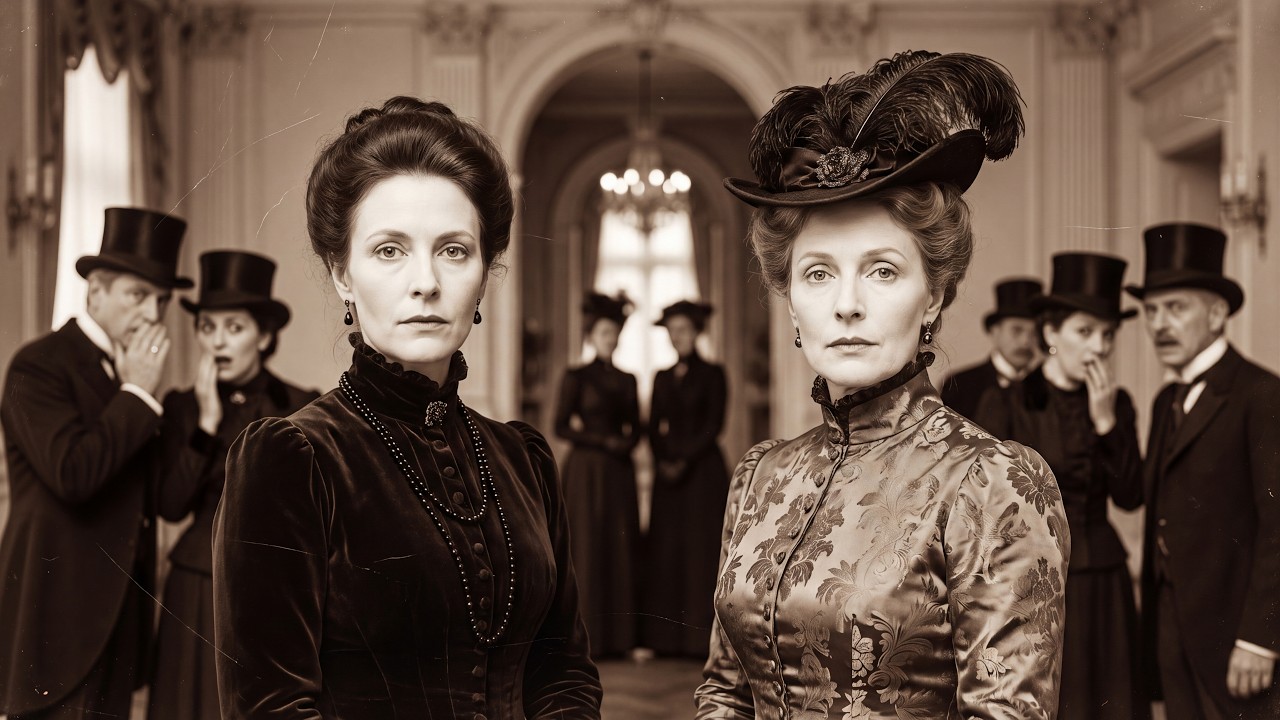
The solution was a husband. His name was William Kissam Vanderbilt, a tall, handsome, not especially bright grandson of the old railroad pirate. The Vanderbilts, for all their money, were new.
Caroline Schermerhorn Astor, the undisputed queen of New York society, refused to acknowledge any Vanderbilt at all.
Alva married William in April 1875. She spent the next eight years studying her enemy like a general studies a fortified city. Then she built a bigger ballroom.
The house at 660 Fifth Avenue went up between 1879 and 1882, designed by Richard Morris Hunt in the style of a late 15th-century French chateau. The construction bill came to $3 million, at the time the largest private house ever built in Manhattan.
On March 26, 1883, she announced she would open it with a costume ball. She invited 1,200 guests. She did not invite Caroline Astor.
The slight was calculated. Alva let it be known that the reason was that Mrs. Astor had never called on her.
In society, a call was the basic currency of acknowledgement.
Mrs. Astor’s daughter Carrie had spent the winter rehearsing for a quadrille to be performed at the Vanderbilt ball. Carrie wanted to dance.
Caroline Astor ordered her carriage, drove to 660 Fifth Avenue, and delivered her calling card. Within the hour, a Vanderbilt footman delivered an invitation to the ball at 350 Fifth Avenue. The war was over in a single afternoon.
Alva had learned her first lesson. Money was not wealth. Position was wealth.
Position was taken by force. She had a second lesson still to learn, and she would teach it in the body of her own daughter.
Alva had three children by William Vanderbilt. The youngest was a girl born on March 2, 1877, christened Consuelo. Alva had chosen the name because she had decided, before her daughter was a week old, that Consuelo would marry a European title.
By the autumn of 1895, Consuelo was 17, tall, slender, shy, and in love with a young New Yorker named Winthrop Rutherford. Alva had other plans. In a rented London house that summer, she had negotiated the sale of her daughter to Charles Richard John Spencer Churchill, 9th Duke of Marlborough.
He was 23, narrow-shouldered, cold, and in possession of the one asset every dollar princess mother coveted: an English dukedom of the first rank. He needed money. Alva had exactly such a trust fund in mind, and she had a daughter attached to it.
The terms were fixed. Consuelo would bring into the marriage an annuity of $100,000 to the Duke personally, secured by railroad stock. The dowry was to be paid by William Kissam Vanderbilt.
But William Kissam had other problems, because his wife, almost simultaneously with the brokering of her daughter’s sale, had sued him for divorce on grounds of adultery.
The settlement, finalized in March 1895, gave Alva $10 million in capital, an income for life, and custody of all three children. It was the largest divorce settlement in American history to that date. The women of New York closed ranks against her.
Alva, now a divorced woman with the social standing of a ghost, needed her daughter’s marriage to a duke more than ever.
Consuelo did not want to marry the duke. She told her mother so repeatedly. When letters from Rutherford arrived, Alva burned them.
When Consuelo tried to refuse the marriage, Alva locked her in her bedroom at Marble House, the 70-room white marble palace Alva had commissioned at a cost of $11 million. The 17-year-old sat in it for three days. Her mother came up at intervals to argue.
Finally, Alva said she would shoot Winthrop Rutherford herself. Then she announced she was dying and would be dead by morning unless Consuelo agreed. Consuelo agreed.
On November 6, 1895, at Saint Thomas Church on Fifth Avenue, Consuelo Vanderbilt was married to the 9th Duke of Marlborough. She cried behind her veil from the moment the carriage door closed until the moment the organ began. A reporter wrote that the bride’s face was bone white beneath the veil and that she did not look once at her groom during the ceremony.
Alva sat in the front pew in ermine. She was radiant. She had won.
The marriage was a disaster. The Duke took his 17-year-old duchess to Blenheim Palace, showed her her rooms, and informed her he had a mistress he intended to continue seeing. They had two sons who secured the succession, and then they stopped sharing a bed.
In 1906, with Alva’s unexpected support, she left him. In 1926, as part of a Vatican annulment process, Alva was required to give sworn testimony about her role. She said, under oath, that she had had absolute power over her daughter.
She said she had forced her daughter to marry the Duke. It was the single most honest sentence a Gilded Age mother ever spoke in public.
When Oliver Belmont died of a ruptured appendix in 1908, his widow did not retreat into crepe. She armed herself. Oliver had been the great surprise of Alva’s life.
He encouraged her opinions and took her politics seriously. The marriage lasted 12 years and was, by all accounts, happy.
Alva inherited his Long Island estate, his townhouses, and a personal fortune in the neighborhood of $10 million. She did not wear black. She wore white and went to London, where she met the most militant wing of the British suffrage movement.
She attended a speech by Emmeline Pankhurst and had what a colleague called a conversion.
She went back to New York with a new plan. She turned Marble House into a lecture hall for the cause of women’s suffrage. She underwrote the Political Equality Association.
When Alice Paul split from the larger suffrage association in 1914 to form a more militant wing, Alva backed her. When Alice Paul founded the National Woman’s Party in 1916, Alva backed her. When Alice Paul needed a headquarters in Washington, Alva bought the house and gave her the keys.
In January 1917, the Silent Sentinels began to picket the White House. They were arrested, beaten, chained, and force-fed. Alva, 64 years old, paid the bail, the lawyers, and the press agents.
The 19th Amendment was ratified on August 18, 1920. In 1921, Alva was elected president of the National Woman’s Party. She used the remainder of the Belmont fortune to fund the next phase of the movement, the Equal Rights Amendment.
She died in Paris in January 1933, 80 years old. Her funeral at Saint Thomas Church was conducted entirely by women. The pallbearers were suffragettes.
The honorary pallbearers carried a purple and gold banner that read, “Failure is impossible.”
Anna Gould was the youngest daughter of Jay Gould, the Wall Street wolf who died in 1892 leaving $72 million. She was not beautiful. The society papers noted this with casual cruelty.

She was short, dark, heavy-set, and entirely without illusion about the reasons men would court her. She knew she was a fortune wearing a dress.
In 1894, at 20 years old, she sailed for Paris. At a reception at the American Embassy, she was introduced to Count Boniface de Castellane. He was tall, slender, blonde, elegantly dressed, and professionally charming.
He had an ancient Provencal title, six generations of published aristocratic ancestors, and a personal income his creditors rated at approximately zero. He was in Paris specifically to meet American heiresses.
They were married on March 4, 1895. Anna’s dowry was $15 million in capital, with an income of $500,000 a year. The marriage contract specified that the capital could not be alienated.
Boni could not touch it. He could, however, spend freely out of the annual income. And this he began to do at a pace that would have alarmed anyone who had ever kept a ledger.
Anna moved to Paris and discovered the rules of her new life. Her husband kept his mistresses, rotating them at a pace his valet tracked in a pocket book. His family regarded her as a useful object.
Paris society watched her from behind fans and laughed.
Boni spent. He bought her houses, furniture, and yachts. Most famously, he commissioned a private palace on the Avenue Foch, a three-quarter scale imitation of the Grand Trianon at Versailles, executed in pale pink marble.
The construction bill came to just over $3 million. It was the most expensive private house built in Paris in the Belle Époque.
Anna paid for it out of her annual income. She paid also for the housewarming, a fete for 3,000 guests with fireworks, a troop of the Garde Républicaine, and two orchestras. Boni’s own birthday parties cost $150,000 apiece.
He complained to his friends that his American wife did not understand Parisian entertaining. He once remarked, within the hearing of a footman, that her legs in her nightdress reminded him of piano legs. The footman told the butler.
The butler told the housekeeper. The housekeeper told Anna’s lady’s maid. Anna’s lady’s maid told Anna.
By 1906, Anna had been married 11 years, had borne four children, and had come to the conclusion that her husband’s cost to her exceeded even the fortune of her father. She began quietly to keep a ledger of her own.
While Boni was away on business, Anna emptied the palace of her possessions, cut every account, and disconnected the telephone. The operation took 36 hours. She had consulted American lawyers in Paris and French lawyers in New York.
She had quietly transferred her portable wealth into vehicles in her own name. She ordered the packing, closed her bank accounts, revoked her husband’s authority over her deposit, and instructed her lawyer to file a petition for judicial separation on grounds of adultery.
The divorce proceedings dragged on for two years. The evidence was detailed. Boni’s mistresses were named in court.
The financial accounting was worse. The court heard that Boni had spent approximately $10 million of his wife’s money across 11 years of marriage. He had acquired no assets of his own.
The decree was granted in 1906.
On July 7, 1908, Anna Gould became the duchesse de Talleyrand. Her new husband was Prince Hélie de Talleyrand-Périgord, duc de Sagan. He was also, as every Parisian paper immediately pointed out, her former husband’s first cousin.
He was 49, tall, reserved, humorous, and crucially, the possessor of an actual private fortune in his own right. He did not need her money. Anna Gould was now a duchess.
Her former husband was now the cousin of her new husband.
Anna set about reinventing the Palais Rose. She hired workmen to chisel Boni’s entwined initials out of the marble above the bedroom doors. She replaced his portrait on the staircase with a portrait of her father, Jay Gould.
She threw parties and became one of the serious hostesses of pre-war Paris. Boni, meanwhile, lived on a small allowance from his own family. He wrote a memoir titled How I Discovered America, blaming his lost fortune on the tastelessness of his wife.
He died in 1932 in debt.
But fortune keeps double entry books. Three of her four sons by Boni died before she did. In the spring of 1929, a telegram arrived from the police of the sixth arrondissement.
Anna’s marriage to Hélie had produced one surviving child, a son named Howard, born in 1909. He was intelligent, wrote poetry, and was prepared to assume a title and a seat at the Jockey Club. He did not cooperate.
In the spring of 1929, when he was 19, Howard informed his parents he wished to marry. The woman was in her early 30s, married though separated, and not wealthy. Hélie refused his consent.
Anna sided with Hélie.
On July 8, 1929, Howard returned to his small apartment on the left bank of the Seine. He wrote a short note. He placed a revolver against his temple.
He pulled the trigger. He was 19 years and 9 months old.
The Parisian papers reported the death in small columns on inside pages. Anna wore black at the funeral. She did not cry in public.
She had been raised by Jay Gould. She had learned as a child that a Gould did not weep in front of creditors.
Hélie died in 1937. The Palais Rose became a mausoleum with a woman living inside it. In June 1940, as the German armies closed on Paris, Anna shuttered the palace, packed the Pissarros, and left France by train to Portugal.
From Lisbon, she sailed home to the United States. She was 65 years old.
She went to Lyndhurst, the Gothic Revival estate her father had purchased on the Hudson River. She lived there, mostly alone, for the next 21 years. She established that on her death, Lyndhurst would be given to the National Trust for Historic Preservation.
She died at Lyndhurst on November 30, 1961, at 86. The Palais Rose, standing empty, passed to a cousin who sold it to a property developer. The pink marble palace was demolished in 1969.
A concrete apartment building now stands on the site.

In a suite at the Plaza Hotel in 1917, a 4-year-old girl walked in on the body of the woman who was supposed to raise her. The girl’s name was Barbara Hutton. Her mother was Edna Woolworth Hutton, the youngest daughter of Frank Winfield Woolworth, who had built a retail empire of five and ten cent stores.
Edna was 27, beautiful, and unhappy. In May 1917, she was found dead in a bedroom of the suite. The official cause was given variously as heart failure and mastoiditis.
The coroner’s report was never made public in full. Whether her death was accidental, illness-related, or self-inflicted has never been conclusively established. What is established is that Barbara, 4 years old, was in the suite at the time.
She saw what was on the bed.
After Edna’s death, Barbara was raised largely by her grandfather. Frank Woolworth lived in a 60-room mansion on Long Island. He slept with a pistol under his pillow.
Barbara grew up in this house, a quiet, dark-haired little girl who read too much and spoke too little. She had a butler named Cuthbert, who pulled her aside on the day of her 10th birthday and warned her that she would someday be the richest girl in the world, and that every man who came near her would want to marry her for it. She must trust nobody.
Frank Woolworth died in 1919. Barbara’s share of the fortune was placed in trust until her 21st birthday. Its initial value was $28 million.
Compounded through the roaring 20s, by the time Barbara came of age in the autumn of 1933, it had grown to approximately $42 million.
The 21st birthday arrived on November 14, 1933. The United States was in the fourth year of the Great Depression. Her father and her aunts threw her a debutante ball at the Ritz-Carlton.
The bill came to approximately $60,000. Editorial pages ran denunciations. A widely reproduced cartoon showed Barbara in a tiara stepping across the bodies of hungry children to reach a champagne fountain.
The caption read, “Poor little rich girl.” The name stuck to her for the rest of her life.
She had already met a man named Alexis Mdivani, the son of a Georgian emigre who claimed a Russian princely title that scholars had been unable to verify. He was handsome, bankrupt, and 28. They married on June 20, 1933.
On their wedding night, he told her she was too fat to be a princess and that she would have to do something about it. She was 21 years old and weighed about 125 pounds. Within a month, she was down to 98.
Within a year, she had developed the disordered relationship with food she would carry to her grave.
The Mdivani marriage was annulled in 1935. She paid him $2 million in cash to leave. He died in 1935, crashing his Rolls-Royce.
She was already engaged to her second husband, a Danish count of genuine but minor pedigree. He beat her, humiliated her, and spent her money. She bore him a son, Lance Reventlow, in 1936.
The marriage ended in 1941.
In July 1942, Barbara Hutton married the only man she ever loved: the British actor Cary Grant. He offered from the start to take nothing from her. The three years of the marriage were by every account the closest Barbara ever came to ordinary happiness.
They separated in 1945. The divorce paid Cary Grant nothing. He remained for the rest of her life one of the few people she could telephone at 4:00 in the morning.
After Cary Grant, the marriages accelerated in quality downward. In 1947, she married Prince Igor Trubetskoy, a Lithuanian bicycle racer. In 1953, she married Porfirio Rubirosa, a Dominican diplomat and professional seducer.
The marriage lasted 73 days. The settlement included $3. 5 million in cash, a converted B-25 bomber, a string of polo ponies, a 17th-century Paris townhouse, and a Dominican coffee plantation.
In 1955, she married Baron Gottfried von Cram, a German tennis champion who was gay. In 1964, she married a Laotian painter elevated to a manufactured princely title.
Between husbands, she lived in hotels. She bought Winfield House in London, and when she found she no longer wished to live in it, gave it to the United States government for $1. It became the official residence of the American Ambassador.
She had, at one point, a gold-plated Rolls-Royce.
The $42 million dwindled. Lance Reventlow, her only child, died in a light plane crash in Colorado in 1972 at the age of 36. After his death, she stopped trying to manage what remained of her fortune.
She took to her bed in a suite at the Beverly Wilshire Hotel. She weighed, at the end, approximately 80 pounds. She kept her jewels in a cookie tin in the closet.
She died in the Beverly Wilshire on May 11, 1979, of a heart attack, aged 66. The accounting of her estate reported that at the time of her death, her bank balance was approximately $3,500.
Four women, four fortunes, four different kinds of defiance. The question the Gilded Age never wanted answered was this: if a woman’s husband could, from the grave, dictate the color of her dress and the occupant of her bed by attaching conditions to the money she had helped him accumulate, what was it exactly that she had been legally permitted to own during his life?
The answer, examined closely, was almost nothing. The mourning apparatus was not a costume of grief. It was an accounting instrument.
The remarriage clause paid her to stay a widow. The dollar princess trade paid her to cross the Atlantic. The dowry trust paid her to stay married to a man who spent her income.
The social register paid her to stay respectable. And the black crepe draped across the body of every rich woman in the first year of her widowhood paid her to stay quiet.
Four women refused to stay quiet. Madeleine walked away from $200 million to marry a banker in Bar Harbor. Alva divorced a Vanderbilt, married a Belmont, buried him, and spent the remainder of his money on a constitutional amendment.
Anna emptied the Palais Rose of everything that belonged to her and married her husband’s cousin three years later. Barbara married seven men and spent a $40 million trust down to $3,500 in a hotel suite in Beverly Hills.
Each of them paid an invoice. Madeleine paid in foreclosed trust funds and four decades of rebuilding a smaller life. Alva paid in the sound of her daughter weeping behind a wedding veil.
Anna paid in the body of a 19-year-old son on the floor of a left bank apartment. Barbara paid in 98 pounds of flesh and a cookie tin full of jewels in the closet of a hotel.
The uncomfortable truth is that the theater has not closed. Every celebrity prenuptial that trends on a phone screen, every billionaire widow photographed in a veil at a funeral, every dollar princess in reverse who marries into a dynasty and finds herself inside a contract she did not read carefully enough, is a direct descendant of the instruments these four women broke their hands trying to snap in half. The black veil was never about grief.
It was about collateral. And the collateral, across six decades and four remarkable women, was always the same thing.