On a sweltering February morning in 1960, a maid walked into a guest room in colonial Borneo and found the richest English woman of her generation lying cold in bed. Beside her, scattered across the sheets, lay a bundle of letters tied with a blue satin ribbon that had come undone in the night. Every single letter was from the prime minister of India.
She was 58 years old, a countess, the wife of the last viceroy. She had inherited the equivalent of 390 million pounds. And she had just died alone, reading love letters from another man.
The woman was Edwina Cynthia Annette Mountbatten, Countess Mountbatten of Burma. She had dined with her hosts the night before, retreated to her room early complaining of fatigue, and asked not to be disturbed. By the time the maid found her, the news was already racing along the cables.
The wife of the last viceroy of India, the cousin-in-law of the queen, had died of a heart attack on an inspection tour she had been begged not to undertake.
In London, Earl Mountbatten was woken with the news. In Delhi, Jawaharlal Nehru was given a slip of paper and walked into a private room and closed the door. The letters were quietly gathered up.
The ribbon was rewound. The bundle disappeared from public view.
But the story had already escaped. Within days, an extraordinary thing began to happen on the other side of the world. A warship of the Indian Navy, the frigate INS Trishul, changed course.
It steamed across thousands of miles of ocean through the Suez Canal, past Gibraltar, up into the cold gray waters of the English Channel. On board were thousands of marigolds, the flower of mourning in the Hindu tradition. The frigate had been dispatched on the personal orders of the prime minister of India.
It had only one purpose: to meet a British naval vessel off the south coast of England and scatter those marigolds on the water where the countess was being buried at sea.
No English woman had ever been mourned this way. No English woman had ever lived in such a way as to deserve it.
To understand the body in the bed, you must first understand the ribbon. And to understand the ribbon, you must first understand the man who built the fortune that made every letter inside it possible. He was a 17-year-old German Jew.
He stepped off a boat in Liverpool in 1869 with almost nothing in his pockets. He would die 52 years later as one of the richest men in the British Empire. He was her grandfather, and he loved her more than he loved anyone else alive.
His name was Ernest Joseph Cassel. He was born in Cologne in 1852, the youngest son of a small Jewish banker. At 17, he arrived in Liverpool with one suitcase, a few coins, and a letter of introduction to a grain merchant.
Within a decade, he was running the international department of one of the most powerful private banks in the City of London. By 30, he was placing bonds for governments. By 40, he was financing the modernization of Egypt.
By 50, he was lending money to kings.
His greatest single triumph was Egypt. In the 1890s and early 1900s, he became the financial architect of the Aswan Dam, the first great barrier across the Nile. The project transformed Egyptian agriculture and transformed Cassel's fortune.
He consolidated the arms manufacturer Vickers. He financed railways in Mexico and Sweden. He owned mines in South Africa.
By 1910, his name appeared on the boards of more than a dozen of the largest enterprises in the world.
And then there was the king. Edward VII, when he was still Prince of Wales, needed a financial adviser who could manage his money discreetly and never speak about it afterwards. He found his man in Cassel.
The friendship became the deepest of the king's life. Cassel attended Edward at his coronation. Cassel sat beside him at Marienbad.
Cassel was at his bedside weeping openly when the king died in 1910.
But beneath the wealth and the titles, Cassel was a German Jew. The respectable English world did not let him forget it. He was kept off some boards.
He was blackballed from clubs. Cartoons in the satirical papers gave him a hooked nose he did not have. The Edwardian aristocracy took his money, ate his food, married into his family, and despised him in private all the same.
In 1909, when his beloved daughter Ma, called Mai by everyone who knew her, lay dying of tuberculosis, Cassel made a quiet decision. He converted to Roman Catholicism. Mai had married a Protestant baronet, Wilfrid Ashley, but she had drawn close to the Catholic Church in her final illness.
Cassel followed her into it. The conversion did not save him from the anti-Semitism. It did not save Mai either.
She died in 1911. She was 32 years old. She left behind a husband she did not seem to love and two small girls.
The younger was a quiet, bookish child called Mary. The elder was a wild-eyed 9-year-old who looked like her mother. Her name was Edwina.
Cassel was 60 years old. He had buried his wife. He had buried his only child.
He had two granddaughters left in the world. He fixed on the elder. He installed her summer after summer at his enormous London house on Park Lane called Brook House.
He took her to Switzerland. He took her to the south of France. He kept her at his side during long political dinners where she would sit silent and watchful, watching prime ministers and generals defer to her grandfather.
He showed her the ledgers. He told her in so many words that everything he had built, he had built for her.
In 1920, he made it official. He named her his principal heir. She was 18 years old.
In September of the following year, almost without warning, his heart gave out. She was 20. She was about to inherit the equivalent of 390 million.
And she was about to discover that money on that scale given to a young woman in 1921 was not a gift. It was a key. It opened every door.
It locked her into a different cage entirely.
The will was read within days. Sir Ernest Cassel left an estate valued at £7,333,000. To Edwina personally, he left a separate trust fund of £1,600,000 untouched by her father, untouchable by any future husband.
He left her Brook House itself. He left her Moulton Paddocks, the country estate at Newmarket. He left her Branksome Dene, the clifftop house on the Dorset coast.
The structure mattered as much as the size. Under the Married Women's Property Act of 1882, a married woman in England could own property in her own name and keep her own income. Cassel had used the act with the cold precision of the banker he was.
Every penny he left her was hers. Not her husband's, not her father's, not her trustees'. Hers.
The income alone was almost incomprehensible. After tax, she drew somewhere in the region of £40,000 a year. In a country where a senior civil servant earned about a thousand, where a junior naval lieutenant of the Royal Cousins took home £310 a year, the gap was vertical.
Suitors began to arrive within weeks. She had the pick of titled Europe. She chose a near-penniless royal cousin.
His name was Lord Louis Mountbatten. He was the great-grandson of Queen Victoria. He was 22.
He was beautiful in a sharp, narrow, restless way. He was vain. He was ambitious.
He was almost entirely without money.
They met properly in 1920. They were engaged within months. The wedding was set for the 18th of July 1922.
It was the wedding of the year of the decade. St. Margaret's Westminster in the shadow of the abbey.
The bride wore a gown of silver lamé. The Prince of Wales served as best man. Inside the church sat the king and queen of England, the king and queen of Spain, the queen of Norway, the crown princess of Sweden.
Outside, the police estimated 8,000 spectators pressed against the barriers.
The newspapers called it the perfect English marriage. The fortune and the bloodline. The dream lasted almost exactly 24 months.
Within 24 months of the wedding of the century, the bride had packed her newborn off to a nanny and started collecting lovers. The first daughter, Patricia, arrived in February 1924. The birth was hard.
Edwina recovered slowly. She handed the baby to a nanny within weeks and went out into the London nights to look for what her marriage had failed to give her.
What it had failed to give her was simple: attention. Real adult attention, the kind her grandfather had given her every single day for the last four years of his life. Louis loved her in his way, but his way was distracted, ambitious, restless, and at heart not very interested in her at all.
He was a sailor. He was a royal cousin. He was a young man on the make.
The arrangement that emerged between them slowly across the middle 1920s was the kind of bargain that an enormous fortune makes possible. It was an open marriage. Not in the modern sense of agreement and equality.
In the older English aristocratic sense of mutual tolerance and quiet bookkeeping. They would stay married. They would maintain the social face.
They would in their own beds on their own terms sleep with whomever they liked.
The trouble was that the bookkeeping was not in any sense equal. Louis was a young naval officer earning £310 a year. Edwina was a countess in her own right who could spend £310 in an evening at the Embassy Club without quite noticing.
He could not host. He could not entertain. He could not buy her so much as a single one of her polo ponies.
She, for her part, was discovering the architecture of her own freedom. The lovers, when one lists them out, have a slightly stunned quality. There was Mike Wardell, the managing editor of the Evening Standard.
There was Laddie Sanford, the American polo player. There was Larry Gray, an Irish playboy. There was Ted Phillips, the cavalry officer.
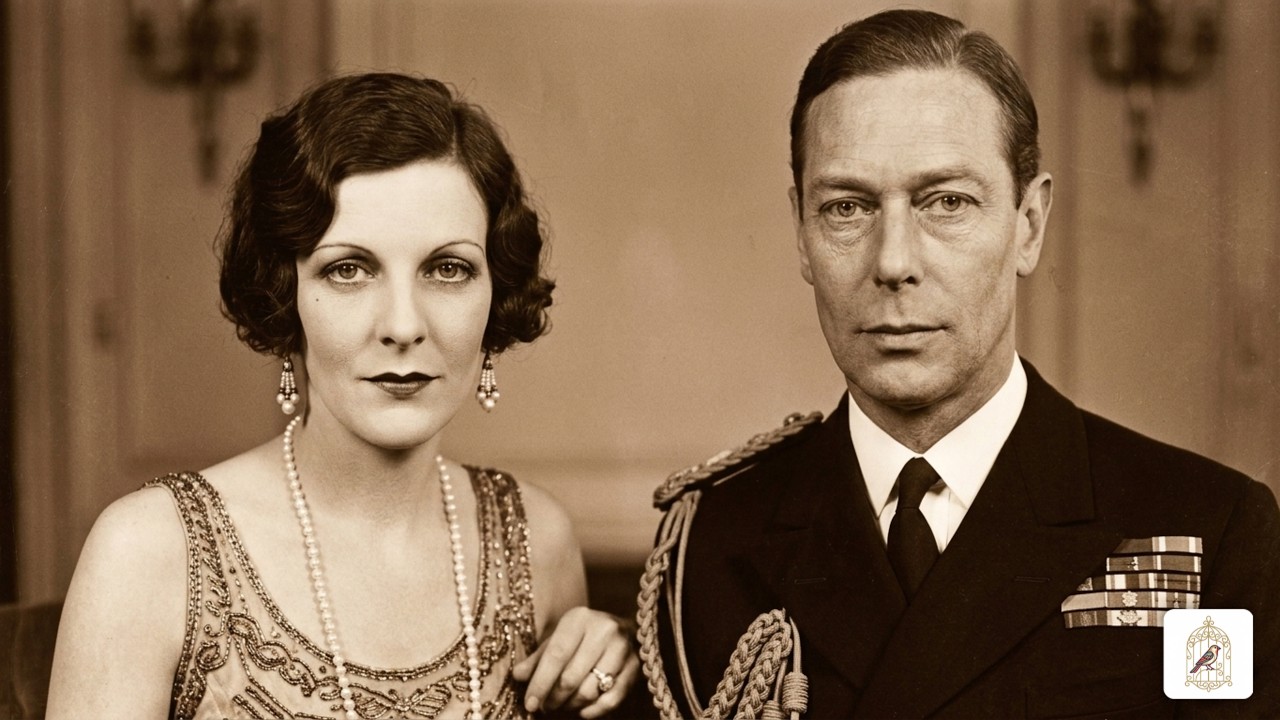
There was Bunny Phillips, the steady one, the long lover, the man Louis genuinely feared because he was decent enough that Edwina might leave for him.
She did not leave for any of them. Brook House by the late 1920s had become an institution. It rose six stories above Park Lane, faced onto Hyde Park, and contained some 60 rooms.
Edwina installed a swimming pool in the basement, a private cinema, and at one point, a small soda fountain.
The butler had the job of bringing the morning tea trays. The story he told, which became legend among the London servant class, ran roughly like this. He would arrive at her ladyship's door with the tea.
He would discover she was not in her own bed. He would proceed down the corridor. He would discover room by room which gentleman she was with that morning.
He would adjust the tray accordingly.
The second daughter, Pamela, arrived in 1929. The husband shut himself into his own quarters, writing furious career letters to admirals while his wife conducted what he himself called her affairs through the rooms below.
Of all the lovers she could have chosen, she picked the one man whose color could end her in a single newspaper paragraph. His name was Leslie Hutchinson. He was known across half the world as Hutch.
He had been born in Grenada in 1890 and had taught himself the piano from an age so young that his mother could remember him picking out hymns on a borrowed harmonium before he could read.
By 1927, he was the highest paid cabaret performer in Britain. He played at the Café de Paris. He played at Quaglino's.
He played at private parties at Brook House. He sang in a velvet baritone, accompanied himself on the piano, and had a stage manner so warm and so faintly knowing that women in the audience could be observed leaning forward without realizing it.
She took him as a lover sometime in 1927 or 28. The relationship lasted in some form several years. It was not casual.
The gifts she gave him have entered legend. There was a gold cigarette case engraved that he kept for the rest of his life. There was a diamond and platinum wristwatch by Cartier.
There were cuff links. There were tie pins. There was a Bentley motor car by some accounts.
And then there was the sheath. The story has been told in so many drawing rooms, biographies, and gossip columns that the precise outline has shifted over the years, but the core has always been the same. Edwina commissioned at Cartier a custom piece of jewelry for Hutch's personal use.
It was by every account that has reached print a jeweled sheath designed to be worn over his penis. Diamonds by some descriptions, sapphires by others, made of platinum. It is the kind of detail that biographers have approached gingerly for decades.
Louis discovered the affair the way husbands of the period generally discovered such things: slowly, then all at once. He had his own affairs. He had no particular standing to object, and in the open architecture of the marriage, he largely did not.
But the color of the lover, in the racial economy of 1929 London, was not something he could be silent about.
One night at Quaglino's, several drinks past his judgment, Louis sat down at the table of a journalist friend and told the entire story. He named Hutch. He described the gifts.
He described in a low voice the sheath. He was confiding. He was furious.
He was in the deep way of the betrayed husband, looking for sympathy. He found instead the beginning of a leak.
By the late spring of 1932, the whisper had reached a particular Sunday paper called The People. In May 1932, The People published a paragraph. It did not name Edwina.
It did not name Hutch. It referred only to a great society lady and a colored man whose name was a household word on both sides of the Atlantic. To anyone in London with ears, the reference was unmistakable.
To anyone outside London, the reference pointed by the curious arithmetic of fame to the most famous black man in the world in 1932. That man was not Leslie Hutchinson. That man was Paul Robeson, the American singer and actor of Showboat fame.
The article was a lie. It named the wrong man. It would by nightfall be ringing in the ears of King George V himself.
Within days, the order came down from Buckingham Palace. Edwina Mountbatten was to come home from Malta. She was to sue.
She was to clear her name in open court.
The defamation suit was prepared with extraordinary speed and extraordinary calculation. The Mountbattens engaged Norman Birkett, the most formidable libel barrister in England. The case was listed at the High Court for the morning of the 8th of July 1932.
The hearing was set with quiet precision for 9:30 in the morning. The hour mattered. Court reporters in London tended to arrive between 10 and 10:30.
By the time the press benches filled, the most explosive testimony was already over.
The court was almost empty when Edwina took the stand. She was 30 years old. She wore a dark suit, a single string of pearls, a small hat.
She was sworn in. Birkett rose. He described the article in The People as the most monstrous and atrocious lie that he had encountered in the whole of his career at the bar.
He turned to Edwina. He asked her with great deliberation whether she had ever in her life met the man Paul Robeson, the American singer and actor. She answered she had never met him.
She had never spoken to him. She had never been in the same room with him.
She was technically telling the truth. The article had named Paul Robeson by implication. She had never met Paul Robeson.
The man she had loved and was perhaps still loving was Leslie Hutchinson, who was not in the courtroom, was not in the article, and was not in the strict legal sense at issue that morning present in the case at all.
The People had no defense. They had run an unprovable insinuation. They folded.
The newspaper apologized. The newspaper printed a full retraction. Damages were paid.
By 11:00 that morning, the lie had been crushed. The next day, on the order of the king, Edwina and Louis were photographed having lunch at Buckingham Palace.
But the bill in the way of bills did not vanish. It simply moved. It was paid by the wrong person.
Leslie Hutchinson, who had not been named in the article, who had not been called to the stand, who had not been mentioned in the court, became overnight a man marked. The producers of the Royal Command performance simply stopped booking him. The BBC quietly removed him from its schedules.
The grand hotels that had once paid him £100 a night to play in their cabaret rooms found other acts.
He was not immediately destroyed. He played on through the 1930s at the Café de Paris. He played through the war.
He recorded. He toured. But the slow and steady erasure had begun.
He died on the 18th of August, 1969. He was 79 years old. His estate at probate was valued at £1,949.
His funeral at a London crematorium was attended by 42 people.
The episode should have hardened her. It should have driven her further into the gilded cage. It did in fact exactly the opposite.
Within seven years, she would walk out of every drawing room she had ever sat in and into the worst air raids in the history of London voluntarily every night.
The woman the gossip columns had spent a decade laughing at became in one September the unlikeliest hero of the London air raids. She had been changing already in private for some years. The libel trial of 1932 had marked her, even if she did not say so out loud.
Somewhere in the middle of the decade, on a long visit to China in 1937, she encountered a level of human suffering she had not previously imagined. Japanese aircraft had been bombing Chinese cities. She walked through hospitals.
She walked through refugee camps. She came home by every account of the people who knew her best, a different person.
In the summer of 1939, with war coming, she enrolled herself as a volunteer in the St. John Ambulance Brigade. She did not at first do so with rank or fanfare.
She trained as an ordinary nursing volunteer. She learned to dress wounds. She learned to drive an ambulance.
The Blitz began on the 7th of September, 1940. Edwina Mountbatten was in it from the first night. She drove ambulances into the East End during raids.
She inspected shelters. She walked through bombed houses with first aid teams pulling survivors from the rubble. By 1941, she was lady superintendent and chief of the St.
John Ambulance Brigade. By 1942, she was responsible in operational terms for an organization of more than 100,000 volunteers across Britain.
The most extraordinary chapter of Edwina's war came at the very end of it. In August and September of 1945, with the Japanese Empire finally collapsing, Allied prisoners began to emerge from the camps across Southeast Asia. Tens of thousands of British, Australian, Indian, and Dutch soldiers.
Tens of thousands of civilian internees. Men weighing five stone. Women so weak they could not stand.
Children who had never tasted milk.
Edwina took it upon herself to inspect the camps in person. She flew, often in small unarmed aircraft, into locations where the Japanese garrisons had not yet fully surrendered. She walked into camps at Changi in Singapore, at Sumatra, at Java, at Sandakan in North Borneo.

The official tally of those repatriated under the operation she oversaw came to more than 90,000 human beings.
She came back to England in 1946. She was 44 years old. The newspapers, even the ones that had once laughed loudest at her, were calling her a heroine without irony.
Within a year, her husband would be appointed the last viceroy of India. She would arrive in Delhi as the wife of the man dismantling the Raj. And there, on a sweltering subcontinent, at the moment of its greatest convulsion, she would meet a thin, white-haired widower with a rose in his buttonhole and the future of 400 million human beings in his hands.
They had in fact met before. The Mountbattens had encountered Jawaharlal Nehru in Singapore in 1946 when Louis was still the Southeast Asia commander. There had been a reception.
There had been a crowd. There had been in the way of postwar Asian crowds a surge that knocked Edwina off her feet. Nehru on one side and Louis on the other had linked arms and pulled her clear of the press of bodies.
It is the moment biographers always return to: the two men, the husband and the future lover, lifting her between them.
They arrived in Delhi as viceroy and vicereine on the 22nd of March 1947. Louis had been given by the Labour government in London what was effectively an impossible task. He was to wind up the British Raj.
He was to do so quickly. He was to do so without making a complete mess of it. Within weeks, he had compressed the timetable to August of 1947.
Edwina arrived with a different kind of mandate. The vicereine's role in the long history of the Raj had been a ceremonial one. She was to host dinners.
She was to receive Maharajas' wives. She was to wear jewels and smile at the camera. Edwina at 45 with a 100,000 St.
John ambulance volunteers behind her and the prisoner camps of Southeast Asia in her memory was not going to be that vicereine.
She set up the United Council for Relief and Welfare within weeks of arrival. She visited refugee camps. She organized cholera vaccination drives.
When partition came in August with 14 million human beings displaced across the new borders and up to 1 million dead in the worst migration violence of the 20th century, Edwina was already in the camps day after day in the worst of it.
Nehru was inseparable from these scenes. He was the new prime minister. He had inherited a country bleeding from two sides.
He came to the camps. He worked beside her. He worked beside Louis.
The three of them became in the heat of the late summer of 1947 an operational triangle of extraordinary intensity. And somewhere in that triangle, Edwina and Nehru fell in love.
The relationship has been argued over for 70 years. Some biographers have insisted it was a full physical affair. Others have insisted it remained chaste.
The truth, as Edwina herself wrote in a careful and famous note to her husband during the viceroyalty, was somewhere in between. The relationship, she told Louis, was mostly platonic. Mostly, she added, but not always.
There exists from the autumn of 1947 a photograph taken by Henri Cartier-Bresson. It is one of the great unposed photographs of the 20th century. Nehru is bent forward in helpless laughter at a joke just told.
Edwina beside him is laughing too, her mouth open, her hand at her throat. Louis stands behind, his arm raised, smiling broadly. The three of them are unguarded for one frame in a public garden.
There was also beneath the affection a political dimension that even the most romantic of the biographers have not been able to ignore. Louis used the relationship. He used it deliberately when the question of Kashmir blew up in October 1947.
It was Edwina who was the channel of communication between the viceroy and the prime minister at the most delicate moments. Pamela Hicks, her younger daughter, confirmed it explicitly in her own memoirs decades later. Her father, she wrote, used her mother as a channel of political influence on the Kashmir question.
The viceroyalty ended in June 1948. Louis handed over the reins to the first Indian governor-general. He and Edwina sailed for home.
Nehru stood on the dock at Bombay and watched them go. He had been a widower since 1936. He had a daughter Indira who would one day be prime minister in her own turn.
He had a country to run. He had also for the first time in 20 years fallen in love.
He would write to her by every count of the surviving documentation somewhere between three and five times a week for the rest of her life.
The years from 1948 to 1960 were in the strange architecture of her last decade sustained by paper. The letters between Edwina and Nehru traveled by every available means. They went by diplomatic bag when one was available.
They went by air mail when speed mattered. The biographer Janet Morgan, who had access to the surviving correspondence in the 1980s, estimated that more than 500 letters survived from his side alone, and that Edwina's side ran into the hundreds as well.
She visited India every winter. The dates were fixed in advance with the precision of treaty timetables. She arrived.
She stayed at the prime minister's residence. She and Nehru walked together in the rose gardens. They had breakfast under the verandas.
They worked together on the relief organizations Edwina continued to support. They sat up late into the Delhi nights talking.
Louis, by every reliable account, knew exactly what was happening and did not object. He had at last achieved after 25 years of marriage the husbandly position he could occupy without bitterness. He liked Nehru.
He genuinely admired him. He even in one famous and slightly extraordinary phrase to a biographer described Nehru as the great love of his wife's life. The remark was not made with rancor.
It was made with the quiet, faintly rueful precision of a man who had at last understood his own marriage.
The work continued. Edwina was now in her early 50s the most senior figure of the St. John Ambulance Brigade.
She traveled relentlessly. She inspected outposts of the organization in Africa, in the Middle East, in the new Commonwealth countries. She visited Singapore.
She visited Cyprus. She flew often in the small, uncomfortable aircraft of the late 1940s and early 1950s into the dust and the heat to spend an afternoon walking through a ward and to fly out again.
The body began slowly to protest. In 1956, she was diagnosed with cardiac angina. The doctors warned her to rest.
She did not. In 1958, she suffered a small stroke. The doctors warned her to slow down.
She did not. Later in the same year, she contracted a severe case of chickenpox from one of her grandchildren and was bedridden for several weeks. The illness in a 57-year-old woman with a damaged heart was nearly fatal.
She recovered. She announced she was resuming her inspection schedule.
Why she did not stop is the question that runs through the last chapter of every biography of her. Pamela Hicks in her later memoir suggested that her mother could not sit still. The stillness was in some way what she had been running from since she was 9 years old and her mother died, since she was 20 and her grandfather died.
Movement was the structure she had built for her life. To stop moving was to encounter the things she could not bear.
There was also perhaps the simple love affair. The letters required reading. The letters required answering.
The work was a way of remaining in the orbit of the one human being who since her grandfather had looked at her as if she were the only thing that mattered. To keep working was to keep flying. To keep flying was to keep meeting him.
In November 1959, Jawaharlal Nehru came to London to celebrate his 70th birthday. The Indian High Commission held a reception in his honor. Edwina Mountbatten was asked to deliver the principal public tribute.
She rose in a long white dress, leaning slightly on a podium. She spoke about Nehru's life and his country and the future of the Commonwealth. She spoke with an intimacy that no public speech of her career had ever displayed before.
People who were there said afterwards that you could not listen to the speech without understanding that the woman speaking and the man being honored had loved each other for more than a decade.
A few weeks later, against the strongest possible medical advice, against the explicit pleading of her daughters, against the muted but unmistakable concern of her husband, Edwina announced that she was undertaking a long inspection tour of the St. John Ambulance Brigade in the Eastern Commonwealth. She would fly to Cyprus.
She would fly on to Karachi. She would visit Delhi. She would press on to Malaya, to Singapore, to North Borneo.
The doctor said no. The family said no. She bought the tickets.
She left London in mid January 1960. She had a small leather suitcase. She had a packet of her current medications.
She had tied with a blue satin ribbon and packed in the inner pocket of her traveling case, the most recent of Nehru's letters to her.
She stopped first in Cyprus. She inspected the local St. John ambulance teams.
She moved on. She stopped in Karachi. She visited Pakistani relief organizations.
She moved on. She arrived in Delhi early in February. She stayed as always at the prime minister's residence.
Nehru cleared his diary. They had several days together. They walked in the gardens.
They sat up late into the night talking. He looked, she noted to Pamela in a letter, more tired than she had ever seen him. He noted to his sister that she looked more tired than he had ever seen her.
She left Delhi on the 11th of February. She flew on to Malaya. She inspected centers in Kuala Lumpur.
She visited Singapore. She arrived on the 18th of February 1960 at Government House in Jesselton in North Borneo, the residence of the governor of the colony.

She was by every account exhausted. She inspected the local brigade headquarters. She visited a small hospital.
She attended an official dinner on the evening of the 20th. She withdrew early. She complained of fatigue.
She said good night to her hosts. She climbed the stairs slowly. She closed the door of the guest room behind her.
In the room that night, she opened the inner pocket of her traveling case. She took out the bundle of letters. She untied the blue satin ribbon.
She lay down on the bed. She began to read.
What time the heart attack came is not known. She did not call out. There was no struggle.
She simply at some hour in the early morning of the 21st of February 1960 slipped from reading into sleep and from sleep into death.
The letters remained where they had been, scattered across the linen by her last movements. The ribbon had come undone. A letter from Nehru written a few days earlier was on its way to her.
It would arrive at Government House Jesselton in the days after her death. He had written it in his own hand. He had not yet been told.
By the time the staff at the residence read the address, the woman to whom it was sent had already been dead for almost a week.
The news traveled fast and cold. Louis was woken in London. Patricia and Pamela were told.
The Queen was informed. The Cabinet Office began its quiet work. Nehru was given the cable in Delhi and walked alone into his study and did not emerge for some hours.
In London, the Queen Mother, who had known Edwina across 40 years of receptions and weddings and christenings and scandals, was told the news in her sitting room at Clarence House. She listened. She lit a cigarette.
She said in the manner of a woman who had known too many people across too long a life, in the line that has survived in the diaries of more than one royal courtier: "Dear Edwina. She always liked to make a splash."
It was the perfect epitaph. It was unkind and tender at the same time. It captured the woman who had spent her life moving between scandal and service.
Even in dying in a colonial bedroom on the edge of the empire, she had made the largest splash of her career.
The body was flown home from North Borneo. The decision had been made by Edwina herself in her will that she was to be buried at sea. She had asked it long before.
She did not, she had written, wish to lie in a cold English churchyard, waiting for visitors who would not come. She wanted the sea.
The funeral was held on the 25th of February, 1960. The Royal Navy destroyer HMS Wakeful was assigned to the duty. The coffin was carried aboard at Portsmouth with full naval ceremony.
Edwina was by a small piece of historical accuracy that pleased the family enormously the first woman who was not a reigning sovereign to be piped aboard a Royal Navy warship with full honors.
The Archbishop of Canterbury officiated. The Duke of Edinburgh stood among the official mourners representing the Queen. Louis was there.
Patricia and Pamela were there. And alongside the British destroyer riding the same gray swell of the English Channel was the Indian Navy frigate INS Trishul.
The Trishul had sailed from India on the personal orders of Jawaharlal Nehru. It had crossed thousands of miles in a matter of days. It carried in its hold baskets of marigold flowers.
At the moment the coffin was committed to the sea, the sailors of the Trishul scattered the marigolds, thousands of them, yellow and orange flowers floating on the cold North Atlantic water around the slowly sinking coffin of an English countess in the chill of a February morning off Portsmouth.
It was by any measure of the 20th century an extraordinary diplomatic gesture. It was also for anybody who understood what the marigolds meant in Hindu tradition the most public and most beautiful love letter that the prime minister of India could write to the wife of the man who had once been his country's last viceroy.
The aftermath, in the days and weeks that followed, was less elegant. The Cassel fortune by 1960 had been substantially eroded by inflation, by the punishing death duties of the postwar Labour government, by the gradual sale of assets, and by the cost of 40 years of an extraordinary life. The death duties when they fell on the estate were savage.
Louis complained openly to friends with the peculiar grievance of an aristocrat encountering tax for the first time. The duties, he said, had left him with one shilling in the pound.
The complaint was overdrawn. He retained Broadlands, the family estate in Hampshire. He retained his own naval pension.
He retained the considerable income of his many official positions. He was not, by any sane definition, poor. He was simply, for the first time since 1922, no longer rich on a scale that exceeded the imagination.
Louis lived on. He became in his last two decades one of the elder statesmen of the British establishment. He was chief of the defence staff.
He was the great-uncle of the young Prince Charles who in his unhappiness leaned heavily on the older man.
His own end came on the 27th of August 1979. He was on holiday at his summer house at Classiebawn Castle in County Sligo in the west of Ireland. He took his small wooden fishing boat called Shadow V out into the calm waters of Mullaghmore Harbor with several family members aboard.
The Provisional Irish Republican Army had placed a 50 lb bomb beneath the deck the night before. They detonated it remotely as the boat moved into the bay.
Louis was killed instantly. He was 79 years old. He died in a final cruelty, exactly the kind of violent and political death that Edwina had spent her own life walking towards in the war zones and refugee camps and ambulance routes of three decades.
The marriage, which had begun on the 18th of July 1922 with 8,000 spectators outside St. Margaret's Westminster, ended on the 27th of August 1979 in the spray of a small Irish bay. The two of them were buried separately.
She lay in fact and in poetry in the cold water of the channel. He lay in the family chapel at Romsey Abbey.
Step back for a moment from the body in the bed and the marigolds on the water and the butler and the sheath and the king and the prime minister. Step back to the 17-year-old boy on the Liverpool dock in 1869. Step back to the cold morning at Brook House on the 21st of September, 1921 when the most important man in a young woman's life slipped from her grasp and left her a fortune in his place.
The central revelation of Edwina Mountbatten's life is not in the end the scandal. The scandals are simply the visible surface, the parts the gossip columns could see and price. The central revelation is structural.
It is legal. It runs through the dry text of the Married Women's Property Act of 1882.
That act passed by a Liberal government and resisted bitterly by the male majority of the Lords established for the first time in English law that a married woman could own property in her own name, keep her own earnings, and not have any of it absorbed into her husband's estate. It was in 1921 less than 40 years old. It had not yet been fully digested by the English ruling class.
Cassel had used it with the surgical precision of a banker who understood exactly what it meant. He had passed his fortune to a young woman in such a way that no husband and no court and no in-law and no future government could touch it. He had given her in a country and a century that still treated most women of her class as ornaments to be exchanged between male owners the simple thing that every man of her class took for granted from birth.
He had given her her own money.
Everything else followed from that. The autonomy made her scandalous. The same autonomy made her useful.
Without the Cassel income, no Bunny Phillips, no Hutch, no jeweled sheath, no Brook House mornings with the butler distributing breakfast trays around three bedrooms. Without the Cassel income, equally, no St. John Ambulance lady superintendent in chief inspecting 10 shelters in a night under the bombs.
No 100,000 volunteers. No 90,000 prisoners repatriated from Japanese camps. No Rajpura camp at the height of the partition.
Without the Cassel income, no Nehru love affair sustained across 13 years and thousands of miles by air tickets that could be bought without thought.
The same money paid for the cabaret pianist and the cholera vaccinations. The same money paid for the polo ponies and for the Order of the Crown of India. This is the awkward truth her biographers have danced around for 60 years.
You cannot finally separate the scandal from the service. They were the same freedom expressed in two different decades.
What did the money buy in the end? It bought the St. John Ambulance Brigade legacy that survives to this day in Britain and across the Commonwealth.
It bought the Cassel Hospital in Richmond, originally a pioneering psychiatric institution, still functioning more than a century after its founding. It bought the Edwina Mountbatten Trust, which continues to distribute grants for nursing and social welfare in her name. It bought in a quiet and lasting way an entire model of female public service that the daughters and granddaughters of her own class would inherit without quite knowing whose example they were following.
It bought also secrets. The British Cabinet Office continues into the 2020s to resist the full release of the Mountbatten-Nehru correspondence. Some of the letters have been published in carefully edited form.
Many remain redacted. The argument cited is diplomatic. The truth in part is more human.
The papers are love letters between the wife of the last viceroy and the founding prime minister of a vast Commonwealth nation. 65 years after her death, the British state has still not quite decided what to do with that.
What the money could not buy is the simpler question and the more important one. It could not buy her stillness. The void left by her mother's death when she was nine, by her grandfather's death when she was 20, by the discovery in her 20s that her marriage had been transactional, was a void that no amount of activity ever quite filled.
She worked herself into the grave because stopping was the one thing the Cassel fortune could not protect her from.
Nehru came the closest. Nehru loved her in the long form of three to five letters a week across 13 years with the kind of steady public structural devotion that the Cassel fortune had originally bought her at 16 in the great drawing rooms of Brook House. But Nehru had a country to run and she had her own continent and the love between them was sustained by paper rather than by presence.
It was not enough. It was for a 58-year-old woman with a damaged heart simply not enough.
She was neither saint nor sinner. She was both. She was the woman in the Cartier-Bresson photograph laughing in the public garden in Delhi in the autumn of 1947.
Nehru bent in laughter beside her, Louis smiling behind. She was the center of that frame. The two most consequential men of her life were arranged around her.
She was for one unposed second exactly what her grandfather had told her she was meant to be. The unmistakable center of the room.
The blue satin ribbon was tied around the letters in her traveling case that morning in February 1960. The maid would find them in less than 13 hours scattered across the sheets. Between the wedding of the year in 1922 and the morning in Jesselton, the most expensive English freedom of the 20th century had been spent in full on everything from the absurd to the magnificent.
And at the end, there was nothing left to buy except the right to be remembered as a real and complicated human being, judged on her own terms.
She had earned that at least. The marigolds on the English Channel were proof.