On the afternoon of the Buckingham Palace presentation in 1938, Rosemary Kennedy stepped forward to curtsy before the king and queen of England. She had practiced for days, because coordination had never come easily to her, but she was determined to get it right, to make her father proud. She tripped. Her father, Joseph Kennedy, standing nearby as the new American ambassador to the Court of St.
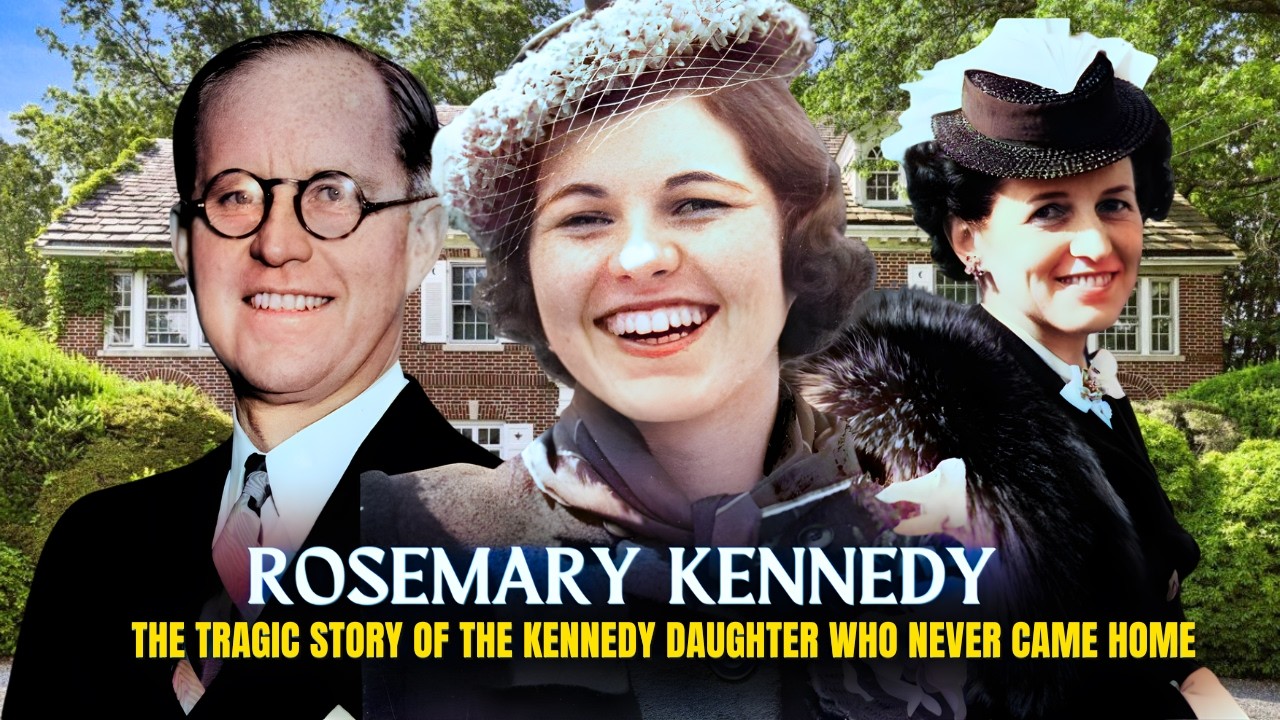
James’s, saw it. He filed it away, the way powerful men file away weaknesses they intend to address later. Three years later, he made a decision about his daughter that took twenty minutes to carry out and stole the next sixty years of her life. He never visited her again after he did it.
Not once. Rosemary Kennedy was born on September 13, 1918, in Brookline, Massachusetts, during the worst of the Spanish influenza pandemic. Hospitals were overwhelmed, doctors were stretched thin, and when Rose Kennedy went into labor with her third child and first daughter, the doctor was late. The nurse, following hospital protocol and terrified of liability, told Rose to stop pushing, to keep her legs closed, to wait.
For two hours, the baby’s head remained in the birth canal. For two hours, oxygen was cut off. Nobody knew it at the time, but those two hours quietly altered the entire course of Rosemary’s life. At first, she seemed fine.
She was beautiful, affectionate, warm, and eager to please. But she was slower than her brothers: slower to crawl, slower to walk, slower to speak. By the time she reached school age, her younger sisters had passed her developmentally. A mandatory intelligence test placed her IQ between 60 and 70.
The doctors of the era used words like “mental retardation” and “genetic accident,” cold clinical labels that told Joseph and Rose Kennedy nothing useful and reduced their daughter to a medical failure. The social stigma attached to disability in the 1920s was severe. Prominent Americans like Theodore Roosevelt, Andrew Carnegie, and John D. Rockefeller openly advocated eugenics, believing that the “defective,” including the mentally disabled, should be sterilized, hidden, and removed from public life.
The Catholic Church offered no comfort either, sometimes speaking of disability as a punishment from God. For a family like the Kennedys, climbing into the highest reaches of American society, a disabled child was a mark of shame, a crack in the porcelain. Yet Joseph Kennedy’s first response was surprisingly humane. When institutionalization was suggested, he said, “What can they do in an institution that we can’t do better for her at home, here with her family?
” The institutions of that era were horrors: filthy, understaffed, patients chained to walls, subjected to medical experiments. Joseph Kennedy looked at that world and refused. So Rosemary stayed home. She went to public school, struggled, repeated grades, but she went.
She swam, sailed, attended parties, and was dressed beautifully and presented to society. Rose Kennedy wrote in her diaries that Rosemary was “affectionate, warmly responsive and loving,” and “so willing to try to do her best, so appreciative of attention and compliments, and so hopeful of deserving them. ”
As Rosemary entered her teenage years, her limitations became more visible, and more dangerous. The Kennedy children were fast, competitive, relentless, raised by a father who treated even touch football like a battle for survival.
Rosemary could not keep up. She was becoming a beautiful young woman in a family that was becoming powerful, and the family began an elaborate performance. At dances, her brothers were assigned to keep her dance card full with carefully chosen partners. Joseph Kennedy himself was documented gripping her arm at public events, steering her, containing her.
Rosemary was kept deliberately unaware of how different she was, which created a profound confusion inside her. She could not understand why she was watched so closely, why the world felt different for her than it did for everyone else. In 1938, Joseph Kennedy was appointed United States ambassador to the United Kingdom, and the family moved to London. For a brief, remarkable period, Rosemary thrived.
She was enrolled in a convent school with a Montessori program, and the method, with its emphasis on self-paced learning and individual development, was tailor-made for her. Teachers described her progress as surprising. She had stability, structure that worked with her rather than against her. And then came the day at Buckingham Palace, the curtsy practiced for days, the trip, the near-fall, and Joseph Kennedy’s silent calculation.
In 1940, with war in Europe, the family returned to America. Rosemary lost the environment that had kept her stable. The schools available to an intellectually disabled woman in her twenties were either inadequate or entirely wrong for her. She bounced between institutions, was expelled from a summer camp, and ended up at a convent school in Washington, D.
C. There, at twenty-two, she began slipping out at night, going to bars, meeting men. The nuns were terrified. They told the Kennedys they believed Rosemary was having sexual relationships, that she could contract a disease or become pregnant.
To Joseph Kennedy, this was the end of the world. Not because of his daughter’s safety or happiness, but because of his family’s reputation, his sons’ political futures, his legacy. Joe Jr. was being groomed for Congress.
Jack would follow. Ted, Robert, all of them. A daughter sneaking out of convents and meeting men in bars was a scandal waiting to happen. So Joseph Kennedy began investigating psychiatric institutions.
Then someone told him about a new procedure being performed by two doctors at George Washington University, Dr. Walter Freeman and Dr. James Watts. It was called a lobotomy, and it was being promoted as a cure for everything, for depression, anxiety, violent mood swings, mental illness of every kind.
What it actually did was sever the neural connections between the prefrontal cortex and the rest of the brain, destroying the part of the brain responsible for personality, cognition, emotional regulation, and independent thought. The American Medical Association already had reservations. Sister Kathleen Kennedy, Rosemary’s own sister in the order, researched it and told their mother it was nothing they wanted done for Rose. Joseph Kennedy did not tell his wife.
He did not tell his children. He did not ask Rosemary. In November 1941, Rosemary Kennedy, twenty-three years old, was taken to the hospital. Dr.
Watts later described the procedure in detail. They made two incisions through the top of her head. She was mildly sedated, conscious for parts of it. Watts asked her questions during the surgery, to recite prayers, to count backward, to sing songs, to monitor her responses.
At a certain point, she stopped being able to respond coherently. That was how they knew they had gone far enough. The procedure took approximately twenty minutes. The damage lasted the rest of her life.
The results were catastrophic immediately. Rosemary’s mental capacity regressed to the level of a two-year-old. She lost the ability to walk without assistance, lost the ability to speak coherently, became incontinent. Her arm was palsied.
The warmth, the laughter, the affection, the hopefulness that everyone who knew her described was gone. After the procedure, Joseph Kennedy hid her. He placed her first at Craig House, a private psychiatric hospital ninety minutes north of New York City, a place no one would look. He told his wife only after it was already done.
Rose Kennedy did not leave him, did not go to her daughter, did not speak about it publicly, and did not visit Rosemary for twenty years. The other Kennedy children were kept in the dark for nearly two decades. They were told Rosemary was living quietly somewhere, that she was reclusive, that she was mentally disabled from birth. When John Kennedy ran for Senate in 1958, the family’s answer to questions about Rosemary was that she was reclusive.
When he ran for president in 1960, she was barely mentioned. She was living in a private cottage on the grounds of a care facility in Jefferson, Wisconsin, with two nuns who cared for her, a dog she took for walks, and a car the nuns drove. She had been there since 1949. Her siblings did not know where she was.
Joseph Kennedy built the cottage himself. He visited briefly at the beginning, then stopped. He never visited her again. Dr.
Watts later told a biographer that in his professional opinion, Rosemary did not have mental retardation at all. What she had, he believed, was a form of depression. Bertram Brown, a director of the National Institute of Mental Health who had served as an aid to President Kennedy, added that Joseph Kennedy deliberately chose to describe his daughter as mentally retarded rather than mentally ill because mental illness in a family was a far more toxic stigma in the 1950s and 1960s. Joseph Kennedy was not just hiding Rosemary.
He was strategically managing the narrative of her condition to do the least damage to his sons’ careers. In December 1961, Joseph Kennedy suffered a devastating stroke that left him unable to speak or walk. In that silence, the patriarch’s control collapsed, and things began to come loose. For the first time, Rosemary’s siblings were told the truth, not all of it, the lobotomy would remain secret for another twenty-five years, but they were told where she was.
John Kennedy had been president for nearly a year before he learned his sister had been living in an institution in Wisconsin for twelve years without any of them knowing. He visited her for the first time while campaigning in the Midwest. The historical record does not preserve what he said or felt in that reunion. In 1962, Eunice Kennedy wrote a piece for the Saturday Evening Post telling America about Rosemary, about how she was slower to crawl, slower to walk and speak.
She called on the country to think differently about intellectual disability. It was a brave piece that changed things, but it did not mention the lobotomy or Joseph Kennedy’s decision or the twenty years of silence. In 1987, historian Doris Kearns Goodwin published The Fitzgeralds and the Kennedys and revealed the full truth: the lobotomy, the secrecy, the fact that it was performed without Rose Kennedy’s knowledge, the fact that it was Joseph Kennedy’s decision alone. But Rosemary had a life.
The cottage in Jefferson, Wisconsin was not a cell. It was a private home with two devoted caretakers, Sister Margaret Anne and Sister Leona. She had a dog. She had a car for rides.
She worked with clay three nights a week with a woman who came to her. Sister Paulus Kohler, who became her primary caretaker and companion for over thirty years, was patient, insightful, and genuinely devoted. Over time, Rosemary learned to walk again, though with a limp. She never regained coherent speech.
Her arm remained palsied. But she was present. She took walks, went to stores, and swam. Eunice invited disabled people, including Rosemary, to her Maryland home to swim, and that backyard program became the seed of the Special Olympics, which by 1968 had become an international competition that eventually involved 1.
4 million athletes from 150 countries. President Kennedy, moved by his sister’s story, pushed federal legislation for people with intellectual disabilities and created the President’s Panel on Mental Retardation in 1962. Rosemary’s siblings slowly found their way back to her. The first time Rose Kennedy visited her daughter after twenty years, Rosemary recoiled.
The nuns who witnessed it said pain, anger, and anguish fled across her face. But over time, with enormous patience, Rosemary allowed the relationship to rebuild. She let her mother in again. She let Eunice in, who visited regularly and never stopped advocating.
She let Ted in, who would be at her bedside when she died. On January 7, 2005, Rosemary Kennedy died in Fort Atkinson, Wisconsin, at the age of eighty-six. Her surviving siblings were with her in her final hours. She was buried next to her parents, beside the mother who did not visit for twenty years and the father who never visited at all.
Eunice gave a eulogy, saying Rosemary left a legacy that was long and deep. The family statement called her a lifelong jewel to every member of the family. She was a girl who loved her social life, who got her hair and nails done, who relished new clothes, who went to the movies, who enjoyed the attention of boys. She was a debutante who practiced a royal curtsy for days because she wanted to get it right.
She was a young woman who snuck out of convents at night because she wanted what every young woman wants: freedom, experience, a life that belongs to her. She never got that life. But she changed the world anyway.