The ink had barely dried on the surrender documents in Wilmer McLean’s parlor when Ulysses S. Grant did something almost no one expected. Outside, Union soldiers were cheering themselves hoarse. Cannons were firing a hundred-gun salute.
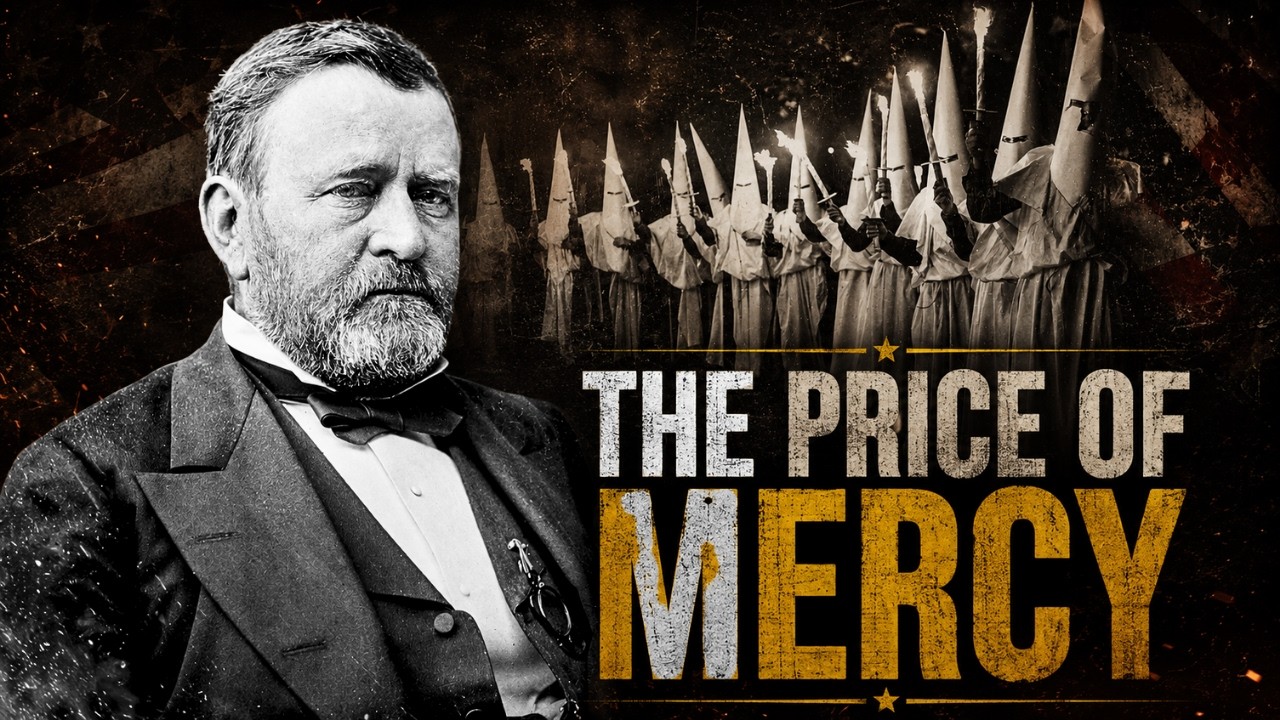
Grant ordered the celebration stopped. Coldly, and at once. “The war is over,” he wrote years later. “The rebels are our countrymen again.
” The best sign of rejoicing after victory, he said, was to refrain from all demonstration in the field. He was not performing. That same week, Grant’s men opened their packs and gave the starving Confederate soldiers twenty-five thousand rations. Hard bread and salt pork passed between hands that had been trying to kill each other seventy-two hours earlier.
He allowed the defeated army to keep its horses so the men would have something to plow with in the coming spring. He pledged his personal word that no one among them would be hanged for treason as long as they returned home and stayed there. For roughly one hundred hours, it looked as if the war might actually end the way wars should end: quietly, completely, with both sides able to live with what had happened. Then, on the night of April 14, John Wilkes Booth stepped into a theater box in Washington and put a bullet into Abraham Lincoln’s skull.
Grant received the telegram aboard a train bound for Philadelphia. In that moment, with no vote, no announcement, no drama, just a piece of paper handed to a tired man in a swaying railcar, the political shield around his surrender terms evaporated. Lincoln was the only man in Washington with enough authority to make Grant’s mercy stick. Lincoln was gone.
Within a week, the Radical Republicans in Congress were talking about gallows. And in the South, men who had just watched Grant feed their army for free began misreading his mercy, not as a gift, but as weakness. Within months, they were writing laws designed to push four million newly freed people back into bondage. Grant walked out of that parlor believing he had ended a war.
What he had actually done was hand his defeated enemy the only weapon they needed to continue fighting, this time outside the battlefield, in legislatures, newspapers, and courtrooms where he could no longer answer in kind. This is the story of what that mercy cost, and what it cost the people he was trying to protect. The peace that ended at Appomattox depended entirely on a single piece of paper: the military parole. Every Confederate soldier who left Appomattox carried one in his pocket.
In clear military language, it stated that the United States government would leave him alone as long as he obeyed the law where he lived. No prosecution. No prison. No noose.
That was the whole agreement, and Grant had staked his personal word on it. Here is the part that should genuinely stop you. Between ninety and ninety-five percent of Confederate veterans honored it. Hundreds of thousands of men who had spent four years trying to kill each other went home, hitched Grant’s mules to their plows, and returned to the business of feeding their families and farming fields that had lain untended for years.
But the men who actually ran the South, the political class, did not read the pardon the way the soldiers in the field did. They did not see it as a gift of mercy from one soldier to another. They saw it as a legal shield. And almost immediately, they began testing how far it could be stretched.
In June 1865, federal prosecutors in Norfolk moved to indict Robert E. Lee for treason. Had it gone forward, it could have meant the gallows for the most revered man in the South. Lee did the only thing left to him.
He wrote to Grant, asking whether the parole he had signed would actually protect him. Grant did not hesitate for a moment. He walked into the office of President Andrew Johnson and told him flatly that he would resign his commission as commanding general of the entire United States Army before he would allow Lee to be arrested under the parole he had given him. Consider what that meant.
The most famous soldier alive, six weeks after winning the war, was threatening to resign rather than allow the government he served to break a promise made to the man he had just defeated. Grant told the president: “I tendered General Lee and his army the terms of surrender. The officers and men received parole. The honor of the United States is pledged to this amnesty.
You cannot break it without breaking my word. ” Johnson backed down, and the indictment quietly dissolved. Lee never spent a day in a courtroom. Grant thought he was protecting his personal honor and the honor of the government he had fought for.
What he actually did, without realizing it, was save the man the South was about to turn into a religion. Because Lee escaped prosecution untouched, the South stopped fearing any real legal consequence of the war at all. If the general could not be tried, why should state legislators worry about the Black Codes? In October 1865, Lee took a job as president of a small, struggling college in Lexington, Virginia, at a salary of fifteen hundred dollars a year, a fraction of what he could have earned trading on his name.
He then fell silent, in a way that was both admirable and easy to underestimate. He refused every offer to write his memoirs, including some for enormous sums. He directed the young men in his classrooms to go home, obey the law, and become good citizens of a country that had, whether they liked it or not, only one flag. To a bitter Confederate widow who asked how she should raise her sons, Lee answered plainly: “Madam, do not bring up your sons to hate the government of the United States.
Remember that we form one country now. Bring your sons up to be Americans. ” That is not the Robert E. Lee most Americans think they know.
And that gap between the man and the legend is the heart of this story, because silence leaves a vacuum, and someone always fills it. For Lee, that someone was Jubal Early, a bitter, unreconciled former Confederate general who had fled to Canada after the war rather than swear allegiance to the United States. Early eventually returned and founded the Southern Historical Society, building its entire foundation on a single sentence from Lee’s farewell address to his troops: that the Army of Northern Virginia had been forced to surrender by overwhelming numbers and resources. One line.
Early turned it into scripture. In Early’s telling, the Confederacy was never beaten in a fair fight on the battlefield. It was simply crushed under the weight of Northern factories and an endless supply of immigrant soldiers. Slavery, in this version, was barely a cause of the war at all, just a footnote.
Lee became untouchable, a marble saint who, in Early’s narrative, never lost a battle he was truly allowed to win. And Grant became the opposite: a butcher, a drunk, a man who only won because he had more lives to spend than Lee. Here is the buried cruelty at the center of it all. Grant never once asked Lee to grovel at Appomattox.
He never asked him to formally admit, publicly, that the cause he had fought for four years was wrong. Grant genuinely believed that mercy was the highest end, and that dignity, not humiliation, would knit the torn country back together. But because Lee never said it, and because the one man with the power to correct the record chose silence, someone else got to write whatever story they wanted in his place. For over a century, that story became the official narrative.
It was carved onto monuments, taught in Southern schools, and printed in textbooks that called the Civil War the War of Northern Aggression well into the twentieth century. By the 1890s, the United Daughters of the Confederacy had completed what Jubal Early began, raising money to place statues on courthouse lawns across the South. The statues were not erected in the 1860s, in the immediate aftermath of the war, but decades later, almost exactly synchronizing with the years Jim Crow was hardening into a permanent part of Southern life. The marble was never really about memory.
It was about telling every Black citizen who passed that courthouse who held real power. Grant never saw most of that. He was gone by 1885. But the legend he had unconsciously helped create kept growing for another hundred years after he was buried.
He ran for president in 1868 under a campaign slogan that, in retrospect, reads like a prayer: Let Us Have Peace. Four words. He meant every one of them. While Jubal Early was busy building a myth in the South, Ulysses S.
Grant was sworn in as the eighteenth president of the United States. He entered the job carrying something Lee never had to face in the quiet of Lexington’s classrooms: absolutely no political training, and a capital that had been actively lying to him since his first week. Grant ran his government the same way he ran his army staff. Absolute loyalty, given without much hesitation, to the men he trusted.
That instinct had won him Vicksburg. It had won him Shiloh. In Washington, it made him a mark for swindlers who knew exactly how to exploit a man who assumed everyone around him shared his integrity. Con artists attached themselves to his administration like leeches.
The Whiskey Ring embezzled millions in liquor tax revenue right under the nose of the Treasury Department. The Belknap scandal reached his own Secretary of War. Even Ely Parker, the Seneca engineer and one of Grant’s closest personal friends, the man who had sat in the parlor at Appomattox and written out the final surrender terms in his own hand, was dragged into a humiliating corruption trial by political enemies who understood that hurting Grant’s friends was the easiest way to hurt Grant himself. Parker was acquitted of every charge.
He resigned anyway, exhausted by the ordeal. Grant, by his own later account, felt he had not defended his friend loudly enough, or fast enough. That silence stayed with him. While Washington scandals filled the headlines, a paramilitary force was rising across the South, wearing white hoods as its uniform.
The Ku Klux Klan was not a quiet secret society meeting in the woods. It functioned as the armed wing of the Southern Democratic Party, and its entire purpose was terror: lynching, arson, and murder of Black voters and the white Republicans who tried to organize alongside them, county after county, election after election. Grant responded the only way he knew how. He declared martial law in South Carolina, suspended habeas corpus, and sent the United States Army south with orders to crush the Klan by force.
Thousands of Klansmen were arrested and dragged into federal courts. “By the acts of Congress,” Grant said, “the life and liberty of the citizen can only be protected by the national power. I will not hesitate to use the full force of the United States to enforce the law. ” It worked.
He effectively smashed the first Klan. But he was fighting a hydra, not a snake, and the moment federal troops withdrew from any county, the same men who had been arrested and released simply took off the hoods, carried their rifles openly, and reorganized under a new name: the White League. No more hiding in darkness. This version marched in daylight.
Ask yourself what it truly takes to fight such an enemy. Not an army in the field with a flag and a chain of command you can force to sign a surrender. A hydra. An idea wearing a thousand different faces, reappearing under a new name every time you cut off one of its heads.
Grant had spent four years mastering the first kind of war. No one on either side had a strategy for the second. He was, quite literally, the first American president forced to figure it out. Of all the great generals who stood beside Robert E.
Lee at Appomattox, only one fully understood what true peace would require of him afterward. His name was James Longstreet. In March 1867, Longstreet published an open letter in a New Orleans newspaper that ended his standing in the South forever in a single paragraph: “The war is over. The surrender of the Confederate armies involved the concession of the right of secession, and the concession of the former political relations of the negroes.
Our duty is to conform to the law, accept Reconstruction, and begin rebuilding. ” Read that again, slowly, and think about who is saying it. This is Lee’s most trusted lieutenant. The man who fought at Antietam, Gettysburg, and the Wilderness.
Here he is, in print, telling the South that the war is over, that slavery is dead, and that Black Americans deserve full and equal rights under the very Constitution he spent four years fighting against. The South never forgave him. Not once. Not ever.
Longstreet joined the Republican Party. Six days after his inauguration, Grant nominated his old West Point friend for one of the richest patronage posts in the country: customs surveyor of the port of New Orleans. The appointment barely passed the Senate, confirmed by a single vote over the quorum. Newspapers spent weeks arguing over whether Grant was rewarding cronyism, extending an olive branch to the South, or simply putting his money where his Appomattox terms already were: on the belief that a defeated man who chose loyalty deserved to be treated as a citizen again, not a suspect.
Longstreet later added the badge of United States Marshal to his customs post. For accepting Grant’s patronage at all, his former soldiers stopped speaking his name in public. Men who had followed him through some of the worst battles of the war would cross the street rather than acknowledge him. He was the only man in that room at McLean’s parlor who did exactly what Grant hoped every defeated soldier would eventually do.
It cost him nearly everything he had left. On September 14, 1874, the war that was supposed to be over appeared on a New Orleans street carrying rifles. Some eight thousand armed men of the White League, nearly all of them former Confederate soldiers, marched on the Louisiana statehouse with a single goal: to forcibly overthrow, in broad daylight, an elected, racially diverse Reconstruction government. The man charged with defending that government, commanding the state militia, was James Longstreet.
He rode his horse out to face thousands of his own former countrymen and ordered them to disperse. Their answer was gunfire. Longstreet was pulled from his saddle, wounded by a stray bullet, and briefly held by men who had once followed him shouting across battlefields. His own artillery was turned against him and fired at the racially mixed police force he commanded.
Outnumbered more than two to one, his lines collapsed within minutes. For three full days, the White League controlled the entire city of New Orleans. The news reached Washington within hours. Grant did not wait for Congress.
Within three days, he moved federal troops toward New Orleans under his direct order, restoring the elected government by force. This was the same man who, nine years earlier, had ordered his soldiers to stop cheering over the defeat of their enemy. Now he was sending troops into American streets against men wearing the same gray jackets he had once let them carry home with their horses. The mercy had not run out.
It had a limit, and armed rebellion against an elected government had crossed it. That was the moment Longstreet’s old comrades had been waiting for. Jubal Early and General William Pendleton immediately set to work systematically destroying what remained of his military reputation. They fabricated a story out of whole cloth, known as the “Sunrise Order,” claiming that Lee had personally ordered Longstreet to attack at dawn on July 2 at Gettysburg, and that Longstreet’s stubbornness and delay in executing that order had cost the Confederacy the battle, and with it the entire war.
It was not true. No credible evidence exists that such an order was ever given. But it was repeated by enough people with personal reasons to believe it that it hardened over the decades into accepted history. It was the comfortable explanation for why the Lost Cause had failed.
An explanation that required no blame for Lee, and no admission that the North simply had more men, more factories, and a cause history would vindicate. Lee got statues in nearly every Southern town. Longstreet got erased from the history. Not because he lost the battle.
But because he told the truth about what peace would cost, and his people never forgave him for it. He lived thirty more years after the events on Canal Street. He lived long enough to see the end of most of the men who cursed his name. When he finally died in 1904, at age eighty-two, some Southern papers that had spent decades calling him a traitor published obituaries that barely dared to mention the open letter, or Canal Street, or the marshal’s badge, as if the man could be forgiven for everything as long as no one spoke about the one thing he had actually gotten right.
By 1876, the North was exhausted. A brutal economic depression had gripped the country for three straight years. Grant’s administration was still reeling from scandal after scandal, and the political will to keep federal troops stationed in the South supporting Reconstruction governments that Washington was tired of defending had simply evaporated. That autumn, the presidential election between Rutherford Hayes and Samuel Tilden was too close to call and too disputed to trust.
Twenty contested electoral votes in four states, no clear resolution, and a country standing closer to a second civil war than most people ever learn in school. The way out was a deal struck behind closed doors. Southern Democrats agreed to let Hayes take the White House without a fight. In return, the last federal soldier would leave the South for good, and Reconstruction would be left to die in silence.
Reconstruction ended in a hotel room, not on a battlefield, not by treaty, not by a single vote historians can point to. A handshake, followed by silence. Within months, the southern state legislatures that had passed the Black Laws a decade earlier came back to finish what they had started. Poll taxes, literacy tests designed for people to fail, grandfather clauses, and Jim Crow laws that would keep Black Americans from the ballot box and from equal citizenship for most of the next hundred years.
Frederick Douglass watched it happen and knew exactly what it meant: that the price of peace between the sections would be paid by those who had just won their freedom. He spent the rest of his career saying so. In 1883 he declared that while the war for the Union faded into the past, the Negro no longer needed to storm forts and receive rebel bullets. They had become, in their eyes, of less consequence.
Peace with the old master class had been war on the Negro. While one rose, the other fell. Grant’s mercy at Appomattox was supposed to build a peace generous enough to hold the whole country together, Black and white, North and South, victor and vanquished alike. What it actually built, once the last soldiers finally went home for good, was a space for the men who lost the war on the battlefield to quietly win it back at the ballot box.
On May 17, 1877, two months after leaving the presidency for the last time, Grant stood on the deck of the steamship Indiana in Philadelphia harbor, age fifty-five, watching the mooring lines cast off. He never bought a return ticket. What was supposed to be a modest trip abroad turned into two and a half years of circling the entire globe. For his wife Julia, it was a triumph tour unlike anything Americans had ever seen.
Palaces, formal banquets, foreign kings rolling out red carpets in city after city, country after country, in honor of the general who had saved the Union. Grant stood at the railing watching the shores of his country fade into the mist behind him. By nearly every account from those who accompanied him, he was not thinking about the palaces at all. He had won the war down in the mud, at a cost that had nearly broken him more than once.
And now he was leaving behind a country that had just spent two years quietly dismantling everything he had tried to build in the wake of the peace. Grant returned home in 1879 with his personal fortune nearly gone. In 1881, he moved to New York City and entered a business partnership with a young, charming Wall Street financier named Ferdinand Ward. The same fatal trust that had cost Ely Parker his peace of mind now targeted Grant’s personal wealth.
Ward was running a Ponzi scheme, and he was running it almost entirely on Grant’s name. Investors did not trust Ferdinand Ward. No one trusted him, not really. They trusted Ulysses S.
Grant, and Ward knew exactly the value of that trust. He spent Grant’s reputation like currency. He never intended to pay it back. On May 4, 1884, Ward told Grant the firm needed emergency cash to cover a short-term gap.
Grant believed him completely. He went to his neighbor, William Vanderbilt, and personally borrowed $150,000 to cover the deficit, putting his name on the line once again on another man’s promise. Two days later, the firm collapsed entirely. Ward had already fled with what money remained.
Grant and Ward was worthless. Ulysses S. Grant, commanding general of the Union Army, twice president of the United States, the man who had once held the fate of an entire nation in his hands, was left with eighty dollars in cash. Julia had an extra $130 hidden in a cookie jar.
That was everything they owned. “I have made it the rule of my life to trust a man long after other people gave him up,” Grant later wrote in a letter that reads like the words of a man trying to absorb his own shock. “But I don’t see how I can trust any human being again. ” A few months after losing everything, Grant bit into a peach on his porch and felt a pain in his throat that would not go away.
The diagnosis was throat cancer, in a terminal stage, inoperable. The doctors told him he had only a few months left. Penniless, dying, and gradually losing his ability to speak, Grant did the only thing he had ever been truly good at. He fought one last war, this time against a clock no one could stop.
Mark Twain personally intervened when he heard what had happened, offering Grant a 70 percent share of publishing profits, an almost unheard-of arrangement at the time, to write his memoirs before it was too late. Grant moved to a small cottage at Mount McGregor in upstate New York. Swallowing became unbearable agony. Doctors swabbed his throat with a cocaine solution so he could write a few sentences at a time.
When his voice failed him completely, he kept writing, jotting notes on scraps of paper because it was faster than waiting for a fresh page. Five to seven hours a day, most days, for months. Nearly 275,000 words in under a year, produced by a man who could no longer speak above a whisper and was in physical pain beyond what most people will face in a lifetime. In his final chapters, his mind kept circling back to one particular afternoon.
April 9, 1865. He wrote the line that has puzzled historians for over a century: that seeing Lee accept defeat that day left him sad and depressed at the fall of a foe who had fought so long and so valiantly, and suffered so much. He finished the manuscript on July 20, 1885. He died three days later, at age sixty-three.
The book saved his family from ruin. It became one of the best-selling books in American publishing history up to that time, and the royalties paid to Julia were the largest sum ever received by an American author’s family. On August 8, 1885, nearly a million people crowded the streets of New York City for his funeral. Walking together as pallbearers, side by side, were men who had once striven to kill each other.
Union generals William Tecumseh Sherman and Philip Sheridan marched shoulder to shoulder with Confederate generals Joseph E. Johnston and Simon Bolivar Buckner. Grant’s true victory was never Appomattox. Appomattox was the easy part.
The cannons stopped. Lee surrendered. The army went home. The harder question was what happened after the soldiers laid down their arms.
Grant believed the country could not remain united forever if half of it was forced to live in humiliation. So he gave Lee terms grounded in dignity: feeding his starving army, letting his men keep the horses they would need to plow the fields in spring, giving them his personal word that they could go home and stay there. He believed that if the men who had fought the war were allowed to leave with their dignity intact, they might eventually become Americans again. For many of them, that is exactly what happened.
But peace was never simply surrender. Lincoln was assassinated. Reconstruction collapsed under Johnson amid conflict with Congress. Freed Black Americans were forced to fight again for the rights freedom was supposed to have given them.
The Lost Cause turned defeated generals into saints and men like Longstreet into traitors. And Grant spent the rest of his life trying, in one way or another, to hold together the peace he had helped make. Sometimes he succeeded. Sometimes he failed.
Sometimes his trust in people was used against him. By the end, he had lost almost everything. His presidency was over. His fortune was gone.
His voice was fading. The cancer was consuming him. But he still had one thing. His memory.
So he began to write. Day after day, through unbearable pain, Grant wrote the story of his life. And when he reached the end, his mind returned to where this story began: Appomattox. To the man sitting across from him in Wilmer McLean’s parlor.
Robert E. Lee. Grant wrote that he felt sad and depressed at the fall of a foe who had fought so long and so bravely. After everything that had happened, after the blood and politics and broken promises and violence and years of bitterness, he still could not celebrate the destruction of the man he had defeated.
Perhaps that was Grant’s greatest strength. And perhaps it was his greatest weakness. History still argues about it. In July 1885, in New York City, Grant lay dead, and the man who had once led the largest army America had ever known was carried through the streets on the shoulders of men who had once stood against him.
Sherman and Sheridan on one side, Johnston and Buckner on the other. Union and Confederate, shoulder to shoulder behind the coffin of the man who had beaten them. No battlefield. No surrender flag.
No cheering crowds. For a few hours, there was no Union army and no Confederate army. No victor, no vanquished. Just Americans carrying one of their own.
Perhaps this was what Grant had been building since April 9, 1865. Not forgiveness, not forgetting. But a country where war could finally become history instead of fate. He never solved the riddle of Reconstruction.
He never lived to see what the country would make of the peace he offered it. But on that July afternoon, for a few hours at least, the peace held. Not because anyone ordered it, but because enough people quietly decided that the war really was over. The guns had fallen silent twenty years before.
And on that day, perhaps the war finally ended too.