The knight called Guillaume was thirty-four years old, the second son of a landowner. Since the age of seven, he had been told that the sword was the noblest weapon in Christendom. Within a minute, he would learn that everything he had been told was a lie. The man standing over him was Robert.
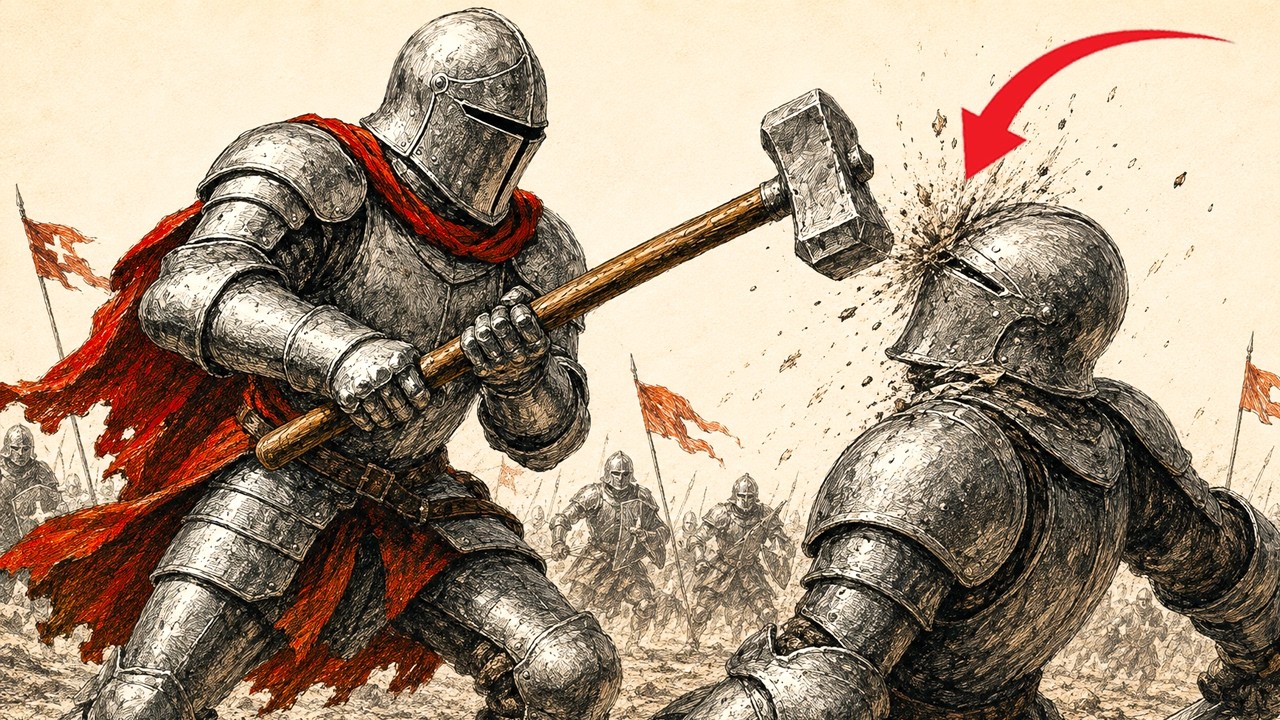
Forty-one years old, a professional who had fought in six campaigns and had been ransomed twice. Technically noble—his grandfather had purchased a title—he was not the kind of man anyone beside him in the line of battle would have called elegant. Robert had learned early what the chivalric romances never mentioned: against a man in armor, you do not swing a sword. You close in, you grapple, you pin, and you strike the places the plates do not cover.
He had learned this while holding a sword and watching the sword do absolutely nothing at all. That was the truth of the era. The sword was a symbol, a mark of status, the weapon you wore at court, drew at ceremonies, and had blessed in church. On the battlefield, it was a sidearm—the medieval equivalent of a military pistol, useful only in the final meters of your life, but rarely what decided a fight against a well-armored opponent.
The sword, that beautiful, noble, bishop-blessed sword with its crossguard, was never designed to defeat plate armor. Not the blade. Not the edge. Not the hilt.
The physics of a sword blade against a curved, hardened steel plate were much like trying to open a bank vault with a butter knife. The men who fought in armor knew this before their first battle. By the late fourteenth century, a well-equipped fighter wore a full suit of steel plate from head to foot, articulated at every joint and curved at angles that made blades slide off. The best harnesses came from Milan and Augsburg, made by armorers whose names were known across Europe like those of great painters.
A full suit cost roughly as much as a small farm. If you could afford it, you were nearly impossible to kill with a sword. You could still be killed—but it took work. It took getting within arm’s reach of a man who also wanted to kill you.
It took reaching behind him, above him, under his visor, and into the gap at his armpit where armor could not cover without hindering the arm’s movement. And it took a weapon that did not care about the armor at all. That world produced three weapons that mattered. The poleaxe: heavy, blunt, transferring shock through the plate into the body beneath.
The war hammer: same principle, but with a spike on the reverse side to pierce weaker armor or catch in gaps. And the pollax: a five-foot tool combining an axe head, a hammer face, and a spear point—the most fearsome close-combat weapon of the late medieval battlefield. The full suit of late medieval armor weighed between fifty and seventy pounds, less than the load of a modern soldier, and distributed across the body rather than hanging from the shoulders. Knights ran in it.
They mounted horses in it without assistance. The legend of the knight who needed a crane to be hoisted onto his saddle was invented by a nineteenth-century French writer who had never seen real armor. In harness, you were not slow. You were nearly invulnerable.
And that changed everything about how you fought. The war hammer in Robert’s hand was about three feet long. The head was forged steel, weighing roughly two and a half pounds. One side was a flat hammer face, designed to concentrate force onto a single square inch of the opponent’s helmet or breastplate.
The other side was a curved, pointed spike called a beak or crow’s beak, sharp enough to pierce armor that had already been weakened, or to hook into a helmet opening and drag a man’s head down. It was not a cinematic weapon. It did not split armor in two. It did not send a man flying through the air.
What it did was more brutal and more efficient. A heavy blow to the helmet did not need to break the steel. It only needed to move it. And inside the steel, the skull moved with it.
Concussion. Loss of consciousness. A man in full armor takes a heavy blow to his helm, staggers for one second—and in that second, the hammer has already found his knee, his back, or his throat. Combat was about control, capture, and ransom—never about duels of honor.
The victor in close combat was often not the man who killed his opponent, but the man who threw him to the ground and forced him to yield. The pollax worked on the same principle but added length and leverage: a five-foot ash shaft with a steel head that could smash, hook, or thrust. It was the preferred weapon of dismounted knights in the great English and French battles of the Hundred Years’ War. Men trained with it from adolescence.
Entire fencing manuals—by Fiore dei Liberi, Filippo Vadi, and Hans Talhoffer—were devoted to fighting in full armor with the poleaxe. The Italian master Fiore dei Liberi, writing around 1409, described armored combat in terms that would horrify a Hollywood fight choreographer. He wrote of striking opponents, seizing their weapons, throwing them down, and dispatching them with a dagger. No duels.
No footwork exhibitions. Only, and this is the phrase that recurs throughout these manuals, “the true way to kill an armored man. ”
The first charge came with the lance. The late medieval knight carried a twelve-to-fourteen-foot ash lance with a steel head, couched under his right arm and braced against his body, so that the full weight of horse and rider drove that head forward.
It was the most kinetic weapon on any pre-gunpowder battlefield, and it was a single-use weapon. The lance was designed to be used once, perhaps twice. It shattered on impact. This was not a weapon failure.
This was the weapon working as intended. A solid lance transferring the momentum of a charging warhorse into a single steel point could penetrate mail and, in some documented cases, plate armor itself. But after that first shock, nothing remained of the lance but a splintered stump. Then the fight became something else entirely.
What the films will not tell you: the horse died first. The primary target of any competent infantryman facing a knight was not the armored man above, but the animal beneath. A dead horse fell on its rider. A wounded horse threw him into the dust and confusion.
A knight who was invincible three seconds earlier suddenly became a man inside expensive metal, wondering where he was from above. When the charge struck, the sound was not what you expected. It was not a single crash. It was a series of impacts—dozens, then hundreds of individual lance strikes, each a small, separate event.
Each either killed a man, shattered harmlessly, or unseated both riders in a tangle of broken wood and screaming animals. The dust rose fast. Within a minute of the first contact, visibility on the field dropped to about ten feet. Banners vanished.
Formations dissolved. Men who had been part of a hundred-strong cavalry force found themselves alone in a whirlwind of dust, hooves, and unfamiliar heraldry. This was the moment when the sword became useless, because there was no space to swing it properly and no time to determine friend from foe until they were already inside your reach. A French chronicler describing the aftermath of one Hundred Years’ War battle wrote that the field was so full of dust and the din of arms that one could no longer see his hand before his face, and the knights struck at everything that moved, killing as many friends as enemies in the first rush.
Robert was on his feet now. His horse had been shot out from under him by an arrow to the neck. Standard tactics: ugly, effective. He had rolled clear before the animal fell.
He was bruised, his right shoulder aching from the impact. The hammer was still in his hand, because he had trained since adolescence to keep the hammer in his hand no matter what happened to the rest of his body. The armor held. The armor did its job.
But the armor also—and this is what no one warns you at sixteen—became a sealed metal furnace in the summer heat. Inside the helm, his breath fogged the steel an inch from his eyes. He heard his own heartbeat in his ears, louder than the noise of battle. He could taste copper in his mouth because he had bitten the inside of his cheek when he fell.
He could not turn his head more than about thirty degrees in any direction without moving his entire body. At this stage of a typical late medieval battle, the ordered formations with which the battle began had dissolved. What had been a line of knights was now clusters of dismounted men. What had been a block of infantry was now individuals picking their way through the wounded and the dead horses.
Commanders on both sides had lost the ability to issue orders that could be heard, obeyed, or even understood. The battle had become what military historians call a melee—a word that in Old French simply meant “mixing. ”
In the melee, armor decided everything. A fully armored man could cut his way through unarmored opponents almost with impunity.
Swords slid off his body. Arrows bounced off angled steel. Spear thrusts glanced aside. He was nearly a walking siege engine.
But when he met another fully armored man, the scales reversed. Now his weapons were useless too. Now combat became something that resembled nothing most people understand as war. It became wrestling.
It became the exploitation of gaps. It became killing at very close range. Robert saw Guillaume through the dust. He did not know the man’s name.
He could see the coat of arms on the shield—a family from a valley two hundred meters from his own. And he could see that Guillaume carried a sword. A beautiful sword. The hilt caught what little light remained.
Robert, who had witnessed this exact scene half a dozen times, already knew how it would end. Guillaume struck first. He did what he had been trained to do, launching a diagonal cut aimed at Robert’s neck. The classic Mordhau technique from the German school, a move that, executed against an unarmored man, would have split him from shoulder to hip.
The blade landed on Robert’s shoulder plate—that curved piece covering the shoulder—and did exactly what such blades had done against such plates thousands of times a year across two centuries of European warfare. It slid off. It bounced. It left a scratch.
Guillaume felt the shock travel back through the sword into his wrist and forearm. He felt the vibration of a blade that had struck something it was never designed to penetrate. For one long second—the second that decided everything—he paused. His body was performing the calculations his mind had not yet accepted.
The sword had failed. The move he had practiced ten thousand times against straw-stuffed dummies had failed. What now? That was the second Robert was waiting for.
He did not swing the hammer at Guillaume’s head. That would come later. He stepped inside the sword’s reach, close enough to prevent Guillaume from using his blade at all, then drove the hammer in a short, violent arc at the outside of Guillaume’s left knee. The joint was armored.
But the joint, by physical necessity, was an articulation point—a place where two pieces of armor had to move independently, which meant a place where the plate was thinner and the shock transferred directly to the bone. Guillaume’s leg collapsed. Not broken, probably not broken, but the shock had traveled through the femur to the hip, and he could not put weight on that leg for the next four or five seconds. He staggered.
He shifted his weight. In a fight between two fully armored men, staggering was nearly equivalent to losing. A man off balance could not generate power, could not control distance, could not prevent what was about to happen to him next. Robert closed the remaining distance.
He dropped the hammer. This was the part the films never show, because dropping your weapon looks like a mistake to a modern viewer. But at close range, with an off-balance opponent, the hammer became an encumbrance. He grabbed Guillaume by the top of his breastplate with his left hand and by the wrist of his sword arm with his right, and did what the fifteenth-century fencing manuals describe with patient precision and terrifying technique.
He wrestled. The entire battlefield around them was now what chroniclers called the press: hundreds, thousands of armored men packed into a space too small for the number of bodies pushing, striking, falling, and being trampled. The dust that had not settled since the first charge was now mixed with sweat, blood, horses, and the metallic smell of steel grinding against steel. Men who fell in the press were often not killed by weapons but by suffocation, crushed under the weight of other armored men who had fallen on top of them and could not rise again.
A late medieval battle was not a series of duels. It was a slow, exhausting shoving match of interlocked armor punctuated by moments of intense violence when one man managed to throw another to the ground. Exhaustion was as lethal as any weapon. A knight in full armor could fight at full strength for two or three minutes before his arms began to fail.
After that, he was an easy target. The image of a hammer smashing a helmet open like a coconut—from a hundred films, a hundred paintings—was not what happened. Historical testing on period armor shows that even the heaviest war hammers, even at full force, rarely penetrated a good helmet directly. What the hammer did was worse.
It did not need to break the steel. It only needed to move it. The skull inside moved too, and a man concussed inside his armor was a dead man, just not yet finished. Robert pinned Guillaume’s sword arm and breastplate, shifted his weight, drove his hip forward, and hooked his right foot behind Guillaume’s already-failing left leg.
It was a wrestling move you could find nearly unchanged in Hans Talhoffer’s fencing manual, written in the 1440s. It was a move older than that manual itself—the move a farmer’s son uses to trip his brother. On the battlefield, wearing sixty pounds of steel, it was the move that ended a nobleman’s life. Guillaume fell hard, not straight down, but with force toward his side.
The sound of the armored back hitting the hard ground was loud enough that Robert felt it through his boots. The sword was still in Guillaume’s right hand, but his hand was trapped beneath his body. His left arm was pinned against Robert’s leg. He lay on his back in full harness in the dust with a man kneeling on his chest, and he could not rise.
No one wearing a full suit of armor who lay on his back with an opponent on top of him ever got up again. Robert reached for the small blade at his waist. Every armed man carried one. It was called a rondel: a stiff, narrow dagger with a needle point, more like a thick awl than a knife.
It was not for cutting. It was not for stabbing muscle. It had one purpose: to find the gaps in an opponent’s armor—the visor, the armpit, the groin, the gap between the helm and the gorget. It was the weapon that actually killed armored men.
In every fencing manual from the period, it was treated with a seriousness that films reserve for magic swords. Robert’s left hand went to the visor of Guillaume’s helmet. He did not try to open it. High-quality visors were designed not to open from the outside.
He hooked his thumb into the slot. Just his thumb. That was enough to provide the necessary leverage. He pulled the visor up—or tried to.
Some visors moved; some did not. The men who wrote the fencing manuals were blunt about this. Fiore dei Liberi had entire techniques devoted to blinding an armored opponent by controlling his vision slit. If the visor moved, the fight was over.
If it did not, you went for the armpit. Guillaume was still fighting. He was thrashing violently, trying to throw Robert off while wearing full armor, with sixty pounds of his own equipment pinning him to the ground and another armored man on top of him. His violent movements accomplished almost nothing.
This was what the sources meant when they used the word “prostrated. ” It was not a metaphor. It was a literal physical condition. A man on the ground in full armor was no longer fighting.
He was in the process of being finished. The dagger went into the gap between the visor and the lower part of the helmet—the plate protecting the lower face. It did not go in deep. It did not need to.
The blade was stiff enough not to bend, narrow enough to enter. It reached soft tissue almost immediately. Whether Robert pierced the eye or the cheek and reached the brain, or the throat, the sources describe the same result. Guillaume stopped moving after about four seconds.
This is what killing an armored man looked like. At Agincourt in 1415, thousands of French dead were recorded, but many of them were not killed during the charge. They were killed exactly the way Guillaume was killed—on the ground, in the dust, by English soldiers who walked among the fallen French knights and dispatched them with daggers through the helmet openings. Some of those English soldiers were not knights at all.
They were archers, commoners. The idea that France’s noble warriors had been killed by their social peers in honorable combat was one of the great lies medieval Europe told itself. The Burgundian chronicler Jean de Wavrin, who witnessed several major engagements of the Hundred Years’ War, recorded in the aftermath of one battle that France’s nobles had been slaughtered, a great part of them killed by the basest of the English, who finished them with knives while they lay on the ground unable to rise. This was not literature.
This was a professional soldier trying, and largely failing, to reconcile what he had been raised to believe about war with what he had actually seen. The battle ended when one side collapsed, not when it ran out of men. No medieval army was ever completely destroyed on a single field. But when the collective will to continue fighting broke—a collapse that could happen within minutes in the press—men throughout the field chose between surrender, continued fighting, or flight.
For a man in full armor, flight was nearly impossible. Not because the armor was too heavy—that myth had been debunked—but because you could not outrun a horse, and the winning side always had horses. The alternative was surrender, and surrender, for a nobleman, was not shameful. It was, by the strict economic logic of the period, a business transaction.
Robert found his hammer. He found three more men to deal with. Two surrendered the moment they saw him coming. One threw his sword aside and shouted his family name, hoping Robert would recognize that he was worth a ransom.
The other refused to surrender and took a hammer blow to the side of his helmet. He fell and did not rise. By the end of the afternoon, Robert had killed two men and captured two others. The two prisoners would make him wealthy for a year.
The most famous ransom of the Middle Ages was paid for King John II of France after the Battle of Poitiers in 1356: three million gold crowns, roughly double the total annual royal revenue of France. John died before it was fully paid. The same logic applied at every social level. If you could afford armor, you were probably worth ransoming.
A skilled fighter with a hammer could knock his opponent down—unconscious, disabled, or with a broken limb—and then decide, in that quiet moment after the blow, whether the man on the ground was worth more alive or dead. The sword offered no such distinction. It was a killing weapon or a useless one, with almost no middle ground. Guillaume, the man Robert killed, was stripped of his armor within an hour of his death.
His breastplate went to a Burgundian sergeant who would sell it in the city market the following month. His sword—the beautiful sword, the bishop-blessed sword, the sword that had failed him—was picked up by a common soldier who kept it as loot and eventually sold it. His body, unrecognizable without the coat of arms on his shield, was buried in a mass grave with about sixty other men. Robert survived his campaigns.
Men like him usually survived, if they were experienced, if they chose the right weapon, if they maintained their armor, if they were lucky. He died in his fifties, in his bed, according to what historians reconstruct about thousands of men like him, of a disease his physicians could not name. His hammer went to his nephew. His sword, which he had barely used in twenty years of fighting, was buried with him, because that was what tradition required—and by then, tradition mattered more than the truth about what had actually kept him alive.
The story of medieval chivalric combat that most people know today is not a medieval story at all. It is a nineteenth-century story, dating roughly from 1820 to 1900. A generation of European writers, painters, and archaeologists took the raw material of the Middle Ages and reshaped it into something the medieval knight would barely have recognized: a world of shining swords, elegant jewels, and moral clarity. Walter Scott, the Pre-Raphaelites, the Gothic Revival.
They gave us the knight of our imagination, but they got him completely wrong. The real knight was a professional worker in violence, wearing expensive mechanical engineering. He carried the sword for status, and the hammer for work. He fought on foot as much as on horseback.
He killed with a nine-inch blade through a two-inch gap in another man’s helmet, kneeling on that man’s chest in the dust, with sixty pounds of sweat-soaked steel plate pressing down on his shoulders. The largest surviving body of instructional material on how medieval knights actually fought is not texts on sword dueling. It is a collection of wrestling manuals, dagger arts, and armored combat texts—Fiore dei Liberi, Hans Talhoffer, Filippo Vadi, and the anonymous authors of the German fight books. Modern researchers have been translating and studying them intensively for about thirty years.
Roughly half the content of the greatest medieval combat manuals concerns unarmed wrestling, dagger fighting, and how to defeat a fully armored opponent by throwing him to the ground. The masters who trained knights spent as much time teaching them to grapple in steel as they did teaching them to swing a sword. That was what it genuinely meant to be a knight. The films have been showing you the wrong half for a century.
The knights of the late Middle Ages did not fight the way you were told. They fought the way men have always fought when the stakes are real and the equipment is good: practically, brutally, without style, with whatever worked. The sword survived in the paintings, because the paintings were made by people who had never fought in a battle. The hammer survived in the ground, in the fencing manuals, in the ransom records, and in the silent knowledge of the men who actually used it.
Now you know which one to trust.