The first people to ever deliberately preserve their dead did not build pyramids, write a single word, or forge a single metal tool. They were fisher-gatherers living on the edge of the Atacama Desert in what is now northern Chile, more than seven thousand years ago. And their mummies predate the earliest Egyptian pyramids by over two thousand years. The Chinchorro people did not develop mummification as a display of royal power or as a state-sponsored religious ritual.
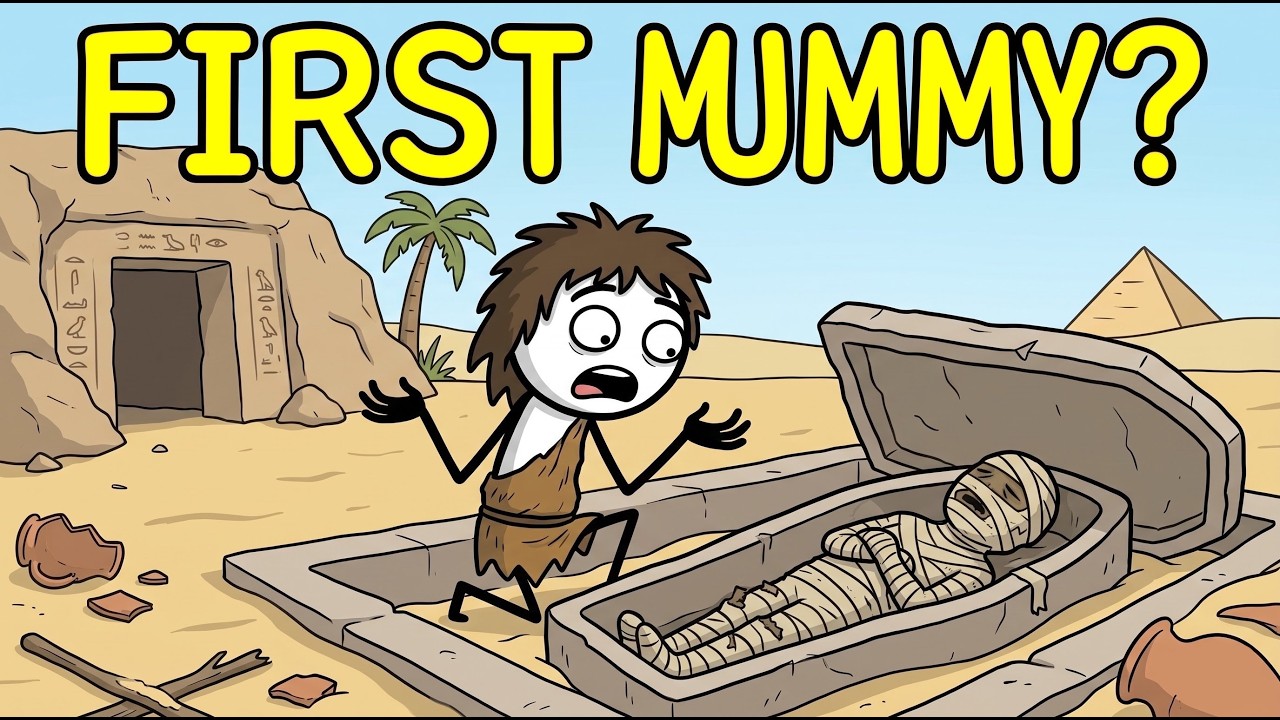
According to the anthropologist Bernardo Arriaza, whose 1995 work classified the Chinchorro mummies, the practice most likely began as grief. Arriaza noted that a disproportionate number of the Chinchorro mummies were infants and small children. Infant mortality in the region was severe, possibly made worse by naturally occurring arsenic in the local water supply. He argued that parents who could not bear the loss of a child turned the body into something permanent, something they could carry, display, and keep close.
His theory, known as the grief hypothesis, holds that mummification began not as science or religion but as love. The oldest Chinchorro technique, dating to around 5050 BC, produced what are called the black mummies. The process involved completely disassembling the body. The skin was removed, the flesh was stripped from the bones, and the skeleton was reinforced with wooden sticks and plant fibers.
Then the body was reassembled, the skin sewn back over it, and the entire surface coated with a thick paste of black manganese. The dead were rebuilt from the inside out. Later techniques were less invasive. The red mummies involved making incisions, removing organs, filling the cavities with plant material, and painting the exterior with red ocher.
A simpler version simply encased the body in a thick protective shell of clay. The Chinchorro were not working without knowledge. The Atacama is the driest non-polar desert on Earth, and some weather stations there have never recorded a single drop of rain. Naturally preserved bodies were a familiar sight.
Arriaza documented naturally dried remains in the region dating back to around 7020 BC, more than two thousand years before the Chinchorro began deliberate mummification. The desert had been showing them what was possible for generations. They simply decided to do it themselves, and to do it better. Egypt, by contrast, perfected mummification on an industrial scale, but it did not invent it.
Egypt’s own path began in much the same way. Pre-dynastic bodies from Gebelein, now in the British Museum, date to around 3400 BC. These were buried in shallow graves directly in the hot, dry desert sand. No treatment, no wrappings, no chemicals, just sand.
Yet the extreme aridity preserved their skin, hair, and internal organs so completely that a CT scan in 2012 revealed that one man, known as Gebelein Man, had been killed by a stab wound to the back. A murder victim perfectly preserved for over five thousand years by geography alone. The real origin of Egyptian mummification begins when Egyptians started building tombs. These enclosed structures with walls and sealed burial chambers separated the body from direct contact with the drying sand, and bodies inside tombs began to rot.
Giving the dead a more dignified burial destroyed the natural preservation the desert had provided for free. The gap between intention and result forced the Egyptians to develop artificial preservation. They had to invent mummification because they had accidentally undone natural mummification by building better tombs. Until recently, the timeline of Egyptian mummification was believed to be much later.
But a 2014 study by Dr. Stephen Buckley of the University of York and Dr. Jana Jones of Macquarie University analyzed prehistoric burial wrappings from sites in Upper Egypt dating to roughly 4500 to 3100 BC. Those wrappings contained a complex chemical recipe: a base of plant oils or animal fats mixed with heated pine resin, possibly imported from as far away as Turkey, along with aromatic plant extracts and natural petroleum.
These were not random substances thrown at a body. The resin had antibacterial properties, and the oil helped preserve tissue. Someone more than six thousand years ago was experimenting with the chemistry of mummification. In 2018, Buckley and Jones went further, publishing an analysis of the Turin mummy, dating to around 3600 BC, which provided the first definitive scientific evidence that ritual mummification was practiced in Egypt more than a thousand years earlier than previously believed.
By the New Kingdom, roughly 1570 to 1070 BC, Egyptian mummification had developed from experimental chemistry into a standardized process. The most detailed ancient account comes from the Greek historian Herodotus, who visited Egypt in the fifth century BC and documented three levels of mummification. The most expensive option was extraordinary. Embalmers extracted the brain through the nose using hooked metal instruments.
They cut the left side of the abdomen with a blade of obsidian, removed the lungs, liver, stomach, and intestines, washed the organs in palm wine, and stored them in four canopic jars. The body cavity was then packed with natron, a natural salt found in dry lake beds. The body was buried in natron for forty days. Natron is a powerful desiccant that draws water out of tissues, and its alkalinity saponifies fats, turning the body’s own lipids into a kind of soap that destroys bacterial membranes.
After forty days, the dried body was washed, stuffed with linen, resin, and sawdust to restore its shape, anointed with oils, and wrapped in hundreds of meters of fine linen sealed with plant gums. Amulets were placed between the layers, and prayers were recited over each wrapping. The entire process took seventy days. The middle option was cheaper and harsher: cedar oil was injected into the body through the rectum without any surgical incisions, the body was placed in natron for the full drying period, and when the plug was removed, the liquefied organs came out with the oil.
The cheapest option was a purge to clean the intestines, seventy days in natron, and the body was returned to the family. The Egyptians preserved bodies because they believed the soul needed a home. In Egyptian theology, a person had multiple spiritual components: the ka, a life force that needed food; the ba, a personality that could move between the world of the living and the dead; and the akh, the immortal spirit. If the physical body was destroyed, the ka had no place to return to, and the ba had nothing to recognize.
The person’s chance at eternal life was over. Every linen wrapping and every drop of resin was part of a theological engineering project designed to give the soul a permanent address. Mummification was never only an Egyptian practice. Cultures across the world developed their own methods independently.
In 1972, workers digging an air-raid shelter near Changsha, China, discovered the tomb of Xin Zhui, a Han dynasty noblewoman who died around 168 BC. Over two thousand years later, her skin was still soft, her joints flexible, her internal organs intact, and blood still in her veins. She was preserved inside four nested lacquered coffins surrounded by thick layers of charcoal and white clay, creating an oxygen-free, moisture-stable environment. In the high Andes, Inca children sacrificed on mountain peaks were naturally freeze-dried by the extreme altitude.
Inca royal mummies, called mallquis, were treated as living rulers, clothed, fed, and paraded through the streets on litters during festivals. In Japan, Shingon Buddhist monks practiced sokushinbutsu, self-mummification, a process that began while they were still breathing. In highland Papua New Guinea, the Anga people of the Aseki region smoke-dried their warriors and leaders over slow fires for months. And in northern Europe, peat bogs preserved bodies so completely that workers who found Tollund Man in Denmark in 1950 called the police, thinking they had discovered a recent murder victim.
The chemistry behind every one of these techniques solves the same two problems. Autolysis is the body digesting itself: enzymes inside cells begin breaking down cell walls from within. Putrefaction is the external attack by bacteria already living in the gut and on the skin. Together they can reduce a body to bones in weeks.
Every mummification method in history works by stopping one or both of these processes. Natron removes water. Resins and bitumen create seals. Tannins from plants bind proteins, tanning human skin.
Smoke deposits formaldehyde and aldehydes. Extreme cold stops all metabolic activity. Every culture that mummified a body, whether or not they understood the chemistry, was doing the same thing: removing water, removing oxygen, and removing the conditions that allow biology to do what it always does. Was mummification invented once and spread from a single origin?
The sources suggest the probability is very low. Chile and Egypt are separated by twelve thousand kilometers and an ocean, with no plausible route of transmission. The timelines do not match a diffusion hypothesis, and the techniques are fundamentally different. The most likely answer is that mummification is convergent innovation.
Any culture with access to naturally preserved bodies, environments that preserve them, and an emotional attachment to the dead will eventually try to imitate what nature was already doing. Grief is universal. The invention was inevitable. Over seven thousand years, across every continent, using every available material, humans have looked at the last physical thing remaining of someone they loved and said the same word in thousands of different languages.
Stay.