In the early 1990s, a graphic designer working on a Macintosh could carry an entire print job across town in a padded envelope. The cartridge inside was roughly the size of a thick paperback book, a hard plastic shell with a metal shutter across its face, holding 44 megabytes of data. You slid it into a dock on your desk, the drive sealed itself shut, spun the platter up to speed, and the machine hummed in a way that told you it was working. In the world of desktop publishing, there was no meaningful alternative.
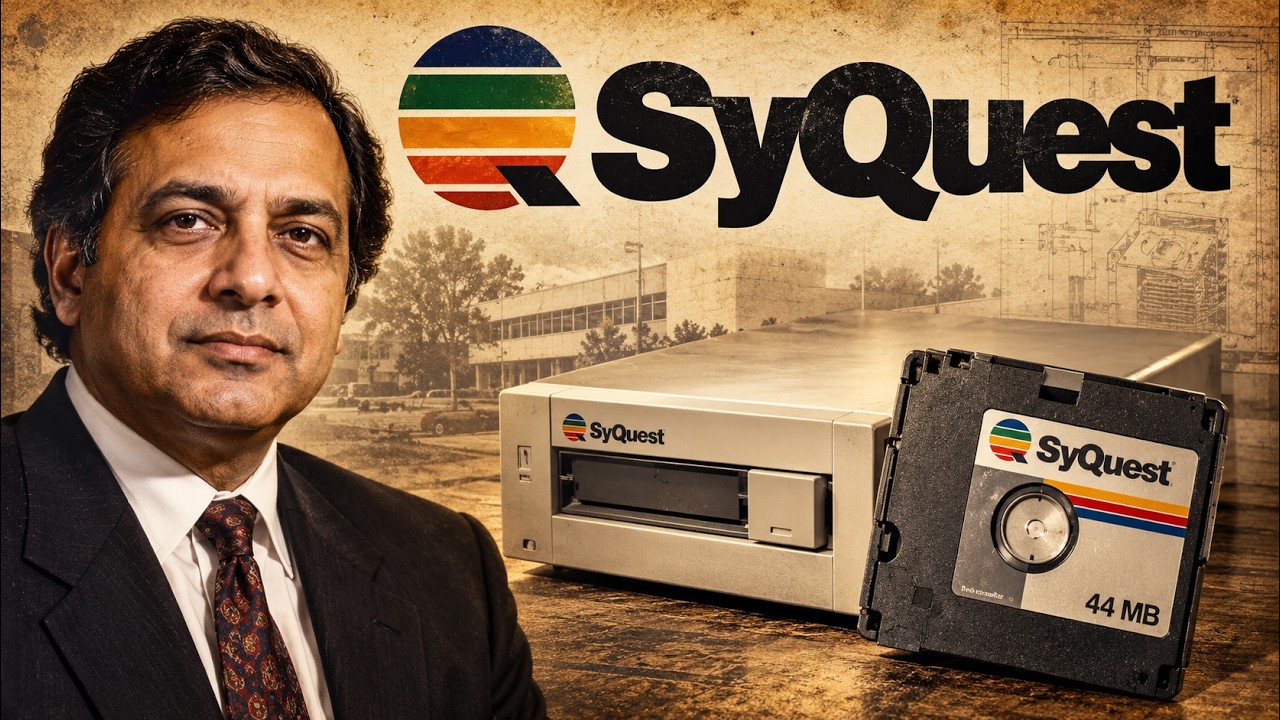
SyQuest, based at 4771 Bayside Parkway in Fremont, California, controlled roughly 90% of the American removable storage market. In 1992, SyQuest was shown a new removable disc technology developed by Fuji. It used a flexible magnetic medium instead of a rigid Winchester platter. It was slower and lower in capacity, but dramatically cheaper to manufacture and far simpler for a consumer to use.
SyQuest’s engineers tested it and passed. Too slow, too small. A step backward from the hard disc technology that had made SyQuest the standard. Three years later, a struggling competitor in Roy, Utah, took that same concept and shipped it under a different name.
They called it the Zip Drive. Iomega priced it at under $200, sold 10 million units within three years, and built a billion-dollar company on technology that SyQuest had held in its hands and set back on the table. SyQuest’s market share dropped from 87% to 30% in a single year. The company filed for bankruptcy in November of 1998.
Its stock, which had traded at $19 a share in August of 1995, closed its final months at 34 cents. In January of 1999, Iomega bought what was left of SyQuest for $9. 5 million. It was the only offer.
The company behind that 44-megabyte cartridge was founded by a man named Syed Iftikar. Born in India, Iftikar studied at the University of Madras before following a professor’s advice that computers were, in his words, the wave of the future. He immigrated to the United States in the 1960s, earned a master’s degree in mechanical engineering from UC Berkeley, and in 1970 took a job at Memorex Corporation in Santa Clara, California. For the next decade, he worked in Memorex’s think tank on magnetic disc drive technology, learning exactly how data is written, read, and stored on a spinning platter.
By the end of the 1970s, Iftikar understood Winchester disc technology as well as almost anyone in Silicon Valley. Named after an IBM project code from the early 1970s, Winchester drives sealed a magnetic disc and its read/write heads inside a clean, airtight enclosure, allowing the heads to fly just micrometers above the platter surface and store far more data per square inch than older open designs. The technology was elegant, precise, and unforgiving. A single speck of dust between the head and the platter could destroy both.
In 1979, Iftikar joined a group of engineers who believed Winchester technology could be shrunk down to fit inside a desktop machine. The group included Al Shugart, a legendary disc drive designer who had led storage engineering at IBM and Memorex, along with Finis Conner and Tom Mitchell. Together they founded Seagate Technology in 1980, and Iftikar, as vice president of mechanical engineering, led the team that designed the first 5¼-inch Winchester hard disk drive for personal computers. That drive, the ST506, shipped in 1980 and became the standard the entire PC industry built on for the next decade.
The industry remembers Seagate as Shugart’s company. But Iftikar was already thinking about something else. A fixed hard drive sat inside a computer and stayed there. The floppy disc was portable, but it held so little data that it was becoming useless beyond simple text files.
What the market needed, Iftikar believed, was a Winchester-quality hard drive built into a cartridge that you could slide in and out of a dock. The technology was not easy, because Winchester drives depended on precisely controlled air pressure and contamination-free environments, and a removable cartridge by definition broke the seal every time you ejected it. Iftikar’s fellow Seagate founders did not share his obsession. In early 1982, he left the company he had helped build, cashed in his Seagate stock for starting capital, and founded his own company.
He called it SyQuest, short for Syed’s Quest. The quest was to build a portable hard disk. SyQuest was incorporated on January 27, 1982, in Fremont, California, with Iftikar and four co-founders. The team set up on Bayside Parkway and began building what they called the SQ306, a removable cartridge drive using a 3.
9-inch platter that stored 6. 38 megabytes of data. In December of 1982, SyQuest introduced the SQ306 at the National Computer Conference. The drive cost $750.
A spare cartridge cost $35. At 6 megabytes, the capacity was modest, roughly four times a double-sided floppy disc. But the concept was unlike anything else on the market. This was not a floppy.
It was a genuine hard disk with hard disk speeds and hard disk reliability in a package you could carry in one hand. The market was not ready. SyQuest sold its drives to original equipment manufacturers, and within a year, IBM, Zenith Data Systems, and AT&T accounted for 80% of revenue. The company survived, but barely.
Revenue was thin, losses mounted, and by 1984 SyQuest was staring at failure. Iftikar went to the United States Army personally and pitched a removable storage system that met the military’s requirement for secure portable data. When a soldier pulled the cartridge out of the drive, the classified data left with it and the machine itself was clean. The army gave SyQuest the contract.
A competitor called DMA did not survive the loss. In 1986, SyQuest increased cartridge capacity to 15 megabytes. One year later, the company shipped a 5¼-inch cartridge that stored 44. 5 megabytes.
And then something happened that no one at SyQuest had planned for. In 1985, Apple introduced the LaserWriter printer and Aldus released PageMaker, and together they created desktop publishing. For the first time, a graphic designer could lay out a magazine page, a brochure, or a poster on a personal computer and print it at near-typeset quality. Almost overnight, files got enormous.
A single high-resolution image could fill 20 or 30 megabytes. A complete print job might run to 40 or 50. Floppy discs were useless. Fixed hard drives could store the files, but you could not carry a hard drive to the service bureau that would output your film separations.
The SyQuest 44-megabyte cartridge was exactly the medium designers needed. It connected via SCSI, which meant it spoke the same interface language as the Macintosh. It was fast because the data lived on a genuine Winchester platter spinning at 3600 revolutions per minute. And it was removable.
A designer could fill a cartridge at her desk, slide it into a padded mailer, and send it to the service bureau, where the operator loaded it into their own SyQuest drive and opened the job immediately. Nobody at SyQuest had designed the 44-megabyte drive for desktop publishing. But the Macintosh desktop publishing boom of the late 1980s created a user base that needed exactly what SyQuest sold. Revenue climbed from $20 million in 1988 to $50 million in 1989 to $80 million in 1990 to over $115 million in 1991.
The business model was the Gillette razor and blades formula: sell the drive at a modest margin and make the real money on cartridges, which customers bought again and again. Cartridge sales eventually accounted for 55% of total revenue. By 1990, SyQuest had shipped over 150,000 drive systems and 700,000 cartridges, roughly 75% of them to Macintosh users. In December of 1991, SyQuest went public on the NASDAQ exchange, raising approximately $23 million.
Revenue was climbing past $115 million with net income above $6 million. In 1992, SyQuest had revenue of $174 million. Iftikar told an interviewer that his target was a billion in annual sales. It was in this atmosphere of confidence that Fuji approached SyQuest with the flexible disc technology.
SyQuest’s engineers evaluated it and recommended against it. The drives were inferior by every metric SyQuest valued: speed, capacity, and data density. Iftikar agreed. SyQuest passed.
The decision made perfect sense in the room where it was made. SyQuest was an engineering company that competed on technical superiority, and the Fuji technology was technically inferior. But the consumer market SyQuest was about to enter did not buy technical superiority. It bought convenience and price, and the Fuji technology had both.
Between 1990 and 1995, the number of personal computers in American homes roughly doubled. The home PC user was a fundamentally different customer from the pre-press professional who had built SyQuest’s empire. The pre-press user cared about speed, capacity, and SCSI compatibility. The home user cared about price, simplicity, and whether the thing worked when you plugged it in.
SyQuest’s drives cost $300 to $500. Its cartridges ran $35 to $70 each. It connected via SCSI, which required a dedicated interface card that most home PCs did not have. The trade press called the new category the floppy killer, and by the mid-1990s, a dozen companies were racing to build one.
Iomega, by contrast, had spent years trying and failing to break out of its own niche with the Bernoulli Box. Reliable, but expensive and limited in capacity. By the early 1990s, Iomega had posted years of losses and was searching for a consumer product that could reverse the company’s decline. The flexible disc technology that SyQuest had rejected was exactly the opportunity Iomega needed.
In March of 1995, Iomega launched the Zip Drive: 100 megabytes of capacity on a disc slightly larger than a standard floppy. The drive cost just under $200. Cartridges were $20 each. It connected via a parallel port, the same connector every PC already used for its printer, which meant zero additional hardware.
You plugged it in, you inserted a disc, and it worked. In 1993, Iomega had earned roughly $150 million. In 1995, revenue hit $362 million. In 1996, it was $1.
2 billion. A company that had spent 15 years struggling with niche products had multiplied its revenue by eight in three years on the strength of a single drive. Major manufacturers, including Apple, Dell, and Gateway, offered Zip drives as factory-installed options. The financial press called it Zip Mania.
SyQuest’s response was the EZ135, launched in 1995. On paper, it was the superior product. It stored 135 megabytes per cartridge versus the Zip’s 100. It was faster because it was still a Winchester drive with a rigid platter.
Its $20 cartridges offered more capacity per dollar. By every engineering metric SyQuest had ever cared about, the EZ135 was the better machine. The market did not care. The external version required SCSI, which most home PCs lacked.
It was not backward compatible with any of SyQuest’s earlier cartridges, which alienated the professional users who had been the company’s core audience for a decade, and it cost more. Iomega cut the Zip’s price aggressively, and SyQuest matched the cuts, which meant selling the EZ135 below manufacturing cost. Every unit shipped lost money. The first quarter of fiscal 1996 delivered the verdict: a $33 million loss on $78 million in revenue.
SyQuest had always competed on technology. Now it was competing on price, and price was Iomega’s war. In February of 1996, SyQuest eliminated 1,500 jobs and moved its manufacturing from Singapore to a lower-cost facility in Penang, Malaysia. In May, the board moved against the founder.
A turnaround specialist was installed as chairman, and new executives took over as president and chief operating officer. Iftikar, the man who had co-founded Seagate, invented the removable Winchester cartridge, and built SyQuest from a five-person startup to a $300 million company, was stripped of day-to-day control. By September of 1996, he was gone from the company that bore his name. The final tally for fiscal 1996: $200 million in revenue and $136.
7 million net loss. New management tried to fight back. They hired a former Iomega executive who had built Iomega’s retail channels. They launched new drives targeting professional users who needed more than a Zip could hold.
They raised over $175 million through private stock placements to fund the recovery. In November of 1997, SyQuest launched the SparQ, a 1-gigabyte drive priced at $199, the golden price point that management believed could finally undercut Iomega’s higher-capacity Jaz drive. The SparQ shipped fast and priced right, and for a moment the reviews were cautiously positive. Then the drive started failing.
A few months after launch, reports surfaced of a catastrophic defect. A damaged SparQ disc could destroy any subsequent disc inserted into the same drive, creating a chain reaction of data loss that could cascade through an entire office. One broken disc killed a drive. That drive killed every disc it touched.
The warranty claims mounted. The returns mounted. The reputation damage was total. Fiscal 1997 brought a $69 million loss on $123 million in revenue.
In the first nine months of 1998, losses accelerated to $97 million against $124 million in sales. In August, SyQuest laid off 950 employees, half its remaining workforce. On November 2, 1998, SyQuest suspended operations and filed for Chapter 11 bankruptcy. The stock price was 34 cents.
In January of 1999, Iomega paid $9. 5 million for SyQuest’s patents, its tooling, its remaining inventory, and whatever institutional knowledge could be extracted from the wreckage. A company that had generated nearly $300 million in annual revenue, that had employed thousands of people across three countries, that had set the standard for an entire American industry, was liquidated for less than the cost of a modest house in the Silicon Valley zip code where its headquarters stood. Iftikar did not stop.
Two years before SyQuest’s bankruptcy, he had already founded a new company called Castlewood Systems. In 1999, Castlewood shipped the Orb drive, a 2. 2-gigabyte removable disc that was faster and cheaper per gigabyte than anything Iomega made. It was in many ways the product SyQuest should have built.
Iomega sued Castlewood over patent infringement, and Castlewood filed for Chapter 7 bankruptcy in 2004. Iomega fared only slightly better than the company it had destroyed. The Zip Drive’s own fatal flaw, a head alignment defect the internet called the click of death, triggered a class action lawsuit in 1998 and eroded the brand’s reputation. Recordable CD drives selling for under $100 with blank discs at 50 cents each, offering 650 megabytes of capacity, made the Zip disc look expensive and small.
USB flash drives finished the job. Iomega’s stock, which had soared past $100 a share during Zip Mania, drifted to roughly $2. EMC Corporation bought Iomega in 2008 for $213 million, a fraction of the nearly $7 billion it had been worth at its height. The Zip Drive was discontinued.
The Jaz Drive was discontinued. The Iomega brand was retired by 2018. The winner of the removable drive war did not survive either. It just died slower.
Today, SyQuest cartridges and drives surface on vintage computing forums and collector sites. Data recovery services charge hundreds of dollars to pull files off old SyQuest media, rescuing photographs, design layouts, and documents trapped on cartridges that no currently manufactured drive can read. Somewhere in storage units and studio closets across America, there are thousands of SyQuest cartridges holding graphic design work from the late 1980s and early 1990s, sealed inside plastic shells on magnetic platters that degrade a little more each year. SyQuest did not lose the removable drive war to a better product.
It lost it to a cheaper, simpler, better marketed one. And the part that should keep every engineer awake at night is that SyQuest had the chance to be both, in 1992, when the technology that became the Zip Drive was sitting on a table in Fremont and the engineers said it was not good enough.