Near Petersburg, a Confederate officer lit a cigar roughly a thousand yards behind his own lines, believing himself safe. It was a reasonable assumption. A thousand yards was beyond any range at which an infantry rifle of the Civil War could be expected to hit a man with any reliability. He struck the match, brought it up to the cigar, and in the half second before the flame caught, a bullet struck him in the chest.
He was dead before the match hit the ground. The men around him scattered, assuming artillery had somehow found a single human target from a mile away. It had not. One man with one rifle had been waiting for hours for exactly that moment.
This was not a folk tale. It was one of dozens of documented incidents involving men who carried British-made target rifles into the Union army and used them to do something American warfare had never before organized: killing individuals, one at a time, by name and rank when possible, from distances that made defense against the practice nearly impossible. Confederate soldiers had a term for what these men did to morale, and it was not a kind one. They called it murder in uniform.
Union officers called it the most effective multiplier of force in their arsenal. Both descriptions were accurate, and the tension between them is part of why the story has been left out of most popular accounts of the Civil War for 160 years. This is the story of how the Union, almost by accident, built the first organized sniper corps in American military history, and why their method of killing was unlike anything that had come before. To understand why these men were strangers in their own army, one first has to understand what infantry combat looked like in the 1860s, because it resembled almost nothing of what people now imagine.
The standard infantry weapon was a rifled musket, the Springfield or the Enfield, firing soft lead bullets that could theoretically hit a man-sized target at 300 yards. In practice, soldiers were trained to fire in disciplined volleys at enemy formations, not at individual soldiers. Individual marksmanship was rarely taught. The doctrine of the era assumed battles were decided by the density and discipline of fire, not by shooting skill.
The soldier’s job was to load, aim, and fire on command, over and over, as part of a collective storm of lead directed generally toward a group of other men doing the same. Killing in that system was anonymous in a specific and almost merciful way. No soldier in a firing line could point to a single bullet and say it was his, that it had struck a particular soldier, that it had ended a particular life. The violence was collective, a statistical outcome of massed fire, not an act any individual soldier could fully own.
The sniper broke that system entirely. A man with a telescopic rifle, and the patience to wait hidden for hours, did not fire into a crowd. He selected a single man. He watched him.
He often understood what that man did. An artillery officer directing a battery, a courier carrying orders, a colonel exposing himself to encourage his troops. He waited for the moment when that man’s death would matter most. Then he fired one shot, and the man died.
And the sniper knew with certainty that he was the one who had done it. There was no statistical comfort. It was the closest thing the Civil War produced to deliberate, individual killing carried out under a flag and called soldiering. The man most responsible for organizing this into a coherent force was Hiram Berdan, a wealthy engineer and champion target shooter from New York with no formal military training and little interest in conventional soldiering.
Before the war, Berdan was among the best rifle shots in the country, a man who had built his reputation in marksmanship competitions where margins between winners and losers were measured in fractions of an inch at long range. When war broke out, Berdan proposed something the American army had never attempted: an entire regiment recruited specifically for shooting skill, where joining required passing a marksmanship examination rather than simply showing up and receiving a rifle. The standard Berdan set for recruits, formalized in 1861, required a man to place ten consecutive shots within a ten-inch circle at 200 yards. This was a standard that would challenge many modern shooters using telescopic sights and bipods on a calm range day.
Berdan’s recruits took the test standing or from improvised field positions, often in competitive conditions designed to simulate the unpredictability of combat, using open sights or, in some cases, the telescopic sights a few men brought themselves or were issued. The men who qualified came from hunting backgrounds across the country. Lumbermen from Vermont and Michigan, fur trappers from Wisconsin, western frontiersmen who had spent years living off what they shot. By the social standards of army officers in the 1860s, they were not gentlemen.
Many had never worn a proper uniform before enlisting. What united them was a familiarity with the rifle that most professional soldiers of the era did not possess. Berdan’s two regiments, the 1st and 2nd U. S.
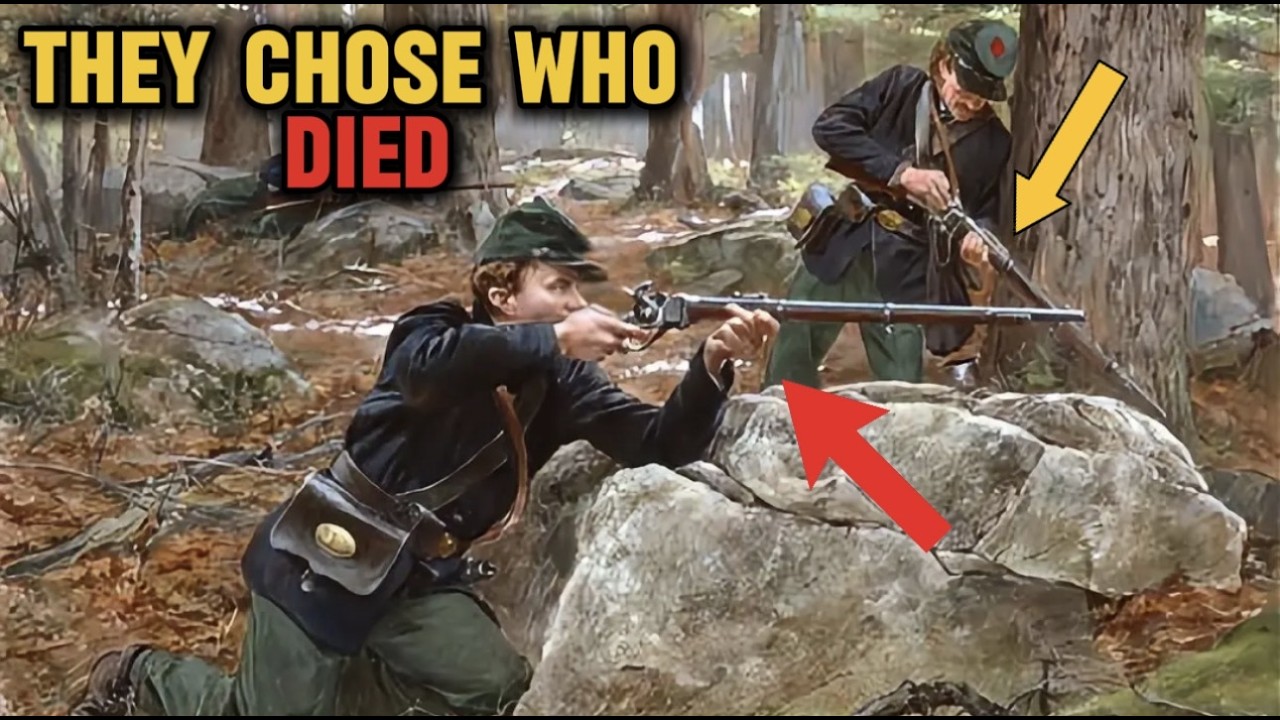
Sharpshooters, became something closer to a professional specialty than a traditional infantry unit. They were issued green uniforms instead of the standard blue and yellow, a deliberate choice to make them less visible among foliage, marking them clearly as different within their own army. Some companies carried heavy target rifles weighing over thirty pounds, fitted with telescopic sights and designed for firing from a fixed position rather than offhand. Weapons with no place in a traditional firing line, but devastating in the hands of a man given time to settle his aim.
Other companies carried the lighter breech-loading Sharps rifles, which traded some of the long-range accuracy of the heavy target rifles for a rate of fire that allowed a skilled soldier to place several accurate shots in the time a conventional soldier took to reload once. What these men were asked to do bore no resemblance to traditional infantry tactics. They did not form ranks. They deployed singly or in pairs, usually ahead of the main Union line, using any natural or improvised cover.
A fallen log, a shell hole, a curtain of brush, sometimes a pit dug specifically for one man to occupy for an entire day. They often worked in two-man teams, one firing while the other watched through a field glass to spot the fall of the shot and correct it. This cooperative method of precision shooting was exceptional for the period. A sniper might lie in one position from before dawn until after dark, moving only enough to keep the blood flowing, watching a stretch of enemy line, waiting for the moment an officer exposed himself or an artillery crew revealed itself while reloading.
The targets they chose were not random, and this selection was part of what made their work fundamentally different from ordinary combat. Officers were preferred targets, identified by sword, bearing, or the deference shown by the men around them. Artillery crews were valuable targets because killing the gunners silenced a battery more effectively than counter-battery fire. Couriers were targeted because killing one disrupted command communications at a critical moment.
In modern terms, this was a targeting doctrine, a deliberate effort to remove specific high-value individuals from the battlefield rather than merely increasing the density of general fire. The Confederate response to this kind of warfare reveals how disruptive it was, even for professional soldiers accustomed to violence. Confederate accounts of the war are full of expressions of a specific kind of horror that does not appear in descriptions of conventional combat. Soldiers wrote of a fear unrelated to the chaos of an assault or the terror of shelling, both of which men on both sides had grown almost entirely accustomed to by 1864.
This was different. It was the fear of being watched. Soldiers in trenches near known sniper positions described the awareness that someone, somewhere in the ground ahead of them, might be looking at them at that very moment through a scope, deciding whether they were worth a bullet. Men changed their habits because of it.
They stopped standing up to stretch. They crawled instead of walking behind their own lines when the ground offered a line of sight toward Union positions. Officers especially learned to remove the insignia that marked their rank, because rank had become, for the first time in the war, a specific burden rather than merely a target of opportunity. This psychological effect was, in its own way, the sharpshooters’ most important contribution to the war, more significant on the whole than any individual killing.
A unit forced to assume that every moment of exposure might be its last developed an exhausting caution that slowed everything: movement, supply, command, control. These were the basic rhythms an army needed to function. Confederate units defending lines near active Union sniper positions during the siege of Petersburg, where this pattern of war reached its peak, reported that ordinary trench routine had become a calculated risk. Cooking fires had to be lit and tended without exposing the man doing the lighting.
Roll call, normally a moment when men gathered in the open without thought, became something units handled with extreme care. An army forced to think carefully about routine logistics lost a large part of its combat effectiveness without fighting any major battle. The equipment these men used deserves particular attention, because the rifles themselves were as far from ordinary infantry experience as the tactics. The heavy target rifles, made by gunsmiths such as Morgan James of Utica, were the most valuable weapons in Berdan’s regiments.
Custom-built pieces weighing up to thirty-two pounds, fitted with telescopic sights that magnified the target several times, and mounted with such care that the slightest misalignment would throw shots off dramatically at long range. These were not weapons a soldier carried on the march. They were transported by wagon and brought forward only when a unit expected to hold its position long enough to justify the trouble of setting them up. The soldier firing one of these rifles usually worked from a rest or a supported position, sometimes using a folding bipod, sometimes simply resting the barrel on a log or a sandbag, because the weight and magnification of the scope made it nearly impossible to guarantee a steady shot from standing at 600 or 800 yards.
On the Confederate side, the equivalent weapon was the British-made Whitworth, a hexagonal-bore target rifle imported through the blockade in limited numbers. It was highly prized by Confederate marksmen for its accuracy, enabling skilled shooters to hit targets at ranges exceeding a thousand yards, ranges at which the targeted soldier heard nothing of the shot’s origin. No crack of the rifle, no warning, only the sound of the impact. The discipline required to use these weapons effectively shaped the kind of men drawn to the role and the reputation they built within their armies.
Loading a target rifle was slow, often involving hammering a tight-fitting bullet down the barrel to engage the rifling more precisely than an ordinary infantry bullet, a process that sacrificed rate of fire almost entirely for accuracy. A sniper who missed his first shot at an alert target had usually lost his only chance, because the muzzle smoke, or in some cases the sound alone, revealed his position well enough for enemy fire or countermeasures to find him before he could reload. This made the work fundamentally different from ordinary skirmishing, where a failed shot simply meant trying again moments later under the cover of dozens of other men firing as well. The sniper’s error had no such cover.
It was usually one chance, taken or wasted, with consequences that fell on him personally and immediately. Specific engagements illustrate how this pattern of war evolved under pressure. At Gettysburg, sharpshooters from Berdan’s regiments, operating ahead of the main Union line near the Peach Orchard on July 2, spotted the movements of Confederate troops under James Longstreet long before conventional Union pickets recognized the threat, providing intelligence that shaped how Union commanders repositioned to meet the attack that followed. During the long siege at Petersburg, sniper fire became so routine and effective along certain stretches of the line that both sides eventually settled into informal arrangements that were not truces in any real sense, never sanctioned by either headquarters, but a kind of mutual restraint during specific hours, such as mealtimes, when neither side’s sharpshooters fired because both sides had sharpshooters of their own relying on the same brief windows of safety.
These arrangements were never reliable, constantly broken by fresh units entering a sector without having learned the local understanding. But their existence itself indicated how deeply this kind of war had affected daily life along the trenches. The Confederates were not without skilled marksmen. The rural hunting culture of the South produced shooters who could hold their own with those of the northern frontier, but the South never matched the organizational commitment the Union eventually made to making marksmanship an independent, specialized arm.
Confederate snipers operated as individuals for most of the war and inflicted terrible losses, including the wounding of Union General John Sedgwick at Spotsylvania. Sedgwick was killed by a shot fired from such a distance that he had just told his men that a Confederate sniper could not hit an elephant from that range. But the Confederate approach remained largely informal and improvised compared with the organized, trained, carefully selected, and tested sharpshooter battalions the Union later established across its armies. By 1864, most Union corps in the Army of the Potomac had organized sharpshooter battalions operating almost independently of the main infantry formations.
The level of institutional investment in precision killing had reached a scale no army in the world had ever attempted. The moral unease this kind of warfare generated, even among the men who practiced it, is part of what kept it out of the celebratory narrative the war produced in its aftermath. Conventional combat, for all its brutality, fit within a frame civilians could absorb as collective, almost impersonal violence. Armies, lines crossing, advances and retreats, casualties as a terrible but justified cost of organized battle.
Sniping did not fit easily into that frame. A man spending an entire day in a pit for the specific purpose of killing one identifiable human being. A man watching another man through a scope long enough to learn something of his habits and routine before ending his life with deliberate, calm precision. This was work that looked even to contemporaries closer to planned execution than to battle.
Some Union soldiers in conventional infantry units expressed open contempt for the sharpshooters in their ranks, considering their work a kind of warfare beneath their honor, which even in 1864 still defined how many soldiers understood what they were doing. This discomfort is reflected in the rarity of celebration of the sharpshooters compared with their obvious effectiveness. Infantry and cavalry regiments that fought conventional battles produced voluminous literature, monuments, veteran reunions, and memorial attention after the war. Berdan’s sharpshooters, despite a documented record of effectiveness arguably exceeding that of many more famous units, received little of this attention in the decades after the conflict.
Hiram Berdan himself left the army in 1864 under circumstances marked by disputes with fellow officers and lukewarm support from a command that, even as it made intensive tactical use of his men, never fully understood what they represented. The skill that made the sharpshooters valuable, the deliberate, individual, almost intimate nature of their killing, was the same quality that made it difficult for their own side to see them as heroes in the traditional sense. A few men who served in Berdan’s ranks achieved individual fame, though usually for a single sensational shot rather than the sustained patience that characterized most of their actual work. Truman Head, known among his fellow soldiers as California Joe, became a well-known figure within the Army of the Potomac for his shooting skill and striking frontier appearance.
Journalists sometimes mentioned him in their reports, giving Northern readers a face and a name to attach to a kind of soldiering that remained largely anonymous. But men like California Joe were the exception within the exception. The vast majority of sharpshooters who served during the war fired their decisive shots with no reporter to document the moment, no name recorded in the other side’s casualty report, and returned to civilian life afterward carrying a kind of combat experience that had no clear counterpart among veterans of conventional regiments. What the Union sharpshooters proved, whether their era acknowledged it or not, was that a few carefully selected, rigorously tested, well-equipped individuals could degrade an enemy’s combat effectiveness in ways unrelated to their numbers.
A two-man sniper team, lying motionless in an advanced position for an entire day, could achieve through patience and accuracy what an entire company of conventional infantry firing volleys could not. The removal of a specific commander at a specific critical moment. The silencing of an artillery crew that a full counter-battery barrage had failed to suppress. The psychological paralysis of a unit so afraid of being individually targeted that it could not function at its usual efficiency.
This was, in essence, a preview of a kind of warfare that would not become formal doctrine in most of the world’s armies for another half century. And it was built almost entirely on the personal initiative of a New York target-shooting engineer who understood before the professional military establishment around him what a skilled, patient man with a good rifle could do.