For ten years, every Friday at six o’clock, my daughter called. That phone ringing was the heartbeat of my week, the one thing I could count on more than anything else. Then last Friday, it didn’t ring. I’m Ray Mercer, sixty-three years old, a retired electrician living in a quiet corner of Tennessee.
I spent forty years tracing circuits, hunting down whatever current had gone astray, putting broken things right. I always told my daughter Diane that everything connects. You just have to trace it back to the source. Diane became a nurse instead of an electrician.
She said she wanted to help people in a different way. Our Friday calls ran an hour, sometimes longer. She’d tell me about her shifts at Stonerest Medical Center, and I’d tell her about my garden and the leaky faucet I finally wrestled into submission. Then my granddaughter Chloe would grab the phone.
She was ten, sharp as a tack, and brimming with questions about everything. She’d visit most weekends and loved being in the garage with me, getting her hands greasy, figuring out how things fit together just the way her mother used to. But last Friday, at six o’clock, the phone hung silent on the wall mount. I waited.
I told myself she was tied up at the hospital. But by midnight, after seven unanswered calls, I knew something was wrong. I drove to her house quietly at dawn, planning not to overreact. The driveway was empty.
The curtains were drawn. The grass had gone long, and a parcel sat on the porch, soft and discolored from several days of dew and drizzle. I knocked. Nothing.
I put my ear to the door and heard only the low, indifferent hum of a refrigerator doing its job. I remembered the spare key. Two summers ago, Diane had gotten locked out and showed me a hollow fake rock tucked in near the flowers. She made me promise not to tell Derek, her husband.
My hand trembled as I fitted the key into the lock. The smell reached me before anything else. The close, stale air of a house shut up for too long. The living room looked nearly normal, but the electrician in me caught the details that were off.
The coffee table was canted at a slight angle. The couch cushions were arranged with an unnatural tidiness, the kind that comes from panicked hands trying to restore order. A throw pillow lay forgotten on the floor behind the armchair. The carpet bore vacuum tracks that ran in cross-hatched directions, the work of someone cleaning fast without paying attention.
I moved into the kitchen. It was immaculate, unsettlingly so. But the refrigerator held only beer cans, pizza boxes, and expired milk. Nothing a ten-year-old would touch.
No juice boxes. No string cheese. Then I heard it. A faint scratching from somewhere above me, like fingernails dragging slowly across wood.
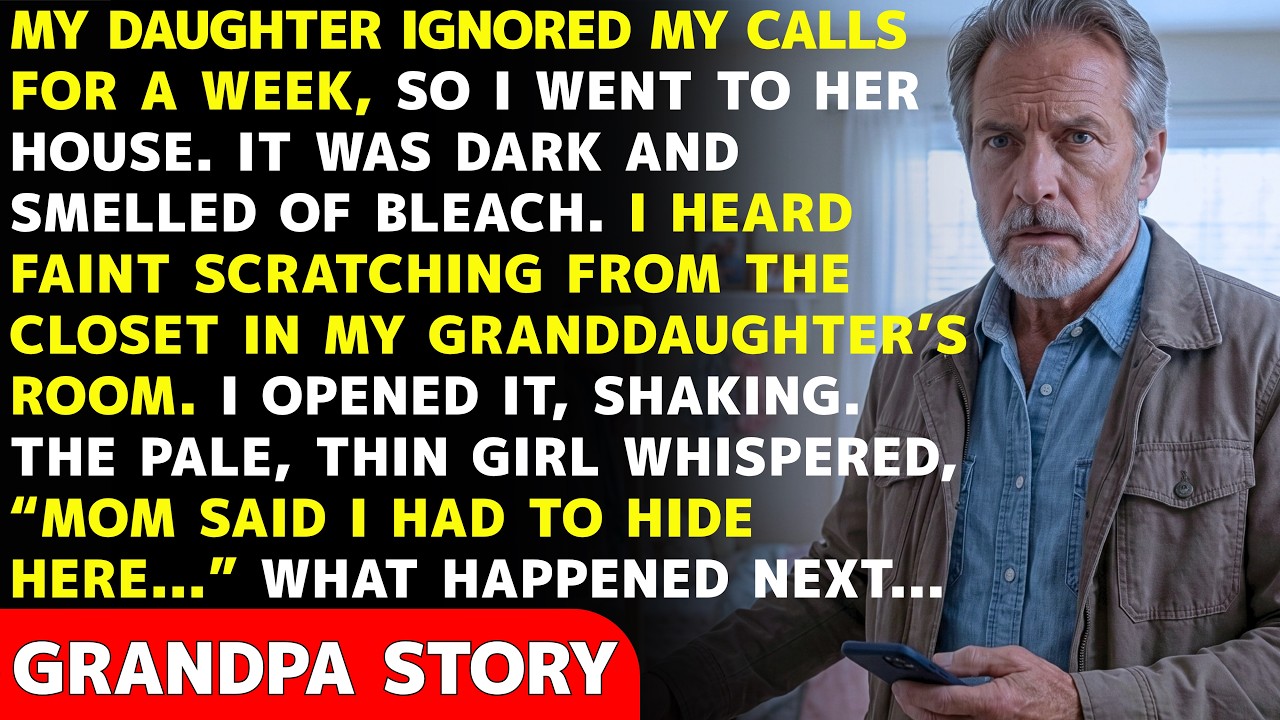
I went up the stairs two at a time. In Chloe’s room, I threw open the closet door. Curled behind a heap of winter coats was my granddaughter. Her lips were cracked and bleeding.
Her skin was paper pale except for feverish blotches burning across her cheeks. Both arms were wrapped tight around her stuffed bunny, its fur matted with dried tears. She whispered, “Grandpa,” and the words scraped out like something breaking. I folded myself down onto the closet floor and pulled her into my arms.
She felt impossibly light, just heat and thin bones. Her forehead burned with fever. I dialed 911 with shaking fingers and stayed on with the dispatcher, one arm around her the whole time. “How long, sweetheart?
” I murmured against her hair. “How long were you in there? ”
Her answer stopped my heart cold. “I don’t know, Grandpa.
I stopped counting after seven days. ”
The ambulance ride to Valley Children’s Medical Center took twenty minutes. It felt like twenty hours. Severe dehydration, the paramedic said.
Malnutrition. This child has been on her own for days. I held her hand and watched her breathe. At the hospital, they moved Chloe to a private room.
As her fever came down, she finally looked at me with real recognition. She told me her mother had taught her what to do if something bad ever happened. Diane would come into her room after dark and quietly go over things with her. “If you ever hear them fighting,” she told Chloe, “really fighting, go straight to the closet and don’t come out.
Wait until Grandpa calls your name or the police come. Nobody else. ”
My daughter had known she was in danger. She had spent those quiet nighttime hours turning her little girl into a survivor.
Diane had hidden snacks in Chloe’s toy box, a secret emergency kit. She told Chloe that being brave just means doing the scary thing when you have to. “Why didn’t you try to get out? ” I asked carefully.
Chloe’s answer was the simplest thing I’d heard in days. “Mama said to wait for you. She said you’d come. She said you always keep your promises, and you promise to call every Friday.
So if the call didn’t come, you would. ”
My daughter had used whatever time she had left to arm her child for a world she would have to face alone. She just hadn’t been able to protect herself. Detective Miles Hadex came to the hospital.
He needed to ask questions. Through the observation room window, I watched a child psychologist work with Chloe. My granddaughter drew stick figures. “Dad, a woman, Mom,” she wrote.
She told us about the night. Derek and a woman had come to the door, yelling at her mother about money. Mom said she didn’t have any. There were terrible sounds.
Mom was crying, begging them to stop. She kept saying, “Please, please think of Chloe. ” The woman said, “We have to finish this. ” And then, right before her mother stopped making any sound, her father said, “I’m sorry.
”
When I asked about the woman, I remembered Derek had mentioned someone named Tara Lyndon once, an ex. Hadex wrote it down. Forensics finished with the house. Hadex showed me photographs taken under ultraviolet light.
Luminol. Every surface blazed with blue-purple patterns. Your daughter fought back, he said. But we haven’t located her body yet.
Derek and Tara took her somewhere. We’re pursuing warrants on every storage unit connected to Derek Duval. I spent five weeks of dead ends and no sleep. Chloe stayed with me, asking when we could hold a funeral for her mother.
Then Hadex’s call came. They found her. An anonymous tip from a manager at a storage facility on the edge of town. An odor coming from unit seventeen.
I drove to the county morgue to make the identification myself. My daughter looked like she was sleeping. Her face was still almost peaceful. Except for the marks at her throat.
I couldn’t pull my eyes from them. Faint bruising in a pattern I didn’t want to read. Someone’s hands had been there. “She fought,” I said, my voice down to almost nothing.
The medical examiner gave a slow nod. “Defensive wounds. Your daughter put up one hell of a fight. ”
I let my fingers rest on hers.
Ice cold. The hand of a baby girl who’d once curled her whole fist around my finger. “I’m sorry, sweetheart,” I breathed. “I should have kept you safe.
”
Hadex built the case from there. Diane had a life insurance policy for five hundred thousand dollars. Derek Duval’s name sat at the top, sole beneficiary. Derek was carrying three hundred eighty-five thousand dollars in debt, most of it swallowed by a Ponzi scheme he’d been recruiting people into.
Security camera footage showed two vehicles in Diane’s driveway that night. Derek’s dark blue SUV and a silver one registered to Tara Lyndon. Diane had told her closest friend she was frightened, that Derek was pressuring her to raise the life insurance, and she’d refused. She had known something was coming.
Derek’s attorney got him out on bail. Two million dollars. He filed a police report claiming I had snatched Chloe right out of his house. He sat down in front of a camera and called himself innocent, a grieving widower, saying his daughter was confused and I was using tragedy to come after him.
He filed motions to throw out Chloe’s testimony, to bar the financial records, and a restraining order keeping me five hundred feet away from him. I retained a family law attorney. I pulled five thousand dollars from my retirement account. The legal fight was brutal.
People started choosing sides. Some of the neighbors saw a bitter old man working out a grudge. I stopped attending church. I couldn’t sit in those pews with the sidelong looks.
Then, two months after I pulled Chloe from that closet, Derek’s legal team moved to dismiss the case entirely. Insufficient evidence, they argued. The judge granted a real hearing. I sat in the courtroom gallery, gripping the bench rail.
Brent Ashwell, Derek’s silver-haired, double-breasted attorney, worked the room. There was no eyewitness, no murder weapon, no confession. The testimony of a traumatized ten-year-old child, however heartbreaking, could not sustain a first-degree murder charge. The judge took the matter under advisement.
Out on the courthouse steps, Hadex drew me aside. “Rey, we may not win this one. ”
That night, I couldn’t sleep. I had every financial document spread across the kitchen table, hunting for anything I’d skimmed past.
That’s when it jumped out at me. A deposit for ninety-five thousand dollars from an entity called MZ Consulting, buried deep in Derek’s bank statements from eight months back. I called Hadex. MZ Consulting turned out to be a shell entity tied to the Ponzi scheme the FBI had been working for two years.
Derek wasn’t one of the victims. He was one of the recruiters, earning commission on every person he brought through the door, mostly elderly people and immigrants. Two hours after that call, I was seated in a conference room at the FBI field office, listening to an accountant named Floyd Echart tell me how Derek had taken everything from him. He described my son-in-law as a professional con artist.
A man who could strip the life savings from strangers without a second thought. I understood then what kind of person could engineer his own wife’s murder. The judge denied the motion to dismiss. The case would proceed to trial.
After that, Tara Lyndon was arrested too. Her own sister had called the tip line, unable to carry what Tara had done. Tara broke down at the station. She took a deal, agreeing to testify against Derek in exchange for a reduced sentence.
Twenty-five years instead of life. I agreed to it because I knew without her on the stand, Derek might walk free. Tara’s testimony laid it out. Derek recruited her, promised her a life together and a share of the insurance money.
He rented the storage unit under a false name. He bought cleaning supplies. On the night of the murder, Derek demanded Diane sign financial power of attorney. When she refused, they took her life.
As they were moving her body out, Tara heard something from upstairs. She asked Derek about Chloe. He said, “She’s probably at a sleepover. Even if she’s here, by the time anyone finds anything, we’ll be in Mexico with the money.
”
A year after Derek took Diane from us, we walked into a courtroom on a cold November morning. The media had assembled in full force. The trial ran for days. Forensic specialists testified about the blood evidence.
Mrs. Vining, Diane’s elderly neighbor, swore she saw Derek’s car that night. Her grandson testified he saw two people hauling something large and heavy wrapped in a tarp. Renee, Diane’s closest friend, told the court about the fear in Diane’s final weeks.
Then came Chloe’s testimony. She refused the privacy screen. She walked into that courtroom with her chin up and told the whole story in her small, clear voice. She heard her father say “I’m sorry” right before her mother stopped making any sound.
The jury wept. When she passed her father’s table on the way out, she stopped and looked him in the eye. “Mom forgave him,” she said. “But I don’t.
”
Tara took the stand and corroborated everything. When she finished, the defense called Derek. He testified in his own defense, calm and rehearsed, claiming Tara had acted alone. On cross-examination, the district attorney masterfully took him apart.
She confronted him with his search history, his DNA under Diane’s fingernails, his Ponzi scheme recruitment, his daughter’s testimony. And then Derek erupted. “She should have helped me,” he shouted. “We were married.
That money belonged to me too. She owed me. ”
He had just confessed in open court. His mask slipped, and I saw what was underneath.
Dead eyes. The jury found him guilty on all counts. Derek Duval was sentenced to life in prison without the possibility of parole. He was screaming as the officers hauled him out.
Six months after the trial, people still asked me how I kept going. The answer is never clean. You don’t recover from losing a child. You reorganize yourself around the loss.
Chloe is my reason to rise in the morning. We built a life together. I renovated my house around her, blue paint on her bedroom wall, shelves for her books and drawings. She started fifth grade at the local school.
Her closest friend is Callie, Renee’s daughter. She laughs more now, and I don’t take a single note of it for granted. She mentions Diane without being asked. She’s learning that being happy doesn’t mean forgetting.
One Saturday in the garage, I was teaching Chloe electrical work, the same lessons I’d once given her mother. She was sitting on a wooden stool, small fingers dark with grease, brow furrowed, absorbed entirely in the broken lamp between us. Diane’s face at that age exactly. “This blue wire connects to the neutral,” I told her.
“See, because everything needs a path to return to. ”
“Right,” she said. “Everything talks to everything else. ”
The ache hit me, and I smiled straight through it.
“Exactly, sweetheart. You sound just like your mom. ”
“Is that okay? ”
“That’s the best thing you could possibly be.
”
She finished wiring the lamp and threw the switch. Light spilled across the whole workspace. “I did it,” she hollered. “It works.
”
“You sure did,” I said. “Your mom would be so proud. ”
She wrapped her arms tight around me. “I love you, Grandpa.
”
“I love you too, Chloe. Always. ”
Every Friday at six o’clock, some part of me still waits for the phone to ring. It never does.
But sometimes when Chloe is laughing in the next room or running in to show me something she just built, I feel Diane here in the sunlight falling through the window, in the warmth of family gathered around Renee’s table, in the bonds that death simply cannot cut. If this story taught me anything, let it be this. Trust the uneasy feeling in your gut. It is trying to protect the people you love.
Don’t talk yourself out of it. Don’t wait until there’s nothing left to save. A parent who prepares their child for the worst, even quietly and in secret, is giving a gift that no one can take back.
Justice matters not because it heals the wound, but because it tells the people we lost that their lives were worth fighting for.