In the autumn of 1889, the town of Ravens Hollow, Massachusetts, a settlement of roughly eight hundred souls nestled between dense pine forests and a dark lake, was shaken by a disappearance that would never be fully explained. Abigail Mercer, a thirty-four-year-old bookbinder and one of only three in the county, vanished without a trace. She was a striking woman, nearly five feet nine inches tall, with gray eyes and dark honey hair, known for her meticulous craft and her uncommon independence. She lived alone at the end of Marramac Street, the last house before the woods pressed close, and she kept to herself, though she was not unfriendly.
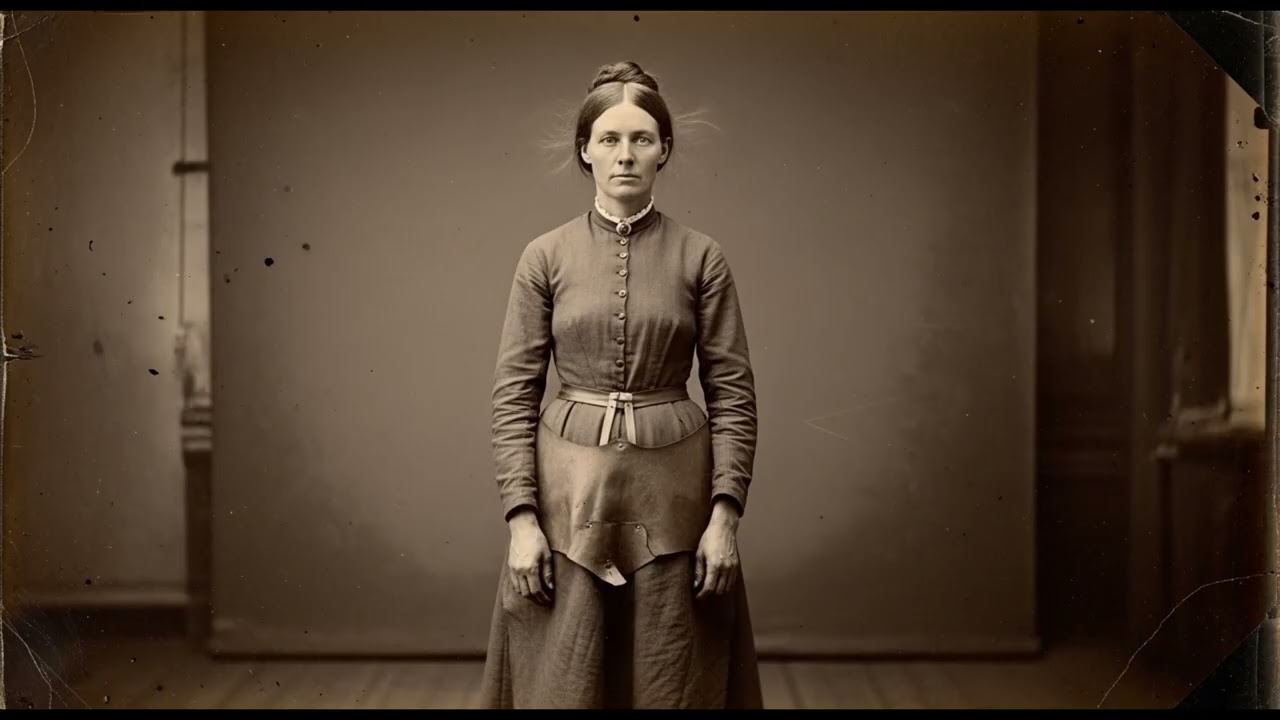
Her life followed quiet rhythms, until October of that year. The first sign that something was wrong came on October 3rd, a Thursday. Cornelius Whitfield, who ran the general store, had an order of leather and thread ready for Abigail, supplies she had requested three weeks prior. She always picked up her orders promptly, but this time she did not come.
By Saturday, Cornelius took the supplies to her house himself. The house appeared normal, shutters closed, but no one answered his knocks. He entered through the unlocked back door and found everything in perfect order. Dishes were washed and stacked, the stove was cold, her purse sat on the kitchen table with seven dollars and thirty-two cents inside, her coat hung by the door.
There was no sign of struggle, no indication of violence. The only thing unusual was a book in her workshop, partially rebound, written in an old language none of the men recognized. Beside it lay her notebook, with a final entry dated September 30th that read, “Commenced restoration. Origin uncertain.
Client requesting absolute discretion. Feel uneasy about this one. ”
Marshal Vernon Ashcraftoft, a former Union cavalry officer and a large, deliberate man, organized a search party of thirty-seven men the following Sunday. They searched the woods behind Abigail’s house for days, expanding their radius, dragging the lake, questioning everyone.
They found nothing. The last confirmed sighting of Abigail had been on October 1st, when she was seen walking home from the post office carrying a small package. The postmaster, Jedediah Parsons, confirmed she had received a parcel that day but had no record of what it contained or who sent it. Vernon turned his attention to the mysterious book.
He took it to Reverend Ezekiel Hartwell, who had studied theology at Harvard and knew Latin. Ezekiel’s reaction was immediate and visceral. His face went pale, and his hands trembled as he turned the pages. The language was indeed Latin, but very old Latin, the kind used in medieval religious texts.
What was written there was anything but holy. As far as Ezekiel could translate before declaring he could not continue, the book appeared to be a grimoire, a book of forbidden knowledge, containing rituals and diagrams that made him repeatedly make the sign of the cross. He told Vernon the book was dangerous and should be destroyed, burned immediately. Vernon refused, insisting it was evidence in a missing person case.
October progressed, and hope dwindled. Vernon interviewed everyone in town. Bartholomew Thorne, the blacksmith, remembered seeing Abigail on September 30th, late afternoon, carrying a heavy parcel wrapped in brown paper. She had looked tired, worried.
Lucinda Merryweather, who ran the boarding house, mentioned a stranger who had taken a room for three nights in late September. He was unremarkable, average height and build, wore a long dark coat and a wide-brimmed hat, kept to himself, and paid in cash. He had left on September 29th, just before Abigail received her mysterious package. Vernon sent telegrams to surrounding counties.
One marshal in Vermont mentioned a similar description connected to a series of thefts of old, rare books from churches and private libraries. Vernon returned to Abigail’s house alone, late at night. Searching her bedroom more carefully than before, he found a diary in the drawer of her bedside table. The entries grew stranger in the weeks before her disappearance.
On September 15th, she wrote, “Dreamed of the forest again. The trees were watching. ” September 20th: “I feel as though I’m being followed, though when I turn, no one is there. ” September 25th: “The stranger came to the shop today.
He had a proposition. I should refuse. I won’t. ” September 28th: “The book arrived.
I shouldn’t have agreed to this. ” And her final entry on September 30th: “Began the work. My hands shake. The pages seem to whisper.
Please God, let it be nothing more. ”
As Vernon prepared to leave the house, he heard footsteps upstairs. He drew his revolver and climbed the stairs. The bedroom was empty, but the wash basin, which had been dry, now contained fresh water, rippling slightly as if someone had just poured it.
The window was closed and locked from the inside. He left quickly, locked the house, and went home to steady his nerves with whiskey. November arrived with the first snow, and the search for Abigail Mercer was officially suspended. The town held a memorial service.
After the service, a retired professor named Matias Caldwell approached Vernon. He confessed that he had seen Abigail on October 2nd, at eleven o’clock at night, walking alone into the woods behind her house with a lantern. He had watched until the light disappeared among the trees. He also mentioned that three nights before that, on September 29th, he had seen strange lights deep in the forest, flickering and dancing like fire but brighter and more intense, lasting about twenty minutes before vanishing.
Vernon decided to search the woods himself. On November 8th, he walked into the forest behind Abigail’s house, carrying a rifle, a lantern, and supplies for two days. He followed no path, marking trees as he went. As evening approached, he made camp.
Through the night, he heard a rhythmic sound, almost like chanting, so faint he could not be sure he was really hearing it. He did not sleep, and he felt an electric sense of being in immediate mortal danger, something he had not felt since the war. Around midday, he found a perfectly circular clearing, about forty feet in diameter. The snow was disturbed, marked with symbols and patterns that reminded him of the diagrams in the cursed book.
At the center stood a large flat stone, like an altar. On it were the remains of a long-cold fire, melted candles, remnants of herbs, and small bird bones arranged in patterns. He found no sign of Abigail, no blood, no clothing, but he knew in his bones she had been here. Carved into the altar stone were words in that same old Latin.
He copied them carefully. The next morning, he took his photographs and notes to Ezekiel. The reverend read the transcribed Latin and went silent for a long time. He said the words carved into the stone were an invocation, a calling forth of something old and hungry.
Whoever had performed the ritual had been attempting to open a doorway, to trade something of this world for something from another. He said old beliefs spoke of places where the world grew thin, where things from outside could push through. He told Vernon that Abigail might not be in this world anymore, not in any place they could reach. He warned Vernon to let it go, to stop investigating.
Some doors, he said, were meant to stay closed. Vernon could not let it go. He became obsessed, interviewing everyone again, returning to the clearing three more times, spending hours with the book he could not read. He stopped sleeping well, stopped eating regularly.
His wife, Henrietta, grew worried and begged him to drop it. Then, on December 19th, a traveler passing through Ravens Hollow stopped at Cornelius Whitfield’s store. He said that while camping in the woods south of town the previous night, he had seen a woman, tall, with dark honey hair, wearing a dress that looked old-fashioned even for 1889. She had stood at the edge of his campfire light, just watching him.
When he stood up and took a step toward her, she vanished, not walked away, vanished. Vernon found the traveler, a timber surveyor named Josiah Merrick, and rode with him to the exact location, about six miles south of town. Vernon searched the area and found footprints in the snow, small, likely a woman’s, leading from the tree line to where Josiah said she had stood, then ending abruptly. He stood in those last footprints.
Then he smelled burning, like charcoal and sulfur, and the temperature dropped suddenly, drastically. At the edge of the clearing stood the figure of a woman. Her face was Abigail’s face, but something was wrong about the proportions. She stood perfectly still, watching with gray eyes that reflected no light.
Vernon called out to her. She tilted her head, a movement too smooth, too fluid, not quite human. Then she spoke, and the voice was layered, as if multiple voices spoke in unison. “Vernon Ashcraftoft,” it said, though he had never told her his name.
“Stop looking. Stop seeking. Some doors must remain closed. ” And then she was gone, and the temperature returned to normal, and the smell of burning disappeared.
They rode back in silence. Josiah left Ravens Hollow that same day. Vernon went home, told Henrietta everything, and broke down. He agreed he was done.
But through the winter of 1889 into 1890, reports continued. People reported seeing a tall woman with gray eyes and dark honey hair watching from the trees at night, never speaking, never approaching. Some said she looked sad. Some said she looked hungry.
Some said she looked like she was trying to warn them. In March of 1890, Reverend Ezekiel Hartwell died suddenly in his sleep, despite having been in good health. At his funeral, his wife Miriam gave Vernon a letter Ezekiel had left with instructions to give it to him upon his death. In the letter, Ezekiel confessed that he had translated more of the book than he had told Vernon.
It was not simply a grimoire. It was a record of bargains made between desperate people and things that existed outside normal reality. The rituals described methods of opening doorways, trading years of life or souls or sanity in exchange for power. Abigail, Ezekiel believed, had been approached by someone who wanted the book restored.
She had taken the job not knowing what it was, or believing she could handle it. But handling such things always came with a cost. The ritual at the clearing, he theorized, had been performed by Abigail herself, willingly or under some compulsion. She had opened a door, and what came through had taken her.
Not killed her, but taken her somewhere else, somewhere between, a place the book called the threshold. Those taken to the threshold did not cease to exist. They remained, caught between this world and whatever lay beyond, visible sometimes, neither alive nor dead. Ezekiel ended the letter with a warning: destroy the book, burn it, scatter the ashes, and never go looking for answers about things beyond mortal understanding.
Vernon did destroy the book. He took it from his locked desk, carried it to an empty field, poured lamp oil over it, and set it alight. The smoke that rose was thick and black and smelled of charcoal and sulfur. He stood there until it was nothing but ash, scattered the ashes, and went home to try to forget.
He never did forget. He served as marshal for another eighteen years, retiring in 1908, and died in 1923. In his final days, delirious with fever, he kept calling out to Abigail, apologizing for not saving her, for not understanding soon enough. His last words were, “Close the door.
Please, God, close the door. ”
Abigail’s house remained empty for years, no one wanting to live at the end of Marramac Street with the woods pressing close behind. It fell into disrepair and was torn down in 1927, the land absorbed back into the forest. The sightings continued through the 1890s and into the 1900s, growing less frequent as the years passed, but never stopping entirely.
As late as 1946, a hunter swore he saw a woman matching Abigail’s description standing in that same circular clearing. The clearing itself became a local legend, a place where compasses spun wildly, where animals avoided the ground, where plants grew twisted and unhealthy. The altar stone remained, its carved words slowly worn away by weather but never quite invisible. The official record lists Abigail Mercer as missing, presumed dead, case unsolved.
But the unofficial record tells a different story, of a woman who got involved in something beyond her understanding, who opened a door that should have stayed closed. Vernon Ashcraftoft did everything a lawman could do, but some questions exist beyond the reach of law, beyond logic, beyond human understanding. Abigail’s case remains one of the most disturbing unsolved disappearances in New England history, not because of what is known, but because of what can never be known.